2007 CHEVROLET MONTE CARLO warning light
[x] Cancel search: warning lightPage 200 of 456

SERVICE AIR BAG
This message displays when there is a problem
with the airbag system. Have your vehicle serviced
by your dealer immediately. SeeAirbag Readiness
Light on page 174for more information.
SERVICE BATTERY CHARGING
SYSTEM
This message displays when there is a problem
with the generator and battery charging systems.
Driving with this problem could drain the battery.
Turn off all unnecessary accessories. Stop
and turn off the vehicle as soon as it is safe to do
so. Have the electrical system checked by your
dealer immediately.
SERVICE BRAKE SYSTEM
This message displays when service is required
on the brake system. Have the brake system
serviced by your dealer as soon as possible.
The brake system warning light also appears on
the instrument panel cluster when this message
appears on the DIC. SeeBrake System Warning
Light on page 177.
SERVICE POWER STEERING
This message displays when a problem is
detected with the power steering system. When
this message is displayed, you may notice that the
effort required to steer the vehicle increases or
feels heavier, but you will still be able to steer the
vehicle. Have your vehicle serviced by your
dealer immediately.
SERVICE THEFT SYSTEM
This message displays when there is a problem
with the theft-deterrent system programmed in the
key. A fault has been detected in the system
which means that the system is disabled and it is
not protecting the vehicle. The vehicle usually
restarts; however, you may want to take the
vehicle to your dealer before turning off the engine.
SeePASS-Key
®III+ Operation on page 107for
more information.
200
Page 201 of 456

SERVICE TIRE MONITOR SYSTEM
This message displays if a part on the Tire
Pressure Monitor (TPM) system is not working
properly. If you drive your vehicle while any of the
four sensors are missing or inoperable, the
warning comes on in about 20 minutes. A sensor
would be missing, for example, if you put
different wheels on your vehicle without
transferring the sensors. If the warning comes on
and stays on, there may be a problem with the
TPM. See your dealer.
SERVICE TRACTION CONTROL
If your vehicle has the Traction Control
System (TCS), this message displays when the
system is not functioning properly. A warning light
also appears on the instrument panel cluster.
SeeTraction Control System (TCS) Warning
Light on page 179. SeeTraction Control
System (TCS) on page 254for more information.
Have the TCS serviced by your dealer as soon
as possible.
SERVICE TRANSMISSION
This message displays when there is a problem
with the transaxle. See your dealer for service.
SERVICE VEHICLE SOON
This message displays when a non-emissions
related malfunction occurs. Have the vehicle
serviced by your dealer as soon as possible.
STARTING DISABLED SERVICE
THROTTLE
This message displays if the starting of the engine
is disabled due to the electronic throttle control
system. Have your vehicle serviced by your dealer
immediately.
This message only appears while the ignition is in
RUN, and will not disappear until the problem
is resolved.
This message cannot be acknowledged.
THEFT ATTEMPTED
This message displays if the content theft-deterrent
system has detected a break-in attempt while
you were away from your vehicle. SeeContent
Theft-Deterrent on page 105for more information.
201
Page 250 of 456

Control of a Vehicle
You have three systems that make your
vehicle go where you want it to go. They are the
brakes, the steering, and the accelerator. All
three systems have to do their work at the places
where the tires meet the road.
Sometimes, as when you are driving on snow or
ice, it is easy to ask more of those control systems
than the tires and road can provide. That means
you can lose control of your vehicle. SeeTraction
Control System (TCS) on page 254.
Adding non-GM accessories can affect your
vehicle’s performance. SeeAccessories and
Modications on page 296.
Braking
SeeBrake System Warning Light on page 177.
Braking action involves perception time and
reaction time.
First, you have to decide to push on the brake
pedal. That is perception time. Then you have to
bring up your foot and do it. That is reaction time.
Average reaction time is about three-fourths of a
second. But that is only an average. It might be less
with one driver and as long as two or three seconds
or more with another. Age, physical condition,
alertness, coordination, and eyesight all play a part.
So do alcohol, drugs, and frustration. But even in
three-fourths of a second, a vehicle moving at
60 mph (100 km/h) travels 66 feet (20 m). That
could be a lot of distance in an emergency, so
keeping enough space between your vehicle and
others is important.
And, of course, actual stopping distances vary
greatly with the surface of the road, whether it is
pavement or gravel; the condition of the road,
whether it is wet, dry, or icy; tire tread; the
condition of the brakes; the weight of the vehicle;
and the amount of brake force applied.
250
Page 251 of 456

Avoid needless heavy braking. Some people drive
in spurts — heavy acceleration followed by
heavy braking — rather than keeping pace with
traffic. This is a mistake. The brakes may not have
time to cool between hard stops. The brakes
will wear out much faster if you do a lot of heavy
braking. If you keep pace with the traffic and
allow realistic following distances, you will
eliminate a lot of unnecessary braking. That means
better braking and longer brake life.
If your vehicle’s engine ever stops while you are
driving, brake normally but do not pump the
brakes. If you do, the pedal may get harder to
push down. If the engine stops, you will still have
some power brake assist. But you will use it
when you brake. Once the power assist is used
up, it may take longer to stop and the brake pedal
will be harder to push.
Adding non-GM accessories can affect your
vehicle’s performance. SeeAccessories and
Modications on page 296.Anti-Lock Brake System (ABS)
Your vehicle may have the Anti-Lock Brake
System (ABS), an advanced electronic braking
system that will help prevent a braking skid.
If your vehicle has ABS,
this warning light on the
instrument panel
cluster will come on
briey when you
start your vehicle.
When you start your engine, or when you begin to
drive away, ABS will check itself. You may hear a
momentary motor or clicking noise while this test is
going on, and you may even notice that your brake
pedal moves or pulses a little. This is normal.
251
Page 254 of 456

Traction Control System (TCS)
Your vehicle may be equipped with a Traction
Control System that limits wheel spin. This is
especially useful in slippery road conditions. The
system operates only if it senses that one or both of
the front wheels are spinning or beginning to lose
traction. When this happens, the system reduces
engine power and may also upshift the transaxle
and apply the front brakes to limit wheel spin.
This light will ash when
your Traction Control
System is limiting wheel
spin. SeeTraction
Control System (TCS)
Warning Light on
page 179.
You may feel or hear the system working, but this
is normal.
If your vehicle is in cruise control when the
traction control system begins to limit wheel spin,
the cruise control will automatically disengage.
When road conditions allow you to safely
use it again, you may re-engage the cruise control.
SeeCruise Control Light on page 185.The Traction Control System operates in all
transaxle shift lever positions. But the system can
upshift the transaxle only as high as the shift
lever position you’ve chosen, so you should use
the lower gears only when necessary. See
Automatic Transaxle Operation on page 113.
The SERVICE TRACTION CONTROL message
will appear in the Driver Information (DIC) to
let you know if there is a problem with the system.
SeeDIC Warnings and Messages on page 195.
When this message appears, the system will
not limit wheel spin. Adjust your driving
accordingly.
To limit wheel spin, especially in slippery road
conditions, you should always leave the Traction
Control System on. But you can turn the system off
if you ever need to.
You should turn the system off if your vehicle ever
gets stuck in sand, mud or snow and rocking
the vehicle is required. SeeIf Your Vehicle
is Stuck in Sand, Mud, Ice, or Snow on page 276.
254
Page 255 of 456
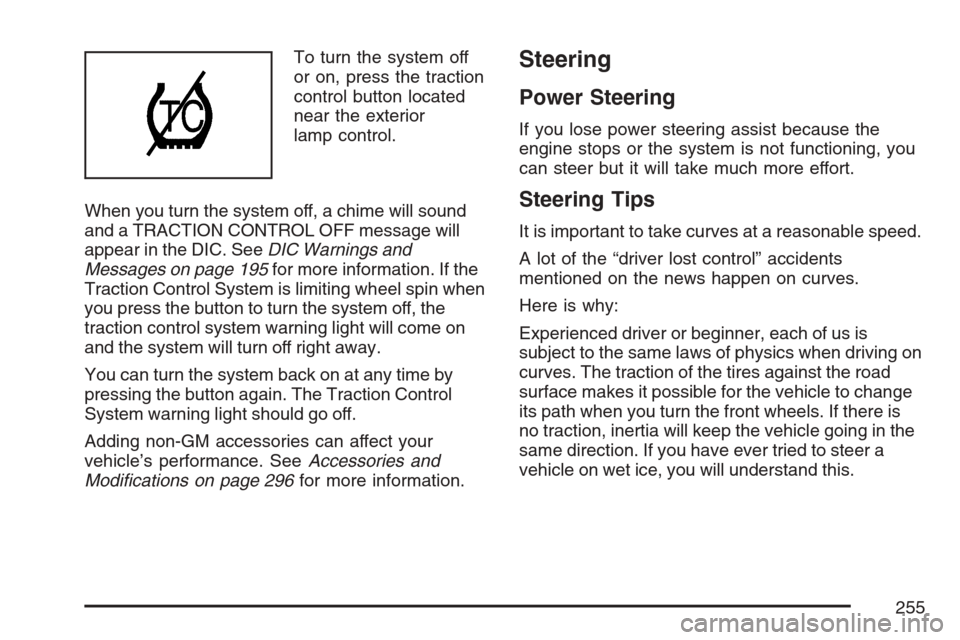
To turn the system off
or on, press the traction
control button located
near the exterior
lamp control.
When you turn the system off, a chime will sound
and a TRACTION CONTROL OFF message will
appear in the DIC. SeeDIC Warnings and
Messages on page 195for more information. If the
Traction Control System is limiting wheel spin when
you press the button to turn the system off, the
traction control system warning light will come on
and the system will turn off right away.
You can turn the system back on at any time by
pressing the button again. The Traction Control
System warning light should go off.
Adding non-GM accessories can affect your
vehicle’s performance. SeeAccessories and
Modications on page 296for more information.Steering
Power Steering
If you lose power steering assist because the
engine stops or the system is not functioning, you
can steer but it will take much more effort.
Steering Tips
It is important to take curves at a reasonable speed.
A lot of the “driver lost control” accidents
mentioned on the news happen on curves.
Here is why:
Experienced driver or beginner, each of us is
subject to the same laws of physics when driving on
curves. The traction of the tires against the road
surface makes it possible for the vehicle to change
its path when you turn the front wheels. If there is
no traction, inertia will keep the vehicle going in the
same direction. If you have ever tried to steer a
vehicle on wet ice, you will understand this.
255
Page 264 of 456

Driving Through Deep Standing Water
Notice:If you drive too quickly through deep
puddles or standing water, water can come in
through your engine’s air intake and badly
damage your engine. Never drive through water
that is slightly lower than the underbody of your
vehicle. If you cannot avoid deep puddles or
standing water, drive through them very slowly.
Driving Through Flowing Water
{CAUTION:
Flowing or rushing water creates strong
forces. If you try to drive through owing
water, as you might at a low water
crossing, your vehicle can be carried away.
As little as six inches of owing water can
carry away a smaller vehicle.
CAUTION: (Continued)
CAUTION: (Continued)
If this happens, you and other vehicle
occupants could drown. Do not ignore
police warning signs, and otherwise be
very cautious about trying to drive
through owing water.
Some Other Rainy Weather Tips
Besides slowing down, allow some extra
following distance. And be especially careful
when you pass another vehicle. Allow yourself
more clear room ahead, and be prepared to
have your view restricted by road spray.
Have good tires with proper tread depth. See
Tires on page 349.
264
Page 265 of 456

City Driving
One of the biggest problems with city streets is
the amount of traffic on them. You will want
to watch out for what the other drivers are doing
and pay attention to traffic signals.Here are ways to increase your safety in city
driving:
Know the best way to get to where you are
going. Get a city map and plan your trip
into an unknown part of the city just as you
would for a cross-country trip.
Try to use the freeways that rim and crisscross
most large cities. You will save time and
energy. SeeFreeway Driving on page 266.
Treat a green light as a warning signal.
A traffic light is there because the corner
is busy enough to need it. When a light turns
green, and just before you start to move,
check both ways for vehicles that have not
cleared the intersection or may be running the
red light.
265