Towing
Towing Your Vehicle
Consult your dealer or a professional towing
service if you need to have your disabled vehicle
towed. SeeRoadside Assistance Program
on page 481.
If you want to tow your vehicle behind another
vehicle for recreational purposes (such as
behind a motorhome), see “Recreational
Vehicle Towing” following.
Recreational Vehicle Towing
Recreational vehicle towing means towing your
vehicle behind another vehicle — such as behind
a motorhome. The two most common types
of recreational vehicle towing are known as
“dinghy towing” (towing your vehicle with all
four wheels on the ground) and “dolly towing”
(towing your vehicle with two wheels on the
ground and two wheels up on a device known
as a “dolly”).With the proper preparation and equipment,
many vehicle can be towed in these ways. See
“Dinghy Towing” and “Dolly Towing”, following.
Here are some important things to consider before
you do recreational vehicle towing:
What’s the towing capacity of the towing
vehicle? Be sure you read the tow vehicle
manufacturer’s recommendations.
How far will you tow? Some vehicles have
restrictions on how far and how long they
can tow.
Do you have the proper towing equipment?
See your dealer/retailer or trailering
professional for additional advice and
equipment recommendations.
Is your vehicle ready to be towed? Just as
you would prepare your vehicle for a long
trip, you’ll want to make sure your vehicle is
prepared to be towed. SeeBefore Leaving
on a Long Trip on page 313.
330
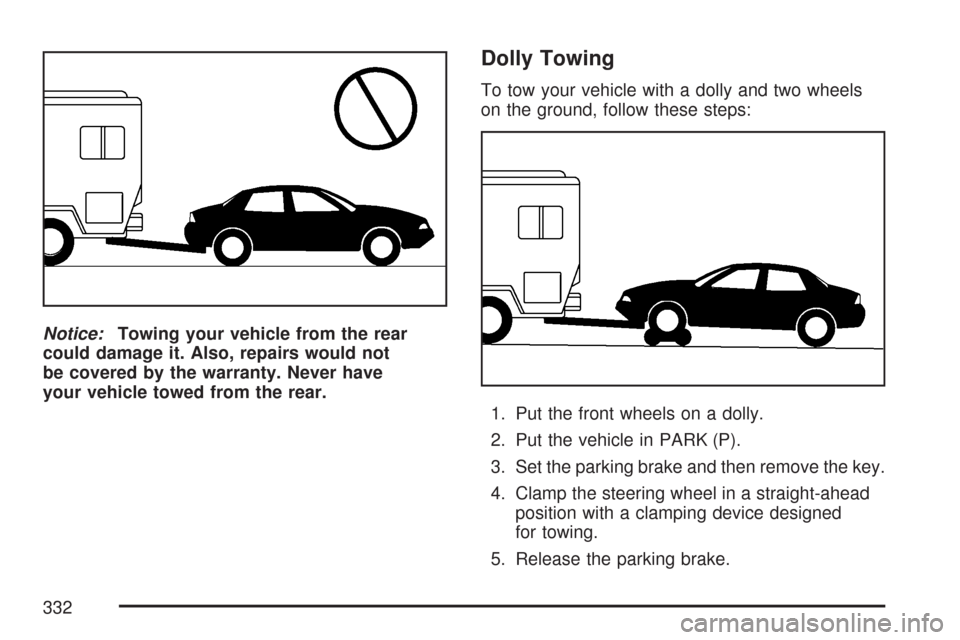
Notice:Towing your vehicle from the rear
could damage it. Also, repairs would not
be covered by the warranty. Never have
your vehicle towed from the rear.
Dolly Towing
To tow your vehicle with a dolly and two wheels
on the ground, follow these steps:
1. Put the front wheels on a dolly.
2. Put the vehicle in PARK (P).
3. Set the parking brake and then remove the key.
4. Clamp the steering wheel in a straight-ahead
position with a clamping device designed
for towing.
5. Release the parking brake.
332