Page 114 of 430

Air Shift Control (Automatic
Transmission)
The rear axle shift
control switch for an
automatic transmission
is located in the
instrument panel
switchbank.
To use the rear axle shift control, press the bottom
of the switch to get to the high range. The
switch indicator light will come on when the vehicle
is in the high range. Press the top of the switch
to return to the low range.The two-speed axle should be in low range when
you park the vehicle. You will need to engage
the transmission and move the vehicle a little to
assure the axle is in range. Then shift into
PARK (P), apply the parking brake, and shut off
the engine.
To shift up from low to high range while driving,
press the bottom of the rear axle shift control
switch as you are releasing the accelerator pedal.
After the shift has occurred, apply the accelerator
as desired.
To shift from high to low range while driving, press
the top of the rear axle shift control switch as
you release the accelerator pedal. Press the
accelerator pedal slowly until the down shift has
occurred, then apply the accelerator as desired.
For better performance during off-road or under a
heavy load, shift the axle into low range and
then operate the transmission normally.
For better performance on the highway, shift the
axle to high range and operate the transmission
normally.
114
Page 116 of 430

Overdrive Defeat
If your vehicle has this feature, you can select not
to shift up to fifth gear. This is useful when
towing or under a heavy load.
The overdrive defeat
switch is located in
the instrument panel
to the right of the
steering column.
Press the switch to limit the transmission to
fourth gear. This will allow for fewer downshifts
while pulling a trailer or under a heavy load.
The indicator light in the switch will come on
whenever overdrive defeat is active.
Manual Transmission Operation
Using the Clutch
When you are starting to move the vehicle, it is
important to begin with the engine speed at idle.
Then start to engage the clutch and listen for an
engine speed drop of about 100 rpm. At this point,
the clutch is engaging, so you should increase the
engine speed and fully engage the clutch. It is
important not to increase the engine speed sooner
or before the clutch begins its engagement. If you
do, you can cause damage to your vehicle.
Double-Clutching
You must use the double-clutching method when
you shift an unsynchronized gear set. Disengage
the clutch, shift to NEUTRAL and engage the
clutch. When upshifting, slow the engine until the
engine rpm and road speed match. When
downshifting, accelerate the engine until the
engine rpm and road speed match. Then quickly
disengage the clutch and move the shift lever
to the next gear position and engage the clutch.
116
Page 118 of 430
Clutch Brake (Vehicles with
Non-Synchronized Transmission)
A clutch brake is used to stop transmission input
shaft rotation so that FIRST (1) or REVERSE (R)
gear selection can be initiated when the vehicle is
at a standstill and the engine is idling.
Press the clutch pedal all the way down to the
floorboard to apply the clutch brake.
When using the clutch brake, disengage the clutch
pedal and shift the transmission into either the
initial starting gear or REVERSE (R). If the
tooth-butting occurs between the clutching teeth,
re-engage the clutch while applying light pressure
to the shift lever. This will provide for a smooth
shift into either FIRST (1) or REVERSE (R) gear.
Notice:Using the clutch brake for shifting
into any gear other than FIRST (1) or
REVERSE (R) may cause premature wear of
the clutch brake and make gear shift effort
more difficult. Do not use the clutch brake for
shifting after engaging FIRST (1) or
REVERSE (R).
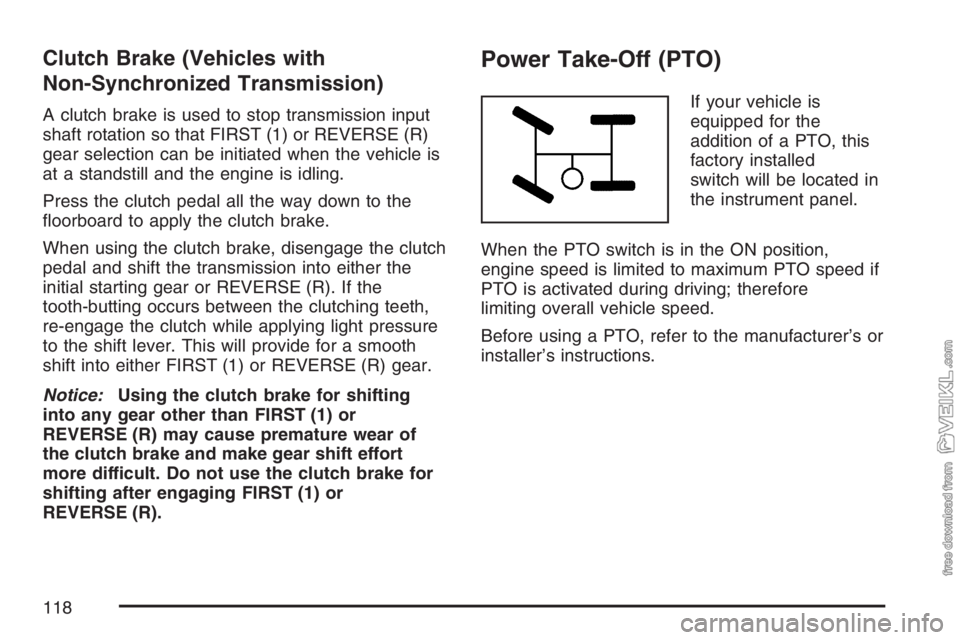
Power Take-Off (PTO)
If your vehicle is
equipped for the
addition of a PTO, this
factory installed
switch will be located in
the instrument panel.
When the PTO switch is in the ON position,
engine speed is limited to maximum PTO speed if
PTO is activated during driving; therefore
limiting overall vehicle speed.
Before using a PTO, refer to the manufacturer’s or
installer’s instructions.
118
Page 120 of 430

If your vehicle has
four-wheel drive, the
transfer case knob
is located to the right of
the steering wheel
on the instrument panel.
Use this knob to shift
into and out of
four-wheel drive.
An indicator light shows you which position the
transfer case is in. The indicator lights come
on briefly when you turn on the ignition and
one stays on. If the lights do not come on, you
should take your vehicle to your dealer for service.
An indicator light flashes while shifting the
transfer case. It will remain on when the shift is
complete. If for some reason the transfer
case cannot make a requested shift, it returns to
the last chosen setting.Recommended Transfer Case Settings
Driving ConditionsTransfer Case Settings
2m4m4nN
Normal YES
Severe YES
Extreme YES
Vehicle in Tow* YES
*SeeTowing Your Vehicle on page 241for further
information.
2m(Two-Wheel High):This setting is for driving
in most street and highway situations. The
transfer case does not drive the front axle in
two-wheel drive. The front-axle spins if the front
wheel hubs are locked. Be sure to unlock the hubs
to achieve the best fuel economy.
4
m(Four-Wheel High):Use Four-Wheel High
when you need extra traction, such as on snowy or
icy roads or in most off-road situations. Be sure
the front wheel hubs are locked when you want to
drive in Four-Wheel High.
120
Page 125 of 430

Parking
{CAUTION:
If you do not park your vehicle properly, it
can roll. If you have left the engine
running, it can move very quickly. You or
others could be injured. To be sure your
vehicle will not move, even when you are
on level ground, follow the steps below.
Parking a Vehicle With the Two-Speed
Rear Axle
1. With the engine running, shift the two-speed
rear axle into low. To be sure it is in low, you
will need to move the vehicle in gear just a little.
2. Hold the regular brake pedal down with your
right foot.
3. Apply the parking brake.
4. Shift the transmission to NEUTRAL for
manual transmission or PARK (P) for
automatic transmission.
Parking Brake (With Hydraulic
Brakes)
If your vehicle has hydraulic brakes, it has either a
parking brake foot pedal or hand lever. If you
have the parking brake foot pedal, it is located
below the instrument panel to the left of the
steering column.
If you have the parking brake hand lever, it is
located to the right of the driver, on the floor.
Parking Brake Hand Lever Shown
125
Page 126 of 430

To set the foot pedal parking brake, hold the
regular brake pedal down with your right foot. Push
down the parking brake pedal with your left foot.
To set the hand lever parking brake, hold the
regular brake pedal down with your right foot. Pull
up on the handle with your right hand, until it stops.
If the ignition is on when the parking brake is set,
the brake system warning light will come on.
To release the foot pedal parking brake, hold
the regular brake pedal down. Pull the brake
release handle, located just above the parking
brake pedal, to release the parking brake.
To release the hand lever parking brake, hold the
regular brake pedal down and push down on
the handle until it stops.
If the ignition is on when the parking brake is
released, the brake system warning light will
go off.Parking Brake (with Air Brakes)
If your vehicle has
air brakes, you will
have this parking brake.
It is located above
the radio in the
instrument panel.
Pulling it out applies the parking brake. The
parking brake light will come on when the air
parking brake is applied.
126
Page 129 of 430

2. Repeat the burnishing procedure in Step 1 a
total of 10 times
3. Between stops, drive the vehicle about
2
1⁄2miles (4 km)
Notice:Driving with the parking brake on can
damage the transmission and brake system
parts. Verify that the parking brake is fully
released and the brake warning light is
off before driving.
Air Suspension
Your vehicle may have the Hendrickson HAS
Series single-axle air suspension which is
designed for a single-axle on-highway use. This
feature is available in 19,000 lb (8 613.3 kg),
21,000 lb (9 525.4 kg) and 23,000 lb (10 432.6 kg)
capacities.
Rear Air Suspension Dump Control
If your vehicle is equipped with the Hendrickson
HAS Series single-axle air suspension, you
may have this control. The air suspension dump
control allows the operator to lower the deck height
approximately 4.5 inches (11.5 cm) from the
normal frame height.
The switch to deflate
and inflate the air
suspension is located in
the instrument panel.
Press the bottom of the switch to deflate the air
suspension and lower the deck height. Press
the top of the switch to return the suspension to
normal deck height.
An indicator light will come on and stay on
whenever the switch is in the dumped position.
129
Page 134 of 430
Outside Convex Mirrors
{CAUTION:
A convex mirror can make things (like
other vehicles) look farther away than
they really are. If you cut too sharply into
the right or left lane, you could hit a
vehicle. Check your regular outside
mirrors (or your inside mirror, if you have
one) before changing lanes.
Your vehicle may have convex mirrors on both the
driver’s side and the passenger’s side. They are
curved to allow more to be seen from the
driver’s seat. A convex mirror can make things
look farther away than they really are.
Outside Heated Mirrors
If your vehicle has this feature, your outside
rearview mirrors can be defrosted.
The switch for this
feature is located in
the instrument
panel switchbank.
Press the bottom of the switch to turn the outside
heated rearview mirrors on. The switch indicator
light will come on and stay on whenever the
outside heated rearview mirrors are activated.
134
