2007 CHEVROLET IMPALA seats
[x] Cancel search: seatsPage 65 of 460
CAUTION: (Continued)
If you need to secure a forward-facing
child restraint in the right front seat,
always move the front passenger seat
as far back as it will go. It is better to
secure the child restraint in a rear seat.
If you need to secure a forward-facing child
restraint in the right front seat position, move the
seat as far back as it will go before securing
the forward-facing child restraint. SeeManual
Passenger Seat on page 9orPower Seats
on page 9.
If your child restraint has the LATCH system,
seeLower Anchors and Tethers for Children
(LATCH) on page 54.
There is no top tether anchor at the right front
seating position. Do not secure a child restraint
in this position if a national or local law requires
that the top tether be anchored or if the
instructions that come with the child restraint
say that the top tether must be anchored.SeeLower Anchors and Tethers for Children
(LATCH) on page 54if your child restraint
has a top tether.
You will be using the lap-shoulder belt to secure
the child restraint in this position. Be sure to follow
the instructions that came with the child restraint.
Secure the child in the child restraint when and
as the instructions say.
1. Your vehicle has a right front passenger’s
frontal airbag. SeePassenger Sensing
System on page 77. We recommend that
rear-facing child restraints be secured in a
rear seat, even if the airbag is off. If your
child restraint is forward-facing, move the
seat as far back as it will go before securing
the child restraint in this seat. SeeManual
Passenger Seat on page 9orPower Seats
on page 9.
When the passenger sensing system has
turned off the right front passenger’s frontal
airbag, the off indicator in the passenger
airbag status indicator should light and
stay lit when you turn the ignition to RUN
or START. SeePassenger Airbag Status
Indicator on page 179.
65
Page 83 of 460

Adding Equipment to Your
Airbag-Equipped Vehicle
Q:Is there anything I might add to the front
or sides of the vehicle that could keep the
airbags from working properly?
A:Yes. If you add things that change your
vehicle’s frame, bumper system, height,
front end or side sheet metal, they may keep
the airbag system from working properly.
Also, the airbag system may not work properly
if you relocate any of the airbag sensors.
If you have any questions about this,
you should contact Customer Assistance
before you modify your vehicle. The phone
numbers and addresses for Customer
Assistance are in Step Two of the Customer
Satisfaction Procedure in this manual.
SeeCustomer Satisfaction Procedure
on page 426.
Q:Because I have a disability, I have to get
my vehicle modied. How can I nd out
whether this will affect my airbag system?
A:Changing or moving any parts of the
front seats, safety belts, the airbag sensing
and diagnostic module, steering wheel,
instrument panel, ceiling headliner, ceiling
and pillar garnish trim, roof-mounted airbag
modules, or airbag wiring can affect the
operation of the airbag system. If you
have questions, call Customer Assistance.
The phone numbers and addresses for
Customer Assistance are in Step Two of
the Customer Satisfaction Procedure in this
manual. SeeCustomer Satisfaction Procedure
on page 426.
83
Page 116 of 460
How long should you keep the coolant heater
plugged in? The answer depends on the outside
temperature, the kind of oil you have, and
some other things. Instead of trying to list
everything here, we ask that you contact your
dealer in the area where you will be parking your
vehicle. The dealer/retailer can give you the
best advice for that particular area.
Active Fuel Management™
(3.9L V6 and 5.3L V8 Engines)
Your vehicle’s engine may be equipped with
Active Fuel Management™. This system allows
the engine to operate on either all or half of
its cylinders, depending on your driving conditions.
When less power is required, such as cruising
at a constant vehicle speed, the system will
operate in the half cylinder mode, allowing your
vehicle to achieve better fuel economy. When
greater power demands are required, such
as accelerating from a stop, passing, or merging
onto a freeway, the system will maintain
full-cylinder operation.
Automatic Transaxle Operation
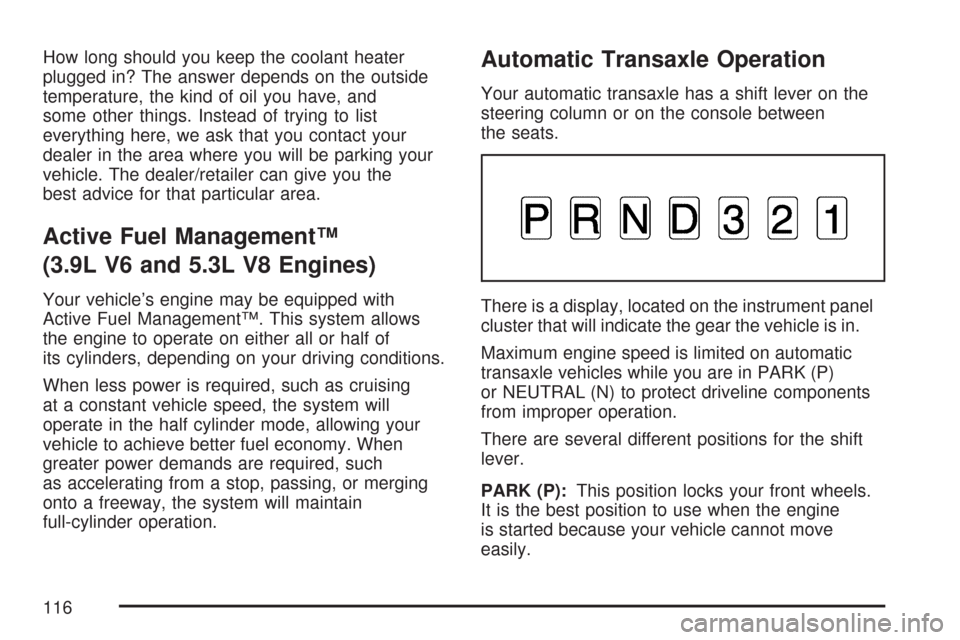
Your automatic transaxle has a shift lever on the
steering column or on the console between
the seats.
There is a display, located on the instrument panel
cluster that will indicate the gear the vehicle is in.
Maximum engine speed is limited on automatic
transaxle vehicles while you are in PARK (P)
or NEUTRAL (N) to protect driveline components
from improper operation.
There are several different positions for the shift
lever.
PARK (P):This position locks your front wheels.
It is the best position to use when the engine
is started because your vehicle cannot move
easily.
116
Page 166 of 460

The battery can be discharged at idle if the
electrical loads are very high. This is true for all
vehicles. This is because the generator (alternator)
may not be spinning fast enough at idle to
produce all the power that is needed for very high
electrical loads.
A high electrical load occurs when several of the
following loads are on: headlamps, high beams,
fog lamps, rear window defogger, climate
control fan at high speed, heated seats, engine
cooling fans, trailer loads, and loads plugged into
accessory power outlets.
EPM works to prevent excessive discharge of the
battery. It does this by balancing the generator’s
output and the vehicle’s electrical needs. It
can increase engine idle speed to generate more
power, whenever needed. It can temporarily
reduce the power demands of some accessories.
Normally, these actions occur in steps or levels,
without being noticeable. In rare cases at the
highest levels of corrective action, this action
may be noticeable to the driver. If so, a Driver
Information Center (DIC) message might be
displayed, such as Battery Saver Active or
Service Battery Charging System.If this message is displayed, it is recommended
that the driver reduce the electrical loads as much
as possible. SeeDIC Warnings and Messages
on page 199.
Battery Run-Down Protection
This vehicle has a feature to help prevent the
battery from being drained, if the interior courtesy
lamps, reading/map lamps, visor vanity lamps
or trunk lamp are accidentally left on. If any
of these lamps are left on, they will automatically
turn off after 10 minutes, if the ignition is off.
The lamps will not come back on again until
one of the following occurs:
The ignition is turned on.
The exterior lamps control is turned off, then
on again.
The headlamps will timeout after 10 minutes, if they
are manually turned on before the ignition is off.
166
Page 168 of 460
Ashtray(s) and Cigarette Lighter
Your vehicle may have an ashtray and a cigarette
lighter. The ashtray and cigarette lighter may
be located in the console, if your vehicle has one,
otherwise, they may be located in the center
armrest of the front seat.
Notice:If you put papers, pins, or other
ammable items in the ashtray, hot cigarettes
or other smoking materials could ignite
them and possibly damage your vehicle.
Never put ammable items in the ashtray.
Notice:Holding a cigarette lighter in while
it is heating does not let the lighter back away
from the heating element when it is hot.
Damage from overheating can occur to the
lighter or heating element, or a fuse could be
blown. Do not hold a cigarette lighter in while it
is heating.
To use the lighter, just push it in all the way and
let go. When it’s ready, it will pop back out by itself.
Climate Controls
Climate Control System
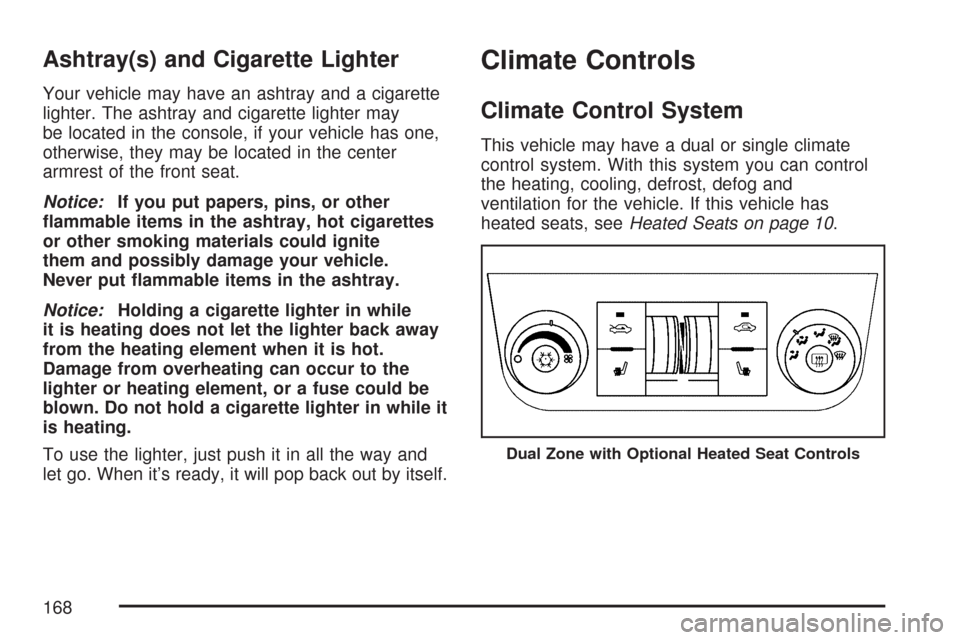
This vehicle may have a dual or single climate
control system. With this system you can control
the heating, cooling, defrost, defog and
ventilation for the vehicle. If this vehicle has
heated seats, seeHeated Seats on page 10.
Dual Zone with Optional Heated Seat Controls
168
Page 172 of 460
Rear Window Defogger
The rear window defogger uses a warming grid to
remove fog from the rear window.
<(Rear Window Defogger):The rear window
defogger will turn off automatically after it has
been activated for 10 minutes. It can be turned off
manually, by pressing the button again or by
turning the ignition to the OFF position. If additional
window clearing is required, the rear window
defogger can be turned on again for additional
window clearing. The length of defogger operation
will increase if the vehicle is being driven.
If your vehicle has heated outside rearview mirrors,
the mirrors will heat to help clear fog or frost
from the surface of the mirror when the rear
window defog button is pressed. SeeOutside
Power Mirrors on page 127.
Do not drive the vehicle until all the windows
are clear.
Notice:Do not use anything sharp on the
inside of the rear window. If you do, you could
cut or damage the warming grid, and the repairs
would not be covered by your warranty. Do not
attach a temporary vehicle license, tape, a decal
or anything similar to the defogger grid.
Outlet Adjustment
Use the thumbwheel located below or to the side of
the outlet, to change the direction of the air ow.
Operation Tips
Clear away any ice, snow or leaves from the
air inlets at the base of the windshield that
may block the ow of air into your vehicle.
Use of non-GM approved hood deectors may
adversely affect the performance of the
system.
Keep the path under the front seats clear of
objects to help circulate the air inside your
vehicle more effectively.
If the airow seems low when the fan is at the
highest setting, the passenger compartment
air lter, if equipped, may need to replaced.
For more information, seePassenger
Compartment Air Filter on page 173and
Scheduled Maintenance on page 408.
If fogging reoccurs while in vent or bi-level
modes with mild temperature throughout
the vehicle, turn on the air conditioner
to reduce windshield fogging.
172
Page 282 of 460
If things like suitcases, tools, packages, or anything
else are put inside the vehicle, they will go as fast
as the vehicle goes. If you have to stop or turn
quickly, or if there is a crash, they will keep going.
{CAUTION:
Things you put inside your vehicle can
strike and injure people in a sudden stop
or turn, or in a crash.
Put things in the trunk of your vehicle.
In a trunk, put them as far forward as
you can. Try to spread the weight
evenly.
Never stack heavier things, like
suitcases, inside the vehicle so that
some of them are above the tops of
the seats.
Do not leave an unsecured child
restraint in your vehicle.
When you carry something inside the
vehicle, secure it whenever you can.
Do not leave a seat folded down
unless you need to.
Towing
Towing Your Vehicle
Consult your dealer or a professional towing
service if you need to have your disabled vehicle
towed. SeeRoadside Assistance Program on
page 432.
If you want to tow your vehicle behind another
vehicle for recreational purposes (such as behind
a motorhome), see “Recreational Vehicle
Towing” following.
Recreational Vehicle Towing
Recreational vehicle towing means towing your
vehicle behind another vehicle – such as behind a
motorhome. The two most common types of
recreational vehicle towing are known as “dinghy
towing” (towing your vehicle with all four wheels
on the ground) and “dolly towing” (towing
your vehicle with two wheels on the ground and
two wheels up on a device known as a “dolly”).
282
Page 356 of 460
Tire Terminology and Denitions
Air Pressure:The amount of air inside the tire
pressing outward on each square inch of the
tire. Air pressure is expressed in pounds
per square inch (psi) or kilopascal (kPa).
Accessory Weight:This means the combined
weight of optional accessories. Some examples of
optional accessories are, automatic transmission,
power steering, power brakes, power windows,
power seats, and air conditioning.
Aspect Ratio:The relationship of a tire’s height
to its width.
Belt:A rubber coated layer of cords that is
located between the plies and the tread. Cords
may be made from steel or other reinforcing
materials.
Bead:The tire bead contains steel wires wrapped
by steel cords that hold the tire onto the rim.Bias Ply Tire:A pneumatic tire in which the plies
are laid at alternate angles less than 90 degrees
to the centerline of the tread.
Cold Tire Pressure:The amount of air pressure
in a tire, measured in pounds per square inch
(psi) or kilopascals (kPa) before a tire has built up
heat from driving. SeeInation - Tire Pressure
on page 359.
Curb Weight:This means the weight of a motor
vehicle with standard and optional equipment
including the maximum capacity of fuel, oil, and
coolant, but without passengers and cargo.
DOT Markings:A code molded into the sidewall
of a tire signifying that the tire is in compliance
with the U.S. Department of Transportation (DOT)
motor vehicle safety standards. The DOT code
includes the Tire Identication Number (TIN),
an alphanumeric designator which can also identify
the tire manufacturer, production plant, brand,
and date of production.
356