2007 CHEVROLET IMPALA climate control
[x] Cancel search: climate controlPage 151 of 460
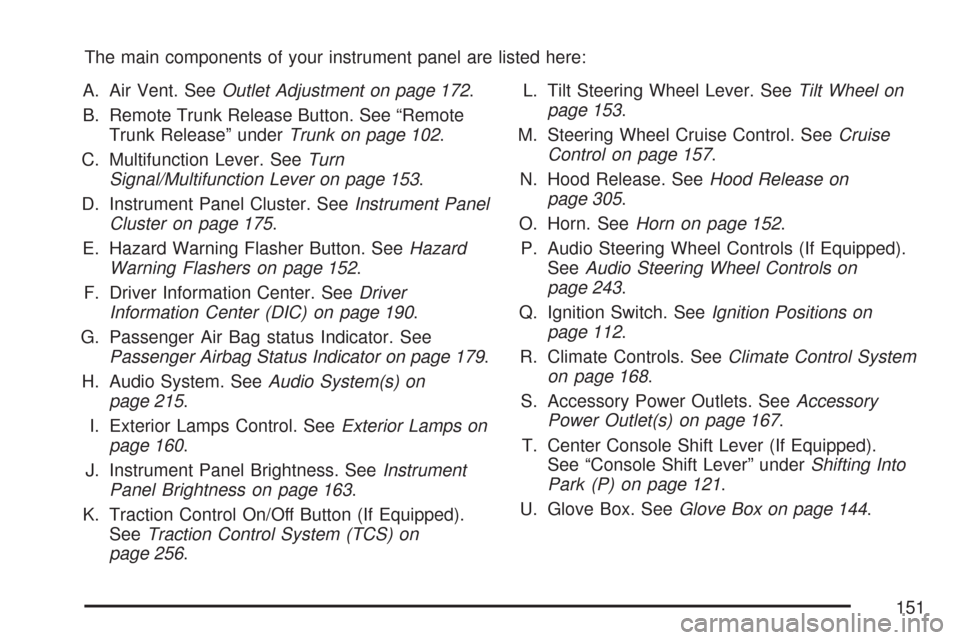
The main components of your instrument panel are listed here:
A. Air Vent. SeeOutlet Adjustment on page 172.
B. Remote Trunk Release Button. See “Remote
Trunk Release” underTrunk on page 102.
C. Multifunction Lever. SeeTurn
Signal/Multifunction Lever on page 153.
D. Instrument Panel Cluster. SeeInstrument Panel
Cluster on page 175.
E. Hazard Warning Flasher Button. SeeHazard
Warning Flashers on page 152.
F. Driver Information Center. SeeDriver
Information Center (DIC) on page 190.
G. Passenger Air Bag status Indicator. See
Passenger Airbag Status Indicator on page 179.
H. Audio System. SeeAudio System(s) on
page 215.
I. Exterior Lamps Control. SeeExterior Lamps on
page 160.
J. Instrument Panel Brightness. SeeInstrument
Panel Brightness on page 163.
K. Traction Control On/Off Button (If Equipped).
SeeTraction Control System (TCS) on
page 256.L. Tilt Steering Wheel Lever. SeeTilt Wheel on
page 153.
M. Steering Wheel Cruise Control. SeeCruise
Control on page 157.
N. Hood Release. SeeHood Release on
page 305.
O. Horn. SeeHorn on page 152.
P. Audio Steering Wheel Controls (If Equipped).
SeeAudio Steering Wheel Controls on
page 243.
Q. Ignition Switch. SeeIgnition Positions on
page 112.
R. Climate Controls. SeeClimate Control System
on page 168.
S. Accessory Power Outlets. SeeAccessory
Power Outlet(s) on page 167.
T. Center Console Shift Lever (If Equipped).
See “Console Shift Lever” underShifting Into
Park (P) on page 121.
U. Glove Box. SeeGlove Box on page 144.
151
Page 166 of 460

The battery can be discharged at idle if the
electrical loads are very high. This is true for all
vehicles. This is because the generator (alternator)
may not be spinning fast enough at idle to
produce all the power that is needed for very high
electrical loads.
A high electrical load occurs when several of the
following loads are on: headlamps, high beams,
fog lamps, rear window defogger, climate
control fan at high speed, heated seats, engine
cooling fans, trailer loads, and loads plugged into
accessory power outlets.
EPM works to prevent excessive discharge of the
battery. It does this by balancing the generator’s
output and the vehicle’s electrical needs. It
can increase engine idle speed to generate more
power, whenever needed. It can temporarily
reduce the power demands of some accessories.
Normally, these actions occur in steps or levels,
without being noticeable. In rare cases at the
highest levels of corrective action, this action
may be noticeable to the driver. If so, a Driver
Information Center (DIC) message might be
displayed, such as Battery Saver Active or
Service Battery Charging System.If this message is displayed, it is recommended
that the driver reduce the electrical loads as much
as possible. SeeDIC Warnings and Messages
on page 199.
Battery Run-Down Protection
This vehicle has a feature to help prevent the
battery from being drained, if the interior courtesy
lamps, reading/map lamps, visor vanity lamps
or trunk lamp are accidentally left on. If any
of these lamps are left on, they will automatically
turn off after 10 minutes, if the ignition is off.
The lamps will not come back on again until
one of the following occurs:
The ignition is turned on.
The exterior lamps control is turned off, then
on again.
The headlamps will timeout after 10 minutes, if they
are manually turned on before the ignition is off.
166
Page 167 of 460
Accessory Power Outlet(s)
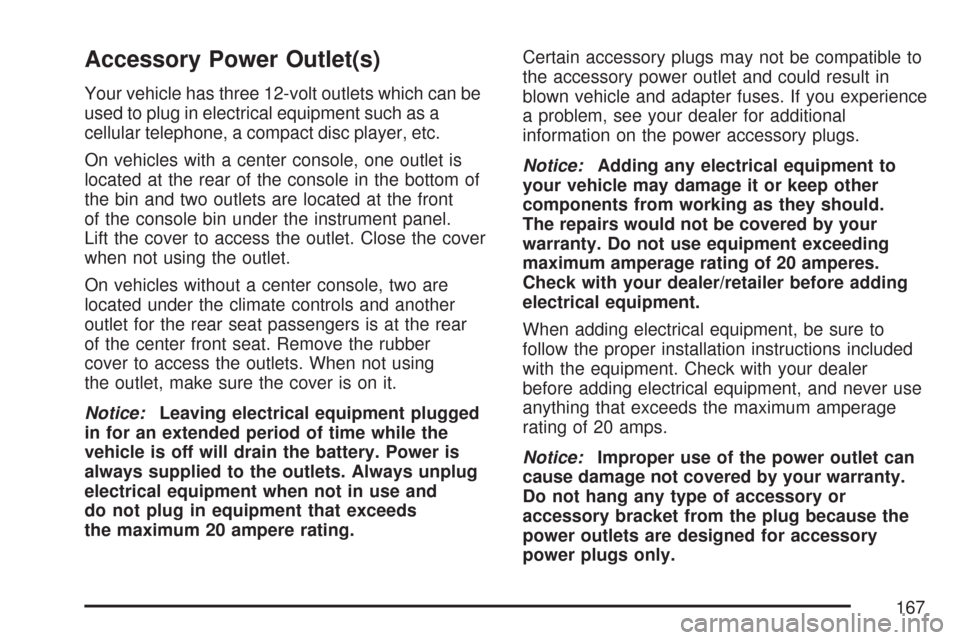
Your vehicle has three 12-volt outlets which can be
used to plug in electrical equipment such as a
cellular telephone, a compact disc player, etc.
On vehicles with a center console, one outlet is
located at the rear of the console in the bottom of
the bin and two outlets are located at the front
of the console bin under the instrument panel.
Lift the cover to access the outlet. Close the cover
when not using the outlet.
On vehicles without a center console, two are
located under the climate controls and another
outlet for the rear seat passengers is at the rear
of the center front seat. Remove the rubber
cover to access the outlets. When not using
the outlet, make sure the cover is on it.
Notice:Leaving electrical equipment plugged
in for an extended period of time while the
vehicle is off will drain the battery. Power is
always supplied to the outlets. Always unplug
electrical equipment when not in use and
do not plug in equipment that exceeds
the maximum 20 ampere rating.Certain accessory plugs may not be compatible to
the accessory power outlet and could result in
blown vehicle and adapter fuses. If you experience
a problem, see your dealer for additional
information on the power accessory plugs.
Notice:Adding any electrical equipment to
your vehicle may damage it or keep other
components from working as they should.
The repairs would not be covered by your
warranty. Do not use equipment exceeding
maximum amperage rating of 20 amperes.
Check with your dealer/retailer before adding
electrical equipment.
When adding electrical equipment, be sure to
follow the proper installation instructions included
with the equipment. Check with your dealer
before adding electrical equipment, and never use
anything that exceeds the maximum amperage
rating of 20 amps.
Notice:Improper use of the power outlet can
cause damage not covered by your warranty.
Do not hang any type of accessory or
accessory bracket from the plug because the
power outlets are designed for accessory
power plugs only.
167
Page 168 of 460
Ashtray(s) and Cigarette Lighter
Your vehicle may have an ashtray and a cigarette
lighter. The ashtray and cigarette lighter may
be located in the console, if your vehicle has one,
otherwise, they may be located in the center
armrest of the front seat.
Notice:If you put papers, pins, or other
ammable items in the ashtray, hot cigarettes
or other smoking materials could ignite
them and possibly damage your vehicle.
Never put ammable items in the ashtray.
Notice:Holding a cigarette lighter in while
it is heating does not let the lighter back away
from the heating element when it is hot.
Damage from overheating can occur to the
lighter or heating element, or a fuse could be
blown. Do not hold a cigarette lighter in while it
is heating.
To use the lighter, just push it in all the way and
let go. When it’s ready, it will pop back out by itself.
Climate Controls
Climate Control System
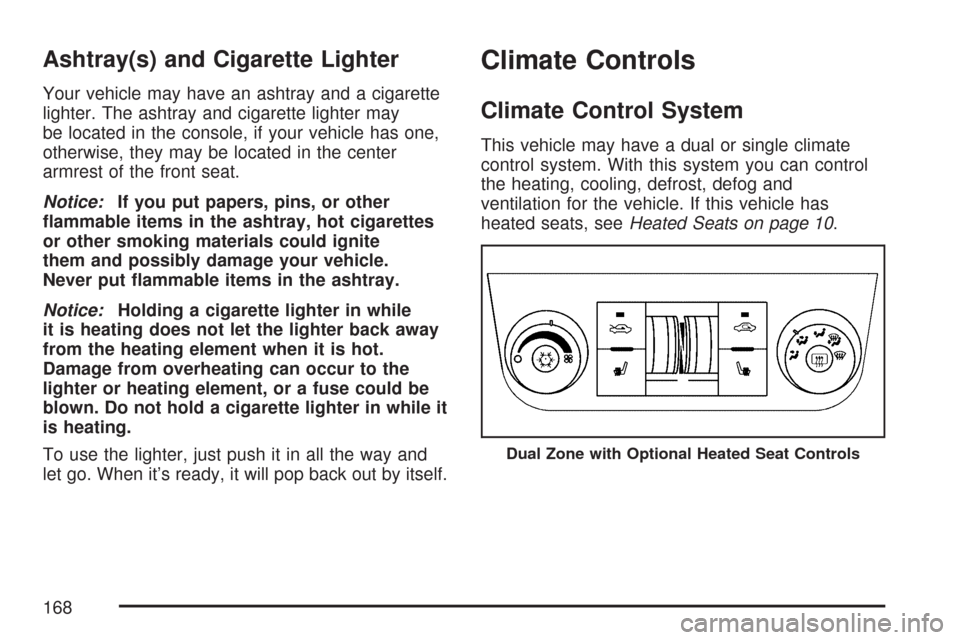
This vehicle may have a dual or single climate
control system. With this system you can control
the heating, cooling, defrost, defog and
ventilation for the vehicle. If this vehicle has
heated seats, seeHeated Seats on page 10.
Dual Zone with Optional Heated Seat Controls
168
Page 170 of 460
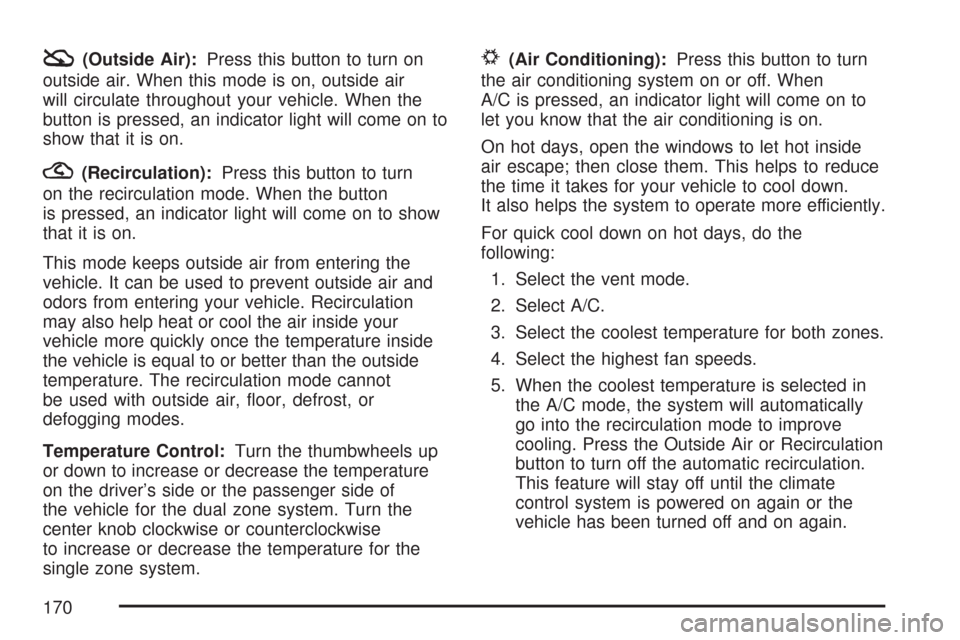
:(Outside Air):Press this button to turn on
outside air. When this mode is on, outside air
will circulate throughout your vehicle. When the
button is pressed, an indicator light will come on to
show that it is on.
?(Recirculation):Press this button to turn
on the recirculation mode. When the button
is pressed, an indicator light will come on to show
that it is on.
This mode keeps outside air from entering the
vehicle. It can be used to prevent outside air and
odors from entering your vehicle. Recirculation
may also help heat or cool the air inside your
vehicle more quickly once the temperature inside
the vehicle is equal to or better than the outside
temperature. The recirculation mode cannot
be used with outside air, oor, defrost, or
defogging modes.
Temperature Control:Turn the thumbwheels up
or down to increase or decrease the temperature
on the driver’s side or the passenger side of
the vehicle for the dual zone system. Turn the
center knob clockwise or counterclockwise
to increase or decrease the temperature for the
single zone system.
#(Air Conditioning):Press this button to turn
the air conditioning system on or off. When
A/C is pressed, an indicator light will come on to
let you know that the air conditioning is on.
On hot days, open the windows to let hot inside
air escape; then close them. This helps to reduce
the time it takes for your vehicle to cool down.
It also helps the system to operate more efficiently.
For quick cool down on hot days, do the
following:
1. Select the vent mode.
2. Select A/C.
3. Select the coolest temperature for both zones.
4. Select the highest fan speeds.
5. When the coolest temperature is selected in
the A/C mode, the system will automatically
go into the recirculation mode to improve
cooling. Press the Outside Air or Recirculation
button to turn off the automatic recirculation.
This feature will stay off until the climate
control system is powered on again or the
vehicle has been turned off and on again.
170
Page 171 of 460

Using these settings together for long periods of
time may cause the air inside of your vehicle
to become too dry. To prevent this from
happening, after the air inside of your vehicle has
cooled, turn the recirculation mode off.
The air conditioning system removes moisture
from the air, so you may sometimes notice a small
amount of water dripping underneath your
vehicle while idling or after turning off the engine.
This is normal.
Defogging and Defrosting
Fog on the inside of the windows is a result of
high humidity (moisture) condensing on the
cool window glass. This can be minimized if the
climate control system is used properly. There are
two modes to clear fog or frost from your
windshield. Use the defog mode to clear the
windows of fog or moisture and warm the
passengers. Use the defrost mode to remove fog
or frost from the windshield more quickly.Do not drive the vehicle until all the windows
are clear.
Turn the right knob clockwise to select the defog
or defrost mode.
-(Defog):This mode directs air equally to the
windshield and the oor outlets. When defog
is selected, the system turns off recirculation and
runs the air conditioning compressor unless
the outside temperature is below 40°F (4°C).
0(Defrost):This mode directs most of the air to
the windshield with some air to the side window
vents and the oor vents. When defrost is selected,
the system will automatically force outside air into
the vehicle. The air conditioning compressor will run
automatically in this setting, unless the outside
temperature is below 40°F (4°C).
171
Page 173 of 460
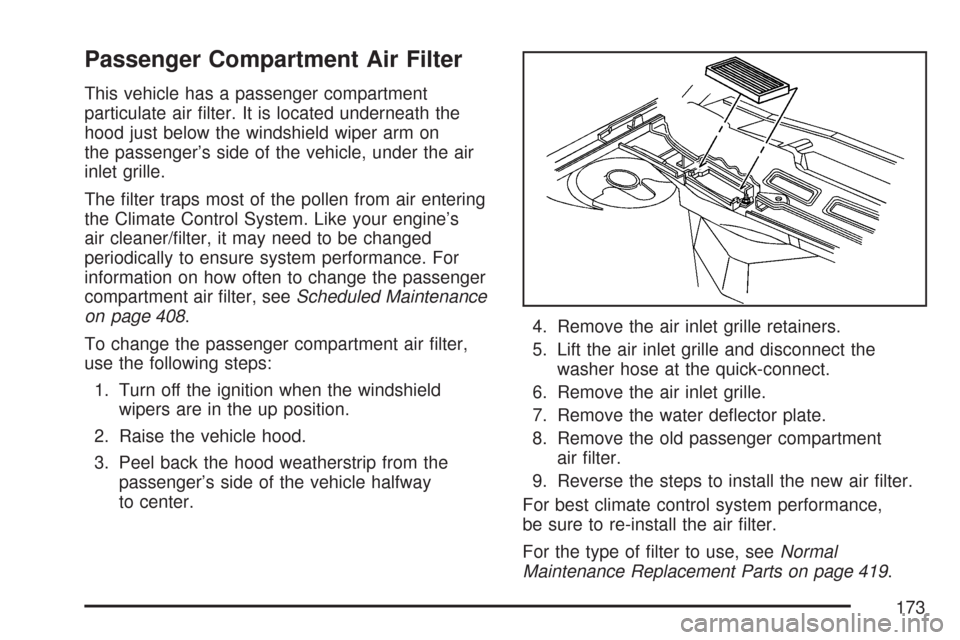
Passenger Compartment Air Filter
This vehicle has a passenger compartment
particulate air lter. It is located underneath the
hood just below the windshield wiper arm on
the passenger’s side of the vehicle, under the air
inlet grille.
The lter traps most of the pollen from air entering
the Climate Control System. Like your engine’s
air cleaner/lter, it may need to be changed
periodically to ensure system performance. For
information on how often to change the passenger
compartment air lter, seeScheduled Maintenance
on page 408.
To change the passenger compartment air lter,
use the following steps:
1. Turn off the ignition when the windshield
wipers are in the up position.
2. Raise the vehicle hood.
3. Peel back the hood weatherstrip from the
passenger’s side of the vehicle halfway
to center.4. Remove the air inlet grille retainers.
5. Lift the air inlet grille and disconnect the
washer hose at the quick-connect.
6. Remove the air inlet grille.
7. Remove the water deector plate.
8. Remove the old passenger compartment
air lter.
9. Reverse the steps to install the new air lter.
For best climate control system performance,
be sure to re-install the air lter.
For the type of lter to use, seeNormal
Maintenance Replacement Parts on page 419.
173
Page 204 of 460

PASSENGER DOOR OPEN
This message displays when the front passenger’s
door is not closed properly. When this message
appears, make sure that the front passenger’s
door is closed completely.
REMOTE KEY LEARNING ACTIVE
This message displays while you are matching
a Remote Keyless Entry (RKE) transmitter to your
vehicle. See “Matching Transmitter(s) to Your
Vehicle” underRemote Keyless Entry (RKE)
System Operation on page 91andDIC Operation
and Displays on page 191for more information.
REPLACE BATTERY IN REMOTE KEY
This message displays when the battery in
the Remote Keyless Entry (RKE) transmitter
needs to be replaced. To replace the battery,
see “Battery Replacement” underRemote Keyless
Entry (RKE) System Operation on page 91.
RIGHT REAR DOOR OPEN
This message displays when the passenger’s
side rear door is not closed properly. When this
message appears, make sure that the passenger’s
side rear door is closed completely.
SERVICE A/C (Air Conditioning)
SYSTEM
This message displays when the electronic
sensors that control the air conditioning and
heating systems are no longer working. Have the
climate control system serviced by your dealer
if you notice a drop in heating and air conditioning
efficiency.
SERVICE AIR BAG
This message displays when there is a problem
with the airbag system. Have your vehicle serviced
by your dealer immediately. SeeAirbag Readiness
Light on page 178for more information.
204