2007 CHEVROLET HHR seats
[x] Cancel search: seatsPage 127 of 446
Parking Brake
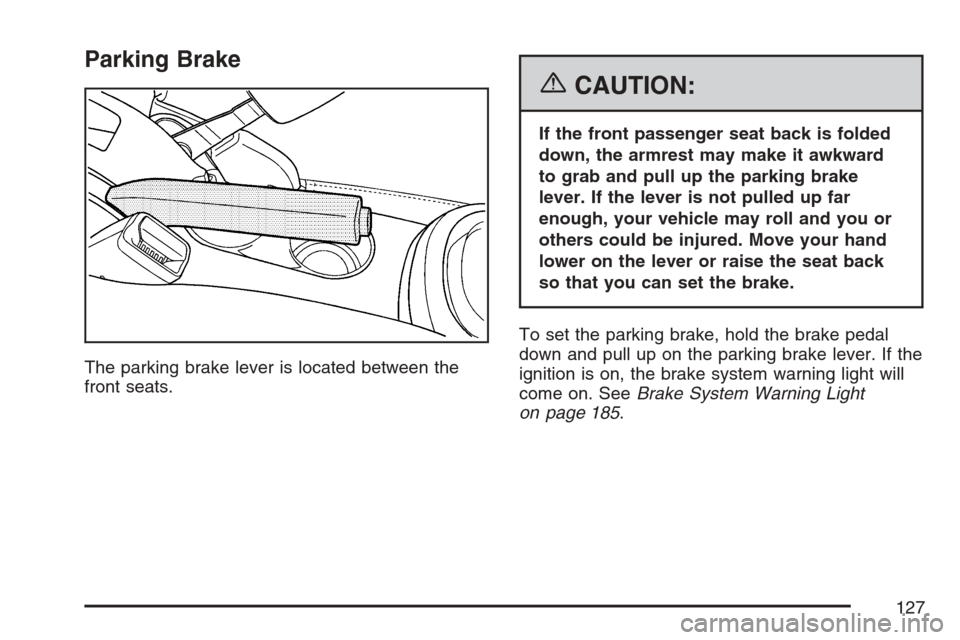
The parking brake lever is located between the
front seats.
{CAUTION:
If the front passenger seat back is folded
down, the armrest may make it awkward
to grab and pull up the parking brake
lever. If the lever is not pulled up far
enough, your vehicle may roll and you or
others could be injured. Move your hand
lower on the lever or raise the seat back
so that you can set the brake.
To set the parking brake, hold the brake pedal
down and pull up on the parking brake lever. If the
ignition is on, the brake system warning light will
come on. SeeBrake System Warning Light
on page 185.
127
Page 143 of 446
Your Responsibility
You may need to increase the volume of your
radio to hear the OnStar®advisor. If the light next
to the OnStar®buttons is red, this means that
your system is not functioning properly and should
be checked by a dealer. If the light appears
clear (no light is appearing), your OnStar
®
subscription has expired. You can always press
the OnStar®button to conrm that your OnStar®
equipment is active.
Storage Areas
Glove Box
Open the glove box by lifting up on the lever.
Close the glove box with a rm push.
Cupholder(s)
There are two cupholders located in the oor
console between the front seats. There is also a
cupholder for the rear seat passenger located
at the rear of the oor console. They can be
removed for cleaning.
Instrument Panel Storage Area
Your vehicle has a storage compartment on the
instrument panel above the air vents. Push
the button on the compartment to open the lid.
Floor Console Storage Area
There are two small storage compartments on the
oor console, one at the front under the window
switches and one next to the parking brake
lever. The rubber liners can be removed for
cleaning.
Rear Storage Area
Your vehicle may have two rear storage areas that
can be used for the convenience net or other
small items.
143
Page 168 of 446
Mirror Reading Lamps
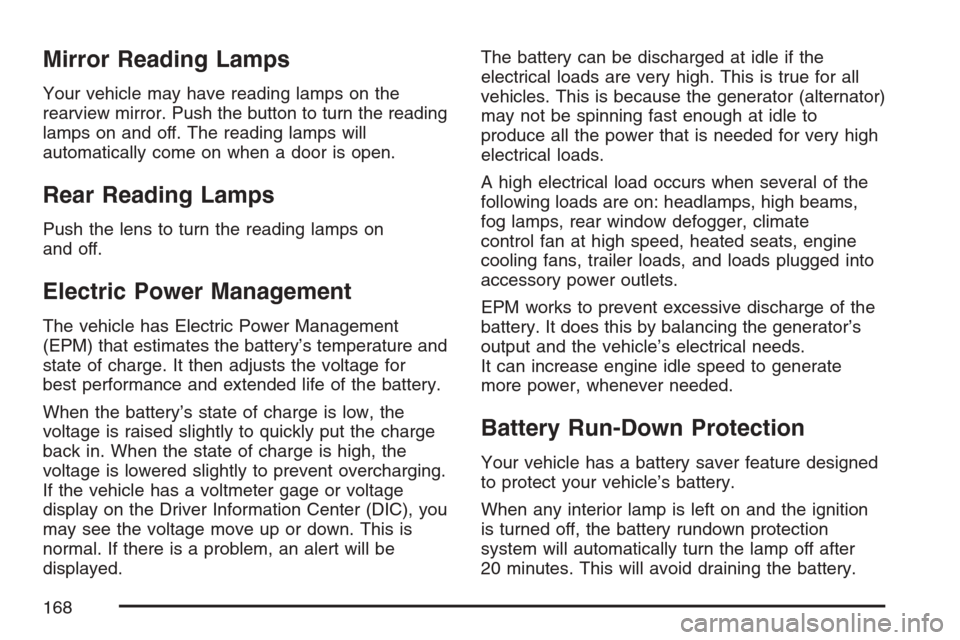
Your vehicle may have reading lamps on the
rearview mirror. Push the button to turn the reading
lamps on and off. The reading lamps will
automatically come on when a door is open.
Rear Reading Lamps
Push the lens to turn the reading lamps on
and off.
Electric Power Management
The vehicle has Electric Power Management
(EPM) that estimates the battery’s temperature and
state of charge. It then adjusts the voltage for
best performance and extended life of the battery.
When the battery’s state of charge is low, the
voltage is raised slightly to quickly put the charge
back in. When the state of charge is high, the
voltage is lowered slightly to prevent overcharging.
If the vehicle has a voltmeter gage or voltage
display on the Driver Information Center (DIC), you
may see the voltage move up or down. This is
normal. If there is a problem, an alert will be
displayed.The battery can be discharged at idle if the
electrical loads are very high. This is true for all
vehicles. This is because the generator (alternator)
may not be spinning fast enough at idle to
produce all the power that is needed for very high
electrical loads.
A high electrical load occurs when several of the
following loads are on: headlamps, high beams,
fog lamps, rear window defogger, climate
control fan at high speed, heated seats, engine
cooling fans, trailer loads, and loads plugged into
accessory power outlets.
EPM works to prevent excessive discharge of the
battery. It does this by balancing the generator’s
output and the vehicle’s electrical needs.
It can increase engine idle speed to generate
more power, whenever needed.
Battery Run-Down Protection
Your vehicle has a battery saver feature designed
to protect your vehicle’s battery.
When any interior lamp is left on and the ignition
is turned off, the battery rundown protection
system will automatically turn the lamp off after
20 minutes. This will avoid draining the battery.
168
Page 174 of 446
Rear Window Defogger
The rear window defogger uses a warming grid to
remove fog from the rear window.
The rear window defogger will only work when the
ignition is in RUN.
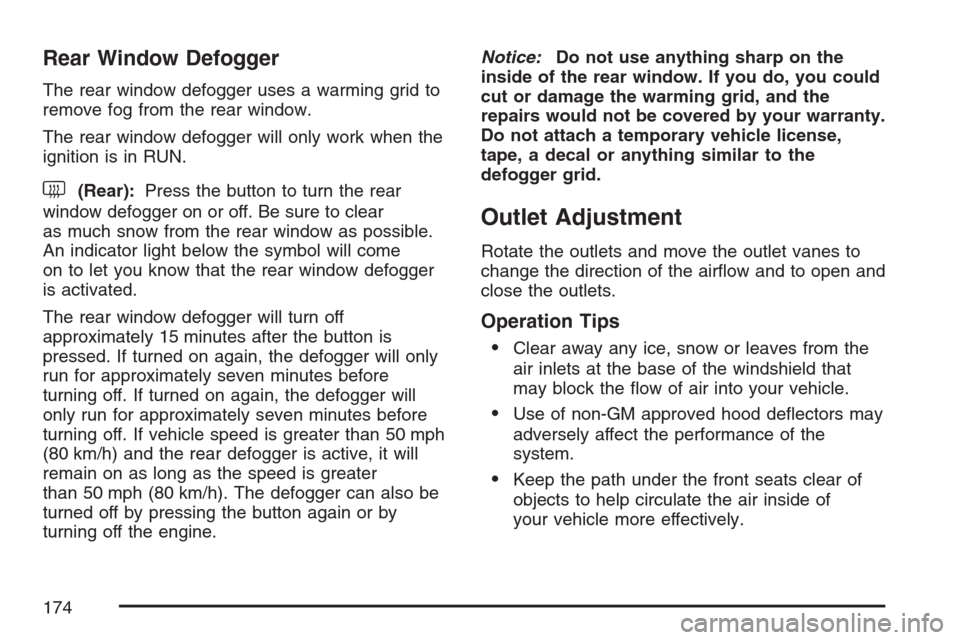
<(Rear):Press the button to turn the rear
window defogger on or off. Be sure to clear
as much snow from the rear window as possible.
An indicator light below the symbol will come
on to let you know that the rear window defogger
is activated.
The rear window defogger will turn off
approximately 15 minutes after the button is
pressed. If turned on again, the defogger will only
run for approximately seven minutes before
turning off. If turned on again, the defogger will
only run for approximately seven minutes before
turning off. If vehicle speed is greater than 50 mph
(80 km/h) and the rear defogger is active, it will
remain on as long as the speed is greater
than 50 mph (80 km/h). The defogger can also be
turned off by pressing the button again or by
turning off the engine.Notice:Do not use anything sharp on the
inside of the rear window. If you do, you could
cut or damage the warming grid, and the
repairs would not be covered by your warranty.
Do not attach a temporary vehicle license,
tape, a decal or anything similar to the
defogger grid.
Outlet Adjustment
Rotate the outlets and move the outlet vanes to
change the direction of the airow and to open and
close the outlets.
Operation Tips
Clear away any ice, snow or leaves from the
air inlets at the base of the windshield that
may block the ow of air into your vehicle.
Use of non-GM approved hood deectors may
adversely affect the performance of the
system.
Keep the path under the front seats clear of
objects to help circulate the air inside of
your vehicle more effectively.
174
Page 274 of 446
If you put things inside your vehicle — like
suitcases, tools, packages, or anything
else — they will go as fast as the vehicle goes.
If you have to stop or turn quickly, or if there is a
crash, they will keep going.
{CAUTION:
Things you put inside your vehicle can
strike and injure people in a sudden stop
or turn, or in a crash.
Put things in the cargo area of your
vehicle. Try to spread the weight
evenly.
Never stack heavier things, like
suitcases, inside the vehicle so that
some of them are above the tops of
the seats.
Do not leave an unsecured child
restraint in your vehicle.
When you carry something inside the
vehicle, secure it whenever you can.
Do not leave a seat folded down
unless you need to.
Towing
Towing Your Vehicle
Consult your dealer or a professional towing
service if you need to have your disabled vehicle
towed. SeeRoadside Assistance Program on
page 418.
If you want to tow your vehicle behind another
vehicle for recreational purposes (such as behind
a motorhome), see “Recreational Vehicle
Towing” following.
Recreational Vehicle Towing
Recreational vehicle towing means towing your
vehicle behind another vehicle — such as behind a
motorhome. The two most common types of
recreational vehicle towing are known as “dinghy
towing” (towing your vehicle with all four wheels
on the ground) and “dolly towing” (towing
your vehicle with two wheels on the ground and
two wheels up on a device known as a “dolly”).
274
Page 340 of 446
(B) Tire Width:The three-digit number indicates
the tire section width in millimeters from sidewall
to sidewall.
(C) Aspect Ratio:A two-digit number that
indicates the tire height-to-width measurements.
For example, if the tire size aspect ratio is
60, as shown in item C of the illustration, it would
mean that the tire’s sidewall is 60 percent as
high as it is wide.
(D) Construction Code:A letter code is used to
indicate the type of ply construction in the tire.
The letter R means radial ply construction;
the letter D means diagonal or bias ply
construction; and the letter B means belted-bias
ply construction.
(E) Rim Diameter:Diameter of the wheel in
inches.(F) Service Description:These characters
represent the load range and speed rating of the
tire. The load index represents the load carry
capacity a tire is certied to carry. The load index
can range from 1 to 279. The speed rating is
the maximum speed a tire is certied to carry a
load. Speed ratings range from A to Z.
Tire Terminology and Denitions
Air Pressure:The amount of air inside the tire
pressing outward on each square inch of the
tire. Air pressure is expressed in pounds
per square inch (psi) or kilopascal (kPa).
Accessory Weight:This means the combined
weight of optional accessories. Some examples of
optional accessories are, automatic
transmission/transaxle, power steering, power
brakes, power windows, power seats, and
air conditioning.
340
Page 384 of 446
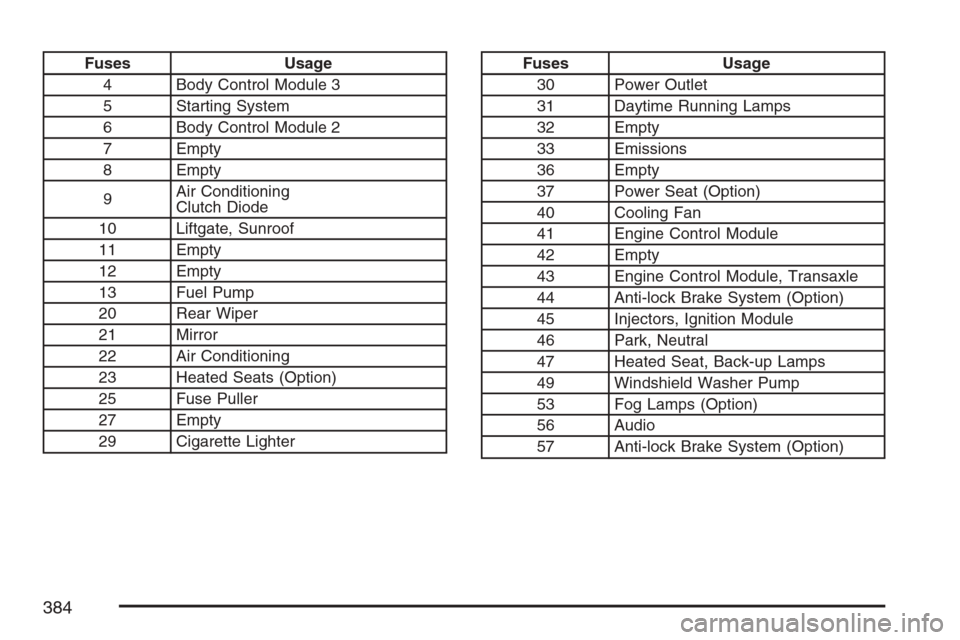
Fuses Usage
4 Body Control Module 3
5 Starting System
6 Body Control Module 2
7 Empty
8 Empty
9Air Conditioning
Clutch Diode
10 Liftgate, Sunroof
11 Empty
12 Empty
13 Fuel Pump
20 Rear Wiper
21 Mirror
22 Air Conditioning
23 Heated Seats (Option)
25 Fuse Puller
27 Empty
29 Cigarette LighterFuses Usage
30 Power Outlet
31 Daytime Running Lamps
32 Empty
33 Emissions
36 Empty
37 Power Seat (Option)
40 Cooling Fan
41 Engine Control Module
42 Empty
43 Engine Control Module, Transaxle
44 Anti-lock Brake System (Option)
45 Injectors, Ignition Module
46 Park, Neutral
47 Heated Seat, Back-up Lamps
49 Windshield Washer Pump
53 Fog Lamps (Option)
56 Audio
57 Anti-lock Brake System (Option)
384
Page 438 of 446
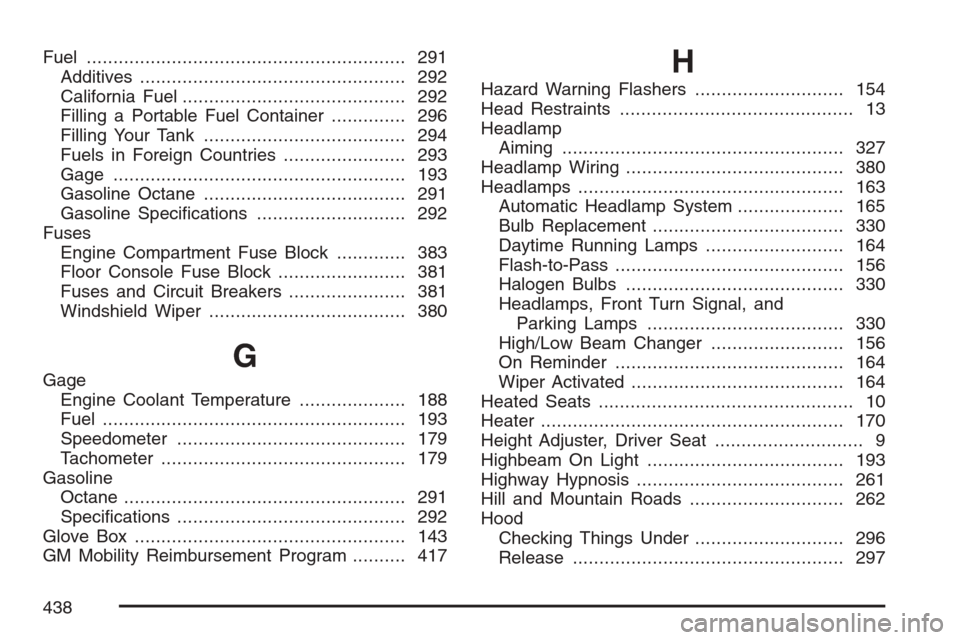
Fuel............................................................ 291
Additives.................................................. 292
California Fuel.......................................... 292
Filling a Portable Fuel Container.............. 296
Filling Your Tank...................................... 294
Fuels in Foreign Countries....................... 293
Gage....................................................... 193
Gasoline Octane...................................... 291
Gasoline Specications............................ 292
Fuses
Engine Compartment Fuse Block............. 383
Floor Console Fuse Block........................ 381
Fuses and Circuit Breakers...................... 381
Windshield Wiper..................................... 380
G
Gage
Engine Coolant Temperature.................... 188
Fuel......................................................... 193
Speedometer........................................... 179
Tachometer.............................................. 179
Gasoline
Octane..................................................... 291
Specications........................................... 292
Glove Box................................................... 143
GM Mobility Reimbursement Program.......... 417
H
Hazard Warning Flashers............................ 154
Head Restraints............................................ 13
Headlamp
Aiming..................................................... 327
Headlamp Wiring......................................... 380
Headlamps.................................................. 163
Automatic Headlamp System.................... 165
Bulb Replacement.................................... 330
Daytime Running Lamps.......................... 164
Flash-to-Pass........................................... 156
Halogen Bulbs......................................... 330
Headlamps, Front Turn Signal, and
Parking Lamps..................................... 330
High/Low Beam Changer ......................... 156
On Reminder........................................... 164
Wiper Activated........................................ 164
Heated Seats................................................ 10
Heater......................................................... 170
Height Adjuster, Driver Seat............................ 9
Highbeam On Light..................................... 193
Highway Hypnosis....................................... 261
Hill and Mountain Roads............................. 262
Hood
Checking Things Under............................ 296
Release................................................... 297
438