Page 52 of 446
Securing an Add-on Child Restraint in
the Vehicle
{CAUTION:
A child can be seriously injured or killed
in a crash if the child restraint is not
properly secured in the vehicle. Make sure
the child restraint is properly installed in
the vehicle using the vehicle’s safety belt
or LATCH system, following the
instructions that came with that restraint,
and also the instructions in this manual.
To help reduce the chance of injury, the child
restraint must be secured in the vehicle. Child
restraint systems must be secured in vehicle seats
by lap belts or the lap belt portion of a lap-shoulder
belt, or by the LATCH system.SeeLower Anchors and Tethers for Children
(LATCH) on page 56for more information. A child
can be endangered in a crash if the child
restraint is not properly secured in the vehicle.
When securing an add-on child restraint, refer to
the instructions that come with the restraint
which may be on the restraint itself or in a booklet,
or both, and to this manual. The child restraint
instructions are important, so if they are not
available, obtain a replacement copy from the
manufacturer.
Keep in mind that an unsecured child restraint can
move around in a collision or sudden stop and
injure people in the vehicle. Be sure to properly
secure any child restraint in your vehicle — even
when no child is in it.
52
Page 58 of 446
Lower Anchor and Top Tether Anchor
Locations
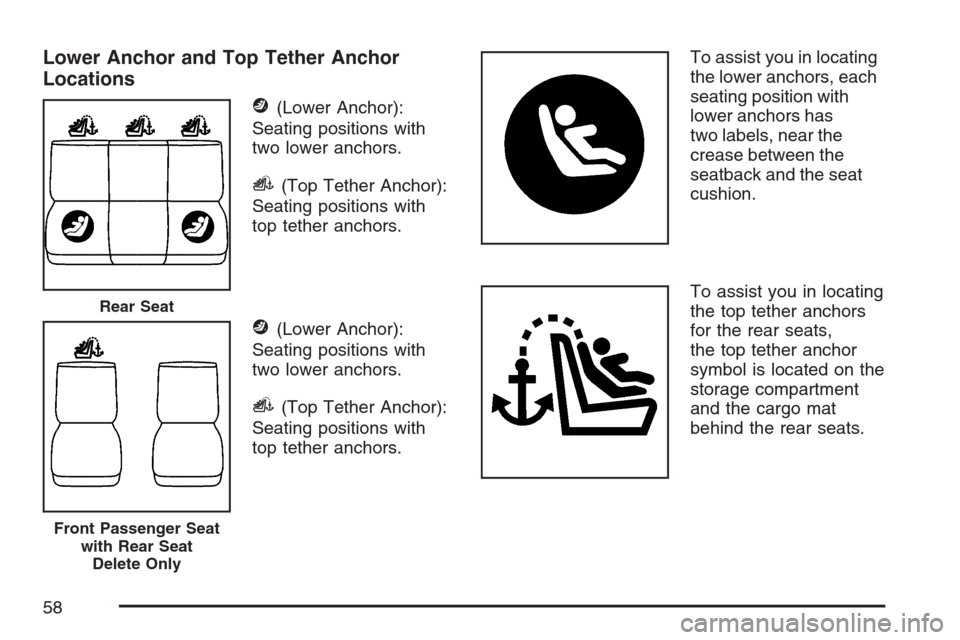
j(Lower Anchor):
Seating positions with
two lower anchors.
i(Top Tether Anchor):
Seating positions with
top tether anchors.
j(Lower Anchor):
Seating positions with
two lower anchors.
i(Top Tether Anchor):
Seating positions with
top tether anchors.To assist you in locating
the lower anchors, each
seating position with
lower anchors has
two labels, near the
crease between the
seatback and the seat
cushion.
To assist you in locating
the top tether anchors
for the rear seats,
the top tether anchor
symbol is located on the
storage compartment
and the cargo mat
behind the rear seats.
Rear Seat
Front Passenger Seat
with Rear Seat
Delete Only
58
Page 59 of 446
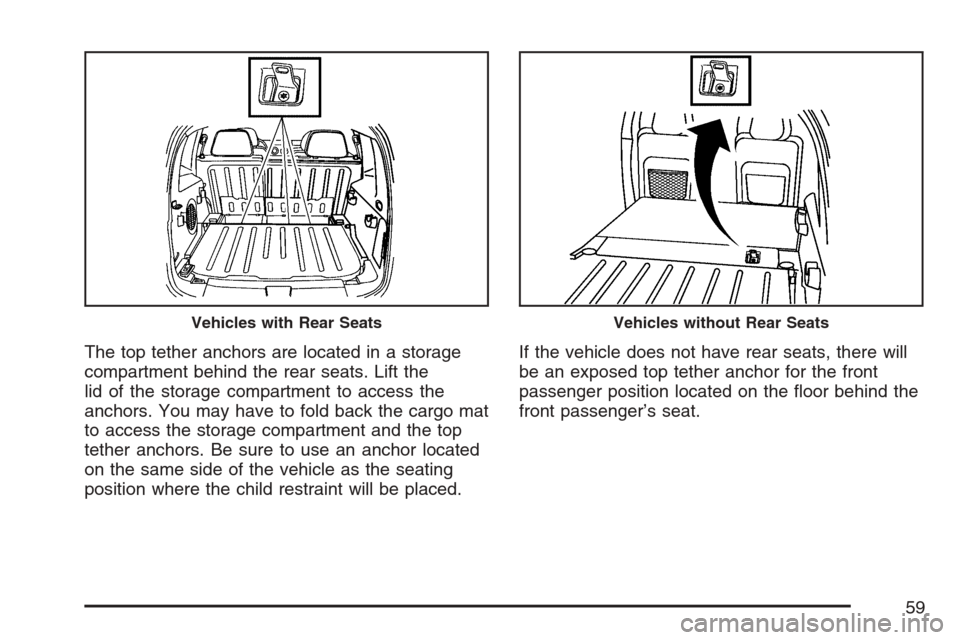
The top tether anchors are located in a storage
compartment behind the rear seats. Lift the
lid of the storage compartment to access the
anchors. You may have to fold back the cargo mat
to access the storage compartment and the top
tether anchors. Be sure to use an anchor located
on the same side of the vehicle as the seating
position where the child restraint will be placed.If the vehicle does not have rear seats, there will
be an exposed top tether anchor for the front
passenger position located on the oor behind the
front passenger’s seat.
Vehicles with Rear SeatsVehicles without Rear Seats
59
Page 60 of 446
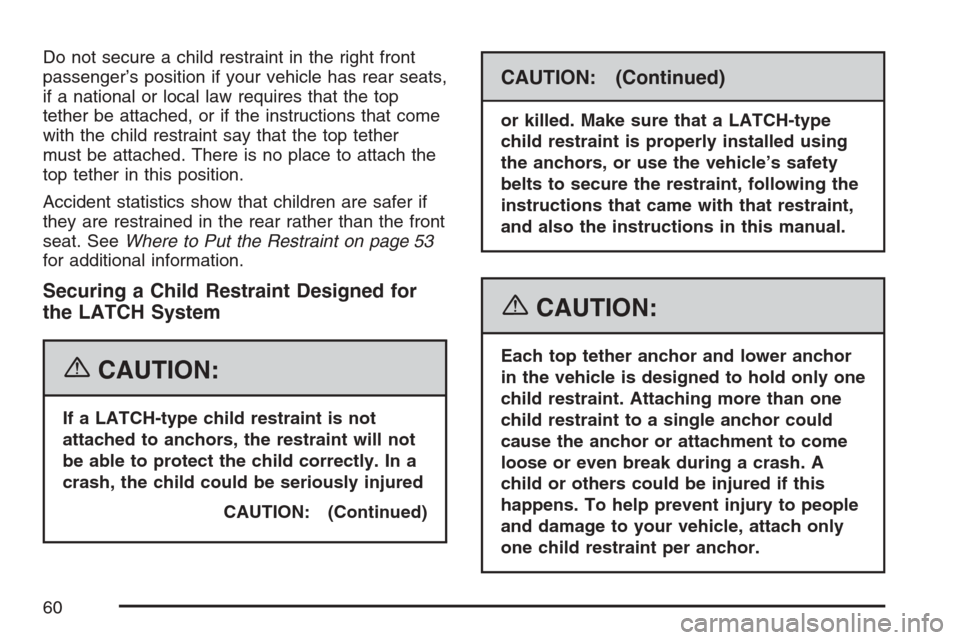
Do not secure a child restraint in the right front
passenger’s position if your vehicle has rear seats,
if a national or local law requires that the top
tether be attached, or if the instructions that come
with the child restraint say that the top tether
must be attached. There is no place to attach the
top tether in this position.
Accident statistics show that children are safer if
they are restrained in the rear rather than the front
seat. SeeWhere to Put the Restraint on page 53
for additional information.
Securing a Child Restraint Designed for
the LATCH System
{CAUTION:
If a LATCH-type child restraint is not
attached to anchors, the restraint will not
be able to protect the child correctly. In a
crash, the child could be seriously injured
CAUTION: (Continued)
CAUTION: (Continued)
or killed. Make sure that a LATCH-type
child restraint is properly installed using
the anchors, or use the vehicle’s safety
belts to secure the restraint, following the
instructions that came with that restraint,
and also the instructions in this manual.
{CAUTION:
Each top tether anchor and lower anchor
in the vehicle is designed to hold only one
child restraint. Attaching more than one
child restraint to a single anchor could
cause the anchor or attachment to come
loose or even break during a crash. A
child or others could be injured if this
happens. To help prevent injury to people
and damage to your vehicle, attach only
one child restraint per anchor.
60
Page 62 of 446
2. If the child restraint manufacturer recommends
that the top tether be attached, attach and
tighten the top tether to the top tether anchor,
if equipped. Refer to the child restraint
instructions and the following steps:
2.1. For vehicles with rear seats, nd the
storage compartments behind the rear
seats. You may have to fold back
the cargo mat to access the storage
compartment and top tether anchors.
2.2. Lift the lid of the storage compartments
to access the top tether anchors.
2.3. For vehicles without rear seats, nd the
top tether anchor.
2.4. If the position you are using has an
adjustable head restraint, raise it.
2.5. Route, attach, and tighten the top tether
according to your child restraint
instructions and the following
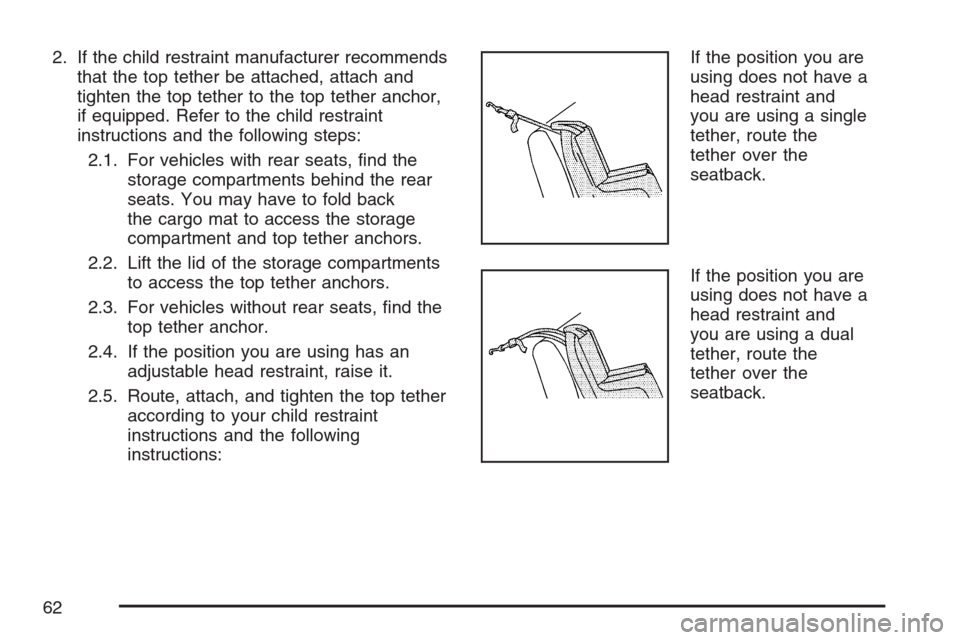
instructions:If the position you are
using does not have a
head restraint and
you are using a single
tether, route the
tether over the
seatback.
If the position you are
using does not have a
head restraint and
you are using a dual
tether, route the
tether over the
seatback.
62
Page 68 of 446
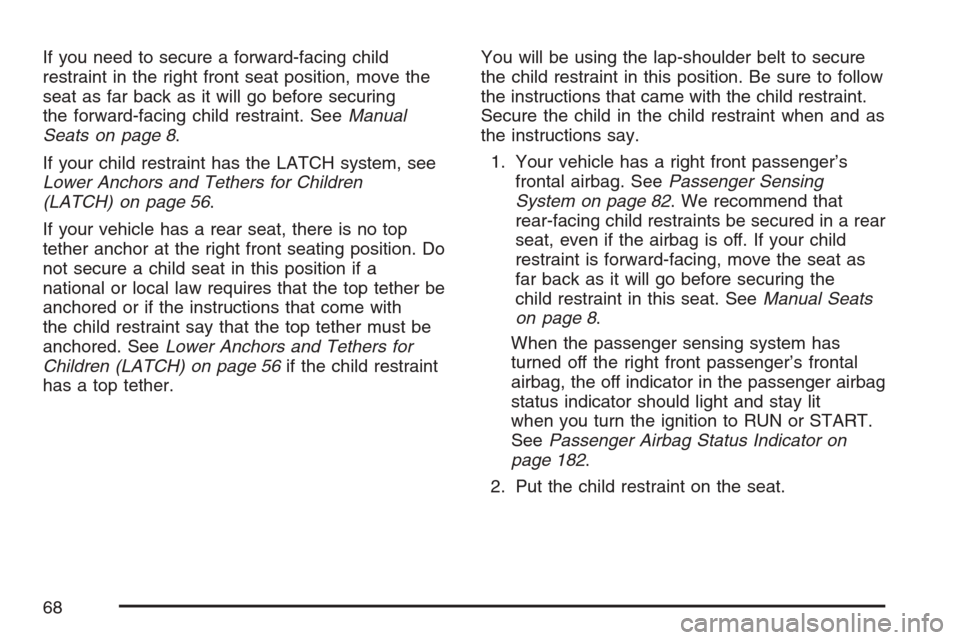
If you need to secure a forward-facing child
restraint in the right front seat position, move the
seat as far back as it will go before securing
the forward-facing child restraint. SeeManual
Seats on page 8.
If your child restraint has the LATCH system, see
Lower Anchors and Tethers for Children
(LATCH) on page 56.
If your vehicle has a rear seat, there is no top
tether anchor at the right front seating position. Do
not secure a child seat in this position if a
national or local law requires that the top tether be
anchored or if the instructions that come with
the child restraint say that the top tether must be
anchored. SeeLower Anchors and Tethers for
Children (LATCH) on page 56if the child restraint
has a top tether.You will be using the lap-shoulder belt to secure
the child restraint in this position. Be sure to follow
the instructions that came with the child restraint.
Secure the child in the child restraint when and as
the instructions say.
1. Your vehicle has a right front passenger’s
frontal airbag. SeePassenger Sensing
System on page 82. We recommend that
rear-facing child restraints be secured in a rear
seat, even if the airbag is off. If your child
restraint is forward-facing, move the seat as
far back as it will go before securing the
child restraint in this seat. SeeManual Seats
on page 8.
When the passenger sensing system has
turned off the right front passenger’s frontal
airbag, the off indicator in the passenger airbag
status indicator should light and stay lit
when you turn the ignition to RUN or START.
SeePassenger Airbag Status Indicator on
page 182.
2. Put the child restraint on the seat.
68
Page 89 of 446
Adding Equipment to Your
Airbag-Equipped Vehicle
Q:Is there anything I might add to the front
or sides of the vehicle that could keep the
airbags from working properly?
A:Yes. If you add things that change your
vehicle’s frame, bumper system, height,
front end or side sheet metal, they may keep
the airbag system from working properly.
Also, the airbag system may not work properly
if you relocate any of the airbag sensors. If
you have any questions about this, you should
contact Customer Assistance before you
modify your vehicle. The phone numbers and
addresses for Customer Assistance are in
Step Two of the Customer Satisfaction
Procedure in this manual. SeeCustomer
Satisfaction Procedure on page 412.
Q:Because I have a disability, I have to get
my vehicle modied. How can I nd out
whether this will affect my airbag system?
A:Changing or moving any parts of the
front seats, safety belts, the airbag sensing
and diagnostic module, steering wheel,
instrument panel, ceiling headliner, ceiling and
pillar garnish trim, roof-mounted airbag
modules, or airbag wiring can affect the
operation of the airbag system. If you have
questions, call Customer Assistance. The
phone numbers and addresses for Customer
Assistance are in Step Two of the Customer
Satisfaction Procedure in this manual.
SeeCustomer Satisfaction Procedure on
page 412.
89
Page 122 of 446
4. Before starting the engine, be sure to unplug
and store the cord as it was before to keep it
away from moving engine parts. If you do
not, it could be damaged.
How long should you keep the coolant heater
plugged in? The answer depends on the outside
temperature, the kind of oil you have, and
some other things. Instead of trying to list
everything here, we ask that you contact a GM
dealer in the area where you will be parking your
vehicle. The dealer can give you the best
advice for that particular area.
Automatic Transaxle Operation
If your vehicle has an automatic transaxle, the
shift lever is located on the console between the
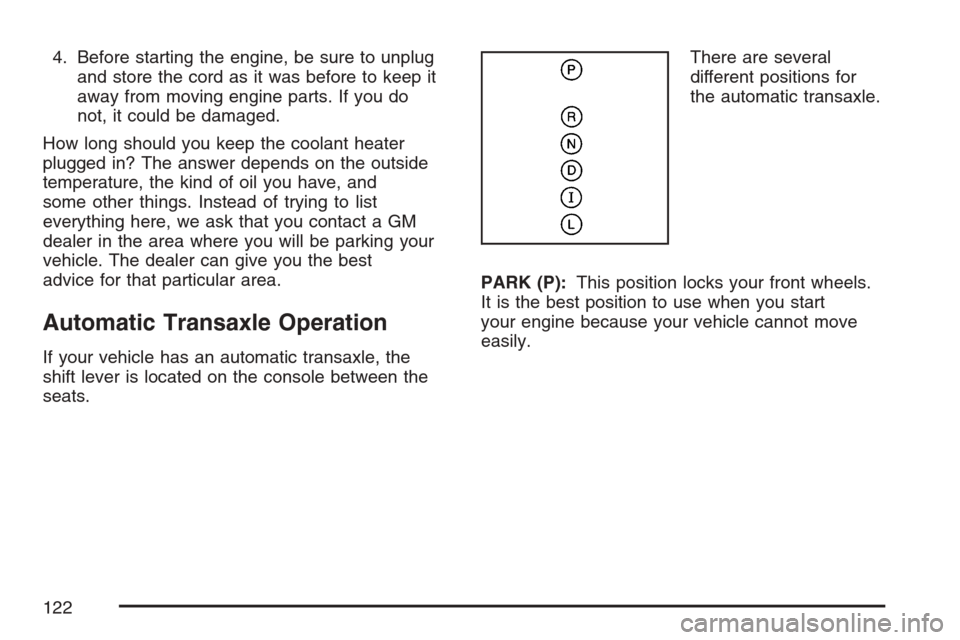
seats.There are several
different positions for
the automatic transaxle.
PARK (P):This position locks your front wheels.
It is the best position to use when you start
your engine because your vehicle cannot move
easily.
122