Page 127 of 446
Parking Brake
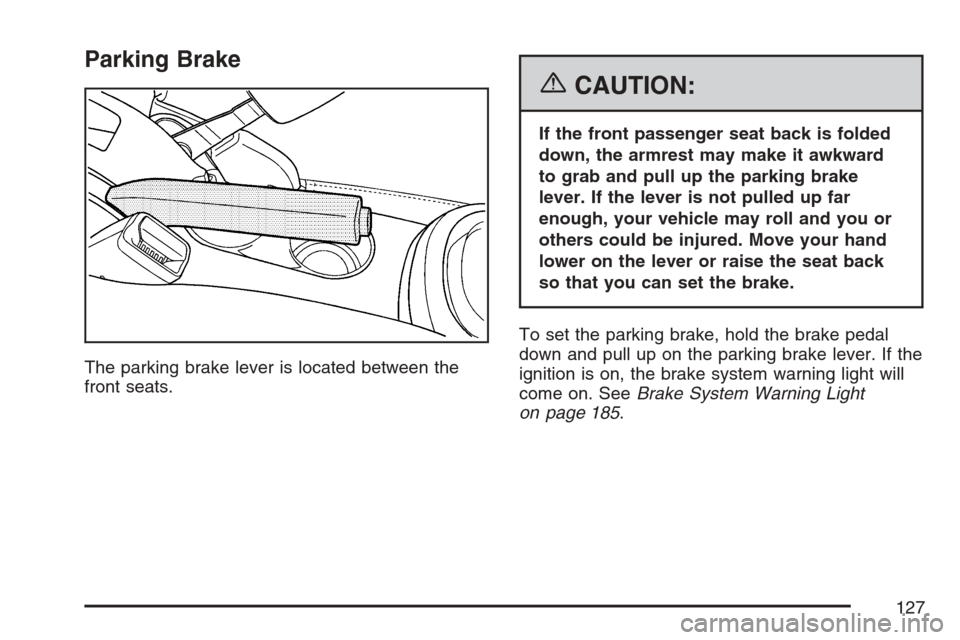
The parking brake lever is located between the
front seats.
{CAUTION:
If the front passenger seat back is folded
down, the armrest may make it awkward
to grab and pull up the parking brake
lever. If the lever is not pulled up far
enough, your vehicle may roll and you or
others could be injured. Move your hand
lower on the lever or raise the seat back
so that you can set the brake.
To set the parking brake, hold the brake pedal
down and pull up on the parking brake lever. If the
ignition is on, the brake system warning light will
come on. SeeBrake System Warning Light
on page 185.
127
Page 129 of 446
3. Turn the ignition key to LOCK.
4. Remove the key and take it with you. If you
can leave your vehicle with the ignition key in
your hand, your vehicle is in PARK (P).
Leaving Your Vehicle With the
Engine Running
{CAUTION:
It can be dangerous to leave your vehicle
with the engine running. Your vehicle
could move suddenly if the shift lever is
not fully in PARK (P) with the parking
brake rmly set. And, if you leave the
vehicle with the engine running, it could
overheat and even catch re. You or
others could be injured. Do not leave your
vehicle with the engine running.
If you have to leave your vehicle with the engine
running, be sure your vehicle is in PARK (P)
and your parking brake is rmly set before you
leave it. After you have moved the shift lever intoPARK (P), hold the regular brake pedal down.
Then, see if you can move the shift lever
away from PARK (P) without rst pushing the
button. If you can, it means that the shift lever was
not fully locked into PARK (P).
Torque Lock
If you are parking on a hill and you do not shift your
transaxle into PARK (P) properly, the weight of the
vehicle may put too much force on the parking pawl
in the transaxle. You may nd it difficult to pull the
shift lever out of PARK (P). This is called “torque
lock.” To prevent torque lock, set the parking brake
and then shift into PARK (P) properly before you
leave the driver’s seat. To nd out how, seeShifting
Into Park (P) (Automatic Transaxle) on page 128.
When you are ready to drive, move the shift lever
out of PARK (P)beforeyou release the parking
brake.
If torque lock does occur, you may need to have
another vehicle push yours a little uphill to
take some of the pressure from the parking pawl
in the transaxle, then you will be able to pull
the shift lever out of PARK (P).
129
Page 130 of 446
Shifting Out of Park (P)
(Automatic Transaxle)
This vehicle is equipped with an electronic shift
lock release system. The shift lock release is
designed to:
Prevent ignition key removal unless the shift
lever is in PARK (P) with the shift lever
button fully released, and
Prevent movement of the shift lever out of
PARK (P) unless the ignition is in a position
other than LOCK.
The shift lock release is always functional except
in the case of a an uncharged or low voltage
(less than 9 volt) battery.
If your vehicle has an uncharged battery or a
battery with low voltage, try charging or jump
starting the battery. SeeJump Starting on
page 320for more information.
To shift out of PARK (P) use the following
sequence:
1. Apply the brake pedal.
2. Then press the shift lever button.
3. Move the shift lever to the desired position.If you still are unable to shift out of PARK (P):
1. Fully release the shift lever button.
2. While holding down the brake pedal, press
the shift lever button again.
3. Move the shift lever to the desired position.
If you still cannot move the shift lever from
PARK (P), consult your dealer or a professional
towing service.Parking Your Vehicle
Before leaving your vehicle, fully press the clutch
pedal in, move the shift lever into REVERSE (R),
and rmly apply the parking brake. Once the
shift lever has been placed in REVERSE (R) with
the clutch pedal pressed in, you can turn the
ignition key to LOCK, remove the key and release
the clutch. SeeManual Transaxle Operation on
page 125.
130
Page 134 of 446
Mirrors
Manual Rearview Mirror
To reduce glare from lamps behind you, move the
lever toward you to the night position. Your
vehicle may also have reading lamps. Press the
buttons, located under the mirror, up to turn
the lamps on or off.
Automatic Dimming Rearview Mirror
with OnStar
®and Compass
Your vehicle may have an automatic dimming
rearview mirror with OnStar®, compass and
reading lamps. This feature enables the mirror to
sense nighttime glare from vehicle headlamps
from behind and automatically dim to reduce the
glare to a safe level.
O(On/Off):This is the on/off button for the
automatic dimming feature.
The automatic dimming feature turns on each time
the vehicle is started. Press and hold the on/off
button once and the green indicator light located to
the left of the button will go out indicating thefeature is off. To turn the feature back on, press
and hold the on/off button and the green indicator
light will come on.
The reading lamps, located under the mirror, can
be turned on or off by pushing the buttons up.
There are three additional buttons for the OnStar
®
system. See your dealer for more information on
the system and how to subscribe to OnStar®. See
OnStar®in the Index for more information.
Compass Operation
Press the on/off button once to turn the compass
on or off.
When the ignition and the compass feature are on,
the compass will show two character boxes for a
few seconds. After a few seconds, the mirror will
display the current compass direction.
Compass Calibration
If after a few seconds the display does not show a
compass direction, (N for North for example),
there may be a strong magnetic eld interfering
with the compass. Such interference may be
caused by a magnetic antenna mount, note pad
holder, or similar object. If the word CAL appears
in the compass window, the compass may
need to be reset or calibrated.
134
Page 136 of 446
Cleaning the Mirror
When cleaning the mirror, use a paper towel or
similar material dampened with glass cleaner. Do
not spray glass cleaner directly on the mirror
as that may cause the liquid cleaner to enter the
mirror housing.
Automatic Dimming Rearview Mirror
with Compass
Your vehicle may have an automatic dimming
rearview mirror with a compass and reading lamps.
This feature enables the mirror to sense nighttime
glare from vehicle headlamps from behind and
automatically dim to reduce the glare to a
safe level.
O(On/Off):This is the on/off button for the
automatic dimming feature.
The automatic dimming feature turns on each time
the vehicle is started. Press the on/off button
once and the green indicator light located to the
left of the button will go out indicating the feature is
off. To turn the feature back on, press and
release the on/off button and the green indicator
light will come on.The reading lamps, located under the mirror, can
be turned on or off by pushing the buttons up.
Compass Operation
Y
:This is the on/off button for the
compass feature.
Press the compass button once to turn the
compass on or off.
When the ignition and the compass feature are
on, the compass will show two character boxes for
a few seconds. After a few seconds, the mirror
will display the current compass direction.
Compass Calibration
If after a few seconds the display does not show a
compass direction, (N for North for example),
there may be a strong magnetic eld interfering
with the compass. Such interference may be
caused by a magnetic antenna mount, note pad
holder, or similar object. If the word CAL appears
in the compass window, the compass may
need to be reset or calibrated.
136
Page 147 of 446
Convenience Net
Your vehicle may have a convenience net located
on the back wall of the cargo area. There are
six metal rings in the cargo area that the net can
be attached to. Two are on the oor behind
the rear seat, two are on the oor near the liftgate
and the last two are near the liftgate glass. The
net can be positioned on the liftgate using
two rings securing the cargo in a envelope or
using four rings, keeping the cargo from falling
over during sharp turns or quick starts and stops.
The net can also be positioned using the four
rings on the oor, with cargo underneath. The net
is not for larger, heavier loads.
Sunroof
The vehicle may have a power sunroof.
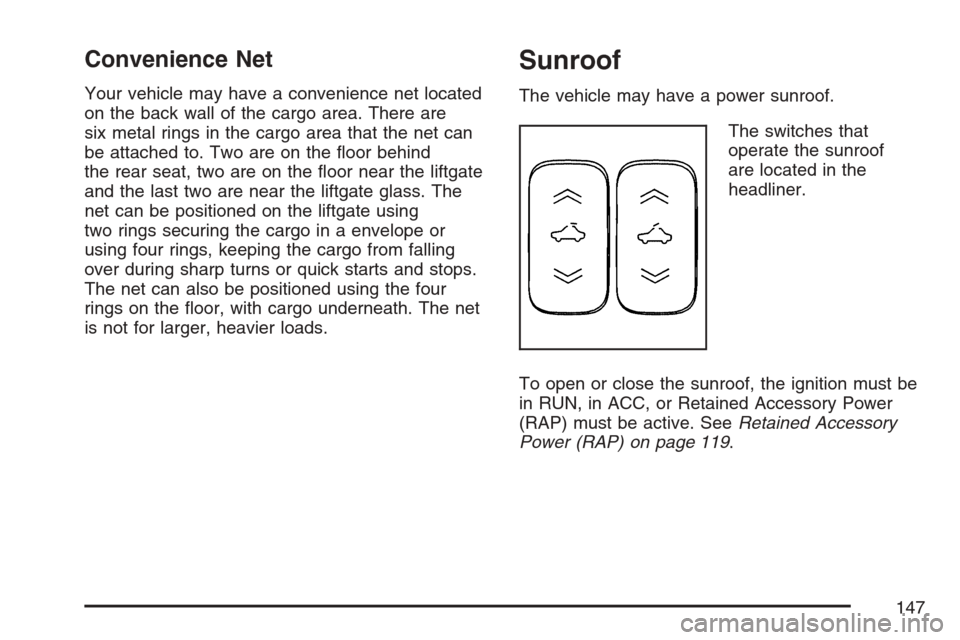
The switches that
operate the sunroof
are located in the
headliner.
To open or close the sunroof, the ignition must be
in RUN, in ACC, or Retained Accessory Power
(RAP) must be active. SeeRetained Accessory
Power (RAP) on page 119.
147
Page 154 of 446
Hazard Warning Flashers
Your hazard warning ashers let you warn others.
They also let police know you have a problem.
Your front and rear turn signal lamps will ash on
and off.
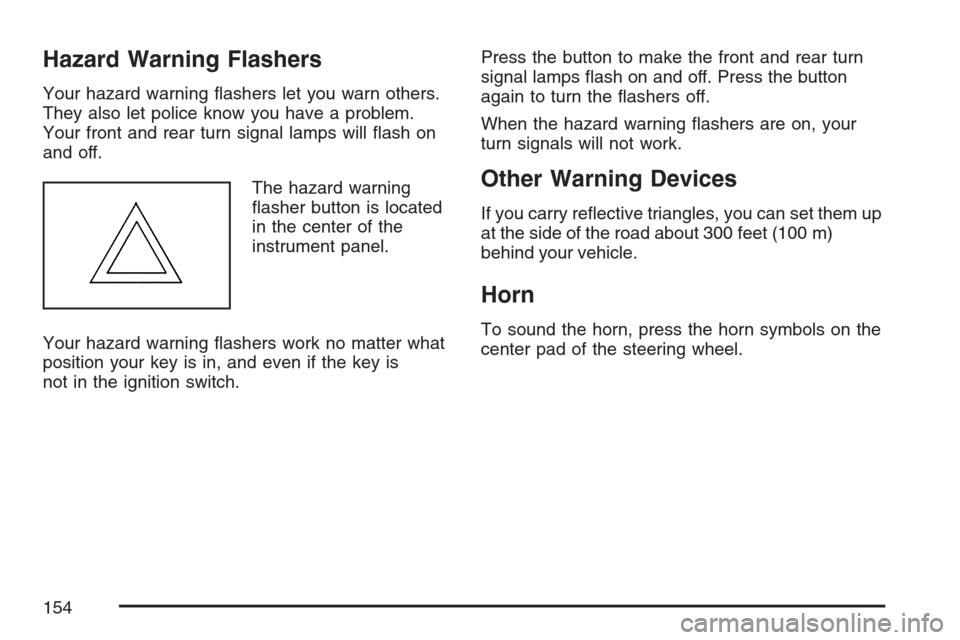
The hazard warning
asher button is located
in the center of the
instrument panel.
Your hazard warning ashers work no matter what
position your key is in, and even if the key is
not in the ignition switch.Press the button to make the front and rear turn
signal lamps ash on and off. Press the button
again to turn the ashers off.
When the hazard warning ashers are on, your
turn signals will not work.
Other Warning Devices
If you carry reective triangles, you can set them up
at the side of the road about 300 feet (100 m)
behind your vehicle.
Horn
To sound the horn, press the horn symbols on the
center pad of the steering wheel.
154
Page 163 of 446
Erasing Speed Memory
When you turn off the cruise control or the ignition,
your cruise control set speed memory is erased.
Headlamps
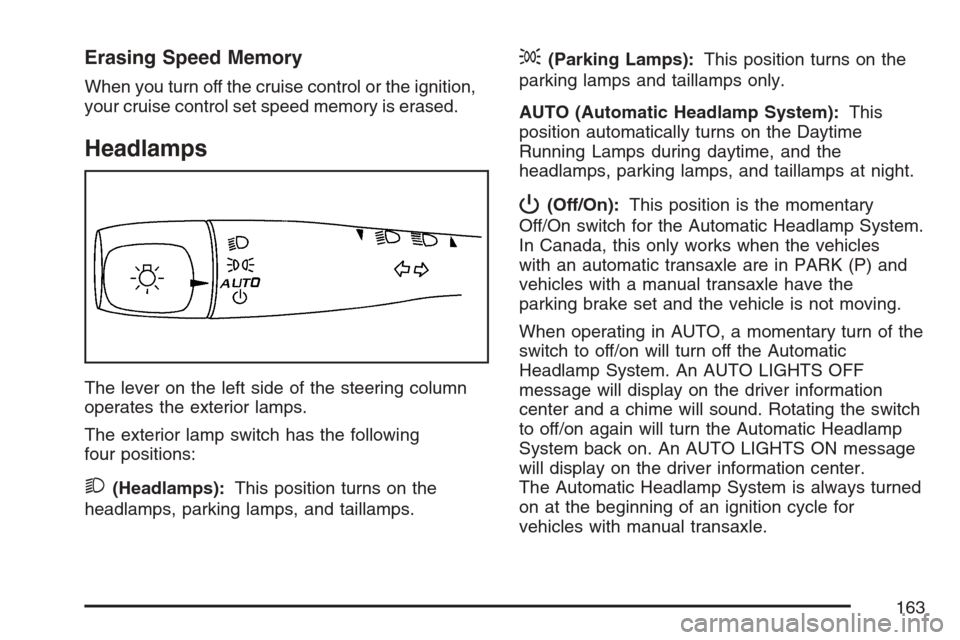
The lever on the left side of the steering column
operates the exterior lamps.
The exterior lamp switch has the following
four positions:
2(Headlamps):This position turns on the
headlamps, parking lamps, and taillamps.
;(Parking Lamps):This position turns on the
parking lamps and taillamps only.
AUTO (Automatic Headlamp System):This
position automatically turns on the Daytime
Running Lamps during daytime, and the
headlamps, parking lamps, and taillamps at night.
P(Off/On):This position is the momentary
Off/On switch for the Automatic Headlamp System.
In Canada, this only works when the vehicles
with an automatic transaxle are in PARK (P) and
vehicles with a manual transaxle have the
parking brake set and the vehicle is not moving.
When operating in AUTO, a momentary turn of the
switch to off/on will turn off the Automatic
Headlamp System. An AUTO LIGHTS OFF
message will display on the driver information
center and a chime will sound. Rotating the switch
to off/on again will turn the Automatic Headlamp
System back on. An AUTO LIGHTS ON message
will display on the driver information center.
The Automatic Headlamp System is always turned
on at the beginning of an ignition cycle for
vehicles with manual transaxle.
163