Page 90 of 446
Restraint System Check
Checking the Restraint Systems
Now and then, make sure the safety belt reminder
light and all your belts, buckles, latch plates,
retractors and anchorages are working properly.
Look for any other loose or damaged safety
belt system parts. If you see anything that might
keep a safety belt system from doing its job, have
it repaired. SeeCare of Safety Belts on page 373
for more information.
Torn or frayed safety belts may not protect you in
a crash. They can rip apart under impact forces.
If a belt is torn or frayed, get a new one right away.
Also look for any opened or broken airbag
covers, and have them repaired or replaced. The
airbag system does not need regular maintenance.Notice:If you damage the covering for the
driver’s or the right front passenger’s airbag,
or the roof-mounted side impact airbag
covering (if equipped) on the garnish trim and
ceiling near the side windows, the airbag
may not work properly. You may have to
replace the airbag module in the steering
wheel, both the airbag module and the
instrument panel for the right front passenger’s
airbag, or the side impact airbag module,
garnish trim and the ceiling covering for
roof-mounted side impact airbags (if equipped).
Do not open or break the airbag coverings.
90
Page 94 of 446
Mirrors......................................................... 134
Manual Rearview Mirror............................. 134
Automatic Dimming Rearview Mirror
with OnStar
®and Compass................... 134
Automatic Dimming Rearview Mirror
with Compass........................................ 136
Outside Power Mirrors............................... 138
Outside Convex Mirror............................... 138
OnStar
®System.......................................... 139Storage Areas............................................. 143
Glove Box................................................. 143
Cupholder(s).............................................. 143
Instrument Panel Storage Area.................. 143
Floor Console Storage Area...................... 143
Rear Storage Area.................................... 143
Rear Compartment Storage Panel/Cover ... 144
Roof Rack System.................................... 146
Convenience Net....................................... 147
Sunroof....................................................... 147
Section 2 Features and Controls
94
Page 119 of 446
Retained Accessory Power (RAP)
Your vehicle has a Retained Accessory
Power (RAP) feature which allow’s the radio,
power windows, and sunroof to continue to work
up to 10 minutes after the ignition is turned off.
Your vehicle’s radio will work when the ignition key
is in RUN or ACC. Once the key is turned from
RUN to LOCK, the radio will continue to work for
10 minutes or until the driver’s door is opened.
Also, the power windows and sunroof will continue
to work for up to 10 minutes or until any door is
opened.
Starting the Engine
Place the transaxle in the proper gear.
Automatic Transaxle
Move your shift lever to PARK (P) or
NEUTRAL (N). Your engine will not start in
any other position -- this is a safety feature.
To restart when you are already moving, use
NEUTRAL (N) only.
Notice:Shifting into PARK (P) with the vehicle
moving could damage the transaxle. Shift into
PARK (P) only when your vehicle is stopped.
Manual Transaxle
The shift lever should be in the neutral position
and the parking brake engaged. Hold the
clutch pedal to the oor and start the engine. Your
vehicle will not start if the clutch pedal is not all
the way down. That is a safety feature.
119
Page 146 of 446
Roof Rack System
Your vehicle may be equipped with a roof rack
system.
{CAUTION:
If you try to carry something on top of
your vehicle that is longer or wider than
the luggage carrier — like paneling,
plywood, a mattress and so forth — the
wind can catch it as you drive along.This
can cause you to lose control. What you
are carrying could be violently torn off, and
this could cause you or other drivers to
have a collision, and of course damage
your vehicle. You may be able to carry
something like this inside. But, never carry
something longer or wider than the
luggage carrier on top of your vehicle.Notice:Loading cargo on the luggage carrier
that weighs more than 150 lbs (68 kg) or hangs
over the rear sides of the vehicle may damage
your vehicle. Load cargo so that it rests on the
slats as far forward as possible and against the
side rails making sure to fasten it securely.
Notice:Loading cargo directly on the roof of
the vehicle may cause damage to the vehicle
and would not be covered under warranty.
Do not place cargo on the roof the vehicle.
Do not exceed the maximum vehicle capacity
when loading your vehicle. For more information
on vehicle capacity and loading, seeLoading Your
Vehicle on page 269.
To prevent damage or loss of cargo as you are
driving, check frequently to ensure your cargo
is securely fastened.
The roof rack system has siderails that are
attached to the roof. All cargo must be loaded on
the luggage carrier crossrails only.
Use GM accessory racks that are compatible with
your roof rack system, these are available at
your GM dealer.
146
Page 147 of 446
Convenience Net
Your vehicle may have a convenience net located
on the back wall of the cargo area. There are
six metal rings in the cargo area that the net can
be attached to. Two are on the oor behind
the rear seat, two are on the oor near the liftgate
and the last two are near the liftgate glass. The
net can be positioned on the liftgate using
two rings securing the cargo in a envelope or
using four rings, keeping the cargo from falling
over during sharp turns or quick starts and stops.
The net can also be positioned using the four
rings on the oor, with cargo underneath. The net
is not for larger, heavier loads.
Sunroof
The vehicle may have a power sunroof.
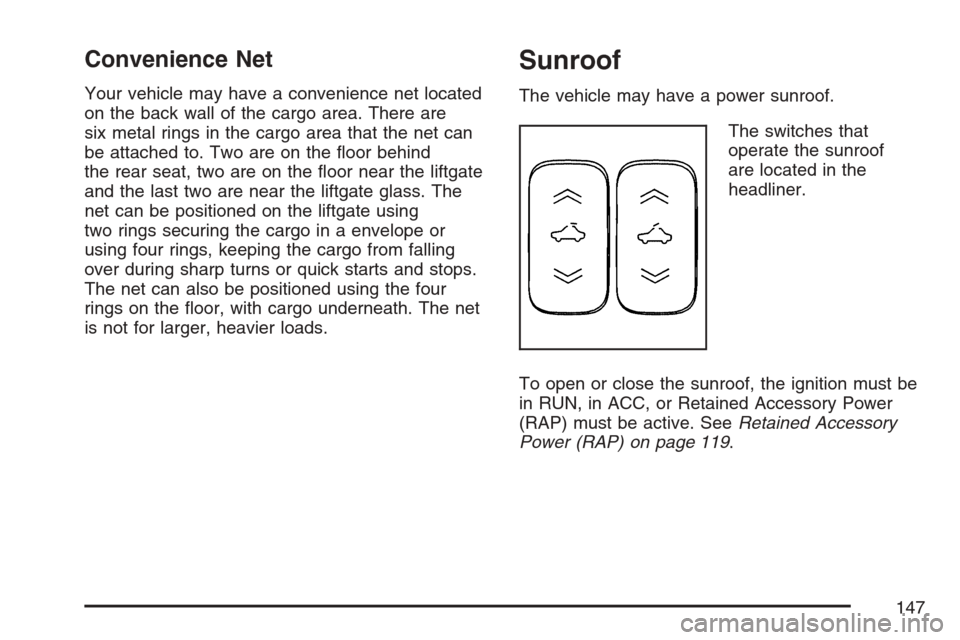
The switches that
operate the sunroof
are located in the
headliner.
To open or close the sunroof, the ignition must be
in RUN, in ACC, or Retained Accessory Power
(RAP) must be active. SeeRetained Accessory
Power (RAP) on page 119.
147
Page 148 of 446
Express Open:The express open feature will
operate from the closed or partially open position.
To express open the power sunroof, fully press
the driver’s side switch rearward once. To stop the
sunroof glass in a desired position other than to
the express-open position, press the switch again,
in either direction, to stop the movement. If the
sunshade is in the closed position, it will open with
the sunroof, or it can be opened manually.
Vent Open:To open the power sunroof to the
vent position from the closed position, press and
hold the passenger’s side sunroof switch forward.
The rear of the sunroof panel will tilt upward to
the full vent position. The sunshade must be
opened manually.
Express Close:The express close feature will
operate from the open or partially open position.
To express close the power sunroof, fully press the
driver’s side switch forward once. To stop the
sunroof glass in a desired position other
than closed, press the switch again in either
direction. The sunshade must be closed manually.Close:To close the power sunroof, operate the
controls according to one of the following:
From the open position, press and hold the
driver’s side sunroof switch forward. The
sunshade must be closed manually.
From the vent position, press and hold the
passenger’s side sunroof switch rearward.
Anti-Pinch:If an object is in the path of the
sunroof while it is closing, the anti-pinch feature
will detect the object and stop the sunroof
from closing at the point of the obstruction. The
sunroof will then return to the full-open or
vent position. To close the sunroof once it has
re-opened, refer to the two options previously
described under the “Close” feature instructions.
148
Page 236 of 446
Fixed Mast Antenna
This type of antenna is called a xed mast
antenna. It is mounted at the center of the roof,
just behind the windshield.
The mast antenna can withstand most car washes
without being damaged. If the mast should ever
become slightly bent, straighten it out by hand.
If the mast is badly bent, replace it.
Check occasionally to make sure the mast is still
tightened to the roof. If tightening is required,
tighten by hand.
If you are putting a protective cover over the
vehicle, remove the mast by hand.
XM™ Satellite Radio Antenna
System
The XM™ Satellite Radio antenna is located at
the rear of the vehicle. Keep this antenna clear of
snow and ice build up for clear radio reception.
If your vehicle has a sunroof, the performance of
the XM™ system may be affected if the sunroof
is open.
If your vehicle has a roof rack, loading items onto
the roof of your vehicle can interfere with the
performance of the XM™ system. Make sure the
XM™ Satellite Radio antenna is not obstructed.
236
Page 382 of 446
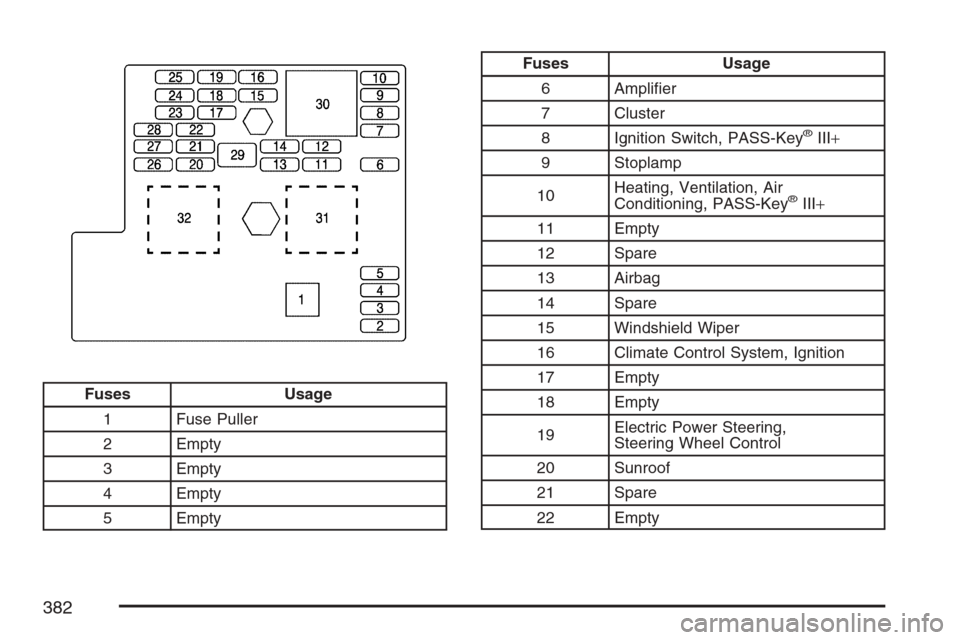
Fuses Usage
1 Fuse Puller
2 Empty
3 Empty
4 Empty
5 Empty
Fuses Usage
6 Amplier
7 Cluster
8 Ignition Switch, PASS-Key
®III+
9 Stoplamp
10Heating, Ventilation, Air
Conditioning, PASS-Key
®III+
11 Empty
12 Spare
13 Airbag
14 Spare
15 Windshield Wiper
16 Climate Control System, Ignition
17 Empty
18 Empty
19Electric Power Steering,
Steering Wheel Control
20 Sunroof
21 Spare
22 Empty
382