Page 343 of 458
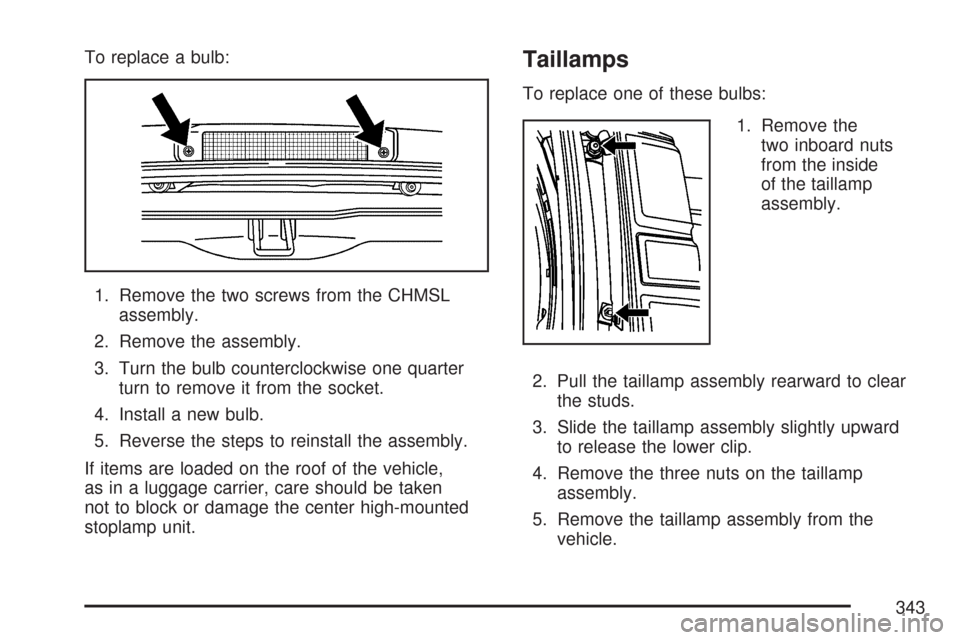
To replace a bulb:
1. Remove the two screws from the CHMSL
assembly.
2. Remove the assembly.
3. Turn the bulb counterclockwise one quarter
turn to remove it from the socket.
4. Install a new bulb.
5. Reverse the steps to reinstall the assembly.
If items are loaded on the roof of the vehicle,
as in a luggage carrier, care should be taken
not to block or damage the center high-mounted
stoplamp unit.Taillamps
To replace one of these bulbs:
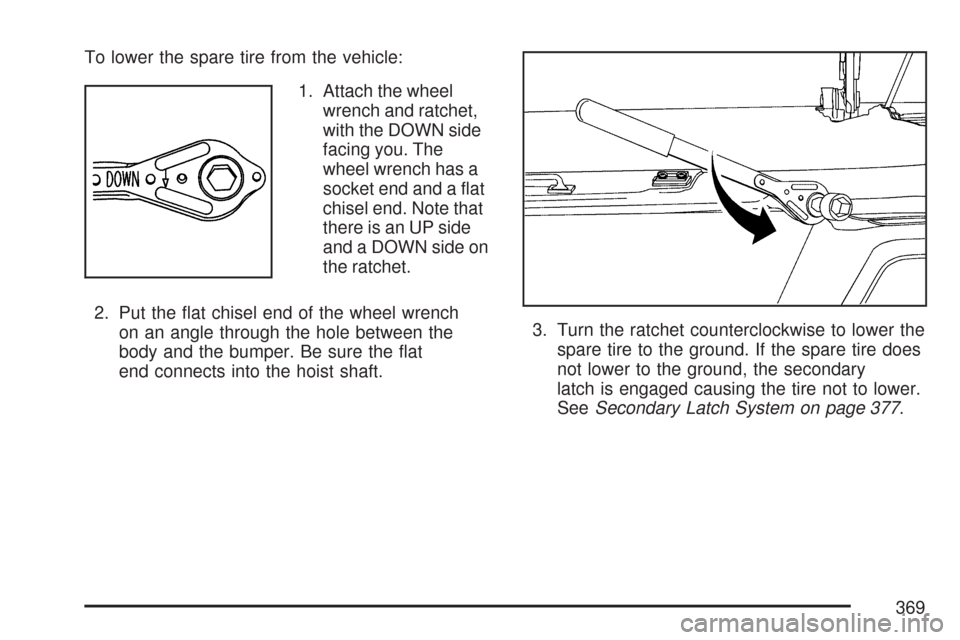
1. Remove the
two inboard nuts
from the inside
of the taillamp
assembly.
2. Pull the taillamp assembly rearward to clear
the studs.
3. Slide the taillamp assembly slightly upward
to release the lower clip.
4. Remove the three nuts on the taillamp
assembly.
5. Remove the taillamp assembly from the
vehicle.
343
Page 344 of 458
6. Remove the bulb socket by squeezing the
tab on the side of the socket while turning
it counterclockwise.
7. Turn the bulb counterclockwise to remove it.
8. Install a new bulb.
9. Reverse the steps to reinstall the taillamp
assembly.
Replacement Bulbs
Exterior Lamp Bulb Number
Back-up, Rear Parking, Stoplamp,
and Turn Signal Lamp3157
Center High Mounted Stop
Lamp (CHMSL)912
Front Parking and Turn
Signal Lamp3157KX
Front Sidemarker Lamp 194
Headlamps
Composite High-Beam
Headlamp9005
Composite Low-Beam
Headlamp9006GS
Sealed Beam Headlamp H6054
For replacement bulbs not listed here, contact
your dealer/retailer.
Windshield Wiper Blade
Replacement
Windshield wiper blades should be inspected for
wear and cracking. SeeScheduled Maintenance
(Gasoline Engine) on page 405for more
information on wiper blade inspection.
344
Page 369 of 458
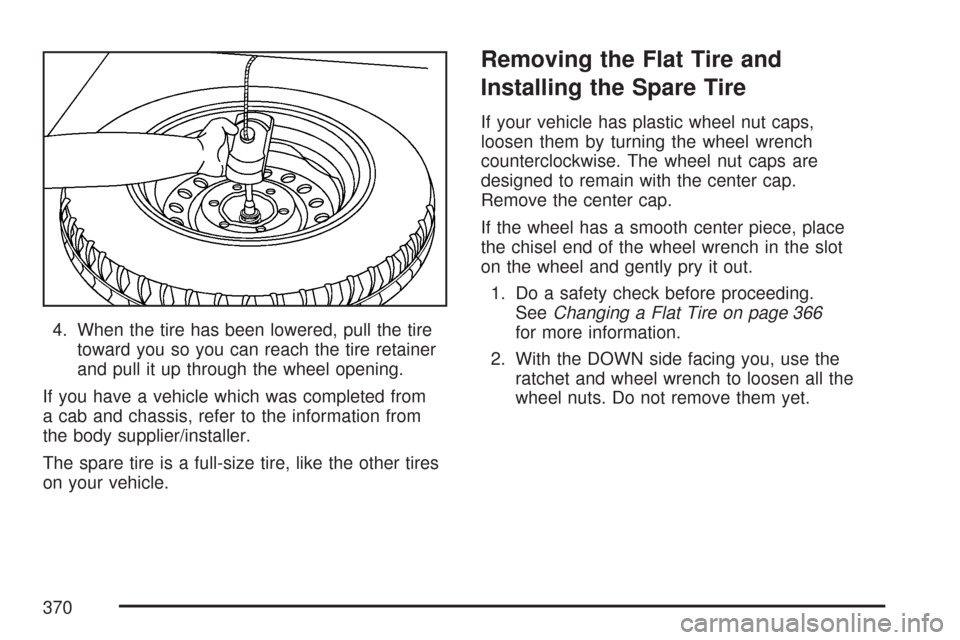
To lower the spare tire from the vehicle:
1. Attach the wheel
wrench and ratchet,
with the DOWN side
facing you. The
wheel wrench has a
socket end and a flat
chisel end. Note that
there is an UP side
and a DOWN side on
the ratchet.
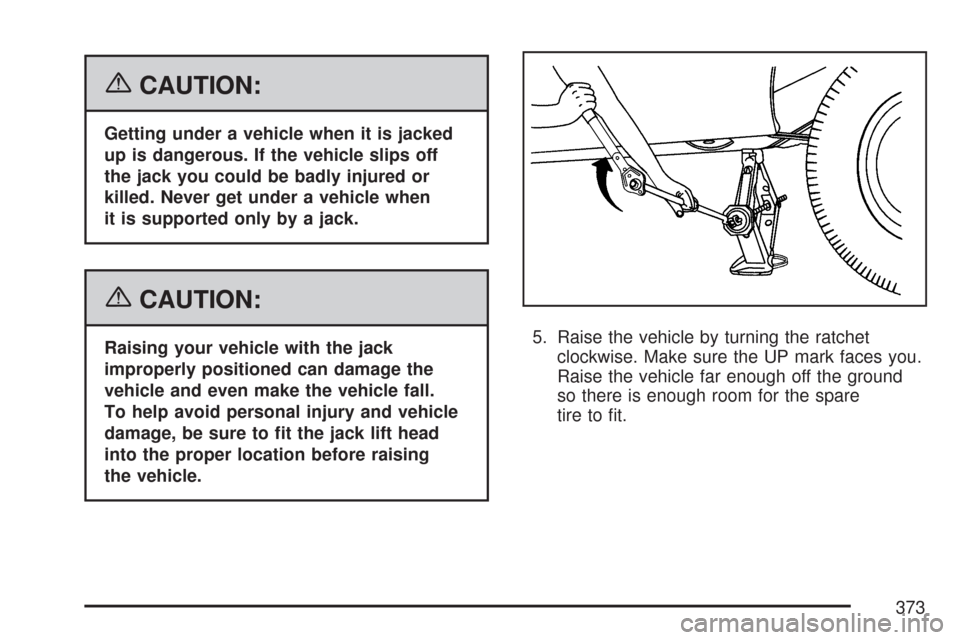
2. Put the flat chisel end of the wheel wrench
on an angle through the hole between the
body and the bumper. Be sure the flat
end connects into the hoist shaft.3. Turn the ratchet counterclockwise to lower the
spare tire to the ground. If the spare tire does
not lower to the ground, the secondary
latch is engaged causing the tire not to lower.
SeeSecondary Latch System on page 377.
369
Page 370 of 458
4. When the tire has been lowered, pull the tire
toward you so you can reach the tire retainer
and pull it up through the wheel opening.
If you have a vehicle which was completed from
a cab and chassis, refer to the information from
the body supplier/installer.
The spare tire is a full-size tire, like the other tires
on your vehicle.
Removing the Flat Tire and
Installing the Spare Tire
If your vehicle has plastic wheel nut caps,
loosen them by turning the wheel wrench
counterclockwise. The wheel nut caps are
designed to remain with the center cap.
Remove the center cap.
If the wheel has a smooth center piece, place
the chisel end of the wheel wrench in the slot
on the wheel and gently pry it out.
1. Do a safety check before proceeding.
SeeChanging a Flat Tire on page 366
for more information.
2. With the DOWN side facing you, use the
ratchet and wheel wrench to loosen all the
wheel nuts. Do not remove them yet.
370
Page 373 of 458
{CAUTION:
Getting under a vehicle when it is jacked
up is dangerous. If the vehicle slips off
the jack you could be badly injured or
killed. Never get under a vehicle when
it is supported only by a jack.
{CAUTION:
Raising your vehicle with the jack
improperly positioned can damage the
vehicle and even make the vehicle fall.
To help avoid personal injury and vehicle
damage, be sure to t the jack lift head
into the proper location before raising
the vehicle.5. Raise the vehicle by turning the ratchet
clockwise. Make sure the UP mark faces you.
Raise the vehicle far enough off the ground
so there is enough room for the spare
tire to fit.
373
Page 375 of 458
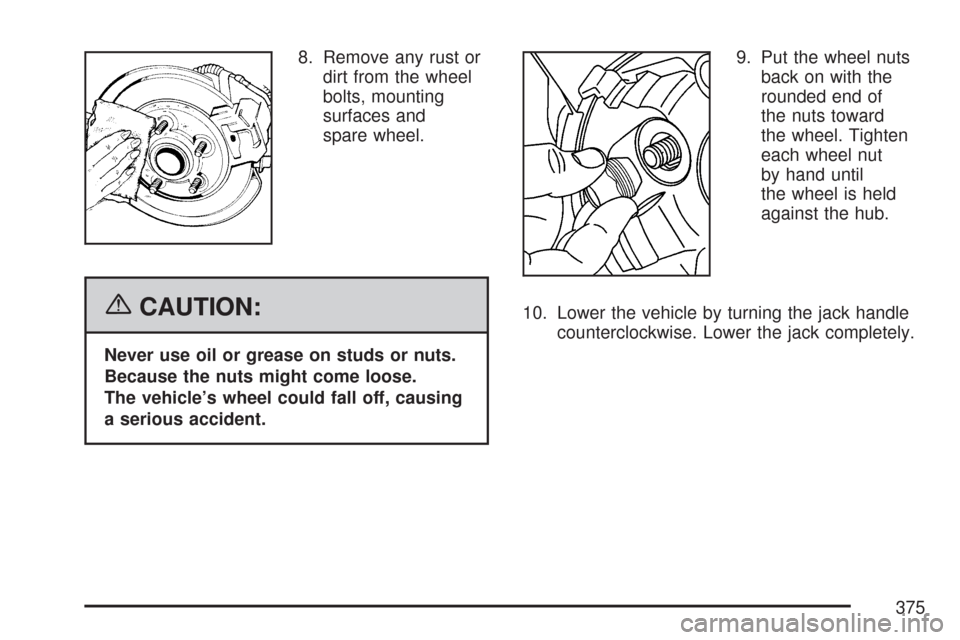
8. Remove any rust or
dirt from the wheel
bolts, mounting
surfaces and
spare wheel.
{CAUTION:
Never use oil or grease on studs or nuts.
Because the nuts might come loose.
The vehicle’s wheel could fall off, causing
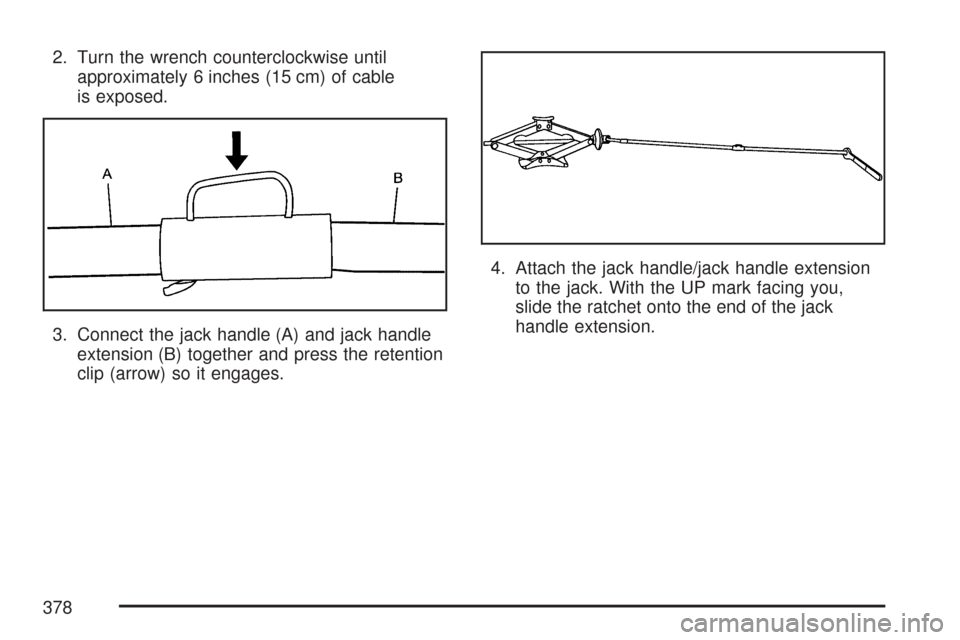
a serious accident.9. Put the wheel nuts
back on with the
rounded end of
the nuts toward
the wheel. Tighten
each wheel nut
by hand until
the wheel is held
against the hub.
10. Lower the vehicle by turning the jack handle
counterclockwise. Lower the jack completely.
375
Page 376 of 458
{CAUTION:
Incorrect wheel nuts or improperly
tightened wheel nuts can cause the wheel
to come loose and even come off. This
could lead to an accident. Be sure to use
the correct wheel nuts. If you have to
replace them, be sure to get new GM
original equipment wheel nuts. Stop
somewhere as soon as you can and have
the nuts tightened with a torque wrench
to the proper torque specication. See
Capacities and Specifications on page 398
for wheel nut torque specication.
Notice:Improperly tightened wheel nuts can
lead to brake pulsation and rotor damage.
To avoid expensive brake repairs, evenly
tighten the wheel nuts in the proper sequence
and to the proper torque specication. See
Capacities and Specifications on page 398
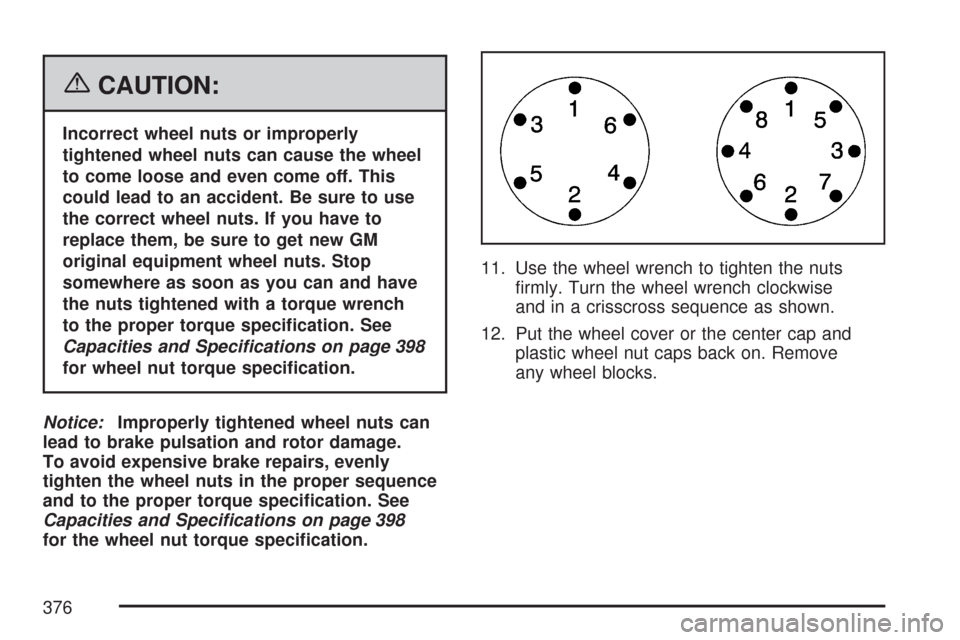
for the wheel nut torque specication.11. Use the wheel wrench to tighten the nuts
firmly. Turn the wheel wrench clockwise
and in a crisscross sequence as shown.
12. Put the wheel cover or the center cap and
plastic wheel nut caps back on. Remove
any wheel blocks.
376
Page 378 of 458
2. Turn the wrench counterclockwise until
approximately 6 inches (15 cm) of cable
is exposed.
3. Connect the jack handle (A) and jack handle
extension (B) together and press the retention
clip (arrow) so it engages.4. Attach the jack handle/jack handle extension
to the jack. With the UP mark facing you,
slide the ratchet onto the end of the jack
handle extension.
378