2007 CHEVROLET EXPRESS CARGO VAN ignition
[x] Cancel search: ignitionPage 225 of 458
When cleaning the cassette tape player with the
recommended non-abrasive cleaning cassette,
it is possible that the cassette might eject, because
the cut tape detection feature on the radio can
recognize it as a broken tape, in error. To prevent
the cleaning cassette from being ejected, use
the following steps:
1. Turn the ignition on.
2. Turn the radio off.
3. Press and hold the TAPE DISC button for
five seconds. READY displays and the
cassette symbol flashes for five seconds.
4. Insert the scrubbing action cleaning cassette.
5. Eject the cleaning cassette after the
manufacturer’s recommended cleaning time.
When the cleaning cassette has been ejected,
the cut tape detection feature activates again.
A non-scrubbing action, wet-type cleaner which
uses a cassette with a fabric belt to clean the tape
head can be used. This type of cleaning cassette
does not eject on its own. A non-scrubbing
action cleaner might not clean as thoroughly
as the scrubbing type cleaner. The use of a
non-scrubbing action, dry-type cleaning cassette
is not recommended.After the player is cleaned, press and hold the
eject button for five seconds to reset the CLEAN
indicator. The radio displays --- or CLEANED
to show the indicator was reset.
Cassettes are subject to wear and the sound
quality can degrade over time. Always make sure
the cassette tape is in good condition before
the tape player is serviced.
Care of Your CDs
Handle CDs carefully. Store them in their original
cases or other protective cases and away from
direct sunlight and dust. The CD player scans the
bottom surface of the disc. If the surface of a CD is
damaged, such as cracked, broken, or scratched,
the CD does not play properly or not at all. If the
surface of a CD is soiled, take a soft, lint free cloth
or dampen a clean, soft cloth in a mild, neutral
detergent solution mixed with water, and clean it.
Make sure the wiping process starts from the center
to the edge.
Do not touch the bottom side of a CD while handling
it; this could damage the surface. Pick up CDs by
grasping the outer edges or the edge of the hole
and the outer edge.
225
Page 226 of 458
Care of the CD Player
Do not use CD lens cleaners for CD players
because the lens of the CD optics can become
contaminated by lubricants.
Fixed Mast Antenna
The fixed mast antenna can withstand most car
washes without being damaged. If the mast should
ever become slightly bent, straighten it out by
hand. If the mast is badly bent, replace it.
Check occasionally to make sure the mast is
still tightened to the fender. If tightening is
required, tighten by hand, then with a wrench
one quarter turn.
Chime Level Adjustment
The radio is used to adjust the vehicle’s chime
level. To change the volume level of the chime,
press and hold pushbutton 6 with the ignition on
and the radio power off. The volume level will
change from the normal level to loud, and LOUD
will appear on the radio display. To change back to
the default or normal setting, press and hold
pushbutton 6 again. The volume level will change
from the loud level to normal, and NORMAL will
appear on the radio display. Each time the chime
volume is changed, three chimes will sound to
indicate the change. Removing the radio and not
replacing it with a factory radio or chime module will
disable vehicle chimes.
226
Page 255 of 458
{CAUTION:
Coasting downhill in NEUTRAL (N) or with
the ignition off is dangerous. The brakes
will have to do all the work of slowing
down. They could get so hot that they
would not work well. You would then have
poor braking or even none going down a
hill. You could crash. Always have the
engine running and your vehicle in gear
when you go downhill.
•Know how to go down hills. The most important
thing to know is this: let the engine do some of
the slowing down. Shift to a lower gear when
you go down a steep or long hill.
•Stay in your own lane when driving on two-lane
roads in hills or mountains. Do not swing wide
or cut across the center of the road. Drive at
speeds that let you stay in your own lane.
•As you go over the top of a hill, be alert. There
could be something in your lane, like a stalled
car or an accident.
•You might see highway signs on mountains that
warn of special problems. Examples are long
grades, passing or no-passing zones, a falling
rocks area, or winding roads. Be alert to these
and take appropriate action.
255
Page 268 of 458
Dolly Towing
Rear Towing (Rear Wheels Off the Ground)
Two-Wheel-Drive Vehicles
Use the following procedure to tow your vehicle
from the rear:
1. Drive the vehicle onto the dolly.
2. Firmly set the parking brake. SeeParking
Brake on page 128for more information.
3. Put the automatic transmission in PARK (P).
4. Follow the dolly manufacturer’s instructions to
attach and secure the vehicle being towed to
the dolly and then the loaded dolly to the tow
vehicle. Make sure the wheels are straight
before towing.
Use an adequate clamping device to ensure
that the front wheels are locked into the
straight position.5. Release the parking brake only after the
vehicle being towed is firmly attached to
the tow vehicle.
6. Turn the ignition to LOCK.
If the tow vehicle will not be started or driven
for six weeks or more, remove the battery
cable from the negative terminal (post) of the
battery to prevent your battery from draining
while towing.
All-Wheel-Drive Vehicles
Your vehicle was not designed to be towed with
two wheels on the ground. To properly tow
these vehicles, they should be placed on a
platform trailer with all four wheels off the ground.
Notice:Towing an all-wheel-drive vehicle
with all four wheels on the ground, or even
with only two of its wheels on the ground, will
damage drivetrain components. Do not tow
an all-wheel-drive vehicle if any of its wheels
will be on the ground.
268
Page 271 of 458
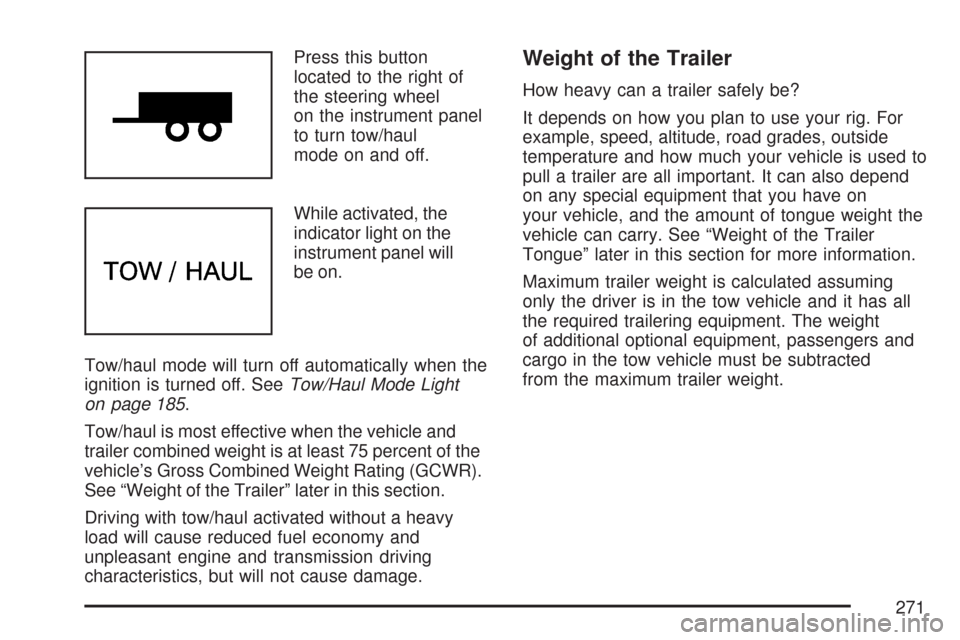
Press this button
located to the right of
the steering wheel
on the instrument panel
to turn tow/haul
mode on and off.
While activated, the
indicator light on the
instrument panel will
be on.
Tow/haul mode will turn off automatically when the
ignition is turned off. SeeTow/Haul Mode Light
on page 185.
Tow/haul is most effective when the vehicle and
trailer combined weight is at least 75 percent of the
vehicle’s Gross Combined Weight Rating (GCWR).
See “Weight of the Trailer” later in this section.
Driving with tow/haul activated without a heavy
load will cause reduced fuel economy and
unpleasant engine and transmission driving
characteristics, but will not cause damage.Weight of the Trailer
How heavy can a trailer safely be?
It depends on how you plan to use your rig. For
example, speed, altitude, road grades, outside
temperature and how much your vehicle is used to
pull a trailer are all important. It can also depend
on any special equipment that you have on
your vehicle, and the amount of tongue weight the
vehicle can carry. See “Weight of the Trailer
Tongue” later in this section for more information.
Maximum trailer weight is calculated assuming
only the driver is in the tow vehicle and it has all
the required trailering equipment. The weight
of additional optional equipment, passengers and
cargo in the tow vehicle must be subtracted
from the maximum trailer weight.
271
Page 307 of 458
How to Reset the Engine Oil
Life System
The Engine Oil Life System calculates when to
change the engine oil and filter based on vehicle
use. Anytime the oil is changed, reset the
system so it can calculate when the next oil
change is required. If a situation occurs where you
change the oil prior to a change engine oil light
being turned on, reset the system.
To reset the change engine oil light:
1. Turn the ignition key to RUN with the
engine off.
2. Fully press and release the accelerator pedal
slowly three times within five seconds.
3. If the Change Engine Oil light flashes for
five seconds, the system is reset.
4. Turn the key to LOCK.
If the change engine oil light comes back on when
you start your vehicle, the engine oil life system
has not reset. Repeat the procedure. If it still does
not reset, see your dealer/retailer for service.
SeeChange Engine Oil Light on page 183.
What to Do with Used Oil
Used engine oil contains certain elements that can
be unhealthy for your skin and could even cause
cancer. Do not let used oil stay on your skin for very
long. Clean your skin and nails with soap and
water, or a good hand cleaner. Wash or properly
dispose of clothing or rags containing used engine
oil. See the manufacturer’s warnings about the use
and disposal of oil products.
Used oil can be a threat to the environment.
If you change your own oil, be sure to drain all
the oil from the filter before disposal. Never
dispose of oil by putting it in the trash, pouring it
on the ground, into sewers, or into streams or
bodies of water. Instead, recycle it by taking it
to a place that collects used oil. If you have
a problem properly disposing of used oil, ask
your dealer/retailer, a service station, or a local
recycling center for help.
307
Page 331 of 458
Notice:Ignoring these steps could result in
costly damage to your vehicle that would
not be covered by your warranty.
Trying to start your vehicle by pushing or
pulling it will not work, and it could damage
your vehicle.
1. Check the other vehicle. It must have a
12-volt battery with a negative ground system.
Notice:If the other vehicle’s system is not
a 12-volt system with a negative ground, both
vehicles can be damaged. Only use vehicles
with 12-volt systems with negative grounds to
jump start your vehicle.
2. Get the vehicles close enough so the jumper
cables can reach, but be sure the vehicles are
not touching each other. If they are, it could
cause a ground connection you do not
want. You would not be able to start your
vehicle, and the bad grounding could damage
the electrical systems.To avoid the possibility of the vehicles rolling,
set the parking brake firmly on both vehicles
involved in the jump start procedure. Put
an automatic transmission in PARK (P) or a
manual transmission in NEUTRAL before
setting the parking brake.
Notice:If you leave your radio or other
accessories on during the jump starting
procedure, they could be damaged. The
repairs would not be covered by your
warranty. Always turn off your radio and
other accessories when jump starting
your vehicle.
3. Turn off the ignition on both vehicles.
Unplug unnecessary accessories plugged
into the cigarette lighter or the accessory
power outlet. Turn off the radio and all
lamps that are not needed. This will avoid
sparks and help save both batteries.
And it could save the radio!
331
Page 396 of 458
Fuse Usage
5 Back-up Lamps Trailer Wiring
6 Ignition 0
7 Stoplamp
8 Rear Defogger/Heated Mirror
9Right Daytime Running
Lamp/Turn Signal
10Left Daytime Running
Lamp/Turn Signal
11 Truck Body Control Module 4
12 Fuel Pump
13 Trailer
14 Hazard Flashers
15 Horn
16 Truck Body Control Module 3
17 Trailer Stop/Turn Signal
18 Truck Body Control Module 2
19 Truck Body Control Module
20 Remote Function Actuator
21 Engine 2 (Gas), Spare (Diesel)
22 Ignition EFuse Usage
23 Engine 1
24Truck Body Control Module
Ignition 1
25 Spare (Gas), Fuel Heater (Diesel)
26 Inside Rearview Mirror
27 Crankcase
28Brake Transmission Shift
Interlock System
29 Auxiliary Power Outlets
30 Cigarette Lighter
31 Instrument Panel Cluster
32 Air Conditioning
33Spare (Gas), Engine Control
Module (Diesel)
34Canister Vent Solenoid (Gas),
Rear Fog Lamps (Diesel)
35 SPARE
36Brake Transmission Shift
Interlock, Vehicle Back-Up
37 Airbag
396