2007 CHEVROLET EXPRESS CARGO VAN trailer
[x] Cancel search: trailerPage 310 of 458
How to Check Automatic
Transmission Fluid
Because this operation can be a little difficult, you
may choose to have this done at the dealer/retailer
service department.
If you do it yourself, be sure to follow all the
instructions here, or you could get a false reading
on the dipstick.
Notice:Too much or too little uid can
damage your transmission. Too much can
mean that some of the uid could come out
and fall on hot engine parts or exhaust system
parts, starting a re. Too little uid could
cause the transmission to overheat. Be sure
to get an accurate reading if you check
your transmission uid.
Wait at least 30 minutes before checking the
transmission fluid level if you have been driving:
•When outside temperatures are
above 90°F (32°C).
•At high speed for quite a while.
•In heavy traffic — especially in hot weather.
•While pulling a trailer.To get the right reading, the fluid should be
at normal operating temperature, which is
180°F to 200°F (82°C to 93°C).
Get the vehicle warmed up by driving about
15 miles (24 km) when outside temperatures are
above 50°F (10°C). If it is colder than 50°F (10°C),
drive the vehicle in DRIVE (D) until the engine
temperature gage moves and then remains
steady for 10 minutes.
A cold fluid check can be made after the vehicle
has been sitting for eight hours or more with
the engine off, but this is used only as a reference.
Let the engine run at idle for five minutes if
outside temperatures are 50°F (10°C) or more.
If it is colder than 50°F (10°C), you may have
to idle the engine longer. Should the fluid level be
low during this cold check, you must check the
fluid hot before adding fluid. Checking the fluid
hot will give you a more accurate reading of
the fluid level.
310
Page 316 of 458
If Steam Is Coming From Your Engine
{CAUTION:
Steam from an overheated engine can
burn you badly, even if you just open the
hood. Stay away from the engine if you
see or hear steam coming from it. Just
turn it off and get everyone away from
the vehicle until it cools down. Wait until
there is no sign of steam or coolant
before you open the hood.
If you keep driving when your engine is
overheated, the liquids in it can catch re.
You or others could be badly burned.
Stop your engine if it overheats, and get
out of the vehicle until the engine is cool.
Notice:If your engine catches re because
you keep driving with no coolant, your vehicle
can be badly damaged. The costly repairs
would not be covered by your warranty.
If No Steam Is Coming From
Your Engine
If you get an engine overheat warning but see
or hear no steam, the problem may not be
too serious. Sometimes the engine can get a
little too hot when you:
•Climb a long hill on a hot day.
•Stop after high-speed driving.
•Idle for long periods in traffic.
•Tow a trailer. See “Driving on Grades”
underTowing a Trailer on page 269.
If you get the overheat warning with no sign of
steam, try this for a minute or so:
1. In heavy traffic, let the engine idle in
NEUTRAL (N) while stopped. If it is safe to
do so, pull off the road, shift to PARK (P)
or NEUTRAL (N) and let the engine idle.
2. Turn on your heater to full hot at the highest
fan speed and open the windows as
necessary.
316
Page 323 of 458
Engine Fan Noise
Your vehicle has a clutched engine cooling fan.
When the clutch is engaged, the fan spins faster
to provide more air to cool the engine. In most
everyday driving conditions, the fan is spinning
slower and the clutch is not fully engaged.
This improves fuel economy and reduces fan
noise. Under heavy vehicle loading, trailer towing,
and/or high outside temperatures, the fan speed
increases as the clutch more fully engages,
so you may hear an increase in fan noise.
This is normal and should not be mistaken as the
transmission slipping or making extra shifts. It
is merely the cooling system functioning properly.
The fan will slow down when additional cooling
is not required and the clutch partially disengages.
You may also hear this fan noise when you
start the engine. It will go away as the fan
clutch partially disengages.
Power Steering Fluid
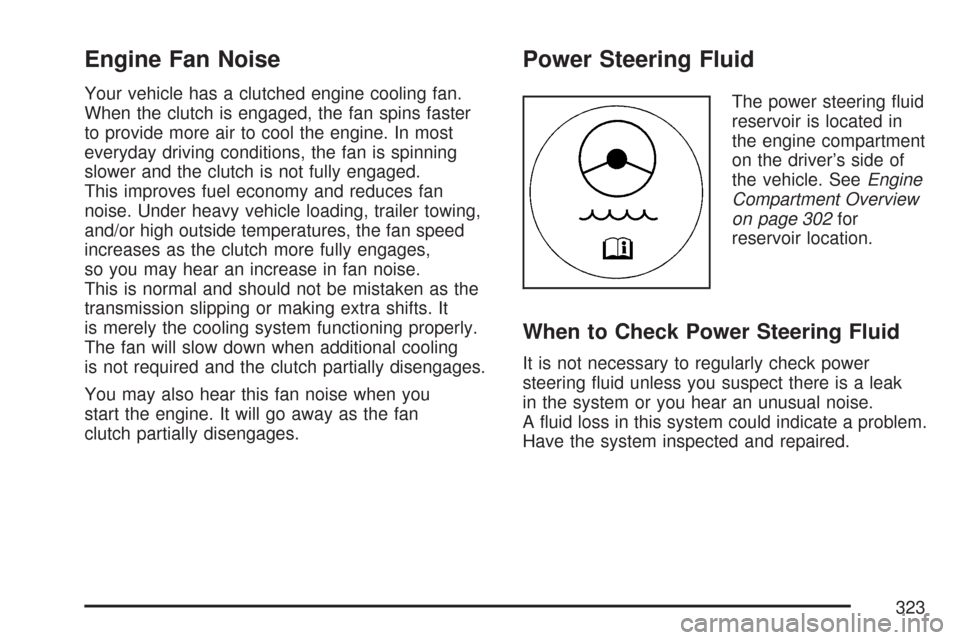
The power steering fluid
reservoir is located in
the engine compartment
on the driver’s side of
the vehicle. SeeEngine
Compartment Overview
on page 302for
reservoir location.
When to Check Power Steering Fluid
It is not necessary to regularly check power
steering fluid unless you suspect there is a leak
in the system or you hear an unusual noise.
A fluid loss in this system could indicate a problem.
Have the system inspected and repaired.
323
Page 395 of 458
Fuse Usage
21 Trailer Park Lamp
22 Front Park Lamp
32 Auxiliary 1
33 Auxiliary 2
Relays Usage
23 Window Retained Accessory Power
24 Auxiliary
25 Rear Window Defogger
26 Courtesy Lamp
27 Cargo Unlock
28 Driver Unlock
29 Park Lamp
30 Door Locks
31 Passenger Unlock
Circuit Breaker Usage
34 Power Window
Engine Compartment Fuse Block
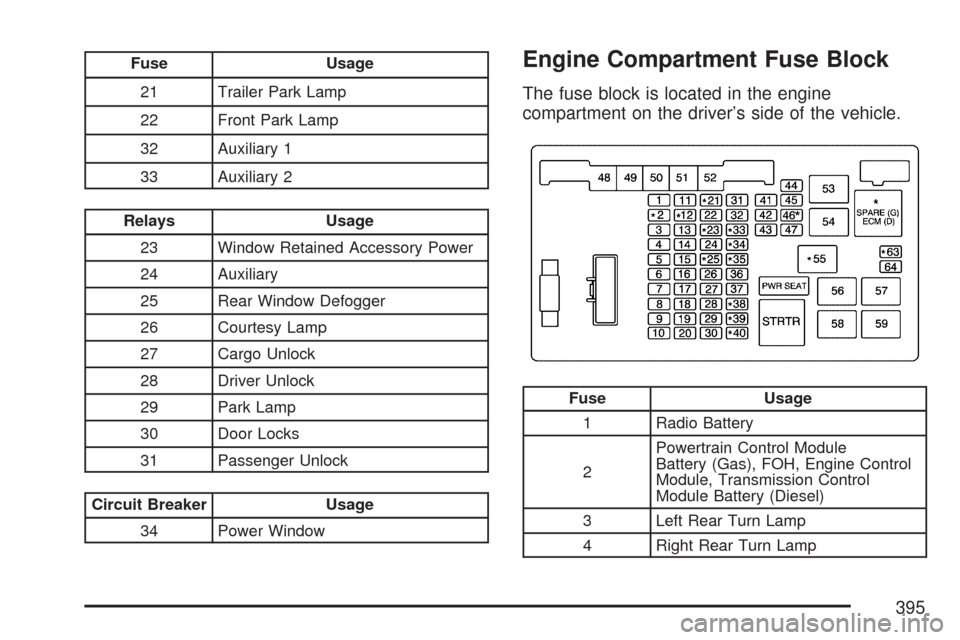
The fuse block is located in the engine
compartment on the driver’s side of the vehicle.
Fuse Usage
1 Radio Battery
2Powertrain Control Module
Battery (Gas), FOH, Engine Control
Module, Transmission Control
Module Battery (Diesel)
3 Left Rear Turn Lamp
4 Right Rear Turn Lamp
395
Page 396 of 458
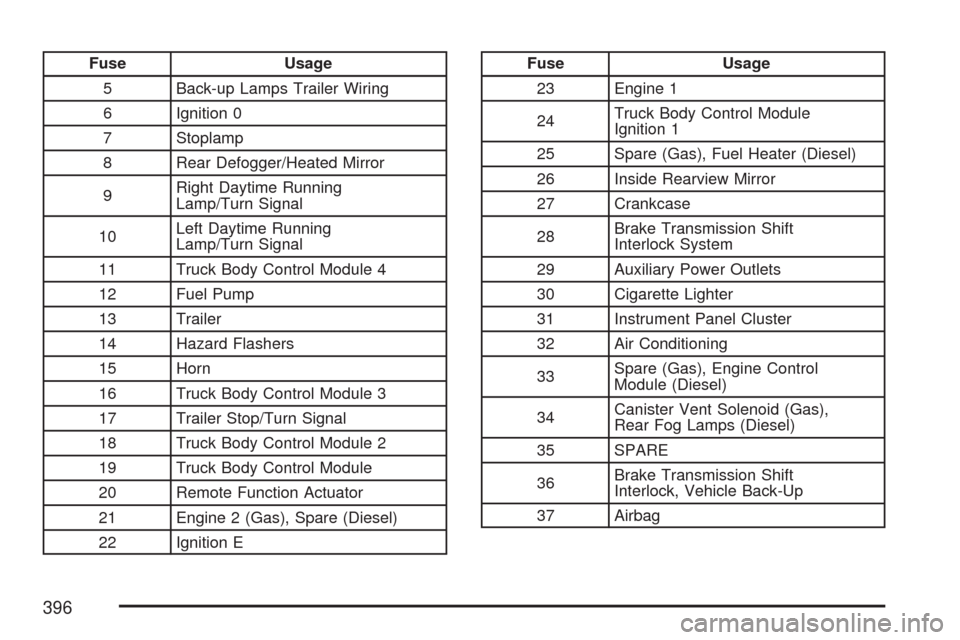
Fuse Usage
5 Back-up Lamps Trailer Wiring
6 Ignition 0
7 Stoplamp
8 Rear Defogger/Heated Mirror
9Right Daytime Running
Lamp/Turn Signal
10Left Daytime Running
Lamp/Turn Signal
11 Truck Body Control Module 4
12 Fuel Pump
13 Trailer
14 Hazard Flashers
15 Horn
16 Truck Body Control Module 3
17 Trailer Stop/Turn Signal
18 Truck Body Control Module 2
19 Truck Body Control Module
20 Remote Function Actuator
21 Engine 2 (Gas), Spare (Diesel)
22 Ignition EFuse Usage
23 Engine 1
24Truck Body Control Module
Ignition 1
25 Spare (Gas), Fuel Heater (Diesel)
26 Inside Rearview Mirror
27 Crankcase
28Brake Transmission Shift
Interlock System
29 Auxiliary Power Outlets
30 Cigarette Lighter
31 Instrument Panel Cluster
32 Air Conditioning
33Spare (Gas), Engine Control
Module (Diesel)
34Canister Vent Solenoid (Gas),
Rear Fog Lamps (Diesel)
35 SPARE
36Brake Transmission Shift
Interlock, Vehicle Back-Up
37 Airbag
396
Page 397 of 458
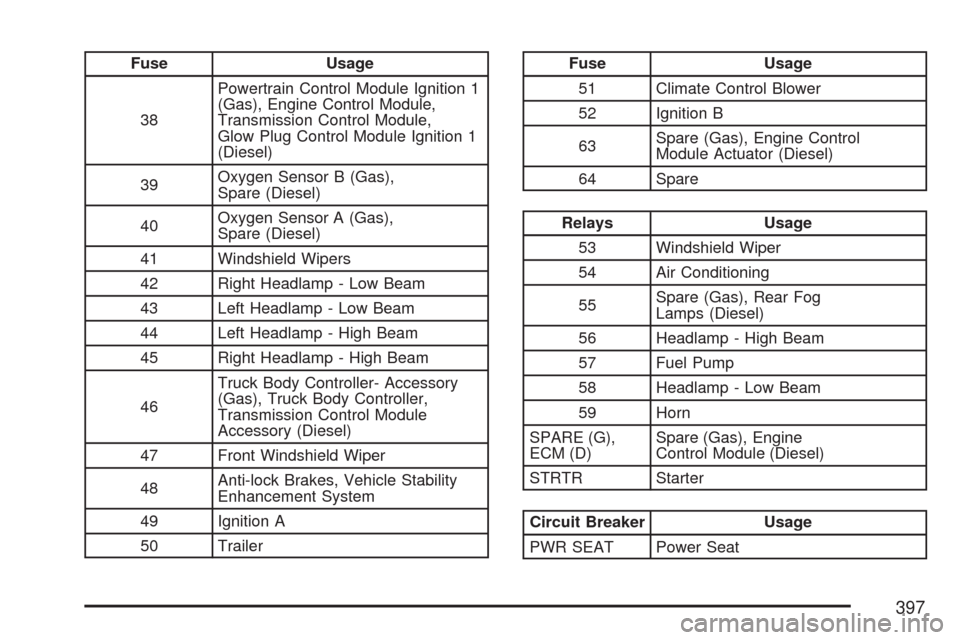
Fuse Usage
38Powertrain Control Module Ignition 1
(Gas), Engine Control Module,
Transmission Control Module,
Glow Plug Control Module Ignition 1
(Diesel)
39Oxygen Sensor B (Gas),
Spare (Diesel)
40Oxygen Sensor A (Gas),
Spare (Diesel)
41 Windshield Wipers
42 Right Headlamp - Low Beam
43 Left Headlamp - Low Beam
44 Left Headlamp - High Beam
45 Right Headlamp - High Beam
46Truck Body Controller- Accessory
(Gas), Truck Body Controller,
Transmission Control Module
Accessory (Diesel)
47 Front Windshield Wiper
48Anti-lock Brakes, Vehicle Stability
Enhancement System
49 Ignition A
50 TrailerFuse Usage
51 Climate Control Blower
52 Ignition B
63Spare (Gas), Engine Control
Module Actuator (Diesel)
64 Spare
Relays Usage
53 Windshield Wiper
54 Air Conditioning
55Spare (Gas), Rear Fog
Lamps (Diesel)
56 Headlamp - High Beam
57 Fuel Pump
58 Headlamp - Low Beam
59 Horn
SPARE (G),
ECM (D)Spare (Gas), Engine
Control Module (Diesel)
STRTR Starter
Circuit Breaker Usage
PWR SEAT Power Seat
397
Page 410 of 458
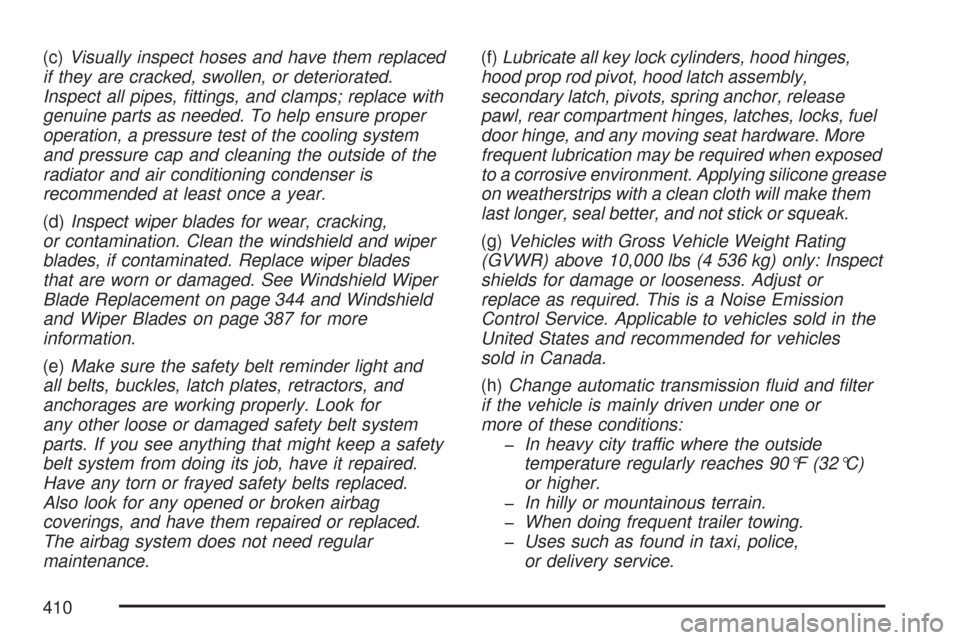
(c)Visually inspect hoses and have them replaced
if they are cracked, swollen, or deteriorated.
Inspect all pipes, ttings, and clamps; replace with
genuine parts as needed. To help ensure proper
operation, a pressure test of the cooling system
and pressure cap and cleaning the outside of the
radiator and air conditioning condenser is
recommended at least once a year.
(d)Inspect wiper blades for wear, cracking,
or contamination. Clean the windshield and wiper
blades, if contaminated. Replace wiper blades
that are worn or damaged. See Windshield Wiper
Blade Replacement on page 344 and Windshield
and Wiper Blades on page 387 for more
information.
(e)Make sure the safety belt reminder light and
all belts, buckles, latch plates, retractors, and
anchorages are working properly. Look for
any other loose or damaged safety belt system
parts. If you see anything that might keep a safety
belt system from doing its job, have it repaired.
Have any torn or frayed safety belts replaced.
Also look for any opened or broken airbag
coverings, and have them repaired or replaced.
The airbag system does not need regular
maintenance.(f)Lubricate all key lock cylinders, hood hinges,
hood prop rod pivot, hood latch assembly,
secondary latch, pivots, spring anchor, release
pawl, rear compartment hinges, latches, locks, fuel
door hinge, and any moving seat hardware. More
frequent lubrication may be required when exposed
to a corrosive environment. Applying silicone grease
on weatherstrips with a clean cloth will make them
last longer, seal better, and not stick or squeak.
(g)Vehicles with Gross Vehicle Weight Rating
(GVWR) above 10,000 lbs (4 536 kg) only: Inspect
shields for damage or looseness. Adjust or
replace as required. This is a Noise Emission
Control Service. Applicable to vehicles sold in the
United States and recommended for vehicles
sold in Canada.
(h)Change automatic transmission uid and lter
if the vehicle is mainly driven under one or
more of these conditions:
-In heavy city traffic where the outside
temperature regularly reaches 90°F (32°C)
or higher.
-In hilly or mountainous terrain.
-When doing frequent trailer towing.
-Uses such as found in taxi, police,
or delivery service.
410
Page 457 of 458
T
Taillamps..................................................... 343
Theft-Deterrent, Radio................................. 223
Theft-Deterrent Systems.............................. 118
Passlock
®................................................ 118
Tilt Wheel.................................................... 147
Time Setting
Radios with Radio Data
Systems (RDS)..................................... 189
Radios without Radio Data
Systems (RDS)..................................... 189
Tires........................................................... 346
Aluminum Wheels, Cleaning..................... 388
Buying New Tires..................................... 358
Chains..................................................... 364
Changing a Flat Tire................................ 366
Cleaning.................................................. 389
Different Size........................................... 360
Dual Tire Operation.................................. 355
If a Tire Goes Flat................................... 365
Inflation - Tire Pressure............................ 354
Inspection and Rotation............................ 356
Installing the Spare Tire........................... 370
Removing the Flat Tire............................. 370Tires (cont.)
Removing the Spare Tire and Tools......... 367
Secondary Latch System......................... 377
Spare Tire................................................ 382
Storing a Flat or Spare Tire and Tools..... 380
Tire Sidewall Labeling.............................. 347
Tire Terminology and Definitions............... 351
Uniform Tire Quality Grading.................... 361
Wheel Alignment and Tire Balance ........... 362
Wheel Replacement................................. 362
When It Is Time for New Tires................. 358
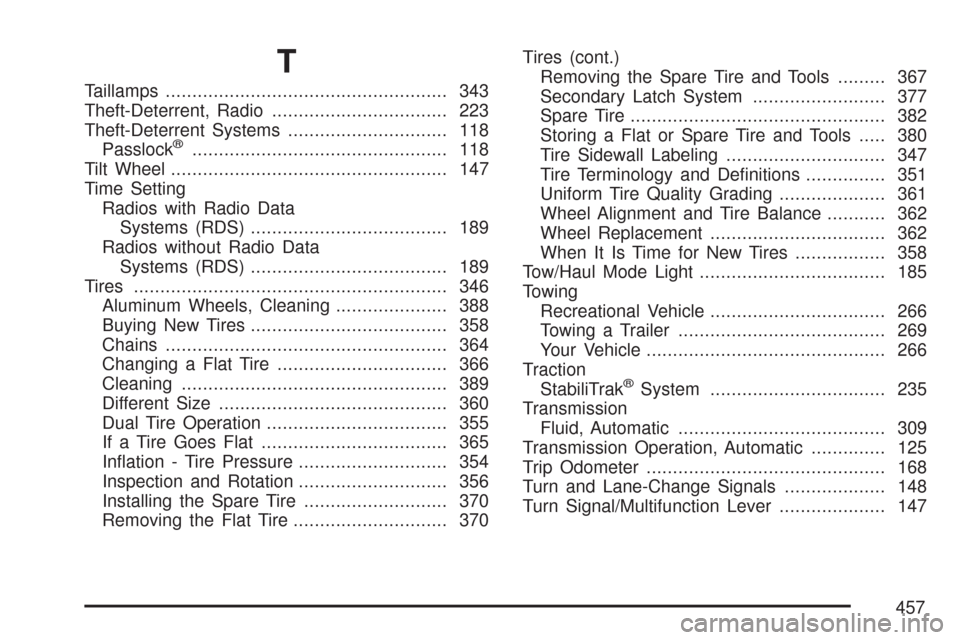
Tow/Haul Mode Light................................... 185
Towing
Recreational Vehicle................................. 266
Towing a Trailer....................................... 269
Your Vehicle............................................. 266
Traction
StabiliTrak
®System................................. 235
Transmission
Fluid, Automatic....................................... 309
Transmission Operation, Automatic.............. 125
Trip Odometer............................................. 168
Turn and Lane-Change Signals................... 148
Turn Signal/Multifunction Lever.................... 147
457