2007 CHEVROLET EXPRESS CARGO VAN trailer
[x] Cancel search: trailerPage 180 of 458
If the Light Is Flashing
The following may prevent more serious damage
to your vehicle:
•Reducing vehicle speed
•Avoiding hard accelerations
•Avoiding steep uphill grades
•If you are towing a trailer, reduce the amount of
cargo being hauled as soon as it is possible
If the light stops flashing and remains on steady,
see “If the Light Is On Steady” following.
If the light continues to flash, when it is safe to do
so, stop the vehicle. Find a safe place to park
your vehicle. Turn the key off, wait at least
10 seconds and restart the engine. If the light
remains on steady, see “If the Light Is On Steady”
following. If the light is still flashing, follow the
previous steps, and see your dealer for service as
soon as possible.
If the Light Is On Steady
You may be able to correct the emission system
malfunction by considering the following:
Did you recently put fuel into your vehicle?
If so, reinstall the fuel cap, making sure to fully
install the cap. SeeFilling the Tank on page 297.
The diagnostic system can determine if the
fuel cap has been left off or improperly installed.
A loose or missing fuel cap will allow fuel to
evaporate into the atmosphere. A few driving trips
with the cap properly installed should turn the
light off.
Did you just drive through a deep puddle
of water?
If so, your electrical system may be wet. The
condition will usually be corrected when the
electrical system dries out. A few driving trips
should turn the light off.
180
Page 185 of 458
Highbeam On Light
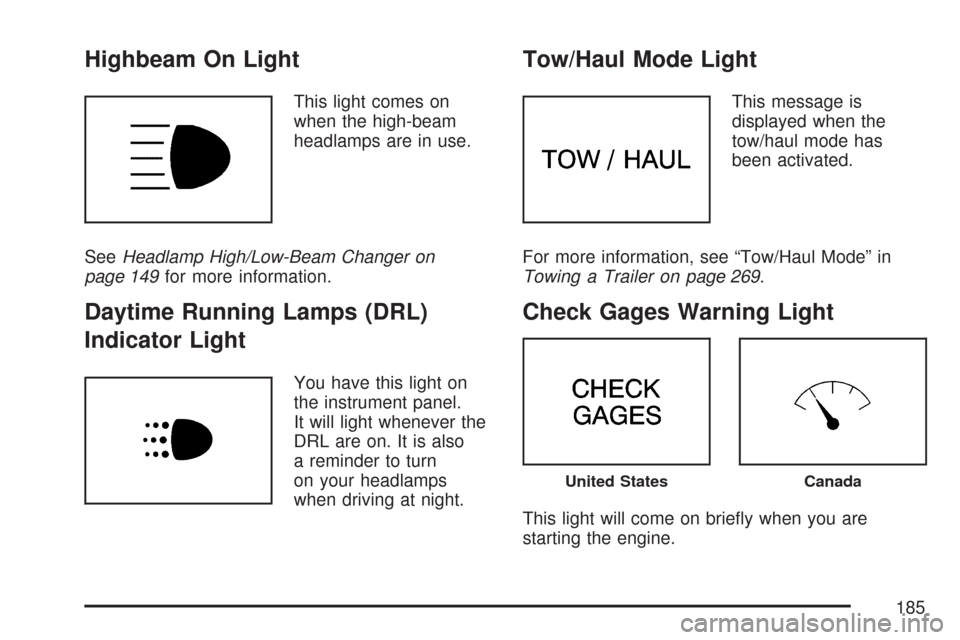
This light comes on
when the high-beam
headlamps are in use.
SeeHeadlamp High/Low-Beam Changer on
page 149for more information.
Daytime Running Lamps (DRL)
Indicator Light
You have this light on
the instrument panel.
It will light whenever the
DRL are on. It is also
a reminder to turn
on your headlamps
when driving at night.
Tow/Haul Mode Light
This message is
displayed when the
tow/haul mode has
been activated.
For more information, see “Tow/Haul Mode” in
Towing a Trailer on page 269.
Check Gages Warning Light
This light will come on briefly when you are
starting the engine.
United StatesCanada
185
Page 227 of 458
Your Driving, the Road, and Your Vehicle... 228
Defensive Driving...................................... 228
Drunken Driving........................................ 229
Control of a Vehicle.................................. 232
Braking...................................................... 232
Anti-Lock Brake System (ABS).................. 233
Braking in Emergencies............................. 235
Locking Rear Axle..................................... 235
StabiliTrak
®System................................... 235
All-Wheel Drive (AWD) System.................. 238
Steering.................................................... 239
Off-Road Recovery.................................... 241
Passing..................................................... 241
Loss of Control.......................................... 243
Driving at Night......................................... 244
Driving in Rain and on Wet Roads............ 246City Driving............................................... 249
Freeway Driving........................................ 250
Before Leaving on a Long Trip.................. 252
Highway Hypnosis..................................... 253
Hill and Mountain Roads........................... 254
Winter Driving........................................... 256
If Your Vehicle is Stuck in Sand, Mud,
Ice, or Snow.......................................... 260
Rocking Your Vehicle to Get It Out........... 260
Loading Your Vehicle................................ 261
Towing........................................................ 266
Towing Your Vehicle................................. 266
Recreational Vehicle Towing...................... 266
Towing a Trailer........................................ 269
Section 4 Driving Your Vehicle
227
Page 262 of 458
The Tire and Loading Information label also shows
the size of the original equipment tires (C) and
the recommended cold tire inflation pressures (D).
For more information on tires and inflation see
Tires on page 346andInation - Tire Pressure on
page 354.
There is also important loading information on the
vehicle Certification/Tire label. It tells you the
Gross Vehicle Weight Rating (GVWR) and
the Gross Axle Weight Rating (GAWR) for the
front and rear axle. See “Certification/Tire Label”
later in this section.
Steps for Determining Correct Load Limit
1. Locate the statement “The combined
weight of occupants and cargo should never
exceed XXX kg or XXX lbs” on your
vehicle’s placard.
2. Determine the combined weight of the driver
and passengers that will be riding in your
vehicle.
3. Subtract the combined weight of the driver
and passengers from XXX kg or XXX lbs.4. The resulting figure equals the available
amount of cargo and luggage load capacity.
For example, if the “XXX” amount equals
1400 lbs and there will be five 150 lb
passengers in your vehicle, the amount of
available cargo and luggage load capacity is
650 lbs (1400−750 (5 x 150) = 650 lbs).
5. Determine the combined weight of luggage
and cargo being loaded on the vehicle. That
weight may not safely exceed the available
cargo and luggage load capacity calculated
in Step 4.
6. If your vehicle will be towing a trailer, the load
from your trailer will be transferred to your
vehicle. Consult this manual to determine how
this reduces the available cargo and luggage
load capacity of your vehicle. SeeTowing
a Trailer on page 269for important information
on towing a trailer, towing safety rules and
trailering tips.
262
Page 267 of 458
Here are some important things to consider before
you do recreational vehicle towing:
•What’s the towing capacity of the towing
vehicle? Be sure you read the tow vehicle
manufacturer’s recommendations.
•How far will you tow? Some vehicles have
restrictions on how far and how long they
can tow.
•Do you have the proper towing equipment?
See your dealer/retailer or trailering
professional for additional advice and
equipment recommendations.
•Is your vehicle ready to be towed? Just as
you would prepare your vehicle for a long
trip, you’ll want to make sure your vehicle is
prepared to be towed.
Dinghy Towing
Two-Wheel-Drive Vehicles
Notice:If you tow your vehicle with all
four wheels on the ground, the drivetrain
components could be damaged. The repairs
would not be covered by your warranty. Do not
tow your vehicle with all four wheels on the
ground.
Two-wheel-drive vehicles should not be towed
with all four wheels on the ground.
Two-wheel-drive transmissions have no provisions
for internal lubrication while being towed.
All-Wheel-Drive Vehicles
Your vehicle was not designed to be towed with
all four wheels on the ground. To properly
tow these vehicles, they should be placed on a
platform trailer with all four wheels off the ground.
Notice:Towing an all-wheel-drive vehicle
with all four wheels on the ground, or even
with only two of its wheels on the ground, will
damage drivetrain components. Do not tow
an all-wheel-drive vehicle if any of its wheels
will be on the ground.
267
Page 268 of 458
Dolly Towing
Rear Towing (Rear Wheels Off the Ground)
Two-Wheel-Drive Vehicles
Use the following procedure to tow your vehicle
from the rear:
1. Drive the vehicle onto the dolly.
2. Firmly set the parking brake. SeeParking
Brake on page 128for more information.
3. Put the automatic transmission in PARK (P).
4. Follow the dolly manufacturer’s instructions to
attach and secure the vehicle being towed to
the dolly and then the loaded dolly to the tow
vehicle. Make sure the wheels are straight
before towing.
Use an adequate clamping device to ensure
that the front wheels are locked into the
straight position.5. Release the parking brake only after the
vehicle being towed is firmly attached to
the tow vehicle.
6. Turn the ignition to LOCK.
If the tow vehicle will not be started or driven
for six weeks or more, remove the battery
cable from the negative terminal (post) of the
battery to prevent your battery from draining
while towing.
All-Wheel-Drive Vehicles
Your vehicle was not designed to be towed with
two wheels on the ground. To properly tow
these vehicles, they should be placed on a
platform trailer with all four wheels off the ground.
Notice:Towing an all-wheel-drive vehicle
with all four wheels on the ground, or even
with only two of its wheels on the ground, will
damage drivetrain components. Do not tow
an all-wheel-drive vehicle if any of its wheels
will be on the ground.
268
Page 269 of 458
Towing a Trailer
If your vehicle has a diesel engine, see the
DURAMAX®Diesel manual for more information.
{CAUTION:
If you do not use the correct equipment
and drive properly, you can lose control
when you pull a trailer. For example, if the
trailer is too heavy, the brakes may not
work well — or even at all. You and your
passengers could be seriously injured.
You may also damage your vehicle; the
resulting repairs would not be covered by
your warranty. Pull a trailer only if you
have followed all the steps in this section.
Ask your dealer/retailer for advice and
information about towing a trailer with
your vehicle.Notice:Pulling a trailer improperly can
damage your vehicle and result in costly repairs
that would not be covered by your warranty.
Always follow the instructions in this section
and check with your dealer/retailer for more
information about towing a trailer with your
vehicle.
To identify the trailering capacity of your vehicle,
you should read the information in “Weight of
the Trailer” that appears later in this section.
Trailering is different than just driving your vehicle
by itself. Trailering means changes in acceleration,
braking, handling, durability and fuel economy.
Successful, safe trailering takes correct equipment,
and it has to be used properly.
That’s the reason for this part. In it are many
time-tested, important trailering tips and safety
rules. Many of these are important for your safety
and that of your passengers. So please read
this section carefully before you pull a trailer.
269
Page 270 of 458
If You Do Decide To Pull A Trailer
If you do, here are some important points:
•There are many different laws, including speed
limit restrictions, having to do with trailering.
Make sure your rig will be legal, not only where
you live but also where you’ll be driving. A
good source for this information can be state
or provincial police.
•Consider using a sway control. See “Hitches”
later in this section.
•Don’t tow a trailer at all during the first
500 miles (800 km) your new vehicle is driven.
Your engine, axle or other parts could be
damaged.
•Then, during the first 500 miles (800 km) that
you tow a trailer, don’t drive over 50 mph
(80 km/h) and don’t make starts at full throttle.
This helps your engine and other parts of
your vehicle wear in at the heavier loads.
•See also “Driving on Grades” later in this
section.Three important considerations have to do
with weight:
•the weight of the trailer
•the weight of the trailer tongue
•and the weight on your vehicle’s tires
Tow/Haul Mode
Tow/haul is designed to assist while your vehicle
is pulling a large or heavy load or trailer.
Tow/haul is most useful while pulling such a load
in rolling terrain, in stop-and-go traffic, or when
you need improved low-speed control, such
as when parking. The purpose of the tow/haul
mode is to:
•Reduce the frequency and improve the
predictability of transmission shifts,
•provide the same solid shift feel when pulling
a heavy load as when the vehicle is unloaded,
•improve control of vehicle speed while
requiring less throttle pedal activity.
270