2007 CHEVROLET EQUINOX ECU
[x] Cancel search: ECUPage 114 of 492
To program the new additional key do the
following:
1. Verify that the new key has a
1stamped on it.
2. Insert the original, already programmed, key in
the ignition and start the engine. If the engine
will not start, see your dealer for service.
3. After the engine has started, turn the key to
LOCK, and remove the key.
4. Insert the new key to be programmed and turn
it to the RUN position within ve seconds of
removing the original key.
5. The security light will turn off once the key
has been programmed.
6. Repeat Steps 1 through 5 if additional keys
are to be programmed.
If you are driving and the security light comes on
and stays on, you may be able to restart your
engine. Your PASS-Key
®III+ system, however,
may not be working properly and must be serviced
by your dealer.
If you lose or damage your PASS-Key
®III+ key,
see your dealer or a locksmith who can service
PASS-Key
®III+ to have a new key made.
Starting and Operating
Your Vehicle
New Vehicle Break-In
Notice:Your vehicle does not need an
elaborate break-in. But it will perform better in
the long run if you follow these guidelines:
Do not drive at any one constant speed,
fast or slow, for the rst 500 miles (805 km).
Do not make full-throttle starts. Avoid
downshifting to brake, or slow, the vehicle.
Avoid making hard stops for the rst
200 miles (322 km) or so. During this time
your new brake linings are not yet broken
in. Hard stops with new linings can mean
premature wear and earlier replacement.
Follow this breaking-in guideline every
time you get new brake linings.
Do not tow a trailer during break-in. See
Towing a Trailer on page 322for the trailer
towing capabilities of your vehicle and
more information.
Following break-in, engine speed and load
can be gradually increased.
114
Page 133 of 492
OnStar®System
OnStar®uses several innovative technologies and
live advisors to provide you with a wide range
of safety, security, information, and convenience
services. If your airbags deploy, the system is
designed to make an automatic call to OnStar
®
Emergency advisors who can request emergency
services be sent to your location. If you lock
your keys in the vehicle, call OnStar
®at
1-888-4-ONSTAR and they can send a signal to
unlock your doors. If you need roadside
assistance, press the OnStar
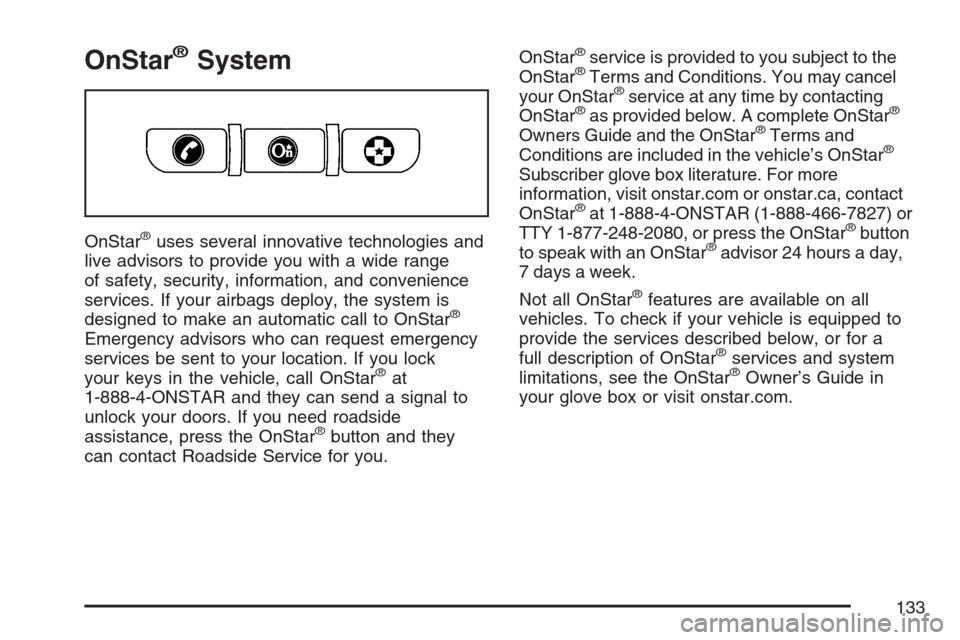
®button and they
can contact Roadside Service for you.OnStar
®service is provided to you subject to the
OnStar®Terms and Conditions. You may cancel
your OnStar®service at any time by contacting
OnStar®as provided below. A complete OnStar®
Owners Guide and the OnStar®Terms and
Conditions are included in the vehicle’s OnStar®
Subscriber glove box literature. For more
information, visit onstar.com or onstar.ca, contact
OnStar
®at 1-888-4-ONSTAR (1-888-466-7827) or
TTY 1-877-248-2080, or press the OnStar®button
to speak with an OnStar®advisor 24 hours a day,
7 days a week.
Not all OnStar
®features are available on all
vehicles. To check if your vehicle is equipped to
provide the services described below, or for a
full description of OnStar
®services and system
limitations, see the OnStar®Owner’s Guide in
your glove box or visit onstar.com.
133
Page 140 of 492
Notice:Loading cargo on the luggage carrier
that weighs more than 220 lbs (100 kg) or
hangs over the rear or sides of the vehicle may
damage your vehicle. Load cargo so that it
rests on the slats as far forward as possible
and against the side rails, making sure to
fasten it securely.
Do not stand on plastic lower body panel when
loading cargo on the luggage carrier.
Do not exceed the maximum vehicle capacity
when loading your vehicle. For more information
on vehicle capacity and loading, seeLoading Your
Vehicle on page 315.
To prevent damage or loss of cargo as you are
driving, check now and then to make sure
the luggage carrier crossrails are locked and
cargo is still securely fastened.
When the luggage carrier is not in use, lock one
crossrail at the rear most position on the siderails
and lock the other crossrail above the opening
of the rear door to reduce wind noise.Rear Compartment Storage
Panel/Cover
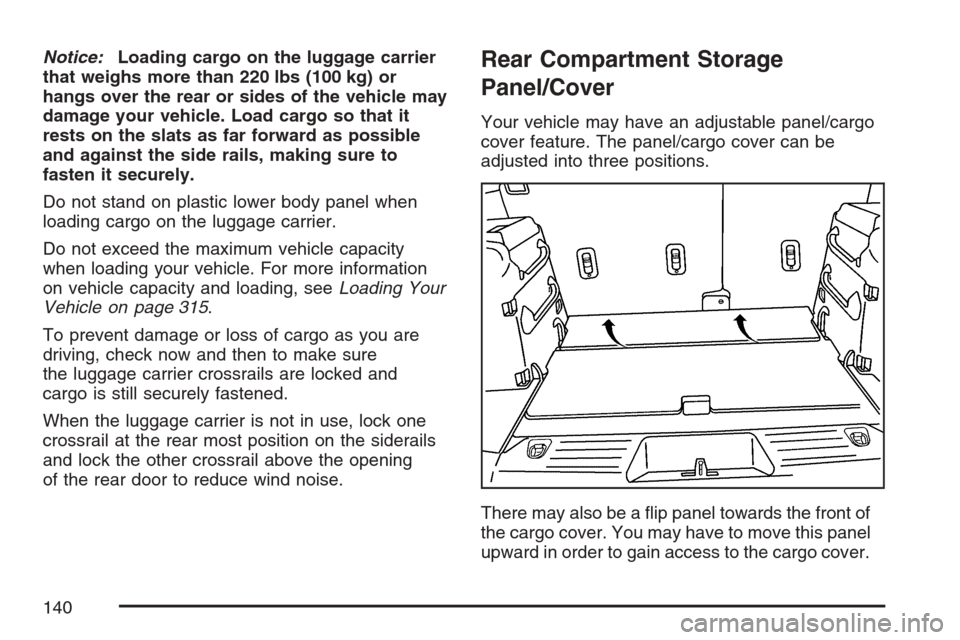
Your vehicle may have an adjustable panel/cargo
cover feature. The panel/cargo cover can be
adjusted into three positions.
There may also be a ip panel towards the front of
the cargo cover. You may have to move this panel
upward in order to gain access to the cargo cover.
140
Page 141 of 492
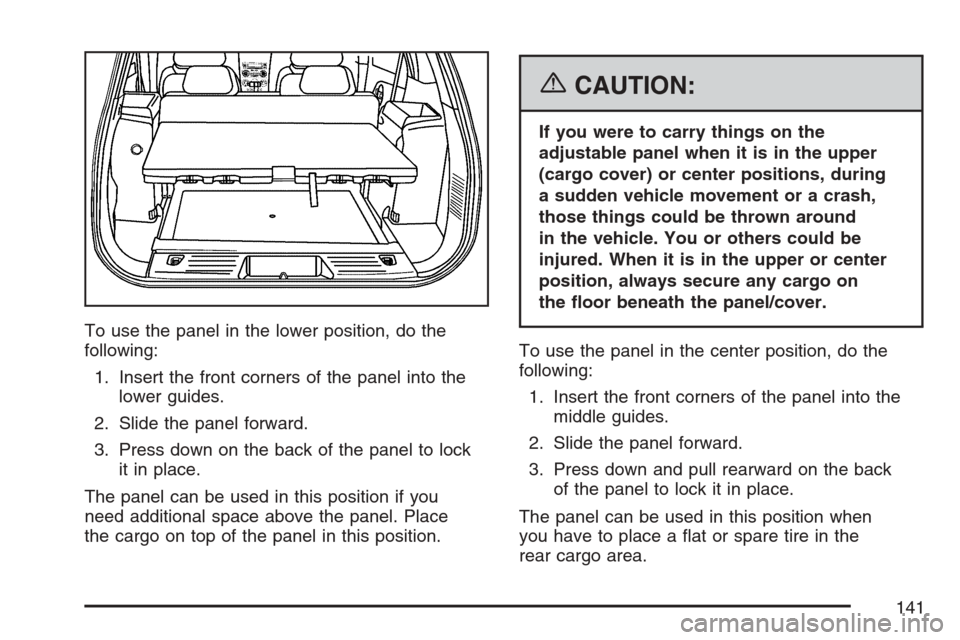
To use the panel in the lower position, do the
following:
1. Insert the front corners of the panel into the
lower guides.
2. Slide the panel forward.
3. Press down on the back of the panel to lock
it in place.
The panel can be used in this position if you
need additional space above the panel. Place
the cargo on top of the panel in this position.
{CAUTION:
If you were to carry things on the
adjustable panel when it is in the upper
(cargo cover) or center positions, during
a sudden vehicle movement or a crash,
those things could be thrown around
in the vehicle. You or others could be
injured. When it is in the upper or center
position, always secure any cargo on
the oor beneath the panel/cover.
To use the panel in the center position, do the
following:
1. Insert the front corners of the panel into the
middle guides.
2. Slide the panel forward.
3. Press down and pull rearward on the back
of the panel to lock it in place.
The panel can be used in this position when
you have to place a at or spare tire in the
rear cargo area.
141
Page 143 of 492
To set up the table, do the following:
1. With the adjustable panel in the upper
position pull rearward to position it for use
as a table. The plastic side should be up.
2. Turn the knob to release the leg from the
plastic side of the table and turn the leg
outward.
3. Set the table leg onto the liftgate lock striker
at the rear edge of the vehicle.
Make sure to place the table leg securely onto the
liftgate lock striker.
Notice:Driving with the panel extended into
the table position could damage your vehicle.
Always have the panel in the stored position
while you are driving.
Notice:Placing hot items on the surface of
the table could damage it. Always be sure that
the items that are placed on the surface of
the table are of moderate temperature.
There are four hooks located on the table that can
be used for grocery bags.Convenience Net
Your vehicle may have a rear compartment net to
prevent items from rolling under the rear seat.
There may also be four convenience net tie-downs.
Two tie-downs are located on the side trim just
behind the rear seat and the other two are located
on the oor at the rear of the cargo area.
Cargo Tie Downs
There are cargo tie-downs in the rear of your
vehicle that allow you to strap cargo in and keep
it from moving.
143
Page 146 of 492
Engine Coolant Temperature Gage............ 182
Tire Pressure Light.................................... 182
Malfunction Indicator Lamp........................ 183
Oil Pressure Light..................................... 186
Change Engine Oil Light........................... 187
Security Light............................................ 188
Fog Lamp Light......................................... 188
Cruise Control Light.................................. 188
Reduced Engine Power Light.................... 188
Highbeam On Light................................... 189
Service All-Wheel Drive Light.................... 189
All-Wheel Drive Disabled Light.................. 190
Gate Ajar Light.......................................... 190
Door Ajar Light.......................................... 190
Service Vehicle Soon Light........................ 191
Fuel Gage................................................. 191
Low Fuel Warning Light............................ 192
Driver Information Center (DIC).................. 192
DIC Operation and Displays...................... 193
DIC Warnings and Messages.................... 198
DIC Vehicle Personalization....................... 207Audio System(s)......................................... 215
Setting the Time
(Without Date Display)........................... 216
Setting the Time
(With Date Display)................................ 217
Radio with CD (Base)............................... 219
Radio with CD (MP3)................................ 224
Radio with CD and DVD........................... 235
Using an MP3 (Radio with CD or
Six-Disc CD Player)............................... 253
Using an MP3 (Radio with CD and
DVD Player)........................................... 260
XM Radio Messages................................. 267
Navigation/Radio System........................... 269
Rear Seat Entertainment System............... 269
Theft-Deterrent Feature............................. 279
Audio Steering Wheel Controls.................. 280
Radio Reception........................................ 281
Care of Your CDs and DVDs.................... 282
Care of the CD and DVD Player............... 282
Multi-Band Antenna................................... 282
Section 3 Instrument Panel
146
Page 176 of 492
If your vehicle has a rear seat that will
accommodate a rear-facing child restraint, there
is a label on your sun visor that says, “Never
put a rear-facing child seat in the front.” This is
because the risk to the rear-facing child is so
great if the airbag deploys.
{CAUTION:
Even though the passenger sensing
system is designed to turn off the
passenger’s frontal airbag if the system
detects a rear-facing child restraint, no
system is fail-safe, and no one can
guarantee that an airbag will not deploy
under some unusual circumstance, even
though it is turned off. We recommend
that rear-facing child restraints be secured
in the rear seat, even if the airbag is off.If your vehicle does not have a rear seat that
will accommodate a rear-facing child restraint,
never put a child in a rear-facing child restraint
in the right front passenger seat unless the
passenger airbag status indicator shows off and
the airbag is off. Here is why:
{CAUTION:
Even though the passenger sensing
system is designed to turn off the
passenger’s frontal airbag if the system
detects a rear-facing child restraint,
no system is fail-safe, and no one can
guarantee that an airbag will not deploy
under some unusual circumstance, even
though it is turned off. We recommend
that rear-facing child restraints be
transported in vehicles with a rear seat
that will accommodate a rear-facing child
restraint, whenever possible.
176
Page 188 of 492
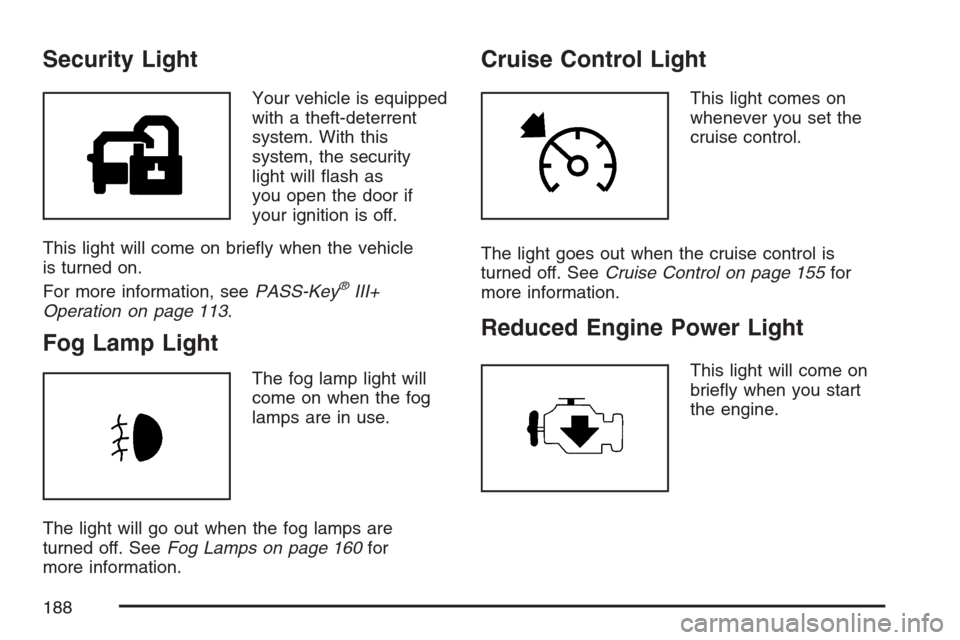
Security Light
Your vehicle is equipped
with a theft-deterrent
system. With this
system, the security
light will ash as
you open the door if
your ignition is off.
This light will come on briey when the vehicle
is turned on.
For more information, seePASS-Key
®III+
Operation on page 113.
Fog Lamp Light
The fog lamp light will
come on when the fog
lamps are in use.
The light will go out when the fog lamps are
turned off. SeeFog Lamps on page 160for
more information.
Cruise Control Light
This light comes on
whenever you set the
cruise control.
The light goes out when the cruise control is
turned off. SeeCruise Control on page 155for
more information.
Reduced Engine Power Light
This light will come on
briey when you start
the engine.
188