2007 CHEVROLET EQUINOX warning
[x] Cancel search: warningPage 205 of 492
SERVICE TIRE MONITOR SYSTEM
This message displays if a part on the Tire
Pressure Monitor (TPM) system is not working
properly. If you drive your vehicle while any of
the four sensors are missing or inoperable,
the warning comes on in about 20 minutes.
A sensor would be missing, for example, if you
put different wheels on your vehicle without
transferring the sensors. If the warning comes
on and stays on, there may be a problem with
the TPM. See your dealer.
SERVICE TRACTION CONTROL
This message displays when the Traction
Control System (TCS) is not functioning properly.
A warning light also appears on the instrument
panel cluster. SeeTraction Control System (TCS)
Warning Light on page 181andTraction Control
System (TCS) on page 291for more information.
Have the TCS serviced by your dealer as soon
as possible.
SERVICE VEHICLE SOON
This message displays when a non-emissions
related malfunction occurs. Have the vehicle
serviced by your dealer as soon as possible.
STABILITRAK NOT READY
This message may display and a warning light
on the instrument panel cluster may be on
after rst driving the vehicle and exceeding
30 mph (48 km/h) for 30 seconds. SeeTraction
Control System (TCS) Warning Light on page 181.
The StabiliTrak
®System is not functional until
the light has turned off. SeeStabiliTrak®System
on page 292for more information.
STABILITRAK OFF
This message displays any time the StabiliTrak®
System turns off. When this message has
been displayed, StabiliTrak®is no longer
available to assist you with directional control
of the vehicle. Adjust your driving accordingly.
SeeStabiliTrak
®System on page 292.
This message displays only while the ignition
is in RUN.
205
Page 206 of 492
Any of the following conditions may cause the
StabiliTrak®System to turn off:
The StabiliTrak®System is turned off by
pressing and holding the traction control
button. SeeStabiliTrak
®System on page 292
for more information.
The battery is low.
There is a StabiliTrak®System failure.
See your dealer for service.
STARTING DISABLD (Disabled)
SERVICE THRTTLE (Throttle)
This message displays if the starting of the engine
is disabled due to the electronic throttle control
system. Have your vehicle serviced by your dealer
immediately.
This message only appears while the ignition is
in RUN, and will not disappear until the problem
is resolved.
This message cannot be acknowledged.
THEFT ATTEMPTED
This message displays if the content theft-deterrent
system has detected a break-in attempt while
you were away from your vehicle. SeeContent
Theft-Deterrent on page 111for more information.
TIRE LEARNING ACTIVE
This message displays when the Tire Pressure
Monitor (TPM) system is re-learning the tire
positions. SeeTire Pressure Monitor System on
page 391. The tire positions must be re-learned
after rotating the tires or after replacing a tire
or sensor. SeeTire Inspection and Rotation on
page 396andInation - Tire Pressure on page 390
for more information.
TRACTION CONTROL OFF
This message displays when the Traction Control
System (TCS) turns off. SeeTraction Control
System (TCS) on page 291for more information.
This message only displays while the ignition
is in RUN and disappears after 10 seconds, unless
it is acknowledged or an urgent warning appears.
206
Page 288 of 492
Control of a Vehicle
You have three systems that make your vehicle go
where you want it to go. They are the brakes, the
steering, and the accelerator. All three systems
have to do their work at the places where the tires
meet the road.
Sometimes, as when you are driving on snow or
ice, it is easy to ask more of those control systems
than the tires and road can provide. That means
you can lose control of your vehicle. SeeTraction
Control System (TCS) on page 291.
Adding non-GM accessories can affect your
vehicle’s performance. SeeAccessories and
Modications on page 333.
Braking
SeeBrake System Warning Light on page 178.
Braking action involves perception time and
reaction time.
First, you have to decide to push on the brake
pedal. That is perception time. Then you have to
bring up your foot and do it. That is reaction time.
Average reaction time is about three-fourths of a
second. But that is only an average. It might
be less with one driver and as long as two or
three seconds or more with another. Age, physical
condition, alertness, coordination, and eyesight
all play a part. So do alcohol, drugs, and
frustration. But even in three-fourths of a second,
a vehicle moving at 60 mph (100 km/h) travels
66 feet (20 m). That could be a lot of distance in
an emergency, so keeping enough space between
your vehicle and others is important.
And, of course, actual stopping distances vary
greatly with the surface of the road, whether it is
pavement or gravel; the condition of the road,
whether it is wet, dry, or icy; tire tread; the
condition of the brakes; the weight of the vehicle;
and the amount of brake force applied.
288
Page 289 of 492
Avoid needless heavy braking. Some people
drive in spurts — heavy acceleration followed
by heavy braking — rather than keeping pace
with traffic. This is a mistake. The brakes may
not have time to cool between hard stops.
The brakes will wear out much faster if you do
a lot of heavy braking. If you keep pace with
the traffic and allow realistic following distances,
you will eliminate a lot of unnecessary braking.
That means better braking and longer brake life.
If your vehicle’s engine ever stops while you
are driving, brake normally but do not pump the
brakes. If you do, the pedal may get harder
to push down. If the engine stops, you will still
have some power brake assist. But you will use
it when you brake. Once the power assist is
used up, it may take longer to stop and the
brake pedal will be harder to push.
Adding non-GM accessories can affect your
vehicle’s performance. SeeAccessories and
Modications on page 333.Anti-Lock Brake System (ABS)
Your vehicle has the Anti-Lock Brake
System (ABS), an advanced electronic braking
system that will help prevent a braking skid.
When you start your engine and begin to drive
away, ABS will check itself. You may hear a
momentary motor or clicking noise while this test
is going on, and you may even notice that
your brake pedal moves a little. This is normal.
If there is a problem
with ABS, this warning
light will stay on.
SeeAnti-Lock Brake
System Warning
Light on page 180.
289
Page 292 of 492
You should turn the system off if your vehicle ever
gets stuck in sand, mud, ice or snow and rocking
the vehicle is required. SeeRocking Your Vehicle
to Get It Out on page 315.
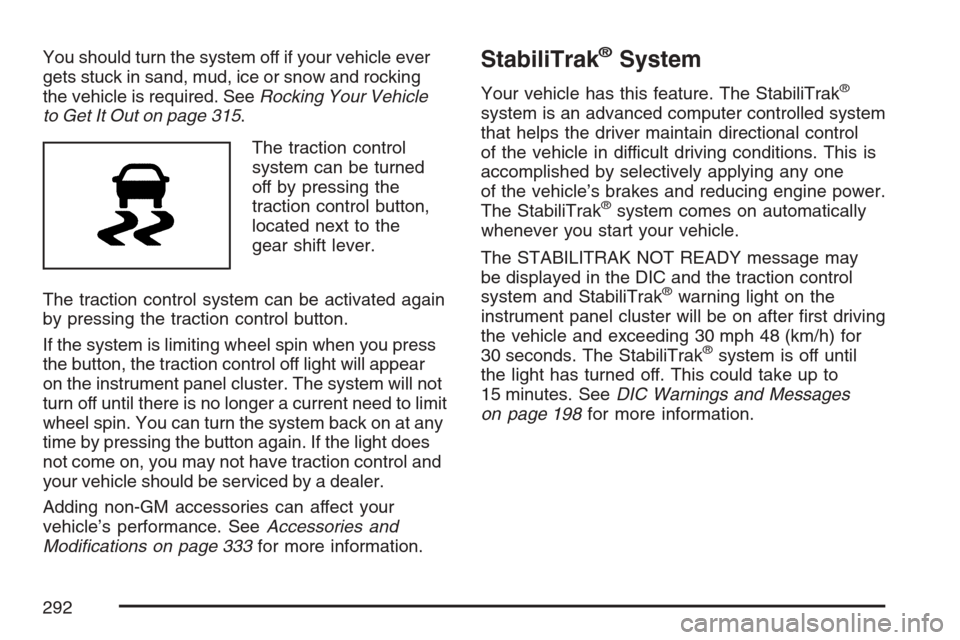
The traction control
system can be turned
off by pressing the
traction control button,
located next to the
gear shift lever.
The traction control system can be activated again
by pressing the traction control button.
If the system is limiting wheel spin when you press
the button, the traction control off light will appear
on the instrument panel cluster. The system will not
turn off until there is no longer a current need to limit
wheel spin. You can turn the system back on at any
time by pressing the button again. If the light does
not come on, you may not have traction control and
your vehicle should be serviced by a dealer.
Adding non-GM accessories can affect your
vehicle’s performance. SeeAccessories and
Modications on page 333for more information.StabiliTrak®System
Your vehicle has this feature. The StabiliTrak®
system is an advanced computer controlled system
that helps the driver maintain directional control
of the vehicle in difficult driving conditions. This is
accomplished by selectively applying any one
of the vehicle’s brakes and reducing engine power.
The StabiliTrak
®system comes on automatically
whenever you start your vehicle.
The STABILITRAK NOT READY message may
be displayed in the DIC and the traction control
system and StabiliTrak
®warning light on the
instrument panel cluster will be on after rst driving
the vehicle and exceeding 30 mph 48 (km/h) for
30 seconds. The StabiliTrak
®system is off until
the light has turned off. This could take up to
15 minutes. SeeDIC Warnings and Messages
on page 198for more information.
292
Page 293 of 492
The traction control system and StabiliTrak®
warning light on the instrument panel cluster will
ash when the system is operating. You may also
feel or hear the system working. This is normal.
StabiliTrak
®can be turned off using the
traction control button. To disable StabiliTrak®,
press and hold the traction control button for
ve seconds. StabiliTrak
®can be activated
again by pressing the traction control button.
The SERVICE STABILITRAK message will
be displayed and the traction control system and
StabiliTrak
®warning light on the instrument
panel cluster will come on if there is a problem
with the system. When this light and the SERVICE
STABILITRAK message are on, the system is
not operational. Adjust your driving accordingly.
All-Wheel Drive (AWD) System
If your vehicle has all-wheel drive (AWD), the
AWD system operates automatically without
any action required by the driver. If the front
drive wheels begin to slip, the rear wheels will
automatically begin to drive the vehicle as
required. Torque is also applied to the rear
wheels during launches. There may be a slight
engagement noise during hard use but this
is normal.
This light is located
on the instrument
panel cluster.
This light and the SERVICE ALL WHEEL DRIVE
message in the DIC will come on and stay on
to indicate there may be a problem with the drive
system and service is required.
SeeService All-Wheel Drive Light on page 189
andDIC Warnings and Messages on page 198
for more information.
293
Page 294 of 492
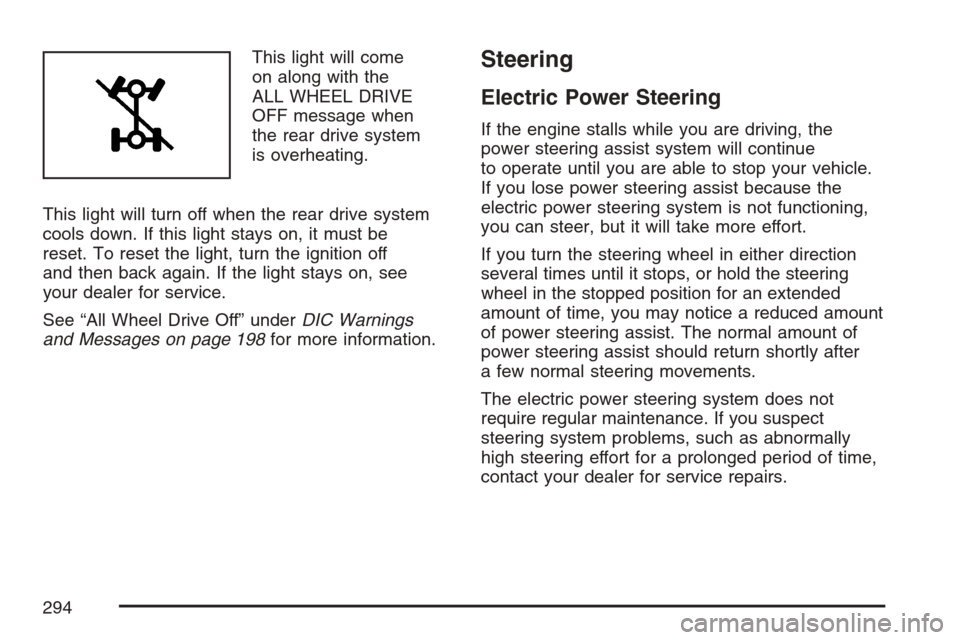
This light will come
on along with the
ALL WHEEL DRIVE
OFF message when
the rear drive system
is overheating.
This light will turn off when the rear drive system
cools down. If this light stays on, it must be
reset. To reset the light, turn the ignition off
and then back again. If the light stays on, see
your dealer for service.
See “All Wheel Drive Off” underDIC Warnings
and Messages on page 198for more information.Steering
Electric Power Steering
If the engine stalls while you are driving, the
power steering assist system will continue
to operate until you are able to stop your vehicle.
If you lose power steering assist because the
electric power steering system is not functioning,
you can steer, but it will take more effort.
If you turn the steering wheel in either direction
several times until it stops, or hold the steering
wheel in the stopped position for an extended
amount of time, you may notice a reduced amount
of power steering assist. The normal amount of
power steering assist should return shortly after
a few normal steering movements.
The electric power steering system does not
require regular maintenance. If you suspect
steering system problems, such as abnormally
high steering effort for a prolonged period of time,
contact your dealer for service repairs.
294
Page 300 of 492
If your vehicle starts to slide, ease your foot off
the accelerator pedal and quickly steer the
way you want the vehicle to go. If you start
steering quickly enough, your vehicle may
straighten out. Always be ready for a second
skid if it occurs.
Of course, traction is reduced when water, snow,
ice, gravel, or other material is on the road.
For safety, you will want to slow down and adjust
your driving to these conditions. It is important
to slow down on slippery surfaces because
stopping distance will be longer and vehicle
control more limited.
While driving on a surface with reduced traction,
try your best to avoid sudden steering, acceleration,
or braking, including reducing vehicle speed by
shifting to a lower gear. Any sudden changes could
cause the tires to slide. You may not realize the
surface is slippery until your vehicle is skidding.
Learn to recognize warning clues — such as
enough water, ice, or packed snow on the road
to make a mirrored surface — and slow down
when you have any doubt.
Remember: Any Anti-Lock Brake System (ABS)
helps avoid only the braking skid.Driving at Night
Night driving is more dangerous than day driving.
One reason is that some drivers are likely to
be impaired — by alcohol or drugs, with night
vision problems, or by fatigue.
Here are some tips on night driving.
Drive defensively.
Do not drink and drive.
Adjust the inside rearview mirror to reduce the
glare from headlamps behind you.
Since you cannot see as well, you may need
to slow down and keep more space between
you and other vehicles.
Slow down, especially on higher speed roads.
Your vehicle’s headlamps can light up only so
much road ahead.
In remote areas, watch for animals.
If you are tired, pull off the road in a safe
place and rest.
300