2007 CHEVROLET EQUINOX warning
[x] Cancel search: warningPage 393 of 492
When a low tire pressure condition is detected,
the TPMS will illuminate the low tire pressure
warning symbol on the instrument panel cluster,
and at the same time a message to check
the pressure in a specic tire will appear on the
Driver Information Center (DIC) display. The
low tire pressure warning symbol on the instrument
panel cluster and the check tire pressure
message will appear at each ignition cycle until
the tires are inated to the correct ination
pressure. Using the DIC, tire pressure levels can
be viewed by the driver. For additional information
and details about the DIC operation and displays
seeDIC Operation and Displays on page 193
andDIC Warnings and Messages on page 198.
The low tire pressure warning light may come on
in cool weather when the vehicle is rst started,
and then turn off as you start to drive. This may be
an early indicator that the air pressure in the
tire(s) are getting low and need to be inated to
the proper pressure.
A Tire and Loading Information Label, attached to
your vehicle, shows the size of your vehicle’s
original equipment tires and the correct inationpressure for your vehicle’s tires when they are cold.
SeeLoading Your Vehicle on page 315, for an
example of the Tire and Loading Information
Label and its location on your vehicle. Also see
Ination - Tire Pressure on page 390.
Your vehicle’s TPMS system can warn you about a
low tire pressure condition but it does not replace
normal tire maintenance. SeeTire Inspection and
Rotation on page 396andTires on page 382.
Notice:Do not use a tire sealant if your vehicle
has Tire Pressure Monitors. The liquid sealant
can damage the tire pressure monitor sensors.
The TPMS will not function properly if one or more
of the TPMS sensors are missing or inoperable. If
the system detects a missing or inoperable sensor,
an error message SERVICE TIRE MONITOR
SYSTEM will be shown on the DIC display. If you
have replaced a tire/wheel assembly without
transferring the TPMS sensors, the error message
will be displayed. Once you re-install the TPMS
sensors, the error message should go off. See your
dealer for service if all TPMS sensors are installed
and the error message comes on and stays on.
393
Page 401 of 492
While the tires available on General Motors
passenger cars and light trucks may vary with
respect to these grades, they must also conform
to federal safety requirements and additional
General Motors Tire Performance Criteria (TPC)
standards.
Treadwear
The treadwear grade is a comparative rating based
on the wear rate of the tire when tested under
controlled conditions on a specied government
test course. For example, a tire graded 150 would
wear one and a half (1.5) times as well on the
government course as a tire graded 100. The
relative performance of tires depends upon the
actual conditions of their use, however, and may
depart signicantly from the norm due to variations
in driving habits, service practices, and differences
in road characteristics and climate.
Traction – AA, A, B, C
The traction grades, from highest to lowest, are AA,
A, B, and C. Those grades represent the tire’s
ability to stop on wet pavement as measured under
controlled conditions on specied government test
surfaces of asphalt and concrete. A tire marked C
may have poor traction performance.Warning:The traction grade assigned to this tire
is based on straight-ahead braking traction
tests, and does not include acceleration, cornering,
hydroplaning, or peak traction characteristics.
Temperature – A, B, C
The temperature grades are A (the highest),
B, and C, representing the tire’s resistance to
the generation of heat and its ability to dissipate
heat when tested under controlled conditions on a
specied indoor laboratory test wheel. Sustained
high temperature can cause the material of the tire
to degenerate and reduce tire life, and excessive
temperature can lead to sudden tire failure.
The grade C corresponds to a level of performance
which all passenger car tires must meet under
the Federal Motor Vehicle Safety Standard
No. 109. Grades B and A represent higher levels
of performance on the laboratory test wheel
than the minimum required by law.
Warning:The temperature grade for this tire
is established for a tire that is properly inated and
not overloaded. Excessive speed, underination,
or excessive loading, either separately or in
combination, can cause heat buildup and possible
tire failure.
401
Page 404 of 492
If a Tire Goes Flat
It is unusual for a tire to blowout while you are
driving, especially if you maintain your vehicle’s
tires properly. If air goes out of a tire, it is
much more likely to leak out slowly. But if you
should ever have a blowout, here are a few tips
about what to expect and what to do:
If a front tire fails, the at tire will create a drag
that pulls the vehicle toward that side. Take your
foot off the accelerator pedal and grip the
steering wheel rmly. Steer to maintain lane
position, and then gently brake to a stop well
out of the traffic lane.
A rear blowout, particularly on a curve, acts much
like a skid and may require the same correction
you would use in a skid. In any rear blowout
remove your foot from the accelerator pedal. Get
the vehicle under control by steering the way
you want the vehicle to go. It may be very bumpy
and noisy, but you can still steer. Gently brake
to a stop, well off the road if possible.{CAUTION:
Lifting a vehicle and getting under it to
do maintenance or repairs is dangerous
without the appropriate safety equipment
and training. The jack provided with your
vehicle is designed only for changing a
at tire. If it is used for anything else, you
or others could be badly injured or killed
if the vehicle slips off the jack. Use the
jack provided with your vehicle only for
changing a at tire.
If a tire goes at, the next part shows how to
use the jacking equipment to change a at
tire safely.
Changing a Flat Tire
If a tire goes at, avoid further tire and wheel
damage by driving slowly to a level place. Turn on
your vehicle’s hazard warning ashers. SeeHazard
Warning Flashers on page 150for more information.
404
Page 477 of 492
A
Accessories and Modications..................... 333
Accessory Power Outlet(s).......................... 164
Adding Equipment to Your Airbag-Equipped
Vehicle....................................................... 89
Additives, Fuel............................................ 336
Add-On Electrical Equipment....................... 428
Air Cleaner/Filter, Engine............................. 349
Air Conditioning........................................... 165
Airbag
Passenger Status Indicator....................... 175
Readiness Light....................................... 174
Airbag Sensing and Diagnostic Module
(SDM)...................................................... 469
Airbag System............................................... 72
Adding Equipment to Your
Airbag-Equipped Vehicle......................... 89
How Does an Airbag Restrain?.................. 80
Passenger Sensing System....................... 82
Servicing Your Airbag-Equipped Vehicle..... 88
What Makes an Airbag Inate?.................. 79
What Will You See After an Airbag
Inates?................................................. 80Airbag System (cont.)
When Should an Airbag Inate?................. 78
Where Are the Airbags?............................. 75
All-Wheel Drive........................................... 374
All-Wheel-Drive (AWD) System.................... 293
All-Wheel-Drive Service Light....................... 189
Anti-Lock Brake System (ABS).................... 289
Anti-Lock Brake, System Warning Light....... 180
Appearance Care
Aluminum or Chrome-Plated Wheels........ 424
Care of Safety Belts................................ 421
Chemical Paint Spotting........................... 426
Cleaning Exterior Lamps/Lenses.............. 422
Cleaning the Inside of Your Vehicle.......... 417
Fabric/Carpet........................................... 418
Finish Care.............................................. 422
Finish Damage......................................... 425
Instrument Panel, Vinyl, and Other
Plastic Surfaces.................................... 421
Leather.................................................... 420
Sheet Metal Damage............................... 425
Tires........................................................ 425
Underbody Maintenance........................... 425
477
Page 478 of 492
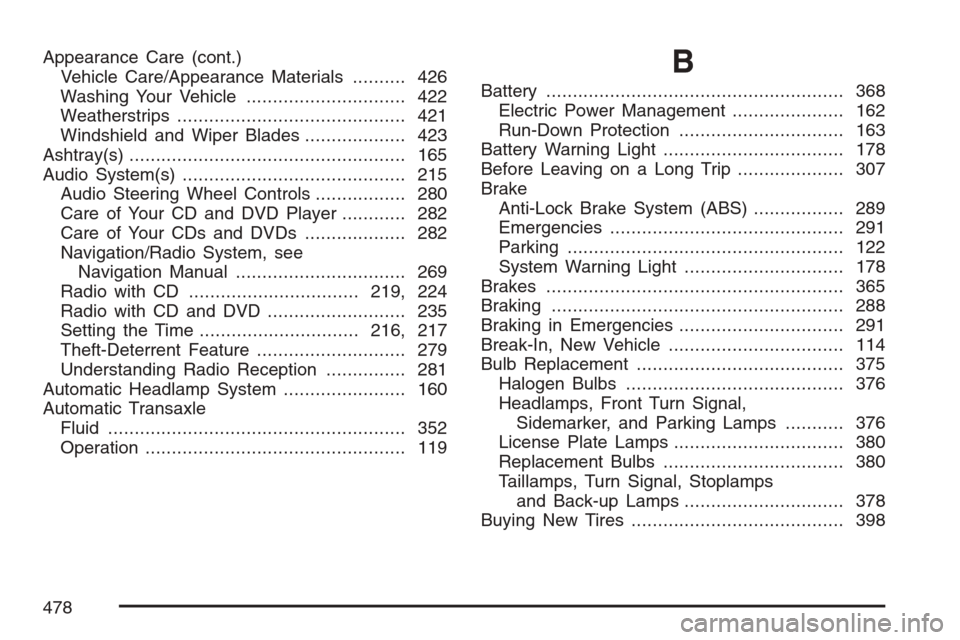
Appearance Care (cont.)
Vehicle Care/Appearance Materials.......... 426
Washing Your Vehicle.............................. 422
Weatherstrips........................................... 421
Windshield and Wiper Blades................... 423
Ashtray(s).................................................... 165
Audio System(s).......................................... 215
Audio Steering Wheel Controls................. 280
Care of Your CD and DVD Player............ 282
Care of Your CDs and DVDs................... 282
Navigation/Radio System, see
Navigation Manual................................ 269
Radio with CD................................219, 224
Radio with CD and DVD.......................... 235
Setting the Time..............................216, 217
Theft-Deterrent Feature............................ 279
Understanding Radio Reception............... 281
Automatic Headlamp System....................... 160
Automatic Transaxle
Fluid........................................................ 352
Operation................................................. 119B
Battery........................................................ 368
Electric Power Management..................... 162
Run-Down Protection............................... 163
Battery Warning Light.................................. 178
Before Leaving on a Long Trip.................... 307
Brake
Anti-Lock Brake System (ABS)................. 289
Emergencies............................................ 291
Parking.................................................... 122
System Warning Light.............................. 178
Brakes........................................................ 365
Braking....................................................... 288
Braking in Emergencies............................... 291
Break-In, New Vehicle................................. 114
Bulb Replacement....................................... 375
Halogen Bulbs......................................... 376
Headlamps, Front Turn Signal,
Sidemarker, and Parking Lamps........... 376
License Plate Lamps................................ 380
Replacement Bulbs.................................. 380
Taillamps, Turn Signal, Stoplamps
and Back-up Lamps.............................. 378
Buying New Tires........................................ 398
478
Page 479 of 492
C
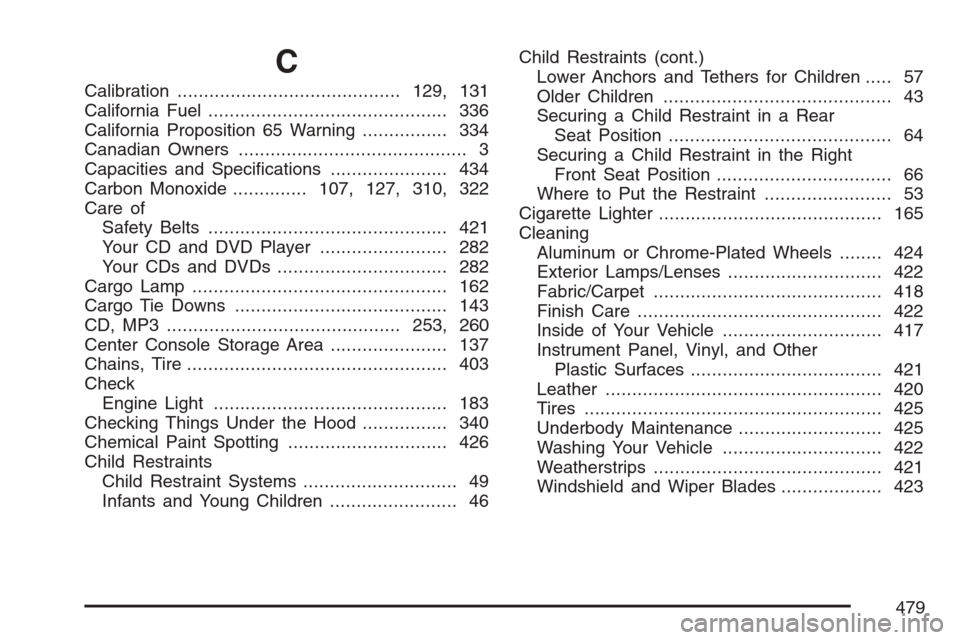
Calibration..........................................129, 131
California Fuel............................................. 336
California Proposition 65 Warning................ 334
Canadian Owners........................................... 3
Capacities and Specications...................... 434
Carbon Monoxide..............107, 127, 310, 322
Care of
Safety Belts............................................. 421
Your CD and DVD Player........................ 282
Your CDs and DVDs................................ 282
Cargo Lamp................................................ 162
Cargo Tie Downs........................................ 143
CD, MP3 ............................................253, 260
Center Console Storage Area...................... 137
Chains, Tire................................................. 403
Check
Engine Light............................................ 183
Checking Things Under the Hood................ 340
Chemical Paint Spotting.............................. 426
Child Restraints
Child Restraint Systems............................. 49
Infants and Young Children........................ 46Child Restraints (cont.)
Lower Anchors and Tethers for Children..... 57
Older Children........................................... 43
Securing a Child Restraint in a Rear
Seat Position.......................................... 64
Securing a Child Restraint in the Right
Front Seat Position................................. 66
Where to Put the Restraint........................ 53
Cigarette Lighter.......................................... 165
Cleaning
Aluminum or Chrome-Plated Wheels........ 424
Exterior Lamps/Lenses............................. 422
Fabric/Carpet........................................... 418
Finish Care.............................................. 422
Inside of Your Vehicle .............................. 417
Instrument Panel, Vinyl, and Other
Plastic Surfaces.................................... 421
Leather.................................................... 420
Tires........................................................ 425
Underbody Maintenance........................... 425
Washing Your Vehicle .............................. 422
Weatherstrips........................................... 421
Windshield and Wiper Blades................... 423
479
Page 480 of 492
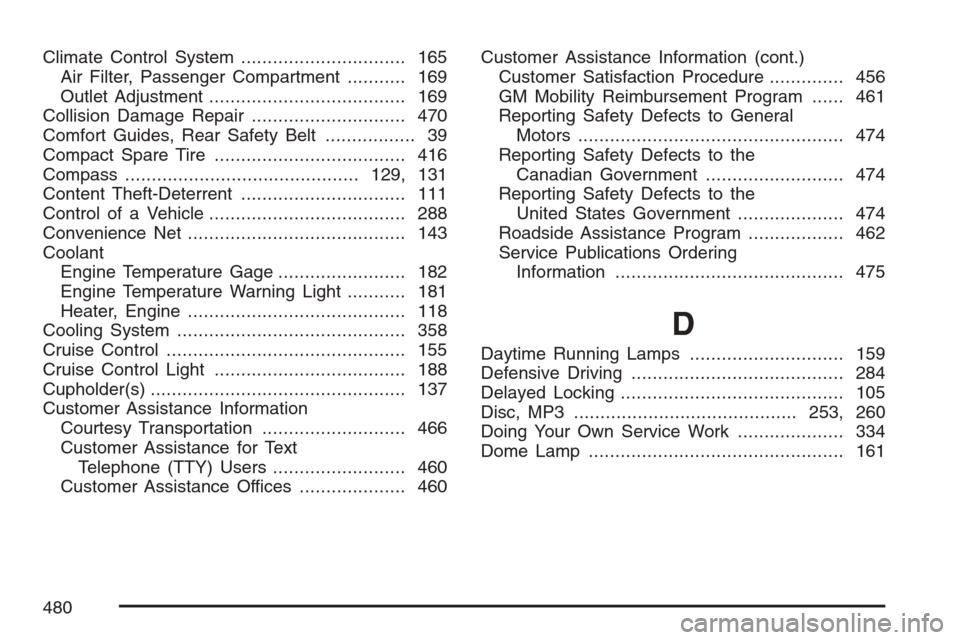
Climate Control System............................... 165
Air Filter, Passenger Compartment........... 169
Outlet Adjustment..................................... 169
Collision Damage Repair............................. 470
Comfort Guides, Rear Safety Belt................. 39
Compact Spare Tire.................................... 416
Compass............................................129, 131
Content Theft-Deterrent............................... 111
Control of a Vehicle..................................... 288
Convenience Net......................................... 143
Coolant
Engine Temperature Gage........................ 182
Engine Temperature Warning Light........... 181
Heater, Engine......................................... 118
Cooling System........................................... 358
Cruise Control............................................. 155
Cruise Control Light.................................... 188
Cupholder(s)................................................ 137
Customer Assistance Information
Courtesy Transportation........................... 466
Customer Assistance for Text
Telephone (TTY) Users......................... 460
Customer Assistance Offices.................... 460Customer Assistance Information (cont.)
Customer Satisfaction Procedure.............. 456
GM Mobility Reimbursement Program...... 461
Reporting Safety Defects to General
Motors.................................................. 474
Reporting Safety Defects to the
Canadian Government.......................... 474
Reporting Safety Defects to the
United States Government.................... 474
Roadside Assistance Program.................. 462
Service Publications Ordering
Information........................................... 475
D
Daytime Running Lamps............................. 159
Defensive Driving........................................ 284
Delayed Locking.......................................... 105
Disc, MP3..........................................253, 260
Doing Your Own Service Work.................... 334
Dome Lamp................................................ 161
480
Page 481 of 492
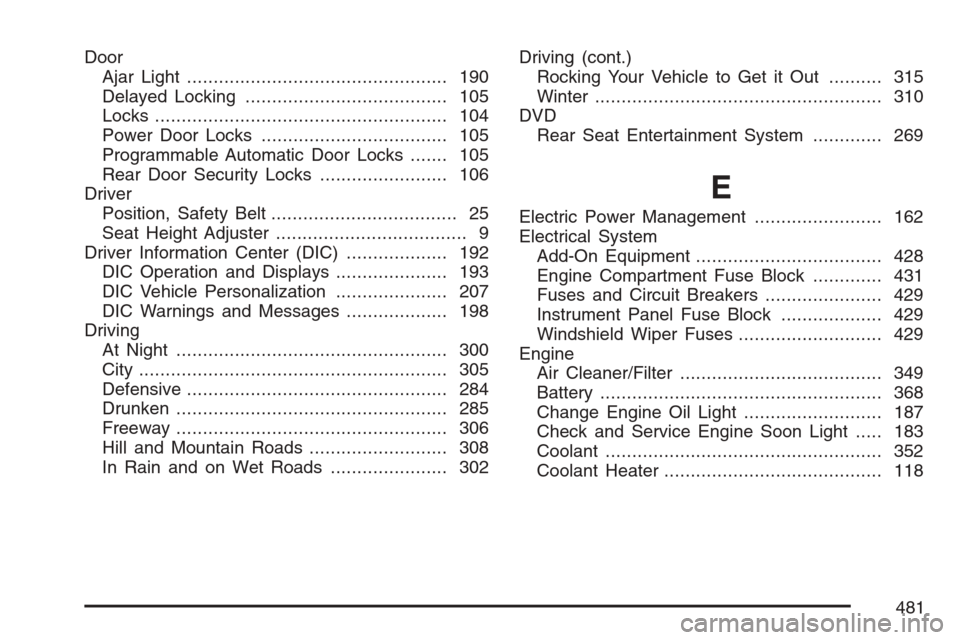
Door
Ajar Light................................................. 190
Delayed Locking...................................... 105
Locks....................................................... 104
Power Door Locks................................... 105
Programmable Automatic Door Locks....... 105
Rear Door Security Locks........................ 106
Driver
Position, Safety Belt................................... 25
Seat Height Adjuster.................................... 9
Driver Information Center (DIC)................... 192
DIC Operation and Displays..................... 193
DIC Vehicle Personalization..................... 207
DIC Warnings and Messages................... 198
Driving
At Night................................................... 300
City.......................................................... 305
Defensive................................................. 284
Drunken................................................... 285
Freeway................................................... 306
Hill and Mountain Roads.......................... 308
In Rain and on Wet Roads...................... 302Driving (cont.)
Rocking Your Vehicle to Get it Out.......... 315
Winter...................................................... 310
DVD
Rear Seat Entertainment System............. 269
E
Electric Power Management........................ 162
Electrical System
Add-On Equipment................................... 428
Engine Compartment Fuse Block............. 431
Fuses and Circuit Breakers...................... 429
Instrument Panel Fuse Block................... 429
Windshield Wiper Fuses........................... 429
Engine
Air Cleaner/Filter...................................... 349
Battery..................................................... 368
Change Engine Oil Light.......................... 187
Check and Service Engine Soon Light..... 183
Coolant.................................................... 352
Coolant Heater......................................... 118
481