2007 CHEVROLET EQUINOX maintenance
[x] Cancel search: maintenancePage 195 of 492
This is because different driving conditions produce
different fuel economies. Generally, freeway driving
produces better fuel economy than city driving.
If your vehicle is low on fuel, the FUEL LEVEL
LOW message will be displayed. See “FUEL
LEVEL LOW” underDIC Warnings and Messages
on page 198for more information.
Blank Display
This display shows no information.
Vehicle Information Menu Items
T
(Vehicle Information):Press this button to
scroll through the following displays:
OIL LIFE
Press the vehicle information button until OIL LIFE
REMAINING displays. This display shows an
estimate of the oil’s remaining useful life. If you see
99% OIL LIFE REMAINING on the display, that
means 99% of the current oil life remains. The
engine oil life system will alert you to change your
oil on a schedule consistent with your driving
conditions.When the remaining oil life is low, the CHANGE
ENGINE OIL SOON message will appear on the
display. See “CHANGE ENGINE OIL SOON” under
DIC Warnings and Messages on page 198. You
should change your oil as soon as possible. See
Engine Oil on page 344. In addition to the engine
oil life system monitoring the oil life, additional
maintenance is recommended in the Maintenance
Schedule in this manual. SeeScheduled
Maintenance on page 439for more information.
Remember, you must reset the OIL LIFE yourself
after each oil change. It will not reset itself. Also, be
careful not to reset the OIL LIFE accidentally at any
time other than when the oil has just been changed.
It cannot be reset accurately until the next oil
change. To reset the engine oil life system, see
Engine Oil Life System on page 347.UNITS
Press the vehicle information button until UNITS
displays. This display allows you to select between
English or Metric units of measurement. Once in
this display, press the set/reset button to select
between ENGLISH or METRIC units.
195
Page 199 of 492
BUCKLE PASSENGER SEATBELT
This message reminds you to buckle the
passenger’s safety belt. SeePassenger Sensing
System on page 82.
This message displays and a chime sounds when
the ignition is on, the driver’s safety belt is
buckled, the passenger’s safety belt is unbuckled
with the passenger airbag enabled, and the
vehicle is in motion. You should have the
passenger buckle their safety belt.
This reminder will be repeated if the ignition is on,
the vehicle is in motion, the driver is buckled
and the passenger is still unbuckled, and
the passenger airbag is enabled. If the
passenger’s safety belt is already buckled, this
message and chime will not come on.
BUCKLE SEATBELT
This message reminds you to buckle the driver’s
safety belt.
This message displays and a chime sounds
when the ignition is on, the driver’s safety belt
is unbuckled, and the vehicle is in motion.
You should buckle your safety belt.If the driver remains unbuckled when the ignition
is on and the vehicle is in motion, the reminder
will be repeated. If the driver’s safety belt is
already buckled, this message and chime will not
come on.
This message is an additional reminder to the
Safety Belt Reminder Light in the instrument
panel cluster. SeeSafety Belt Reminder Light
on page 173.
CHANGE ENGINE OIL SOON
This message displays when service is required
for the vehicle. See your dealer. SeeEngine
Oil on page 344andScheduled Maintenance
on page 439for more information.
Acknowledging this message will not reset the
OIL LIFE REMAINING display. That must be
done at the OIL LIFE screen under the vehicle
information menu. See “OIL LIFE” underDIC
Operation and Displays on page 193andEngine
Oil Life System on page 347for more information.
199
Page 294 of 492
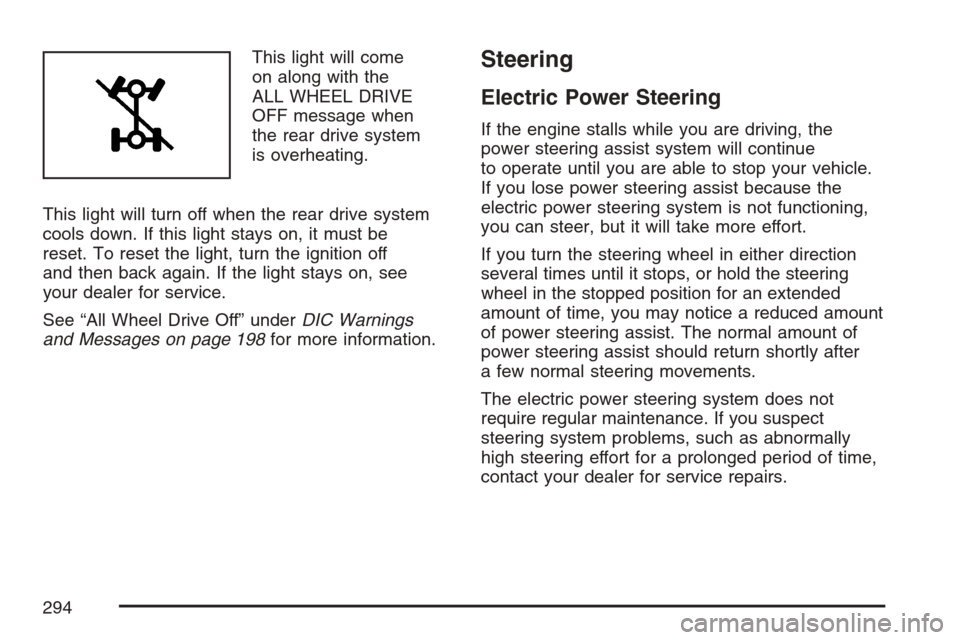
This light will come
on along with the
ALL WHEEL DRIVE
OFF message when
the rear drive system
is overheating.
This light will turn off when the rear drive system
cools down. If this light stays on, it must be
reset. To reset the light, turn the ignition off
and then back again. If the light stays on, see
your dealer for service.
See “All Wheel Drive Off” underDIC Warnings
and Messages on page 198for more information.Steering
Electric Power Steering
If the engine stalls while you are driving, the
power steering assist system will continue
to operate until you are able to stop your vehicle.
If you lose power steering assist because the
electric power steering system is not functioning,
you can steer, but it will take more effort.
If you turn the steering wheel in either direction
several times until it stops, or hold the steering
wheel in the stopped position for an extended
amount of time, you may notice a reduced amount
of power steering assist. The normal amount of
power steering assist should return shortly after
a few normal steering movements.
The electric power steering system does not
require regular maintenance. If you suspect
steering system problems, such as abnormally
high steering effort for a prolonged period of time,
contact your dealer for service repairs.
294
Page 330 of 492
When You Are Ready to Leave After
Parking on a Hill
1. Apply your regular brakes and hold the pedal
down while you do the following:
Start your engine.
Shift into a gear.
Release the parking brake.
2. Let up on the brake pedal.
3. Drive slowly until the trailer is clear of
the chocks.
4. Stop and have someone pick up and
store the chocks.
Maintenance When Trailer Towing
Your vehicle will need service more often when
you are pulling a trailer. See the Maintenance
Schedule for more on this. Things that are
especially important in trailer operation are
automatic transaxle uid, engine oil, belts, cooling
system and brake system. Each of these is
covered in this manual, and the Index will help
you nd them quickly. If you are trailering, it is a
good idea to review these sections before you
start your trip.
Check periodically to see that all hitch nuts and
bolts are tight.
330
Page 332 of 492
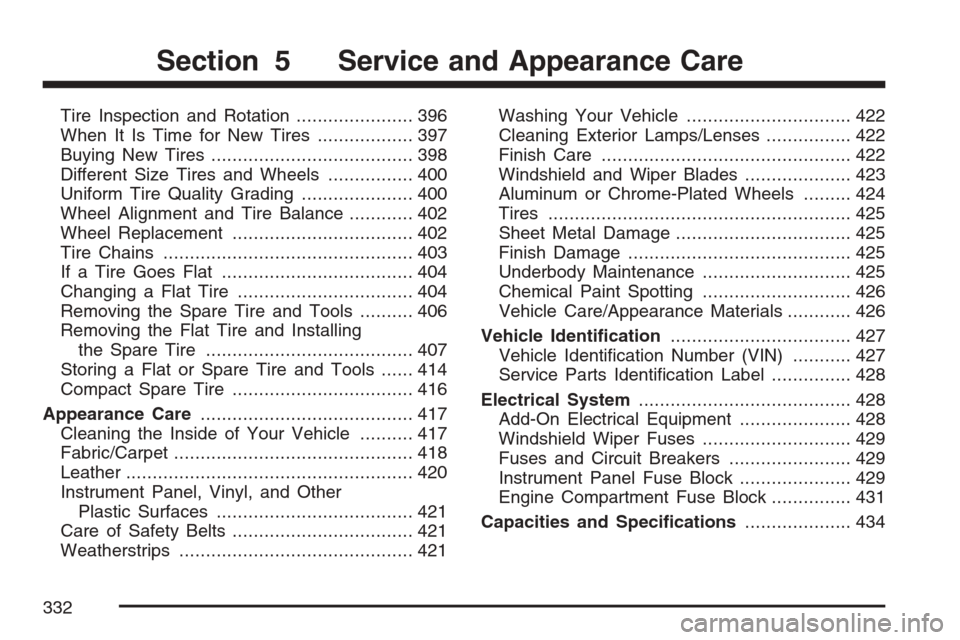
Tire Inspection and Rotation...................... 396
When It Is Time for New Tires.................. 397
Buying New Tires...................................... 398
Different Size Tires and Wheels................ 400
Uniform Tire Quality Grading..................... 400
Wheel Alignment and Tire Balance............ 402
Wheel Replacement.................................. 402
Tire Chains............................................... 403
If a Tire Goes Flat.................................... 404
Changing a Flat Tire................................. 404
Removing the Spare Tire and Tools.......... 406
Removing the Flat Tire and Installing
the Spare Tire....................................... 407
Storing a Flat or Spare Tire and Tools...... 414
Compact Spare Tire.................................. 416
Appearance Care........................................ 417
Cleaning the Inside of Your Vehicle.......... 417
Fabric/Carpet............................................. 418
Leather...................................................... 420
Instrument Panel, Vinyl, and Other
Plastic Surfaces..................................... 421
Care of Safety Belts.................................. 421
Weatherstrips............................................ 421Washing Your Vehicle............................... 422
Cleaning Exterior Lamps/Lenses................ 422
Finish Care............................................... 422
Windshield and Wiper Blades.................... 423
Aluminum or Chrome-Plated Wheels......... 424
Tires......................................................... 425
Sheet Metal Damage................................. 425
Finish Damage.......................................... 425
Underbody Maintenance............................ 425
Chemical Paint Spotting............................ 426
Vehicle Care/Appearance Materials............ 426
Vehicle Identication.................................. 427
Vehicle Identication Number (VIN)........... 427
Service Parts Identication Label............... 428
Electrical System........................................ 428
Add-On Electrical Equipment..................... 428
Windshield Wiper Fuses............................ 429
Fuses and Circuit Breakers....................... 429
Instrument Panel Fuse Block..................... 429
Engine Compartment Fuse Block............... 431
Capacities and Specications.................... 434
Section 5 Service and Appearance Care
332
Page 334 of 492
California Proposition 65 Warning
Most motor vehicles, including this one, contain
and/or emit chemicals known to the State of
California to cause cancer and birth defects or other
reproductive harm. Engine exhaust, many parts and
systems (including some inside the vehicle), many
uids, and some component wear by-products
contain and/or emit these chemicals.
Doing Your Own Service Work
{CAUTION:
You can be injured and your vehicle could
be damaged if you try to do service work
on a vehicle without knowing enough
about it.
Be sure you have sufficient knowledge,
experience, the proper replacement
parts, and tools before you attempt any
vehicle maintenance task.
CAUTION: (Continued)
CAUTION: (Continued)
Be sure to use the proper nuts, bolts,
and other fasteners. English and metric
fasteners can be easily confused. If you
use the wrong fasteners, parts can later
break or fall off. You could be hurt.
If you want to do some of your own service work,
you will want to use the proper service manual.
It tells you much more about how to service your
vehicle than this manual can. To order the
proper service manual, seeService Publications
Ordering Information on page 475.
Your vehicle has an airbag system. Before
attempting to do your own service work, see
Servicing Your Airbag-Equipped Vehicle on
page 88.
You should keep a record with all parts receipts
and list the mileage and the date of any service
work you perform. SeeMaintenance Record
on page 451.
334
Page 335 of 492
Adding Equipment to the Outside
of Your Vehicle
Things you might add to the outside of your
vehicle can affect the airow around it. This may
cause wind noise and affect windshield washer
performance. Check with your dealer before
adding equipment to the outside of your vehicle.
Fuel
Use of the recommended fuel is an important
part of the proper maintenance of your vehicle.
To help keep your engine clean and maintain
optimum vehicle performance, GM recommends
the use of gasoline advertised as TOP TIER
Detergent Gasoline.
Gasoline Octane
Use regular unleaded gasoline with a posted
octane rating of 87 or higher. If the octane rating
is less than 87, you may notice an audible
knocking noise when you drive, commonly referred
to as spark knock. If this occurs, use a gasoline
rated at 87 octane or higher as soon as possible.
If you are using gasoline rated at 87 octane or
higher and you hear heavy knocking, your engine
needs service.
Gasoline Specications
At a minimum, gasoline should meet ASTM
specication D 4814 in the United States or
CAN/CGSB-3.5 in Canada. Some gasolines may
contain an octane-enhancing additive called
methylcyclopentadienyl manganese tricarbonyl
(MMT). General Motors recommends against the
use of gasolines containing MMT. SeeAdditives
on page 336for additional information.
335
Page 349 of 492
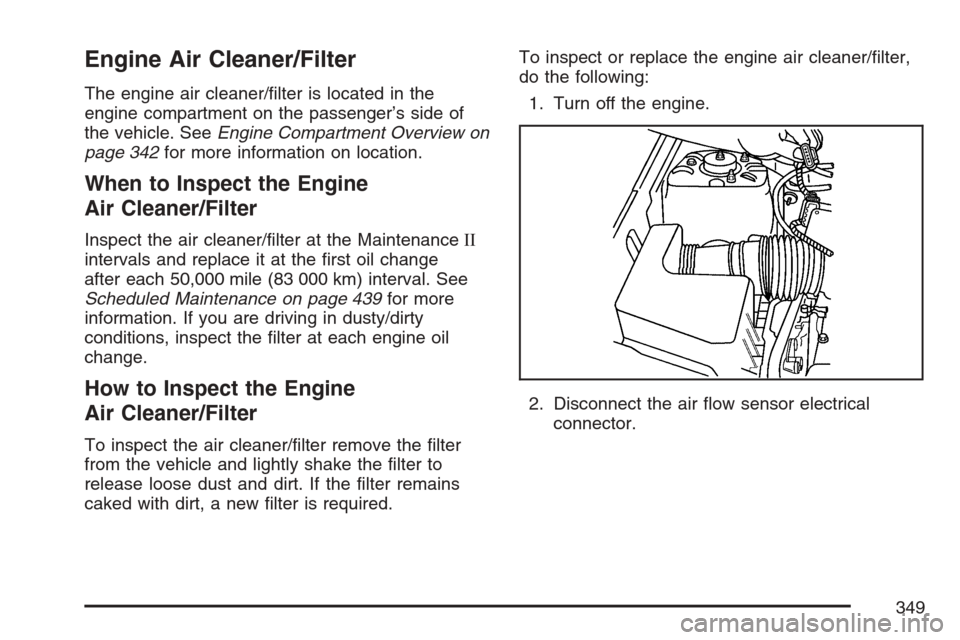
Engine Air Cleaner/Filter
The engine air cleaner/lter is located in the
engine compartment on the passenger’s side of
the vehicle. SeeEngine Compartment Overview on
page 342for more information on location.
When to Inspect the Engine
Air Cleaner/Filter
Inspect the air cleaner/lter at the MaintenanceII
intervals and replace it at the rst oil change
after each 50,000 mile (83 000 km) interval. See
Scheduled Maintenance on page 439for more
information. If you are driving in dusty/dirty
conditions, inspect the lter at each engine oil
change.
How to Inspect the Engine
Air Cleaner/Filter
To inspect the air cleaner/lter remove the lter
from the vehicle and lightly shake the lter to
release loose dust and dirt. If the lter remains
caked with dirt, a new lter is required.To inspect or replace the engine air cleaner/lter,
do the following:
1. Turn off the engine.
2. Disconnect the air ow sensor electrical
connector.
349