2007 CHEVROLET EQUINOX headlamp
[x] Cancel search: headlampPage 189 of 492
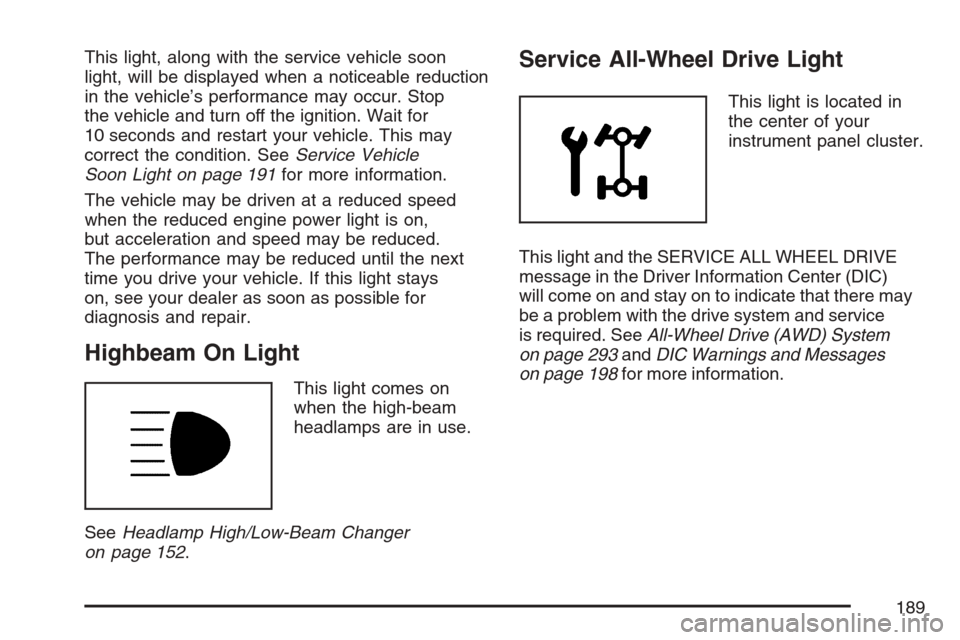
This light, along with the service vehicle soon
light, will be displayed when a noticeable reduction
in the vehicle’s performance may occur. Stop
the vehicle and turn off the ignition. Wait for
10 seconds and restart your vehicle. This may
correct the condition. SeeService Vehicle
Soon Light on page 191for more information.
The vehicle may be driven at a reduced speed
when the reduced engine power light is on,
but acceleration and speed may be reduced.
The performance may be reduced until the next
time you drive your vehicle. If this light stays
on, see your dealer as soon as possible for
diagnosis and repair.
Highbeam On Light
This light comes on
when the high-beam
headlamps are in use.
SeeHeadlamp High/Low-Beam Changer
on page 152.
Service All-Wheel Drive Light
This light is located in
the center of your
instrument panel cluster.
This light and the SERVICE ALL WHEEL DRIVE
message in the Driver Information Center (DIC)
will come on and stay on to indicate that there may
be a problem with the drive system and service
is required. SeeAll-Wheel Drive (AWD) System
on page 293andDIC Warnings and Messages
on page 198for more information.
189
Page 208 of 492
Entering the Feature Settings Menu
1. Turn the ignition on and place the vehicle in
PARK (P).
To avoid excessive drain on the battery, it is
recommended that the headlamps are
turned off.
2. Press the vehicle information button until
FEATURE SETTINGS PRESS
VTO
SELECT appears on the DIC display.
3. Press the set/reset button to enter the feature
settings menu.
If the menu is not available, FEATURE
SETTINGS AVAILABLE IN PRK (Park) will
display. Before entering the menu, make sure
the vehicle is in PARK (P).
Feature Settings Menu Items
The following are personalization features that
allow you to program settings to the vehicle:
DISPLAY ENGLISH
This feature will only display if a language other
than English has been set. This feature allows
you to change the language in which the DIC
messages appear to English.Press the vehicle information button until the
PRESS
VTO DISPLAY ENGLISH screen appears
on the DIC display. Press the set/reset button to
display all DIC messages in English.
DISPLAY LANGUAGE
This feature allows you to select the language in
which the DIC messages will appear.
Press the vehicle information button until DISPLAY
LANGUAGE appears on the DIC display. Press
the set/reset button to access the settings for this
feature. Then press the vehicle information
button to scroll through the following settings:
ENGLISH (default):All messages will appear
in English.
FRANCAIS (French):All messages will appear
in French.
ESPANOL (Spanish):All messages will appear
in Spanish.
NO CHANGE:No change will be made to this
feature. The current setting will remain.
Choose one of the available settings and press
the set/reset button while it is displayed on the
DIC to select it.
208
Page 300 of 492
If your vehicle starts to slide, ease your foot off
the accelerator pedal and quickly steer the
way you want the vehicle to go. If you start
steering quickly enough, your vehicle may
straighten out. Always be ready for a second
skid if it occurs.
Of course, traction is reduced when water, snow,
ice, gravel, or other material is on the road.
For safety, you will want to slow down and adjust
your driving to these conditions. It is important
to slow down on slippery surfaces because
stopping distance will be longer and vehicle
control more limited.
While driving on a surface with reduced traction,
try your best to avoid sudden steering, acceleration,
or braking, including reducing vehicle speed by
shifting to a lower gear. Any sudden changes could
cause the tires to slide. You may not realize the
surface is slippery until your vehicle is skidding.
Learn to recognize warning clues — such as
enough water, ice, or packed snow on the road
to make a mirrored surface — and slow down
when you have any doubt.
Remember: Any Anti-Lock Brake System (ABS)
helps avoid only the braking skid.Driving at Night
Night driving is more dangerous than day driving.
One reason is that some drivers are likely to
be impaired — by alcohol or drugs, with night
vision problems, or by fatigue.
Here are some tips on night driving.
Drive defensively.
Do not drink and drive.
Adjust the inside rearview mirror to reduce the
glare from headlamps behind you.
Since you cannot see as well, you may need
to slow down and keep more space between
you and other vehicles.
Slow down, especially on higher speed roads.
Your vehicle’s headlamps can light up only so
much road ahead.
In remote areas, watch for animals.
If you are tired, pull off the road in a safe
place and rest.
300
Page 301 of 492
No one can see as well at night as in the daytime.
But as we get older these differences increase.
A 50-year-old driver may require at least twice as
much light to see the same thing at night as a
20-year-old.
What you do in the daytime can also affect your
night vision. For example, if you spend the
day in bright sunshine you are wise to wear
sunglasses. Your eyes will have less trouble
adjusting to night. But if you are driving, do not
wear sunglasses at night. They may cut down on
glare from headlamps, but they also make a
lot of things invisible.
You can be temporarily blinded by approaching
headlamps. It can take a second or two, or
even several seconds, for your eyes to re-adjust
to the dark. When you are faced with severe glare,
as from a driver who does not lower the high
beams, or a vehicle with misaimed headlamps,
slow down a little. Avoid staring directly into
the approaching headlamps.Keep the windshield and all the glass on your
vehicle clean — inside and out. Glare at night is
made much worse by dirt on the glass. Even
the inside of the glass can build up a lm caused
by dust. Dirty glass makes lights dazzle and
ash more than clean glass would, making the
pupils of your eyes contract repeatedly.
Remember that the headlamps light up far less of a
roadway when you are in a turn or curve. Keep your
eyes moving; that way, it is easier to pick out dimly
lighted objects. Just as the headlamps should be
checked regularly for proper aim, so should your
eyes be examined regularly. Some drivers suffer
from night blindness — the inability to see in dim
light — and are not even aware of it.
301
Page 304 of 492
Driving Through Deep Standing Water
Notice:If you drive too quickly through deep
puddles or standing water, water can come in
through your engine’s air intake and badly
damage your engine. Never drive through water
that is slightly lower than the underbody of your
vehicle. If you cannot avoid deep puddles or
standing water, drive through them very slowly.
Driving Through Flowing Water
{CAUTION:
Flowing or rushing water creates strong
forces. If you try to drive through owing
water, as you might at a low water
crossing, your vehicle can be carried away.
As little as six inches of owing water
can carry away a smaller vehicle. If this
happens, you and other vehicle occupants
could drown. Do not ignore police warning
signs, and otherwise be very cautious
about trying to drive through owing water.
Some Other Rainy Weather Tips
Turn on your low-beam headlamps — not
just your parking lamps — to help make
you more visible to others.
Besides slowing down, allow some extra
following distance. And be especially
careful when you pass another vehicle.
Allow yourself more clear room ahead,
and be prepared to have your view
restricted by road spray.
Have good tires with proper tread depth.
SeeTires on page 382.
304
Page 314 of 492
You will need a well-charged battery to restart the
vehicle, and possibly for signaling later on with
your headlamps. Let the heater run for a while.
Then, shut the engine off and close the window
almost all the way to preserve the heat. Start
the engine again and repeat this only when you
feel really uncomfortable from the cold. But do it as
little as possible. Preserve the fuel as long as
you can. To help keep warm, you can get out of
the vehicle and do some fairly vigorous exercises
every half hour or so until help comes.
If Your Vehicle is Stuck in Sand,
Mud, Ice, or Snow
In order to free your vehicle when it is stuck, you
will need to spin the wheels, but you do not
want to spin your wheels too fast. The method
known as rocking can help you get out when you
are stuck, but you must use caution.
{CAUTION:
If you let your vehicle’s tires spin at high
speed, they can explode, and you or others
could be injured. And, the transaxle or
other parts of the vehicle can overheat.
That could cause an engine compartment
re or other damage. When you are stuck,
spin the wheels as little as possible. Do not
spin the wheels above 35 mph (55 km/h)
as shown on the speedometer.
Notice:Spinning the wheels can destroy
parts of your vehicle as well as the tires.
If you spin the wheels too fast while shifting
the transaxle back and forth, you can destroy
the transaxle. SeeRocking Your Vehicle to
Get It Out on page 315.
For information about using tire chains on your
vehicle, seeTire Chains on page 403.
314
Page 331 of 492
Service........................................................ 333
Accessories and Modications................... 333
California Proposition 65 Warning.............. 334
Doing Your Own Service Work.................. 334
Adding Equipment to the Outside
of Your Vehicle...................................... 335
Fuel............................................................. 335
Gasoline Octane........................................ 335
Gasoline Specications.............................. 335
California Fuel........................................... 336
Additives................................................... 336
Fuels in Foreign Countries........................ 337
Filling the Tank......................................... 337
Filling a Portable Fuel Container............... 339
Checking Things Under the Hood.............. 340
Hood Release........................................... 340
Engine Compartment Overview.................. 342
Engine Oil................................................. 344
Engine Oil Life System.............................. 347
Engine Air Cleaner/Filter............................ 349
Automatic Transaxle Fluid......................... 352
Engine Coolant.......................................... 352
Engine Overheating................................... 355Overheated Engine Protection
Operating Mode..................................... 357
Cooling System......................................... 358
Windshield Washer Fluid........................... 364
Brakes...................................................... 365
Battery...................................................... 368
Jump Starting............................................ 368
All-Wheel Drive........................................... 374
Bulb Replacement....................................... 375
Halogen Bulbs........................................... 376
Headlamps, Front Turn Signal,
Sidemarker, and Parking Lamps............. 376
Taillamps, Turn Signal, Stoplamps
and Back-up Lamps............................... 378
License Plate Lamp................................... 380
Replacement Bulbs................................... 380
Windshield Wiper Blade Replacement....... 380
Tires............................................................ 382
Tire Sidewall Labeling............................... 383
Tire Terminology and Denitions............... 387
Ination - Tire Pressure............................. 390
Tire Pressure Monitor System................... 391
Section 5 Service and Appearance Care
331
Page 376 of 492
Halogen Bulbs
{CAUTION:
Halogen bulbs have pressurized gas
inside and can burst if you drop or
scratch the bulb. You or others could be
injured. Be sure to read and follow the
instructions on the bulb package.
Headlamps, Front Turn Signal,
Sidemarker, and Parking Lamps
To replace one of these bulbs, do the following:
1. Open the hood. SeeHood Release on
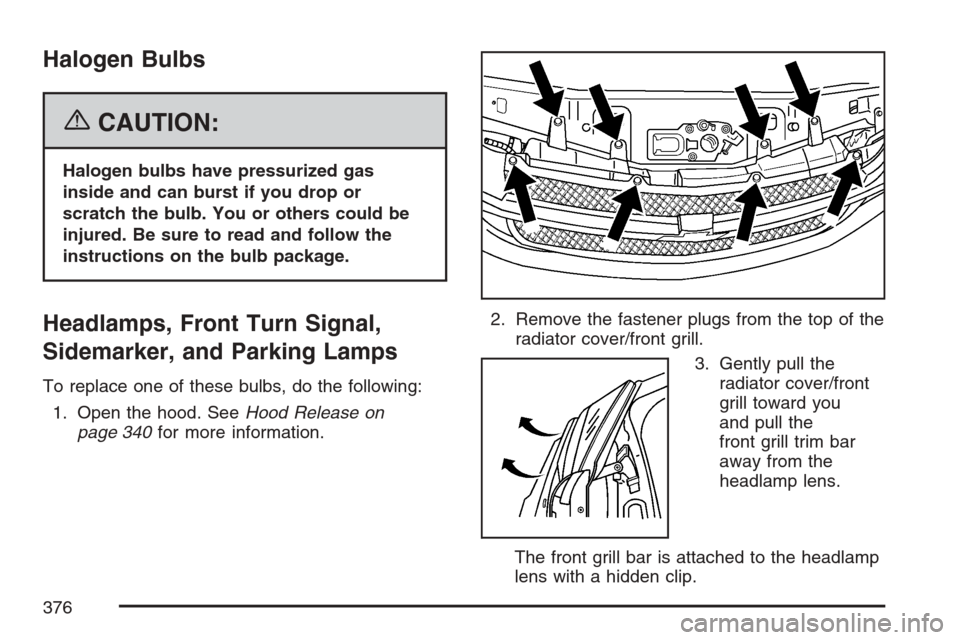
page 340for more information.2. Remove the fastener plugs from the top of the
radiator cover/front grill.
3. Gently pull the
radiator cover/front
grill toward you
and pull the
front grill trim bar
away from the
headlamp lens.
The front grill bar is attached to the headlamp
lens with a hidden clip.
376