Page 362 of 492
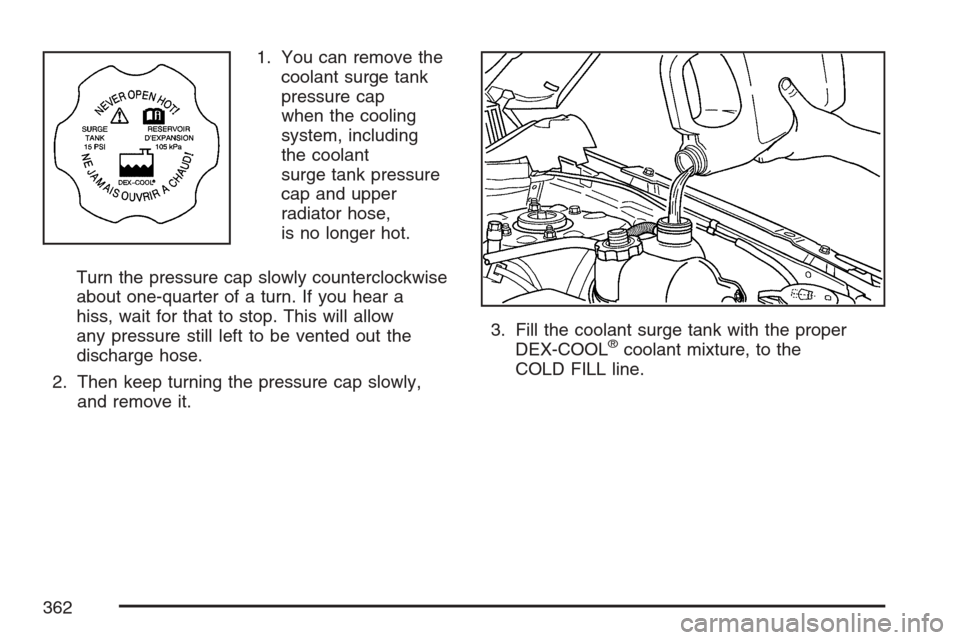
1. You can remove the
coolant surge tank
pressure cap
when the cooling
system, including
the coolant
surge tank pressure
cap and upper
radiator hose,
is no longer hot.
Turn the pressure cap slowly counterclockwise
about one-quarter of a turn. If you hear a
hiss, wait for that to stop. This will allow
any pressure still left to be vented out the
discharge hose.
2. Then keep turning the pressure cap slowly,
and remove it.3. Fill the coolant surge tank with the proper
DEX-COOL
®coolant mixture, to the
COLD FILL line.
362
Page 368 of 492
Battery
Your vehicle has a maintenance free battery.
When it is time for a new battery, get one that has
the replacement number shown on the original
battery’s label. We recommend an ACDelco
®
replacement battery.
For battery replacement, see your dealer or the
service manual. To purchase a service manual,
seeService and Owner PublicationsinService
Publications Ordering Information on page 475.
Warning:Battery posts, terminals, and related
accessories contain lead and lead compounds,
chemicals known to the State of California
to cause cancer and reproductive harm.
Wash hands after handling.
Vehicle Storage
If you are not going to drive your vehicle for
25 days or more, remove the black, negative (−)
cable from the battery. This will help keep
your battery from running down.
{CAUTION:
Batteries have acid that can burn you and
gas that can explode. You can be badly
hurt if you are not careful. SeeJump
Starting on page 368for tips on working
around a battery without getting hurt.
You must close all doors and the liftgate before
reconnecting the battery. After reconnecting
the battery, you must press the unlock button on
the remote keyless entry transmitter. Failure
to follow this procedure may result in a sounding
alarm. Pressing unlock on the remote keyless
entry transmitter would stop the sounding alarm.
Jump Starting
If your battery has run down, you may want to use
another vehicle and some jumper cables to start
your vehicle. Be sure to use the following steps to
do it safely.
368
Page 370 of 492
3. Turn off the ignition on both vehicles. Unplug
unnecessary accessories plugged into the
cigarette lighter or the accessory power outlet.
Turn off the radio and all lamps that are not
needed. This will avoid sparks and help save
both batteries. And it could save your radio!
4. Open the hoods and locate the positive (+)
and negative (−) terminal locations on each
vehicle.
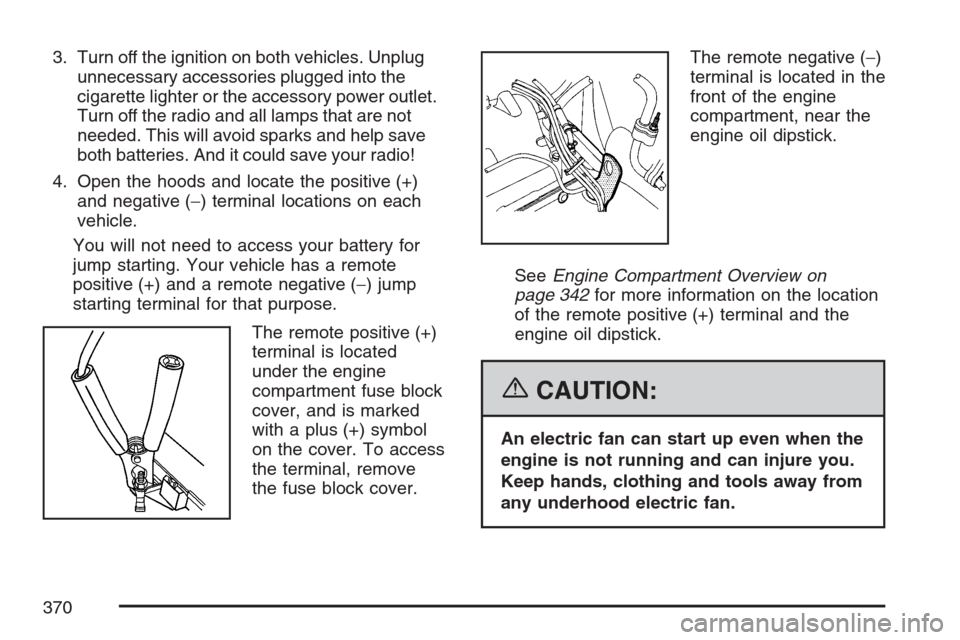
You will not need to access your battery for
jump starting. Your vehicle has a remote
positive (+) and a remote negative (−) jump
starting terminal for that purpose.
The remote positive (+)
terminal is located
under the engine
compartment fuse block
cover, and is marked
with a plus (+) symbol
on the cover. To access
the terminal, remove
the fuse block cover.The remote negative (−)
terminal is located in the
front of the engine
compartment, near the
engine oil dipstick.
SeeEngine Compartment Overview on
page 342for more information on the location
of the remote positive (+) terminal and the
engine oil dipstick.
{CAUTION:
An electric fan can start up even when the
engine is not running and can injure you.
Keep hands, clothing and tools away from
any underhood electric fan.
370
Page 372 of 492
6. Connect the red positive (+) cable to the
positive (+) terminal of the dead battery.
Use a remote positive (+) terminal if
the vehicle has one.
7. Do not let the other end touch metal. Connect
it to the positive (+) terminal of the good
battery. Use a remote positive (+) terminal if
the vehicle has one.
8. Now connect the black negative (−) cable to
the negative (−) terminal of the good battery.
Use a remote negative (−) terminal if the
vehicle has one.
Do not let the other end touch anything until
the next step. The other end of the negative (−)
cable does not go to the dead battery. It
goes to a heavy, unpainted metal engine part
or to a remote negative (−) terminal on the
vehicle with the dead battery.
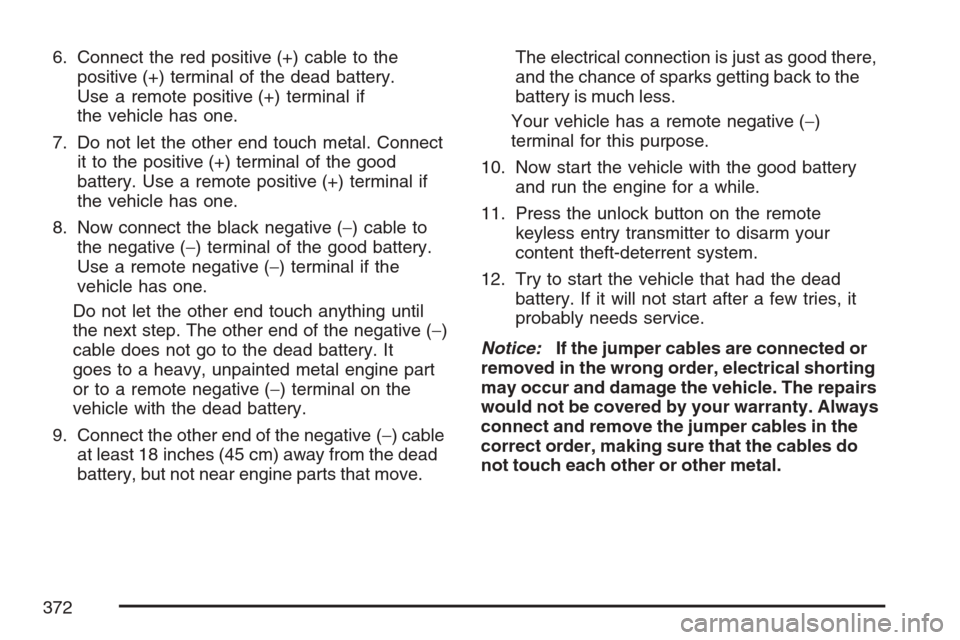
9. Connect the other end of the negative (−) cable
at least 18 inches (45 cm) away from the dead
battery, but not near engine parts that move.The electrical connection is just as good there,
and the chance of sparks getting back to the
battery is much less.
Your vehicle has a remote negative (−)
terminal for this purpose.
10. Now start the vehicle with the good battery
and run the engine for a while.
11. Press the unlock button on the remote
keyless entry transmitter to disarm your
content theft-deterrent system.
12. Try to start the vehicle that had the dead
battery. If it will not start after a few tries, it
probably needs service.
Notice:If the jumper cables are connected or
removed in the wrong order, electrical shorting
may occur and damage the vehicle. The repairs
would not be covered by your warranty. Always
connect and remove the jumper cables in the
correct order, making sure that the cables do
not touch each other or other metal.
372
Page 373 of 492
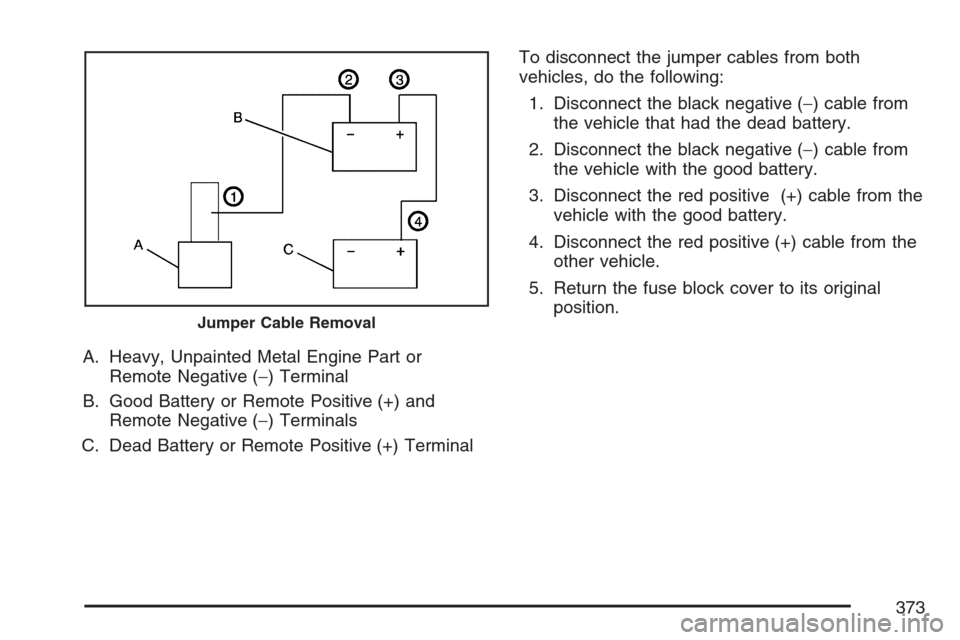
A. Heavy, Unpainted Metal Engine Part or
Remote Negative (−) Terminal
B. Good Battery or Remote Positive (+) and
Remote Negative (−) Terminals
C. Dead Battery or Remote Positive (+) TerminalTo disconnect the jumper cables from both
vehicles, do the following:
1. Disconnect the black negative (−) cable from
the vehicle that had the dead battery.
2. Disconnect the black negative (−) cable from
the vehicle with the good battery.
3. Disconnect the red positive (+) cable from the
vehicle with the good battery.
4. Disconnect the red positive (+) cable from the
other vehicle.
5. Return the fuse block cover to its original
position.
Jumper Cable Removal
373
Page 378 of 492
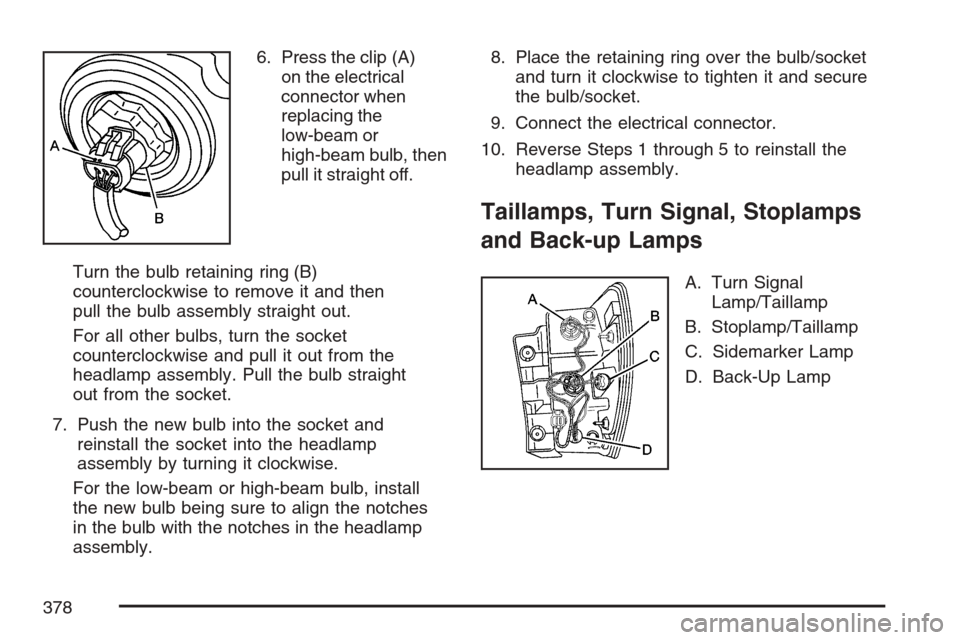
6. Press the clip (A)
on the electrical
connector when
replacing the
low-beam or
high-beam bulb, then
pull it straight off.
Turn the bulb retaining ring (B)
counterclockwise to remove it and then
pull the bulb assembly straight out.
For all other bulbs, turn the socket
counterclockwise and pull it out from the
headlamp assembly. Pull the bulb straight
out from the socket.
7. Push the new bulb into the socket and
reinstall the socket into the headlamp
assembly by turning it clockwise.
For the low-beam or high-beam bulb, install
the new bulb being sure to align the notches
in the bulb with the notches in the headlamp
assembly.8. Place the retaining ring over the bulb/socket
and turn it clockwise to tighten it and secure
the bulb/socket.
9. Connect the electrical connector.
10. Reverse Steps 1 through 5 to reinstall the
headlamp assembly.
Taillamps, Turn Signal, Stoplamps
and Back-up Lamps
A. Turn Signal
Lamp/Taillamp
B. Stoplamp/Taillamp
C. Sidemarker Lamp
D. Back-Up Lamp
378
Page 379 of 492
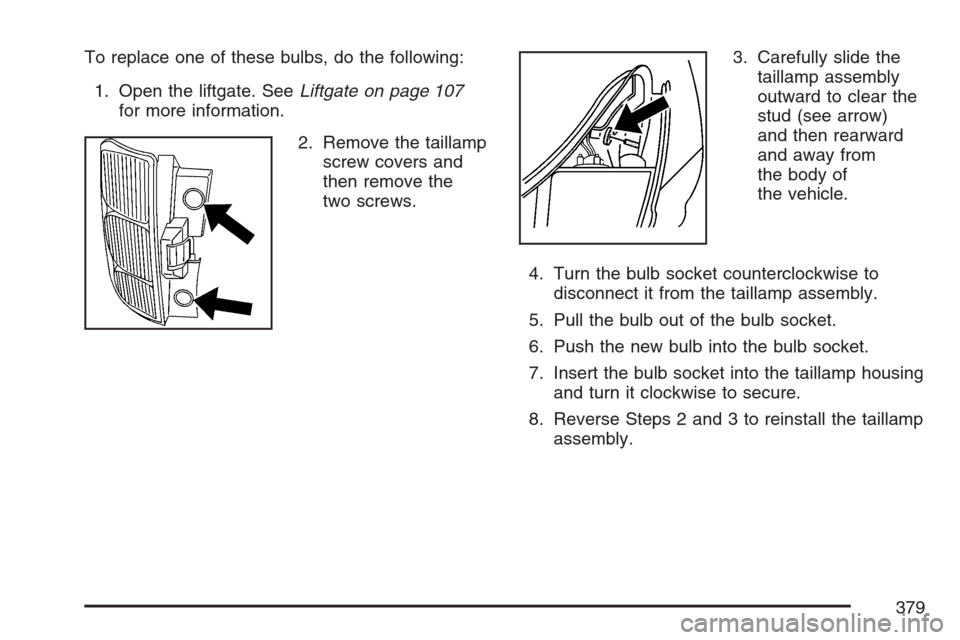
To replace one of these bulbs, do the following:
1. Open the liftgate. SeeLiftgate on page 107
for more information.
2. Remove the taillamp
screw covers and
then remove the
two screws.3. Carefully slide the
taillamp assembly
outward to clear the
stud (see arrow)
and then rearward
and away from
the body of
the vehicle.
4. Turn the bulb socket counterclockwise to
disconnect it from the taillamp assembly.
5. Pull the bulb out of the bulb socket.
6. Push the new bulb into the bulb socket.
7. Insert the bulb socket into the taillamp housing
and turn it clockwise to secure.
8. Reverse Steps 2 and 3 to reinstall the taillamp
assembly.
379
Page 380 of 492
License Plate Lamp
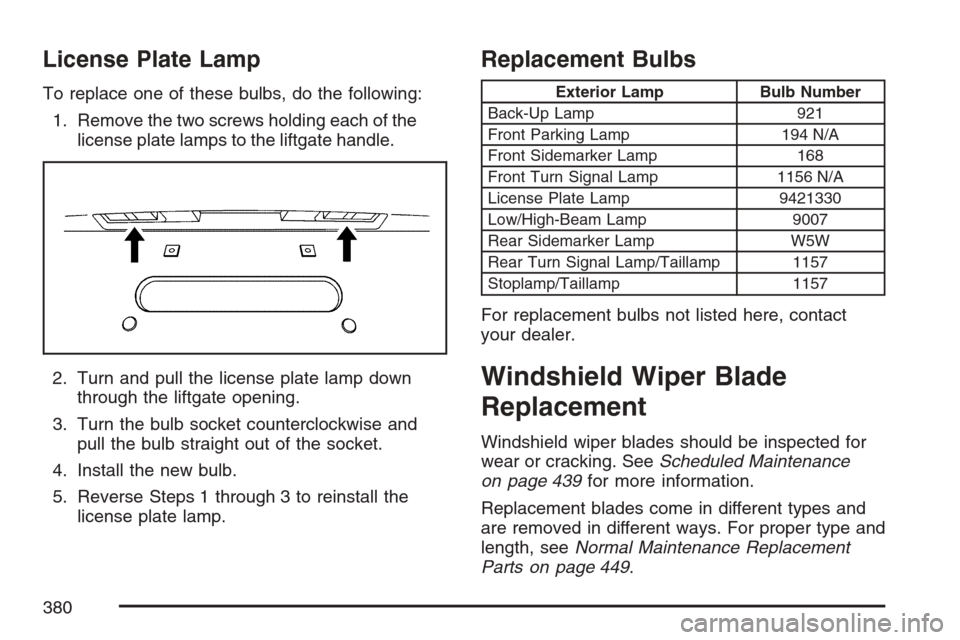
To replace one of these bulbs, do the following:
1. Remove the two screws holding each of the
license plate lamps to the liftgate handle.
2. Turn and pull the license plate lamp down
through the liftgate opening.
3. Turn the bulb socket counterclockwise and
pull the bulb straight out of the socket.
4. Install the new bulb.
5. Reverse Steps 1 through 3 to reinstall the
license plate lamp.
Replacement Bulbs
Exterior Lamp Bulb Number
Back-Up Lamp 921
Front Parking Lamp 194 N/A
Front Sidemarker Lamp 168
Front Turn Signal Lamp 1156 N/A
License Plate Lamp 9421330
Low/High-Beam Lamp 9007
Rear Sidemarker Lamp W5W
Rear Turn Signal Lamp/Taillamp 1157
Stoplamp/Taillamp 1157
For replacement bulbs not listed here, contact
your dealer.
Windshield Wiper Blade
Replacement
Windshield wiper blades should be inspected for
wear or cracking. SeeScheduled Maintenance
on page 439for more information.
Replacement blades come in different types and
are removed in different ways. For proper type and
length, seeNormal Maintenance Replacement
Parts on page 449.
380