Page 309 of 488
Rocking Your Vehicle to Get It Out
First, turn the steering wheel left and right to
clear the area around the front wheels. Turn the
traction control system off. SeeTraction Control
System (TCS) on page 281. Then shift back
and forth between REVERSE (R) and a forward
gear, spinning the wheels as little as possible.
For a manual transmission, shift slowly
between either FIRST (1) or SECOND (2) and
REVERSE (R), allowing the wheels to stop
before shifting into gear. To prevent transmission
wear, wait until the wheels stop spinning before
shifting gears. Release the accelerator pedal while
you shift, and press lightly on the accelerator
pedal when the transmission is in gear. By slowly
spinning the wheels in the forward and reverse
directions, you will cause a rocking motion
that could free your vehicle. If that does not get
your vehicle out after a few tries, it might need to
be towed out. If your vehicle does need to be
towed out, seeTowing Your Vehicle on page 315.
Loading Your Vehicle
It is very important to know how much weight your
vehicle can carry. This weight is called the vehicle
capacity weight and includes the weight of all
occupants, cargo and all nonfactory-installed
options. Two labels on your vehicle show how much
weight it may properly carry, the Tire and Loading
Information label and the Certication label.
{CAUTION:
Do not load your vehicle any heavier than
the Gross Vehicle Weight Rating (GVWR),
or either the maximum front or rear Gross
Axle Weight Rating (GAWR). If you do,
parts on your vehicle can break, and it
can change the way your vehicle handles.
These could cause you to lose control
and crash. Also, overloading can shorten
the life of your vehicle.
309
Page 315 of 488
Towing
Towing Your Vehicle
Consult your dealer or a professional towing
service if you need to have your disabled vehicle
towed. SeeRoadside Assistance Program
on page 458.
Recreational Vehicle Towing
Recreational vehicle towing means towing your
vehicle behind another vehicle — such as behind
a motorhome. The two most common types
of recreational vehicle towing are known as“dinghy towing”, towing your vehicle with all
four wheels on the ground, and “dolly towing”,
towing your vehicle with two wheels on the
ground and two wheels up on a device known
as a “dolly”.
Your vehicle was not designed to be towed with
any of its wheels on the ground. If your vehicle
must be towed, see “Towing Your Vehicle” earlier
in this section.Towing a Trailer
Your Corvette is neither designed nor intended
to tow a trailer.
315
Page 318 of 488
High-Speed Operation............................... 388
Tire Pressure Monitor System................... 389
Tire Rotation............................................. 393
When It Is Time for New Tires.................. 393
Buying New Tires...................................... 394
Different Size Tires and Wheels................ 396
Uniform Tire Quality Grading..................... 396
Wheel Alignment and Tire Balance............ 398
Wheel Replacement.................................. 398
Tire Chains............................................... 401
Lifting Your Vehicle................................... 402
If a Tire Goes Flat.................................... 406
Appearance Care........................................ 407
Cleaning the Inside of Your Vehicle.......... 407
Fabric/Carpet............................................. 409
Coated Moldings....................................... 409
Leather...................................................... 410
Instrument Panel, Vinyl, and Other
Plastic Surfaces..................................... 410
Cargo Cover and Convenience Net........... 411
Care of Safety Belts.................................. 411
Weatherstrips............................................ 411
Washing Your Vehicle............................... 411
Cleaning Exterior Lamps/Lenses................ 412Finish Care............................................... 412
Windshield and Wiper Blades.................... 413
Removable Roof Panel.............................. 413
Convertible Top......................................... 414
Aluminum or Chrome-Plated Wheels
and Trim................................................ 414
Tires......................................................... 415
Finish Damage.......................................... 415
Underbody Maintenance............................ 416
Fiberglass Springs (Composite Springs)..... 416
Chemical Paint Spotting............................ 416
Vehicle Care/Appearance Materials............ 417
Vehicle Identication.................................. 418
Vehicle Identication Number (VIN)........... 418
Service Parts Identication Label............... 418
Electrical System........................................ 418
Add-On Electrical Equipment..................... 418
Headlamp Wiring....................................... 419
Windshield Wiper Fuses............................ 419
Power Windows and Other Power Options ... 419
Fuses and Circuit Breakers....................... 419
Instrument Panel Fuse Block..................... 419
Engine Compartment Fuse Block............... 422
Capacities and Specications.................... 426
Section 5 Service and Appearance Care
318
Page 325 of 488
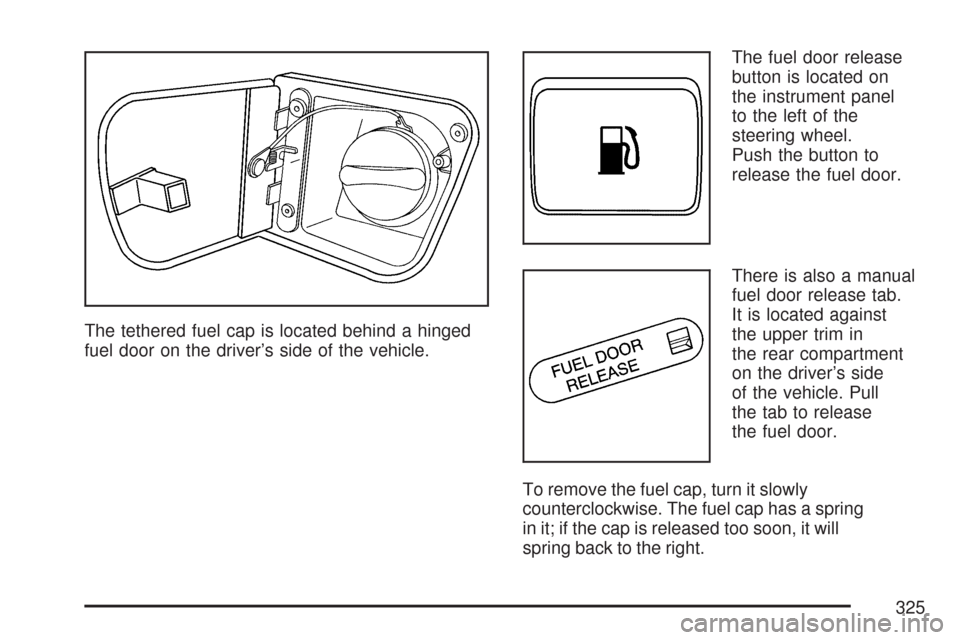
The tethered fuel cap is located behind a hinged
fuel door on the driver’s side of the vehicle.The fuel door release
button is located on
the instrument panel
to the left of the
steering wheel.
Push the button to
release the fuel door.
There is also a manual
fuel door release tab.
It is located against
the upper trim in
the rear compartment
on the driver’s side
of the vehicle. Pull
the tab to release
the fuel door.
To remove the fuel cap, turn it slowly
counterclockwise. The fuel cap has a spring
in it; if the cap is released too soon, it will
spring back to the right.
325
Page 363 of 488
Brake Wear
Your vehicle has four-wheel disc brakes.
Disc brake pads have built-in wear indicators that
make a high-pitched warning sound when the
brake pads are worn and new pads are needed.
The sound can come and go or be heard all
the time your vehicle is moving, except when you
are pushing on the brake pedal rmly.
{CAUTION:
The brake wear warning sound means that
soon the brakes will not work well. That
could lead to an accident. When you hear
the brake wear warning sound, have your
vehicle serviced.Notice:Continuing to drive with worn-out
brake pads could result in costly brake repair.
Some driving conditions or climates can cause
a brake squeal when the brakes are rst applied
or lightly applied. This does not mean something
is wrong with the brakes.
Brake linings should always be replaced as
complete axle sets.
Brake Pedal Travel
See your dealer/retailer if the brake pedal does
not return to normal height, or if there is a
rapid increase in pedal travel. This could be a
sign that brake service might be required.
Brake Adjustment
As you make brake stops, the disc brakes
automatically adjust for wear.
363
Page 373 of 488
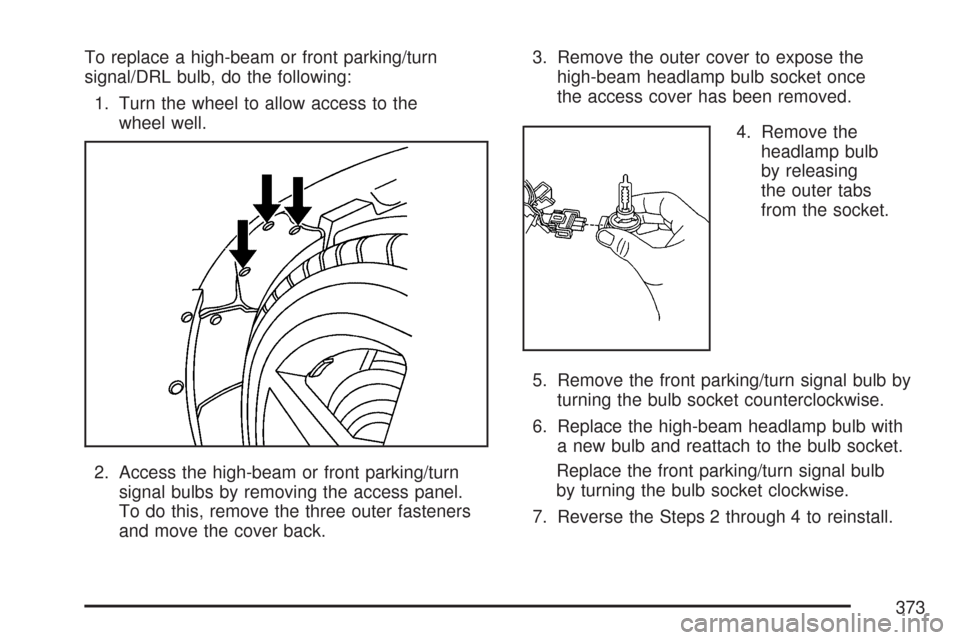
To replace a high-beam or front parking/turn
signal/DRL bulb, do the following:
1. Turn the wheel to allow access to the
wheel well.
2. Access the high-beam or front parking/turn
signal bulbs by removing the access panel.
To do this, remove the three outer fasteners
and move the cover back.3. Remove the outer cover to expose the
high-beam headlamp bulb socket once
the access cover has been removed.
4. Remove the
headlamp bulb
by releasing
the outer tabs
from the socket.
5. Remove the front parking/turn signal bulb by
turning the bulb socket counterclockwise.
6. Replace the high-beam headlamp bulb with
a new bulb and reattach to the bulb socket.
Replace the front parking/turn signal bulb
by turning the bulb socket clockwise.
7. Reverse the Steps 2 through 4 to reinstall.
373
Page 379 of 488
Low-Prole Performance Tire
The original equipment tires on your vehicle are
classied as low-prole performance tires. These
tires are designed for very responsive driving on
wet or dry pavement. You may also notice more
road noise with low-prole tires and that they
tend to wear faster.
Notice:If your vehicle has low-prole tires,
they are more susceptible to damage from
road hazards or curb impact than standard
prole tires. Tire and/or wheel assembly
damage can occur when coming into contact
with road hazards like, potholes, or sharp
edged objects, or when sliding into a curb.
Your GM warranty does not cover this type
of damage. Keep tires set to the correct
ination pressure and, when possible avoid
contact with curbs, potholes, and other
road hazards.
Winter Tires
If you expect to drive on snow or ice covered
roads often, you may want to get winter tires
for your vehicle. All season tires provide good
overall performance on most surfaces butthey may not offer the traction you would like
or the same level of performance as winter tires
on snow or ice covered roads.
Winter tires, in general, are designed for increased
traction on snow and ice covered roads. With winter
tires, there may be decreased dry road traction,
increased road noise, and shorter tread life. After
switching to winter tires, be alert for changes in
vehicle handling and braking.
See your dealer for details regarding winter tire
availability and proper tire selection. Also, see
Buying New Tires on page 394.
If you choose to use winter tires:
Use tires of the same brand and tread type
on all four wheel positions.
Use only radial ply tires of the same size,
load range, and speed rating as the original
equipment tires.
Winter tires with the same speed rating as your
original equipment tires may not be available for H,
V, W, Y, and ZR speed rated tires. If you choose
winter tires with a lower speed rating, never
exceed the tire’s maximum speed capability.
379
Page 381 of 488
(F) Uniform Tire Quality Grading (UTQG):
Tire manufacturers are required to grade
tires based on three performance factors:
treadwear, traction and temperature resistance.
For more information seeUniform Tire Quality
Grading on page 396.
(G) Maximum Cold Ination Load Limit:
Maximum load that can be carried and the
maximum pressure needed to support that load.
Tire Size
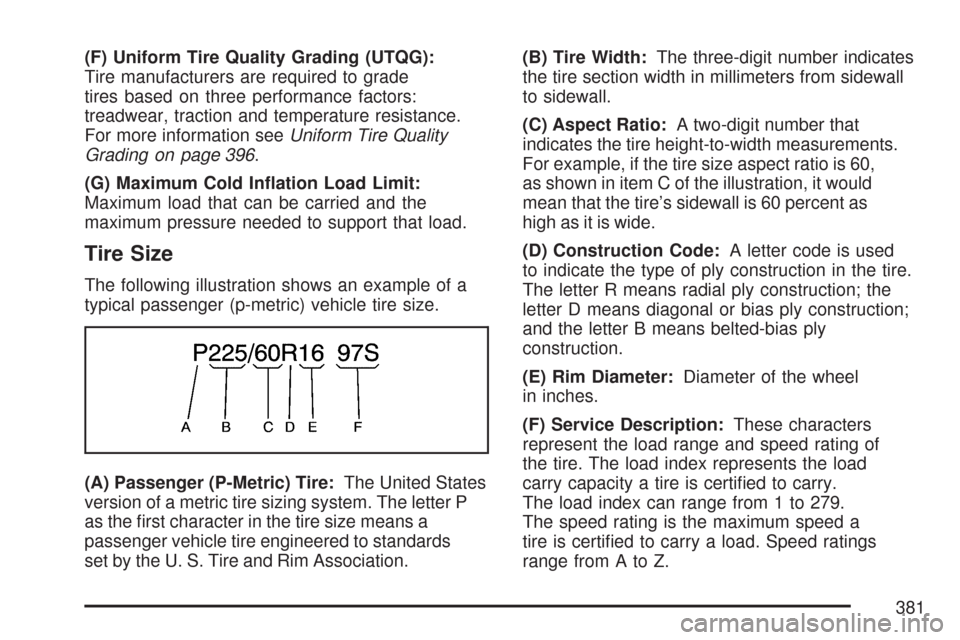
The following illustration shows an example of a
typical passenger (p-metric) vehicle tire size.
(A) Passenger (P-Metric) Tire:The United States
version of a metric tire sizing system. The letter P
as the rst character in the tire size means a
passenger vehicle tire engineered to standards
set by the U. S. Tire and Rim Association.(B) Tire Width:The three-digit number indicates
the tire section width in millimeters from sidewall
to sidewall.
(C) Aspect Ratio:A two-digit number that
indicates the tire height-to-width measurements.
For example, if the tire size aspect ratio is 60,
as shown in item C of the illustration, it would
mean that the tire’s sidewall is 60 percent as
high as it is wide.
(D) Construction Code:A letter code is used
to indicate the type of ply construction in the tire.
The letter R means radial ply construction; the
letter D means diagonal or bias ply construction;
and the letter B means belted-bias ply
construction.
(E) Rim Diameter:Diameter of the wheel
in inches.
(F) Service Description:These characters
represent the load range and speed rating of
the tire. The load index represents the load
carry capacity a tire is certied to carry.
The load index can range from 1 to 279.
The speed rating is the maximum speed a
tire is certied to carry a load. Speed ratings
range from A to Z.
381