2007 CHEVROLET AVEO service
[x] Cancel search: servicePage 108 of 436
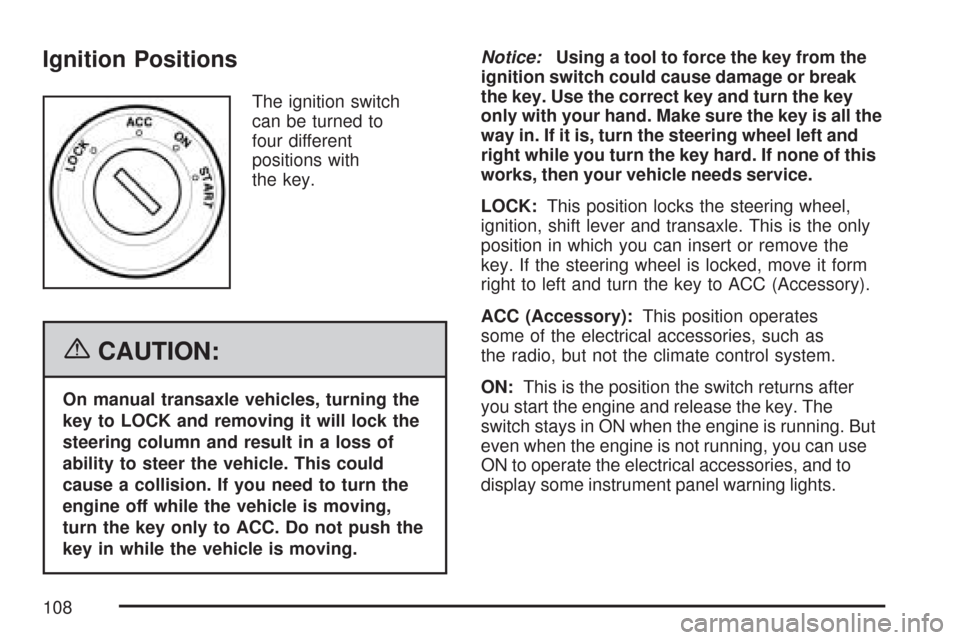
Ignition Positions
The ignition switch
can be turned to
four different
positions with
the key.
{CAUTION:
On manual transaxle vehicles, turning the
key to LOCK and removing it will lock the
steering column and result in a loss of
ability to steer the vehicle. This could
cause a collision. If you need to turn the
engine off while the vehicle is moving,
turn the key only to ACC. Do not push the
key in while the vehicle is moving.Notice:Using a tool to force the key from the
ignition switch could cause damage or break
the key. Use the correct key and turn the key
only with your hand. Make sure the key is all the
way in. If it is, turn the steering wheel left and
right while you turn the key hard. If none of this
works, then your vehicle needs service.
LOCK:This position locks the steering wheel,
ignition, shift lever and transaxle. This is the only
position in which you can insert or remove the
key. If the steering wheel is locked, move it form
right to left and turn the key to ACC (Accessory).
ACC (Accessory):This position operates
some of the electrical accessories, such as
the radio, but not the climate control system.
ON:This is the position the switch returns after
you start the engine and release the key. The
switch stays in ON when the engine is running. But
even when the engine is not running, you can use
ON to operate the electrical accessories, and to
display some instrument panel warning lights.
108
Page 114 of 436
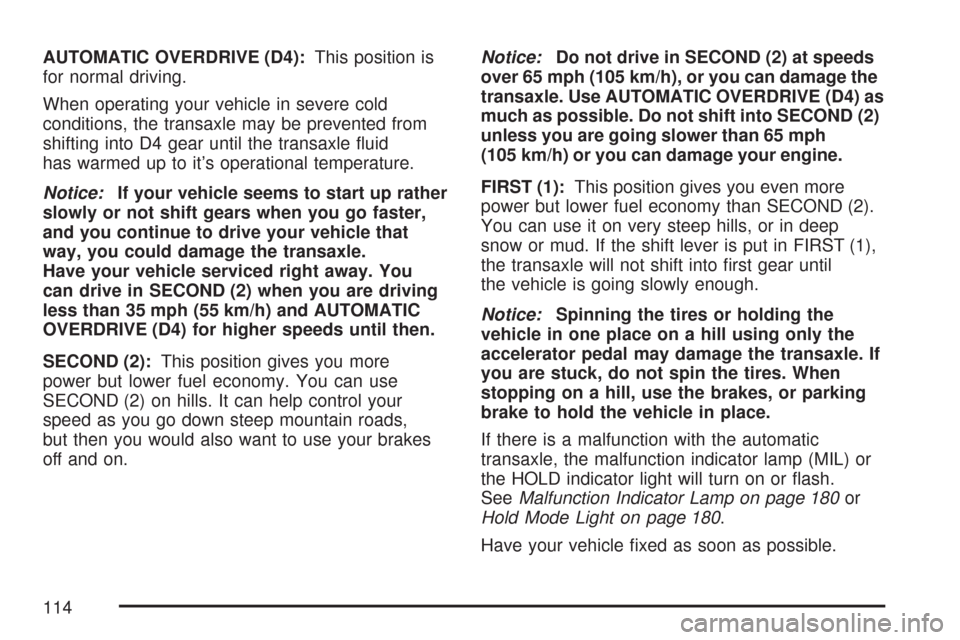
AUTOMATIC OVERDRIVE (D4):This position is
for normal driving.
When operating your vehicle in severe cold
conditions, the transaxle may be prevented from
shifting into D4 gear until the transaxle fluid
has warmed up to it’s operational temperature.
Notice:If your vehicle seems to start up rather
slowly or not shift gears when you go faster,
and you continue to drive your vehicle that
way, you could damage the transaxle.
Have your vehicle serviced right away. You
can drive in SECOND (2) when you are driving
less than 35 mph (55 km/h) and AUTOMATIC
OVERDRIVE (D4) for higher speeds until then.
SECOND (2):This position gives you more
power but lower fuel economy. You can use
SECOND (2) on hills. It can help control your
speed as you go down steep mountain roads,
but then you would also want to use your brakes
off and on.Notice:Do not drive in SECOND (2) at speeds
over 65 mph (105 km/h), or you can damage the
transaxle. Use AUTOMATIC OVERDRIVE (D4) as
much as possible. Do not shift into SECOND (2)
unless you are going slower than 65 mph
(105 km/h) or you can damage your engine.
FIRST (1):This position gives you even more
power but lower fuel economy than SECOND (2).
You can use it on very steep hills, or in deep
snow or mud. If the shift lever is put in FIRST (1),
the transaxle will not shift into first gear until
the vehicle is going slowly enough.
Notice:Spinning the tires or holding the
vehicle in one place on a hill using only the
accelerator pedal may damage the transaxle. If
you are stuck, do not spin the tires. When
stopping on a hill, use the brakes, or parking
brake to hold the vehicle in place.
If there is a malfunction with the automatic
transaxle, the malfunction indicator lamp (MIL) or
the HOLD indicator light will turn on or flash.
SeeMalfunction Indicator Lamp on page 180or
Hold Mode Light on page 180.
Have your vehicle fixed as soon as possible.
114
Page 161 of 436
If the airbag readiness light stays on after you
start the vehicle or comes on when you are driving,
your airbag system may not work properly.
Have your vehicle serviced right away.
{CAUTION:
If the airbag readiness light stays on after
you start your vehicle, it means the airbag
system may not be working properly. The
airbags in your vehicle may not inate in
a crash, or they could even inate without
a crash. To help avoid injury to yourself
or others, have your vehicle serviced right
away if the airbag readiness light stays on
after you start your vehicle.
The airbag readiness light should flash for a few
seconds when you turn the ignition key to RUN. If
the light does not come on then, have it fixed
so it will be ready to warn you if there is a problem.
Passenger Airbag Status Indicator
(Sedan)
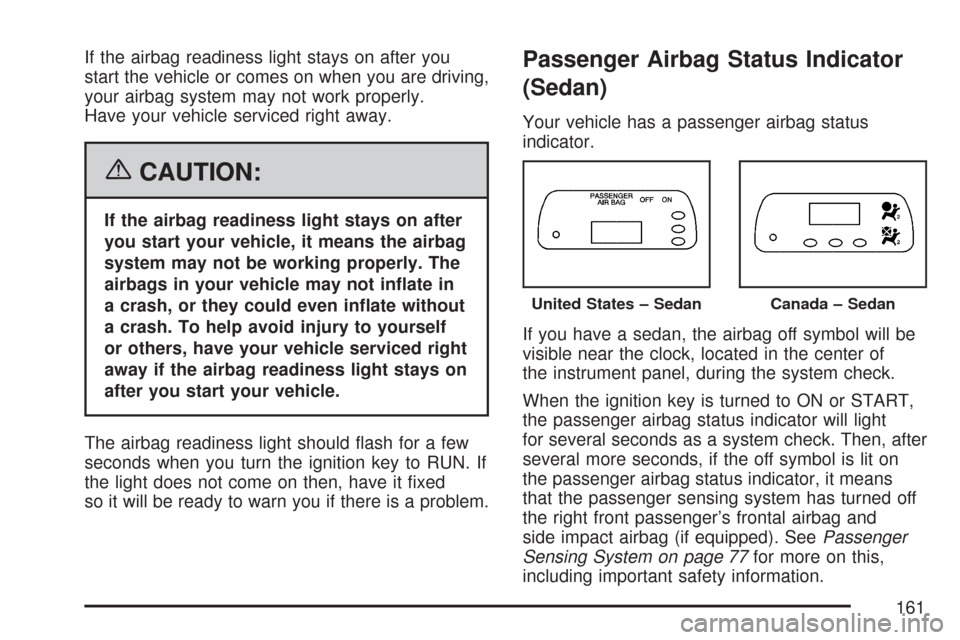
Your vehicle has a passenger airbag status
indicator.
If you have a sedan, the airbag off symbol will be
visible near the clock, located in the center of
the instrument panel, during the system check.
When the ignition key is turned to ON or START,
the passenger airbag status indicator will light
for several seconds as a system check. Then, after
several more seconds, if the off symbol is lit on
the passenger airbag status indicator, it means
that the passenger sensing system has turned off
the right front passenger’s frontal airbag and
side impact airbag (if equipped). SeePassenger
Sensing System on page 77for more on this,
including important safety information.
United States – SedanCanada – Sedan
161
Page 162 of 436
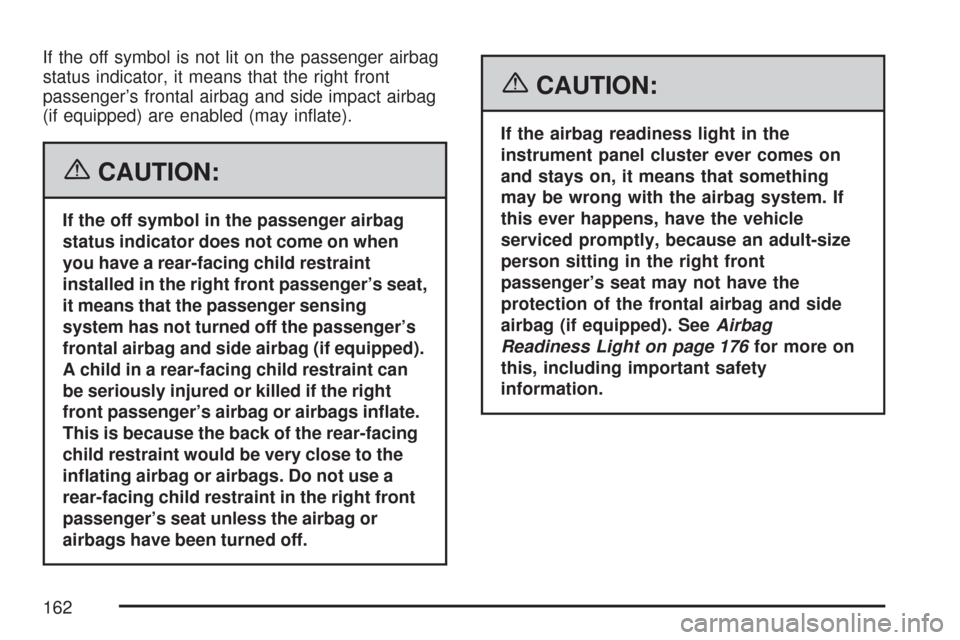
If the off symbol is not lit on the passenger airbag
status indicator, it means that the right front
passenger’s frontal airbag and side impact airbag
(if equipped) are enabled (may inflate).
{CAUTION:
If the off symbol in the passenger airbag
status indicator does not come on when
you have a rear-facing child restraint
installed in the right front passenger’s seat,
it means that the passenger sensing
system has not turned off the passenger’s
frontal airbag and side airbag (if equipped).
A child in a rear-facing child restraint can
be seriously injured or killed if the right
front passenger’s airbag or airbags inate.
This is because the back of the rear-facing
child restraint would be very close to the
inating airbag or airbags. Do not use a
rear-facing child restraint in the right front
passenger’s seat unless the airbag or
airbags have been turned off.
{CAUTION:
If the airbag readiness light in the
instrument panel cluster ever comes on
and stays on, it means that something
may be wrong with the airbag system. If
this ever happens, have the vehicle
serviced promptly, because an adult-size
person sitting in the right front
passenger’s seat may not have the
protection of the frontal airbag and side
airbag (if equipped). SeeAirbag
Readiness Light on page 176for more on
this, including important safety
information.
162
Page 164 of 436
If the light comes on while you are driving, pull off
the road and stop carefully. You may notice that the
pedal is harder to push or the pedal may go closer
to the floor. It may take longer to stop. If the light is
still on, have the vehicle towed for service. See
Towing Your Vehicle on page 258.
{CAUTION:
Your brake system may not be working
properly if the brake system warning light
is on. Driving with the brake system
warning light on can lead to an accident.
If the light is still on after you have pulled
off the road and stopped carefully, have
the vehicle towed for service.
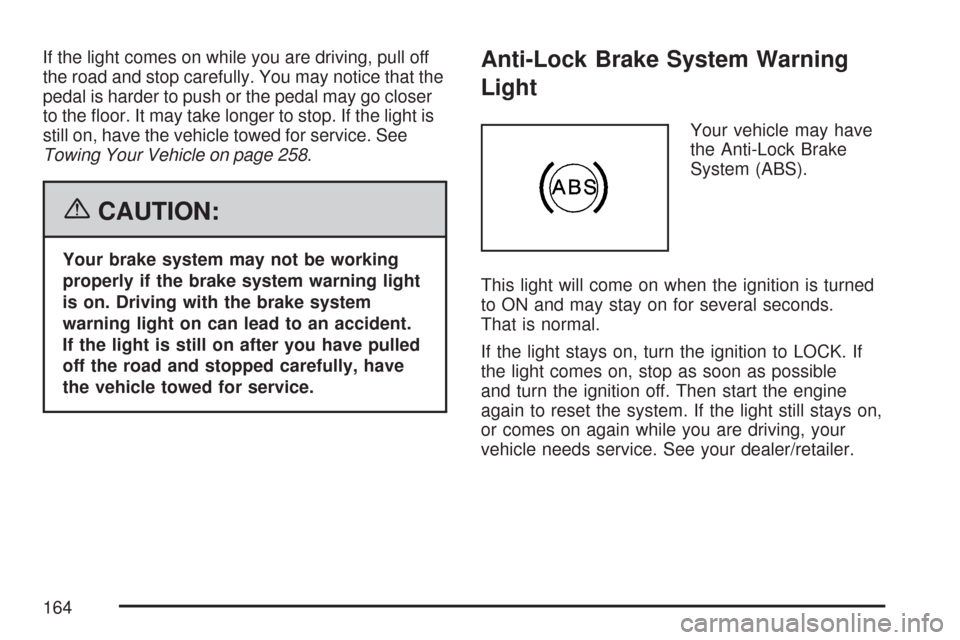
Anti-Lock Brake System Warning
Light
Your vehicle may have
the Anti-Lock Brake
System (ABS).
This light will come on when the ignition is turned
to ON and may stay on for several seconds.
That is normal.
If the light stays on, turn the ignition to LOCK. If
the light comes on, stop as soon as possible
and turn the ignition off. Then start the engine
again to reset the system. If the light still stays on,
or comes on again while you are driving, your
vehicle needs service. See your dealer/retailer.
164
Page 166 of 436

Your vehicle has an engine coolant temperature
gage. With the ignition turned to ON, this gage
shows the engine coolant temperature.
If the gage pointer moves into the red area, your
engine is too hot. It means that your engine
coolant has overheated.
If you have been operating your vehicle under
normal driving conditions, you should pull off the
road, stop your vehicle and turn off the engine
as soon as possible.
SeeEngine Overheating on page 290.
Malfunction Indicator Lamp
Check Engine Light
Your vehicle has a
computer which
monitors operation of
the fuel, ignition,
and emission control
systems.
This system is called OBD II (On-Board
Diagnostics-Second Generation) and is intended
to assure that emissions are at acceptablelevels for the life of the vehicle, helping to produce
a cleaner environment. The Check Engine light
comes on to indicate that there is a problem and
service is required. Malfunctions often will be
indicated by the system before any problem is
apparent. This may prevent more serious damage
to your vehicle. This system is also designed to
assist your service technician in correctly
diagnosing any malfunction.
Notice:If you keep driving your vehicle with
this light on, after awhile, the emission controls
might not work as well, your vehicle’s fuel
economy might not be as good, and the engine
might not run as smoothly. This could lead
to costly repairs that might not be covered by
your warranty.
Notice:Modications made to the engine,
transaxle, exhaust, intake, or fuel system
of your vehicle or replacement tires that do not
match your vehicle’s original tires can affect
your vehicle’s emission controls and may
cause this light to come on. Modications to
these systems could lead to costly repairs not
covered by your warranty. This may also
result in a failure to pass a required Emission
Inspection/Maintenance test. SeeAccessories
and Modifications on page 264.
166
Page 167 of 436

When the ignition is on, this light should come on
and should go out after a few seconds as a
check to show you it is working. If the light does
not come on, have it repaired.
This light will also come on during a malfunction in
one of two ways:
•Light Flashing— A misfire condition has
been detected. A misfire increases vehicle
emissions and may damage the emission
control system on your vehicle. Diagnosis
and service may be required.
•Light On Steady— An emission control
system malfunction has been detected on
your vehicle. Diagnosis and service may be
required.
If the Light Is Flashing
The following may prevent more serious damage
to your vehicle:
•Reducing vehicle speed
•Avoiding hard accelerations
•Avoiding steep uphill grades
If the light stops flashing and remains on steady,
see “If the Light Is On Steady” following.
If the light continues to flash, when it is safe to do
so, stop the vehicle. Find a safe place to park
your vehicle. Turn the key off, wait at least
10 seconds and restart the engine. If the light
remains on steady, see “If the Light Is On Steady”
following. If the light is still flashing, follow the
previous steps, and see your dealer for service as
soon as possible.
167
Page 170 of 436
The oil light could also come on in three other
situations:
•When the ignition is on but the engine is not
running, the light will come on as a test to
show you it is working. The light will go
out when you turn the ignition on. If it does
not come on with the ignition on, you
may have a problem with the fuse or bulb.
Have it fixed right away.
•If you make a hard stop, the light may come
on for a moment. This is normal.
{CAUTION:
Do not keep driving if the oil pressure is
low. If you do, your engine can become so
hot that it catches re. You or others could
be burned. Check your oil as soon as
possible and have your vehicle serviced.Notice:Lack of proper engine oil maintenance
may damage the engine. The repairs would
not be covered by your warranty. Always follow
the maintenance schedule in this manual for
changing engine oil.
Fog Lamp Light
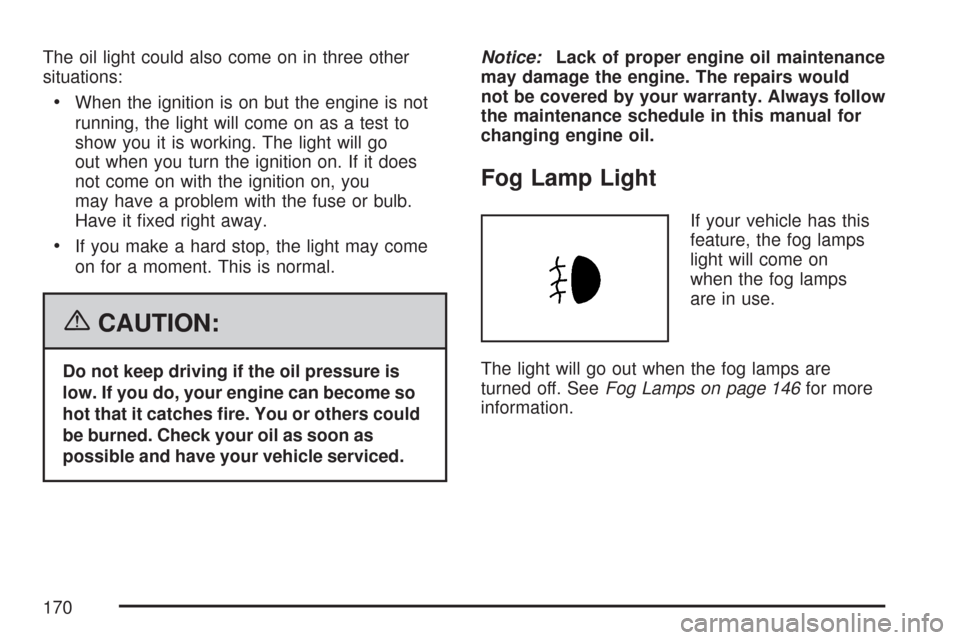
If your vehicle has this
feature, the fog lamps
light will come on
when the fog lamps
are in use.
The light will go out when the fog lamps are
turned off. SeeFog Lamps on page 146for more
information.
170