Page 265 of 436
California Proposition 65 Warning
Most motor vehicles, including this one, contain
and/or emit chemicals known to the State of
California to cause cancer and birth defects or other
reproductive harm. Engine exhaust, many parts and
systems (including some inside the vehicle), many
fluids, and some component wear by-products
contain and/or emit these chemicals.
Doing Your Own Service Work
{CAUTION:
You can be injured and your vehicle could
be damaged if you try to do service work
on a vehicle without knowing enough
about it.
Be sure you have sufficient knowledge,
experience, the proper replacement
parts, and tools before you attempt any
vehicle maintenance task.
CAUTION: (Continued)
CAUTION: (Continued)
Be sure to use the proper nuts, bolts,
and other fasteners. English and
metric fasteners can be easily
confused. If you use the wrong
fasteners, parts can later break or fall
off. You could be hurt.
If you want to do some of your own service work,
you will want to use the proper service manual.
It tells you much more about how to service your
vehicle than this manual can. To order the
proper service manual, seeService Publications
Ordering Information on page 420.
Your vehicle has an airbag system. Before
attempting to do your own service work, see
Servicing Your Airbag-Equipped Vehicle on
page 82.
You should keep a record with all parts receipts
and list the mileage and the date of any service
work you perform. SeePart E: Maintenance
Record on page 398.
265
Page 266 of 436
Adding Equipment to the Outside of
Your Vehicle
Things you might add to the outside of your
vehicle can affect the airflow around it. This may
cause wind noise and affect windshield washer
performance. Check with your dealer before
adding equipment to the outside of your vehicle.
Fuel
Use of the recommended fuel is an important part
of the proper maintenance of your vehicle. To
help keep the engine clean and maintain optimum
vehicle performance, GM recommends the use
of gasoline advertised as TOP TIER Detergent
Gasoline.
Gasoline Octane
Use regular unleaded gasoline with a posted
octane rating of 87 or higher. If the octane rating
is less than 87, you might notice an audible
knocking noise when you drive, commonly referred
to as spark knock. If this occurs, use a gasoline
rated at 87 octane or higher as soon as possible. If
you are using gasoline rated at 87 octane or
higher and you hear heavy knocking, the engine
needs service.
Gasoline Specications
At a minimum, gasoline should meet ASTM
specification D 4814 in the United States or
CAN/CGSB-3.5 in Canada. Some gasolines
may contain an octane-enhancing additive
called methylcyclopentadienyl manganese
tricarbonyl (MMT). General Motors recommends
against the use of gasolines containing MMT. See
Additives on page 267for additional information.
266
Page 268 of 436
Gasolines containing oxygenates, such as ethers
and ethanol, and reformulated gasolines may
be available in your area. General Motors
recommends that you use these gasolines if they
comply with the specifications described earlier.
However, E85 (85% ethanol) and other fuels
containing more than 10% ethanol must not be
used in vehicles that were not designed for
those fuels.
Notice:Your vehicle was not designed for
fuel that contains methanol. Do not use
fuel containing methanol. It can corrode metal
parts in the fuel system and also damage
plastic and rubber parts. That damage would
not be covered under your warranty.
Some gasolines that are not reformulated for low
emissions may contain an octane-enhancing
additive called methylcyclopentadienyl manganese
tricarbonyl (MMT); ask the attendant where you
buy gasoline whether the fuel contains MMT.General Motors recommends against the use of
such gasolines. Fuels containing MMT can reduce
the life of spark plugs and the performance of
the emission control system may be affected. The
malfunction indicator lamp may turn on. If this
occurs, return to your dealer for service.
Fuels in Foreign Countries
If you plan on driving in another country outside the
United States or Canada, the proper fuel might be
hard to find. Never use leaded gasoline or any other
fuel not recommended in the previous text on fuel.
Costly repairs caused by use of improper fuel would
not be covered by your warranty.
To check the fuel availability, ask an auto club, or
contact a major oil company that does business
in the country where you will be driving.
268
Page 280 of 436
If you are in an area of extreme cold, where the
temperature falls below−20°F (−29°C), it is
recommended that you use either an SAE 5W-30
synthetic oil or an SAE 0W-30 oil. Both provide
easier cold starting and better protection for
the engine at extremely low temperatures.
Engine Oil Additives
Do not add anything to the oil. The recommended
oils with the starburst symbol that meet GM
Standard GM6094M are all you need for good
performance and engine protection.
When to Change Engine Oil
If any one of these is true for you, use the short
trip/city maintenance schedule:
•Most trips are less than 5 miles (8 km). This is
particularly important when outside
temperatures are below freezing.
•Most trips include extensive idling, such as
frequent driving in stop-and-go traffic.
•You frequently use a carrier on top of
your vehicle.
•The vehicle is used for delivery service,
police, taxi, or other commercial application.
Driving under these conditions causes engine oil
to break down sooner. If any one of these is
true for your vehicle, you need to change the oil
and filter every 3,000 miles (5 000 km) or
3 months, whichever occurs first.
If none of them is true, use the long trip/highway
maintenance schedule. Change the oil and
filter every 7,500 miles (12 500 km) or 12 months,
whichever occurs first. Driving a vehicle with a
fully warmed engine under highway conditions will
cause engine oil to break down slower.
280
Page 281 of 436
What to Do with Used Oil
Used engine oil contains certain elements that can
be unhealthy for your skin and could even cause
cancer. Do not let used oil stay on your skin for very
long. Clean your skin and nails with soap and
water, or a good hand cleaner. Wash or properly
dispose of clothing or rags containing used engine
oil. See the manufacturer’s warnings about the use
and disposal of oil products.
Used oil can be a threat to the environment. If you
change your own oil, be sure to drain all the oil
from the filter before disposal. Never dispose of oil
by putting it in the trash, pouring it on the
ground, into sewers, or into streams or bodies of
water. Instead, recycle it by taking it to a place
that collects used oil. If you have a problem
properly disposing of used oil, ask your
dealer/retailer, a service station, or a local
recycling center for help.
Engine Air Cleaner/Filter
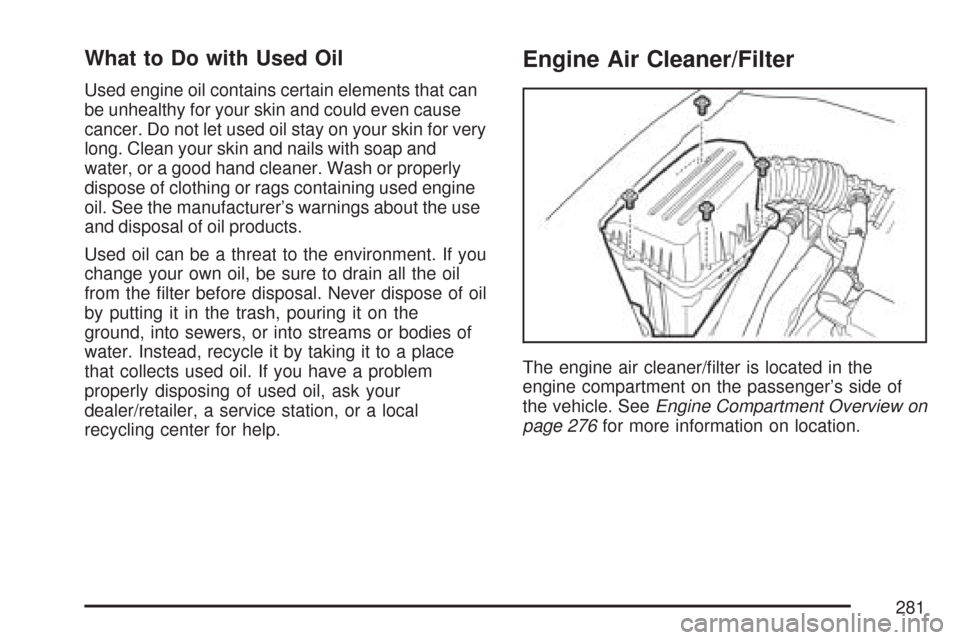
The engine air cleaner/filter is located in the
engine compartment on the passenger’s side of
the vehicle. SeeEngine Compartment Overview on
page 276for more information on location.
281
Page 282 of 436
When to Inspect the Engine Air
Cleaner/Filter
Inspect the engine air cleaner/filter every
15,000 miles (25 000 km) and replace it every
30,000 miles (50 000 km). If you are driving
in dusty/dirty conditions, inspect the filter at each
engine oil change.
How to Inspect the Engine Air
Cleaner/Filter
To inspect the engine air cleaner/filter remove the
filter from the vehicle and lightly shake the filter
to release loose dust and dirt. If the filter remains
caked with dirt, a new filter is required.
To inspect or replace the filter, do the following:
1. Remove the screws and lift off the cover.
2. Inspect or replace the engine air cleaner/filter.
3. Put the cover back on tightly and tighten
the screws.
SeePart A: Scheduled Maintenance Services on
page 374for replacement intervals.
{CAUTION:
Operating the engine with the air
cleaner/lter off can cause you or others
to be burned. The air cleaner not only
cleans the air; it helps to stop ames if
the engine backres. If it is not there and
the engine backres, you could be
burned. Do not drive with it off, and be
careful working on the engine with the air
cleaner/lter off.
Notice:If the air cleaner/lter is off, a backre
can cause a damaging engine re. And, dirt
can easily get into your engine, which will
damage it. Always have the air cleaner/lter in
place when you are driving.
282
Page 283 of 436
Automatic Transaxle Fluid
When to Check Automatic
Transaxle Fluid
Check your automatic transaxle fluid level at least
twice a year. Add fluid if needed. SeeAt Least
Twice a Year on page 389.
How to Check Automatic
Transaxle Fluid
Because this operation can be a little difficult, you
may choose to have this done at the dealership
service department.
If you do it yourself, be sure to follow all the
instructions here, or you could get a false reading
on the dipstick.Notice:Too much or too little uid can damage
the transaxle. Too much can mean that some of
the uid could come out and fall on hot engine
or exhaust system parts, starting a re. Too
little uid could cause the transaxle to overheat.
Be sure to get an accurate reading if you check
the transaxle uid.
Wait at least 30 minutes before checking the
transaxle fluid level if you have been driving:
•When outside temperatures are above
90°F (32°C).
•At high speed for quite a while.
•In heavy traffic — especially in hot weather.
To get the right reading, the fluid should be
at normal operating temperature, which is 158°F
to 176°F (70°C to 80°C).
Get the vehicle warmed up by driving about
15 miles (24 km) when outside temperatures are
above 50°F (10°C). If it is colder than 50°F (10°C),
you may have to drive longer.
283
Page 285 of 436
How to Add Automatic Transaxle Fluid
Refer to the Maintenance Schedule to determine
what kind of transaxle fluid to use. SeePart D:
Recommended Fluids and Lubricants on page 396.
If the fluid level is low, add only enough of the
proper fluid to bring the level into the area between
the two dimples in the hot range on the dipstick.
1. Pull out the dipstick.
2. Using a long-neck funnel, add enough fluid at
the dipstick hole to bring it to the proper level.
It does not take much fluid, generally less
than one pint (0.5 L). Do not overfill.Notice:Use of the incorrect automatic
transaxle uid may damage your vehicle, and
the damages may not be covered by your
warranty. Always use the automatic transaxle
uid listed inPart D: Recommended Fluids
and Lubricants on page 396.
3. After adding fluid, recheck the fluid level as
described under “How to Check Automatic
Transaxle Fluid,” earlier in this section.
4. When the correct fluid level is obtained, push
the dipstick back in all the way.
Manual Transaxle Fluid
It is not necessary to check the transaxle fluid level.
A transaxle fluid leak is the only reason for fluid
loss. If a leak occurs, take the vehicle to the
dealership service department and have it repaired
as soon as possible. SeePart D: Recommended
Fluids and Lubricants on page 396for the proper
fluid to use.
285