2007 CHEVROLET AVALANCHE fuel
[x] Cancel search: fuelPage 393 of 618

Here are some things you can check before a trip:
Windshield Washer Fluid:Is the reservoir
full? Are all windows clean inside and outside?
Wiper Blades:Are they in good shape?
Fuel, Engine Oil, Other Fluids:Have you
checked all levels?
Lamps:Are they all working? Are the
lenses clean?
Tires:They are vitally important to a safe,
trouble-free trip. Is the tread good enough
for long-distance driving? Are the tires
all inated to the recommended pressure?
Weather Forecasts:What is the weather
outlook along your route? Should you
delay your trip a short time to avoid a
major storm system?
Maps:Do you have up-to-date maps?
Highway Hypnosis
Is there actually such a condition as highway
hypnosis? Or is it just plain falling asleep at the
wheel? Call it highway hypnosis, lack of
awareness, or whatever.
There is something about an easy stretch of road
with the same scenery, along with the hum of the
tires on the road, the drone of the engine, and the
rush of the wind against the vehicle that can make
you sleepy. Do not let it happen to you! If it does,
your vehicle can leave the road in less than a
second, and you could crash and be injured.
What can you do about highway hypnosis?
First, be aware that it can happen.
Then here are some tips:
Make sure your vehicle is well ventilated, with
a comfortably cool interior.
Keep your eyes moving. Scan the road ahead
and to the sides. Check your vehicle’s mirrors
and instruments frequently.
If you get sleepy, pull off the road into a rest,
service, or parking area and take a nap, get
some exercise, or both. For safety, treat
drowsiness on the highway as an emergency.
393
Page 399 of 618

You can run the engine to keep warm, but be
careful.
{CAUTION:
Snow can trap exhaust gases under your
vehicle. This can cause deadly CO (carbon
monoxide) gas to get inside. CO could
overcome you and kill you. You cannot see
it or smell it, so you might not know it is in
your vehicle. Clear away snow from around
the base of your vehicle, especially any
that is blocking the exhaust pipe. And
check around again from time to time to
be sure snow does not collect there.
Open a window just a little on the side of
the vehicle that is away from the wind.
This will help keep CO out.
Run your engine only as long as you must. This
saves fuel. When you run the engine, make it go
a little faster than just idle. That is, push the
accelerator slightly. This uses less fuel for the heat
that you get and it keeps the battery charged.
You will need a well-charged battery to restart the
vehicle, and possibly for signaling later on with
your headlamps. Let the heater run for a while.
399
Page 400 of 618
Then, shut the engine off and close the window
almost all the way to preserve the heat. Start
the engine again and repeat this only when you
feel really uncomfortable from the cold. But do it as
little as possible. Preserve the fuel as long as
you can. To help keep warm, you can get out of
the vehicle and do some fairly vigorous exercises
every half hour or so until help comes.
If Your Vehicle is Stuck in Sand,
Mud, Ice, or Snow
In order to free your vehicle when it is stuck, you
need to spin the wheels, but you do not want to spin
the wheels too fast. The method known as rocking
can help you get out when you are stuck, but you
must use caution.
{CAUTION:
If you let your vehicle’s tires spin at
high speed, they can explode, and
you or others could be injured.
CAUTION: (Continued)
CAUTION: (Continued)
And, the transmission or other parts of
the vehicle can overheat. That could
cause an engine compartment re or
other damage. When you are stuck, spin
the wheels as little as possible. Do not
spin the wheels above 35 mph (55 km/h)
as shown on the speedometer.
Notice:Spinning the wheels can destroy parts
of your vehicle as well as the tires. If you
spin the wheels too fast while shifting the
transmission back and forth, you can destroy
the transmission.
For information about using tire chains on your
vehicle, seeTire Chains on page 514.
Rocking Your Vehicle to Get It Out
First, turn the steering wheel left and right. That
will clear the area around the front wheels.
If you have a four-wheel-drive vehicle, shift into
Four-Wheel High. Turn the StabiliTrak
®System off.
400
Page 405 of 618
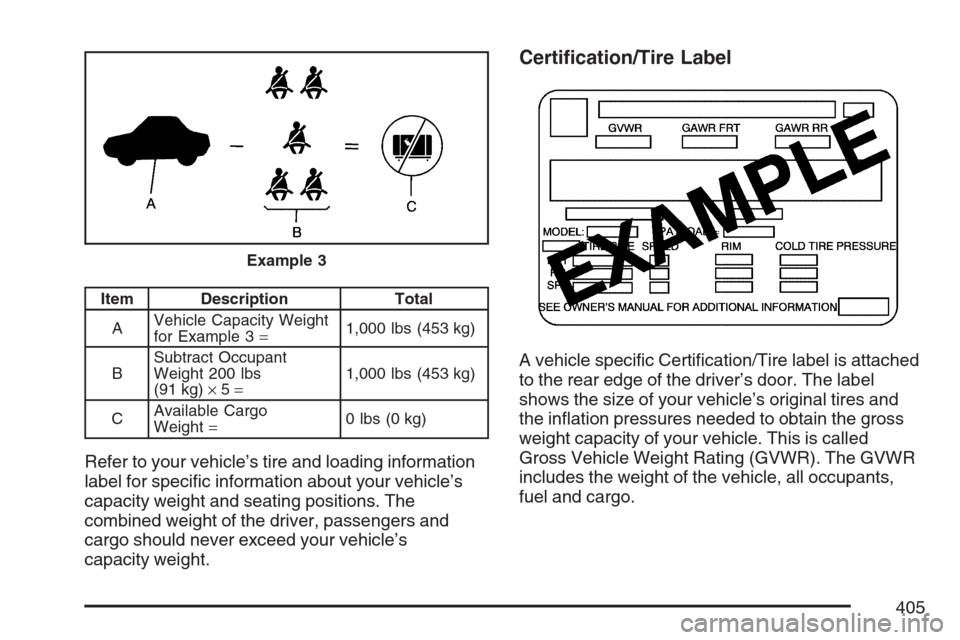
Item Description Total
AVehicle Capacity Weight
for Example 3=1,000 lbs (453 kg)
BSubtract Occupant
Weight 200 lbs
(91 kg)×5=1,000 lbs (453 kg)
CAvailable Cargo
Weight=0 lbs (0 kg)
Refer to your vehicle’s tire and loading information
label for specic information about your vehicle’s
capacity weight and seating positions. The
combined weight of the driver, passengers and
cargo should never exceed your vehicle’s
capacity weight.
Certication/Tire Label
A vehicle specic Certication/Tire label is attached
to the rear edge of the driver’s door. The label
shows the size of your vehicle’s original tires and
the ination pressures needed to obtain the gross
weight capacity of your vehicle. This is called
Gross Vehicle Weight Rating (GVWR). The GVWR
includes the weight of the vehicle, all occupants,
fuel and cargo.
Example 3
405
Page 414 of 618
Towing a Trailer
Do not tow a trailer during break-in. SeeNew
Vehicle Break-In on page 122for more information.
{CAUTION:
If you do not use the correct equipment
and drive properly, you can lose control
when you pull a trailer. For example, if the
trailer is too heavy, the brakes may not
work well — or even at all. You and your
passengers could be seriously injured.
Pull a trailer only if you have followed all
the steps in this section. Ask your dealer
for advice and information about towing
a trailer with your vehicle.Notice:Pulling a trailer improperly can
damage your vehicle and result in costly repairs
not covered by your warranty. To pull a trailer
correctly, follow the advice in this part, and
see your dealer for important information about
towing a trailer with your vehicle.
To identify the trailering capacity of your vehicle,
you should read the information in “Weight of
the Trailer” that appears later in this section.
Trailering is different than just driving your vehicle
by itself. Trailering means changes in handling,
acceleration, braking, durability and fuel economy.
Successful, safe trailering takes correct
equipment, and it has to be used properly.
That’s the reason for this part. In it are many
time-tested, important trailering tips and safety
rules. Many of these are important for your safety
and that of your passengers. So please read
this section carefully before you pull a trailer.
414
Page 416 of 618
Tow/haul is designed to be most effective when
the vehicle and trailer combined weight is at least
75 percent of the vehicle’s Gross Combination
Weight Rating (GCWR). See “Weight of the
Trailer” later in this section.
Press the button at the end of the shift lever to
enable/disable the tow/haul mode.
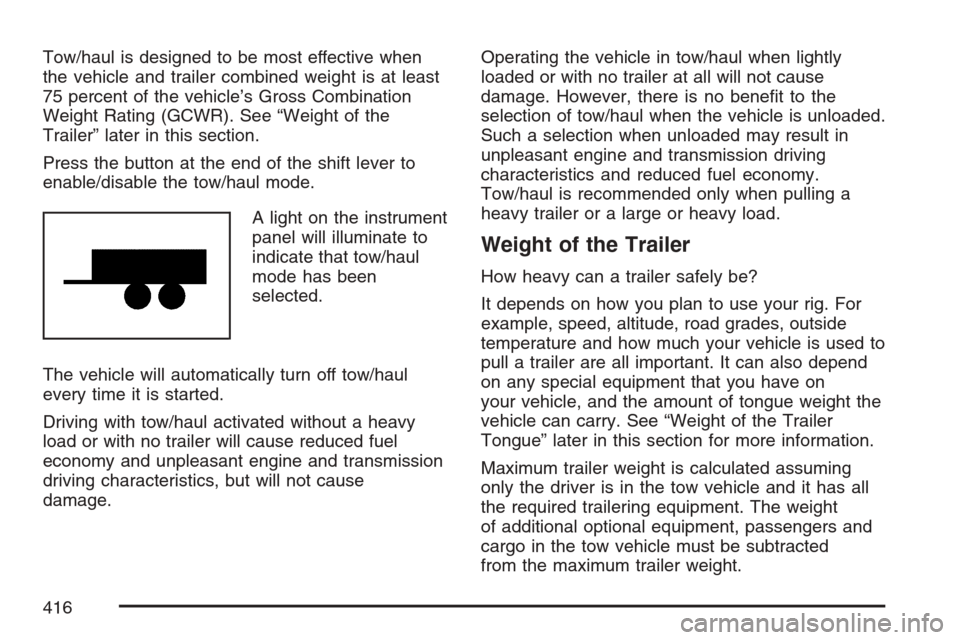
A light on the instrument
panel will illuminate to
indicate that tow/haul
mode has been
selected.
The vehicle will automatically turn off tow/haul
every time it is started.
Driving with tow/haul activated without a heavy
load or with no trailer will cause reduced fuel
economy and unpleasant engine and transmission
driving characteristics, but will not cause
damage.Operating the vehicle in tow/haul when lightly
loaded or with no trailer at all will not cause
damage. However, there is no benet to the
selection of tow/haul when the vehicle is unloaded.
Such a selection when unloaded may result in
unpleasant engine and transmission driving
characteristics and reduced fuel economy.
Tow/haul is recommended only when pulling a
heavy trailer or a large or heavy load.
Weight of the Trailer
How heavy can a trailer safely be?
It depends on how you plan to use your rig. For
example, speed, altitude, road grades, outside
temperature and how much your vehicle is used to
pull a trailer are all important. It can also depend
on any special equipment that you have on
your vehicle, and the amount of tongue weight the
vehicle can carry. See “Weight of the Trailer
Tongue” later in this section for more information.
Maximum trailer weight is calculated assuming
only the driver is in the tow vehicle and it has all
the required trailering equipment. The weight
of additional optional equipment, passengers and
cargo in the tow vehicle must be subtracted
from the maximum trailer weight.
416
Page 429 of 618

Service........................................................ 432
Accessories and Modications................... 433
California Proposition 65 Warning.............. 433
Doing Your Own Service Work.................. 434
Adding Equipment to the Outside
of Your Vehicle...................................... 435
Fuel............................................................. 435
Gasoline Octane........................................ 436
Gasoline Specications.............................. 436
California Fuel........................................... 436
Additives................................................... 437
Fuel E85 (85% Ethanol)............................ 438
Fuels in Foreign Countries........................ 439
Filling the Tank......................................... 440
Filling a Portable Fuel Container............... 442
Checking Things Under the Hood.............. 442
Hood Release........................................... 443
Engine Compartment Overview.................. 444
Engine Oil................................................. 446
Engine Oil Life System.............................. 449Engine Air Cleaner/Filter............................ 451
Automatic Transmission Fluid.................... 454
Engine Coolant.......................................... 457
Coolant Surge Tank Pressure Cap............ 460
Engine Overheating................................... 460
Overheated Engine Protection
Operating Mode..................................... 463
Cooling System......................................... 464
Engine Fan Noise..................................... 469
Power Steering Fluid ................................. 469
Windshield Washer Fluid........................... 470
Brakes...................................................... 472
Battery...................................................... 475
Jump Starting............................................ 476
Rear Axle.................................................... 482
Four-Wheel Drive........................................ 483
Front Axle................................................... 484
Headlamp Aiming........................................ 485
Section 5 Service and Appearance Care
429
Page 435 of 618
Adding Equipment to the Outside
of Your Vehicle
Things you might add to the outside of your
vehicle can affect the airow around it. This may
cause wind noise and affect windshield washer
performance. Check with your dealer before
adding equipment to the outside of your vehicle.
Fuel
Use of the recommended fuel is an important
part of the proper maintenance of your vehicle.
To help keep your engine clean and maintain
optimum vehicle performance, GM recommends
the use of gasoline advertised as TOP TIER
Detergent Gasoline.The 8th digit of your Vehicle Identication
Number (VIN) shows the code letter or number
that identies your engine. You will nd the VIN at
the top left of the instrument panel. SeeVehicle
Identication Number (VIN) on page 546.
If your vehicle has the 5.3L V8 engine (VIN Code 0)
or the 5.3L V8 engine (VIN Code 3), you may use
either regular unleaded gasoline or ethanol fuel
containing up to 85% ethanol (E85); also see
Fuel E85 (85% Ethanol) on page 438. In all other
engines, use only regular unleaded gasoline.
435