Page 507 of 618

When rotating your vehicle’s tires, always use the
correct rotation pattern shown here.
Do not include the spare tire in the tire rotation.
After the tires have been rotated, adjust the
front and rear ination pressures as shown on the
tire and loading information label. SeeLoading
Your Vehicle on page 402andInation - Tire
Pressure on page 500, for more information.
Vehicles that have the Tire Pressure Monitor
System (TPMS) will need to have the TPMS
sensors reset after a tire rotation. See “TPMS
Sensor Identication Codes” underTire Pressure
Monitor System on page 501.Make certain that all wheel nuts are properly
tightened. See “Wheel Nut Torque” under
Capacities and Specications on page 556.
{CAUTION:
Rust or dirt on a wheel, or on the parts to
which it is fastened, can make wheel nuts
become loose after time. The wheel could
come off and cause an accident. When
you change a wheel, remove any rust or
dirt from places where the wheel attaches
to the vehicle. In an emergency, you can
use a cloth or a paper towel to do this;
but be sure to use a scraper or wire brush
later, if needed, to get all the rust or dirt
off. SeeChanging a Flat Tire on page 516.
507
Page 509 of 618
{CAUTION:
Mixing tires could cause you to lose
control while driving. If you mix tires of
different sizes, brands, or types (radial
and bias-belted tires), the vehicle may not
handle properly, and you could have a
crash. Using tires of different sizes,
brands or types may also cause damage
to your vehicle. Be sure to use the same
size, brand, and type tires on all wheels.
Your vehicle may have a different size
spare than the road tires (those originally
installed on your vehicle). When new, your
vehicle included a spare tire and wheel
assembly with a similar overall diameter
as your vehicle’s road tires and wheels,
so it is all right to drive on it. Because
this spare was developed for use on your
vehicle, it will not affect vehicle handling.
{CAUTION:
If you use bias-ply tires on your vehicle,
the wheel rim anges could develop
cracks after many miles of driving. A tire
and/or wheel could fail suddenly, causing
a crash. Use only radial-ply tires with the
wheels on your vehicle.
If you must replace your vehicle’s tires with those
that do not have a TPC Spec number, make
sure they are the same size, load range, speed
rating, and construction type (radial and
bias-belted tires) as your vehicle’s original tires.
Vehicles that have a tire pressure monitoring
system may give an inaccurate low-pressure
warning if non-TPC spec rated tires are installed
on your vehicle. Non-TPC Spec rated tires
may give a low-pressure warning that is higher or
lower than the proper warning level you would
get with TPC Spec rated tires. SeeTire Pressure
Monitor System on page 501.
509
Page 511 of 618

Uniform Tire Quality Grading
Quality grades can be found where applicable on
the tire sidewall between tread shoulder and
maximum section width. For example:
Treadwear 200 Traction AA Temperature A
The following information relates to the system
developed by the United States National Highway
Traffic Safety Administration (NHTSA), which
grades tires by treadwear, traction, and
temperature performance. This applies only to
vehicles sold in the United States. The grades are
molded on the sidewalls of most passenger car
tires. The Uniform Tire Quality Grading (UTQG)
system does not apply to deep tread, winter-type
snow tires, space-saver, or temporary use
spare tires, tires with nominal rim diameters of
10 to 12 inches (25 to 30 cm), or to some
limited-production tires.
While the tires available on General Motors
passenger cars and light trucks may vary with
respect to these grades, they must also conform
to federal safety requirements and additional
General Motors Tire Performance Criteria (TPC)
standards.
Treadwear
The treadwear grade is a comparative rating
based on the wear rate of the tire when tested
under controlled conditions on a specied
government test course. For example, a tire
graded 150 would wear one and a half (1.5) times
as well on the government course as a tire
graded 100. The relative performance of tires
depends upon the actual conditions of their use,
however, and may depart signicantly from
the norm due to variations in driving habits, service
practices, and differences in road characteristics
and climate.
Traction – AA, A, B, C
The traction grades, from highest to lowest, are
AA, A, B, and C. Those grades represent the tire’s
ability to stop on wet pavement as measured
under controlled conditions on specied
government test surfaces of asphalt and concrete.
A tire marked C may have poor traction
performance.
Warning:The traction grade assigned to this tire
is based on straight-ahead braking traction
tests, and does not include acceleration, cornering,
hydroplaning, or peak traction characteristics.
511
Page 518 of 618
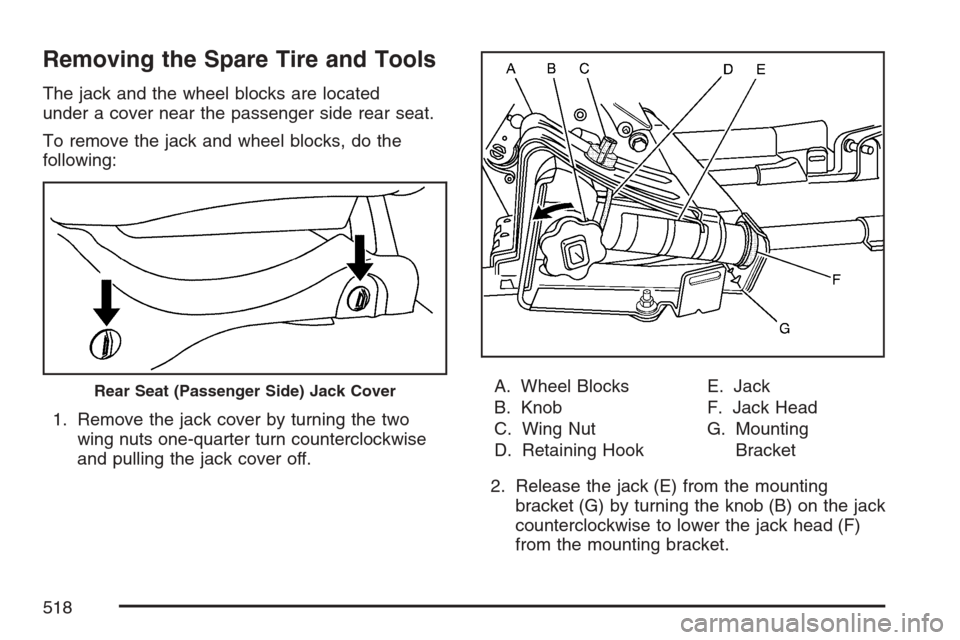
Removing the Spare Tire and Tools
The jack and the wheel blocks are located
under a cover near the passenger side rear seat.
To remove the jack and wheel blocks, do the
following:
1. Remove the jack cover by turning the two
wing nuts one-quarter turn counterclockwise
and pulling the jack cover off.A. Wheel Blocks
B. Knob
C. Wing Nut
D. Retaining HookE. Jack
F. Jack Head
G. Mounting
Bracket
2. Release the jack (E) from the mounting
bracket (G) by turning the knob (B) on the jack
counterclockwise to lower the jack head (F)
from the mounting bracket.
Rear Seat (Passenger Side) Jack Cover
518
Page 519 of 618
3. Remove the wheel blocks (A) attached to
the jack (E) by turning the wing nut (C)
counterclockwise. Place the wheel blocks
where needed as indicated in previously in
this section.
The tools for changing a at tire are located in the
passenger’s side top-box storage unit.
To remove the tools, do the following:
1. Open the top door on the passenger’s side
top-box storage unit. Use the ignition/door
key to unlock it if it is locked. SeeTop-Box
Storage on page 191for more information.
2. Remove the black pouch from the storage box.
You now have all of the tools you will need to
lower the spare tire and change a at.
Top-Box Storage Unit (Passenger’s Side)
519
Page 520 of 618
To access the spare tire, refer to the following
graphics and instructions:
A. Spare Tire
(Valve Stem
Pointed Down)
B. Hoist Assembly
C. Hoist Cable
D. Tire Retainer
E. Hoist ShaftF. Hoist End of
Extension Tool
G. Hoist Shaft
Access Hole
H. Wheel Wrench
I. Jack Handle
Extension
J. Spare Tire Lock1. Open the hoist shaft access cover on the
bumper to access the spare tire lock (J).
2. Insert the ignition key, turn it clockwise and
then pull it to remove the spare tire lock.
3. Assemble the two jack handle extensions (I)
and wheel wrench (H) as shown.
520
Page 521 of 618
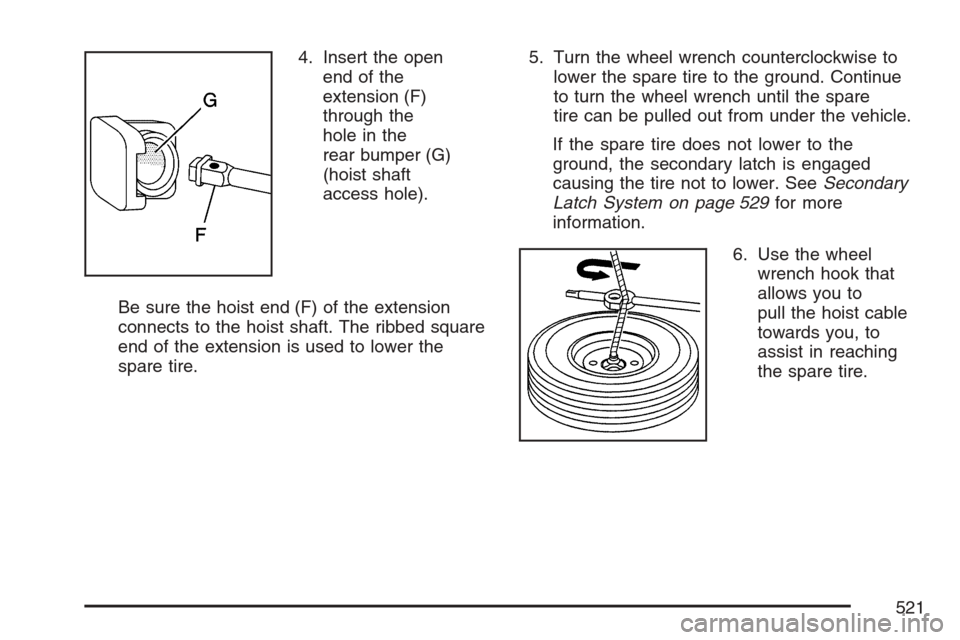
4. Insert the open
end of the
extension (F)
through the
hole in the
rear bumper (G)
(hoist shaft
access hole).
Be sure the hoist end (F) of the extension
connects to the hoist shaft. The ribbed square
end of the extension is used to lower the
spare tire.5. Turn the wheel wrench counterclockwise to
lower the spare tire to the ground. Continue
to turn the wheel wrench until the spare
tire can be pulled out from under the vehicle.
If the spare tire does not lower to the
ground, the secondary latch is engaged
causing the tire not to lower. SeeSecondary
Latch System on page 529for more
information.
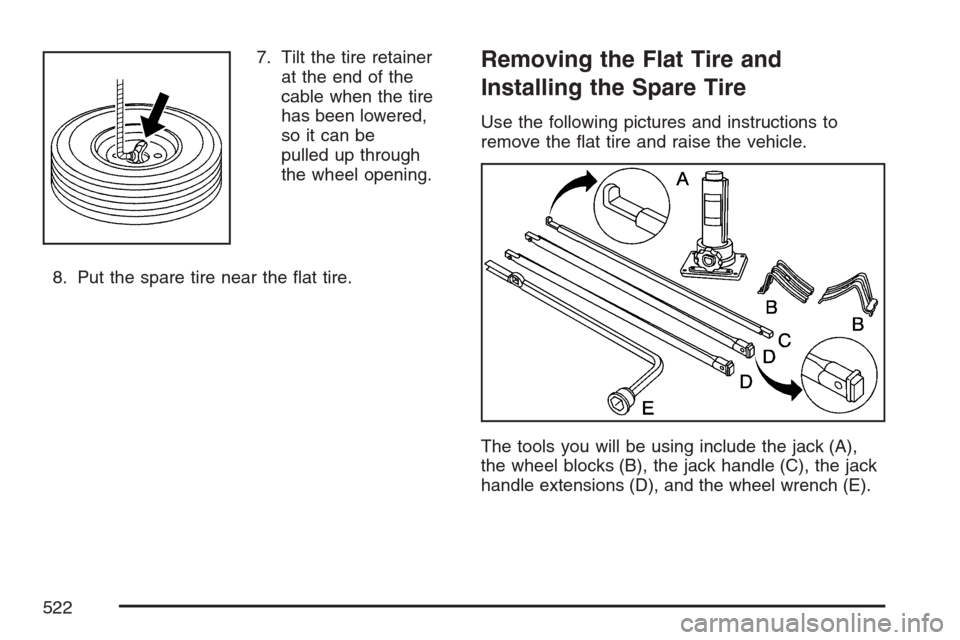
6. Use the wheel
wrench hook that
allows you to
pull the hoist cable
towards you, to
assist in reaching
the spare tire.
521
Page 522 of 618
7. Tilt the tire retainer
at the end of the
cable when the tire
has been lowered,
so it can be
pulled up through
the wheel opening.
8. Put the spare tire near the at tire.Removing the Flat Tire and
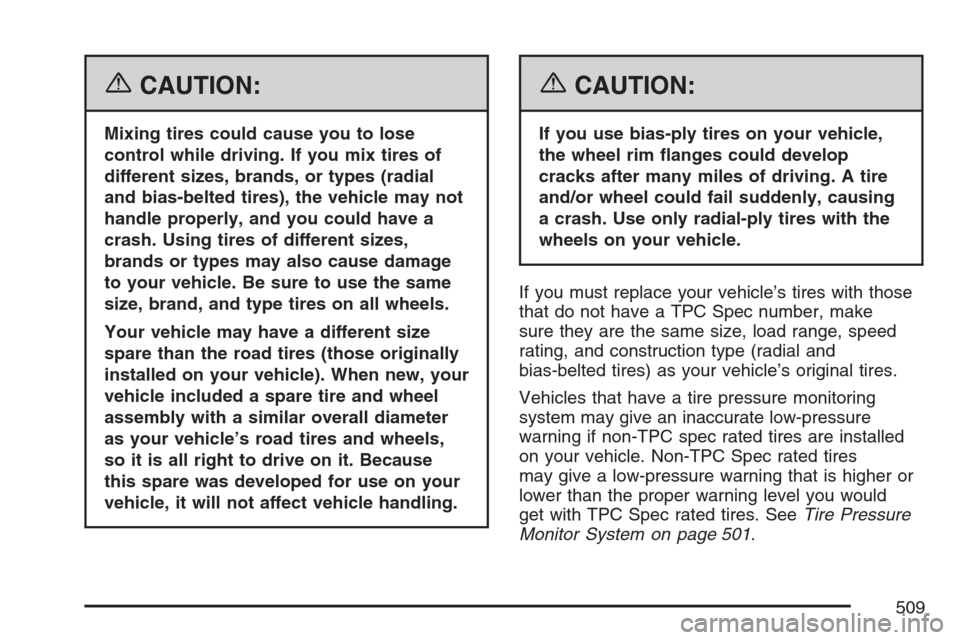
Installing the Spare Tire
Use the following pictures and instructions to
remove the at tire and raise the vehicle.
The tools you will be using include the jack (A),
the wheel blocks (B), the jack handle (C), the jack
handle extensions (D), and the wheel wrench (E).
522