Page 87 of 618

Adding Equipment to Your
Airbag-Equipped Vehicle
Q:Is there anything I might add to the front
or sides of the vehicle that could keep
the airbags from working properly?
A:Yes. If you add things that change your
vehicle’s frame, bumper system, height, front
end or side sheet metal, they may keep the
airbag system from working properly. Also,
the airbag system may not work properly if you
relocate any of the airbag sensors. If you have
any questions about this, you should contact
Customer Assistance before you modify your
vehicle. The phone numbers and addresses
for Customer Assistance are in Step Two of
the Customer Satisfaction Procedure in this
manual. SeeCustomer Satisfaction Procedure
on page 582.
Q:Because I have a disability, I have to get
my vehicle modied. How can I nd out
whether this will affect my airbag system?
A:Changing or moving any parts of the
front seats, safety belts, the airbag sensing
and diagnostic module, rollover sensor
module, steering wheel, instrument panel,
overhead console, ceiling headliner, ceiling
and pillar garnish trim, roof-mounted rollover
airbag modules, or airbag wiring can affect the
operation of the airbag system. If you have
questions, call Customer Assistance. The
phone numbers and addresses for Customer
Assistance are in Step Two of the Customer
Satisfaction Procedure in this manual.
SeeCustomer Satisfaction Procedure
on page 582.
87
Page 88 of 618
Restraint System Check
Checking the Restraint Systems
Now and then, make sure the safety belt reminder
light and all your belts, buckles, latch plates,
retractors and anchorages are working properly.
Look for any other loose or damaged safety
belt system parts. If you see anything that might
keep a safety belt system from doing its job,
have it repaired. Keep safety belts clean and
dry. SeeCare of Safety Belts on page 540
for more information.
Torn or frayed safety belts may not protect you in
a crash. They can rip apart under impact forces.
If a belt is torn or frayed, get a new one right away.Also look for any opened or broken airbag covers,
and have them repaired or replaced. The airbag
system does not need regular maintenance.
Notice:If you damage the covering for the
driver’s or the right front passenger’s airbag,
or the side impact airbag covering on the
ceiling near the side windows, the airbag may
not work properly. You may have to replace
the airbag module in the steering wheel, both
the airbag module and the instrument panel
for the right front passenger’s airbag, or
side impact airbag module and ceiling covering
for roof-mounted rollover airbags (if equipped).
Do not open or break the airbag coverings.
88
Page 105 of 618
Midgate®
{CAUTION:
It can be dangerous to drive with the
cargo area covered and the tailgate and
the Midgate
®open because carbon
monoxide (CO) gas can come into your
vehicle. You can not see or smell CO.
It can cause unconsciousness and even
death. If you must drive with the cargo
covers on and the tailgate and Midgate
®
open or if electrical wiring or other cable
connections must pass through the seal
between the body and the Midgate
®:
Make sure all windows are shut.
Turn the fan on your heating or cooling
system to its highest speed on the
setting that brings in outside air.
CAUTION: (Continued)
CAUTION: (Continued)
This will force outside air into your
vehicle. SeeDual Automatic Climate
Control System on page 230.
If you have air outlets on or under the
instrument panel, open them all the
way. SeeEngine Exhaust on page 143.
Midgate®Operation
Your vehicle is equipped with a Midgate®and
a removable rear glass panel. The Midgate®
allows you to extend the length of your vehicle’s
cargo area.
105
Page 120 of 618

Testing the Alarm
The alarm can be tested by following these steps:
1. From inside the vehicle, lower the driver’s
window and open the driver’s door.
2. Activate the system by locking the doors with
the power door lock switch while the door is
open, or with the RKE transmitter.
3. Get out of the vehicle, close the door and wait
for the security light to go out.
4. Then reach in through the window, unlock the
door with the manual door lock and open the
door. This should set off the alarm.
While the alarm is set, the power door unlock
switch is not operational.
If the alarm does not sound when it should but the
headlamps ash, check to see if the horn works.
The horn fuse may be blown. To replace the fuse,
seeInstrument Panel Fuse Block on page 548
andUnderhood Fuse Block on page 551.
If the alarm does not sound or the headlamps
do not ash, the vehicle should be serviced
by your dealer.
PASS-Key®III+
The PASS-Key®III+ system operates on a radio
frequency subject to Federal Communications
Commission (FCC) Rules and with Industry
Canada.
This device complies with Part 15 of the
FCC Rules. Operation is subject to the
following two conditions:
1. This device may not cause harmful
interference.
2. This device must accept any interference
received, including interference that may
cause undesired operation.
This device complies with RSS-210 of Industry
Canada. Operation is subject to the following
two conditions:
1. This device may not cause interference.
2. This device must accept any interference
received, including interference that may
cause undesired operation of the device.
Changes or modications to this system by
other than an authorized service facility could
void authorization to use this equipment.
120
Page 121 of 618

PASS-Key®III+ uses a radio frequency
transponder in the key that matches a decoder
in your vehicle.
PASS-Key®III+ Operation
Your vehicle has PASS-Key®III+ (Personalized
Automotive Security System) theft-deterrent
system. PASS-Key
®III+ is a passive theft-deterrent
system. This means you do not have to do anything
special to arm or disarm the system. It works when
you transition the key to RUN, ACCESSORY or
START from the OFF position.
When the PASS-Key
®III+ system senses that
someone is using the wrong key, it prevents
the vehicle from starting. Anyone using a
trial-and-error method to start the vehicle will be
discouraged because of the high number of
electrical key codes.
If the engine does not start and the security light on
the instrument panel cluster comes on when trying
to start the vehicle, the key may have a damaged
transponder. Turn the ignition off and try again.If the engine still does not start, and the key
appears to be undamaged, try another ignition
key. At this time, you may also want to check
the fuse, seeFuses and Circuit Breakers on
page 548. If the engine still does not start with
the other key, your vehicle needs service.
If your vehicle does start, the rst key may be
faulty. See your dealer who can service the
PASS-Key
®III+ to have a new key made.
In an emergency, contact Roadside Assistance.
It is possible for the PASS-Key
®III+ decoder
to learn the transponder value of a new or
replacement key. Up to nine additional keys may
be programmed for the vehicle. The following
procedure is for programming additional keys only.
If all the currently programmed keys are lost or
do not operate, you must see your dealer or
a locksmith who can service PASS-Key
®III+ to
have keys made and programmed to the system.
See your dealer or a locksmith who can service
PASS-Key
®III+ to get a new key blank that is cut
exactly as the ignition key that operates the system.
121
Page 126 of 618
Adjustable Throttle and Brake Pedal
If your vehicle has this feature, you can change
the position of the throttle and brake pedals.
This feature is designed for shorter drivers, since
the pedals cannot move farther away from the
standard position, but can move toward the driver
for better pedal reach.
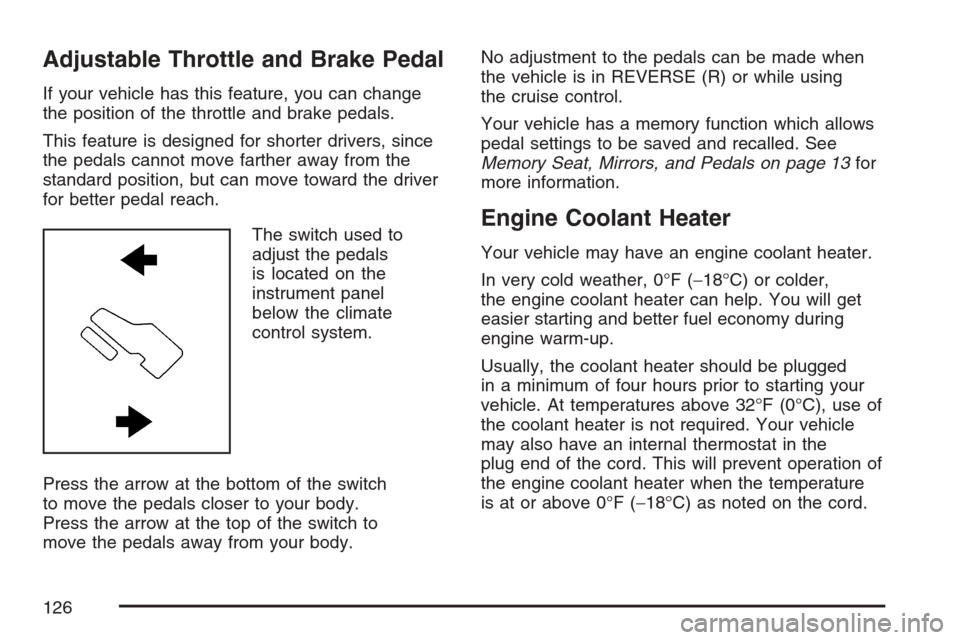
The switch used to
adjust the pedals
is located on the
instrument panel
below the climate
control system.
Press the arrow at the bottom of the switch
to move the pedals closer to your body.
Press the arrow at the top of the switch to
move the pedals away from your body.No adjustment to the pedals can be made when
the vehicle is in REVERSE (R) or while using
the cruise control.
Your vehicle has a memory function which allows
pedal settings to be saved and recalled. See
Memory Seat, Mirrors, and Pedals on page 13for
more information.
Engine Coolant Heater
Your vehicle may have an engine coolant heater.
In very cold weather, 0°F (−18°C) or colder,
the engine coolant heater can help. You will get
easier starting and better fuel economy during
engine warm-up.
Usually, the coolant heater should be plugged
in a minimum of four hours prior to starting your
vehicle. At temperatures above 32°F (0°C), use of
the coolant heater is not required. Your vehicle
may also have an internal thermostat in the
plug end of the cord. This will prevent operation of
the engine coolant heater when the temperature
is at or above 0°F (−18°C) as noted on the cord.
126
Page 128 of 618

Automatic Transmission Operation
There are several different positions for the
shift lever.
Your vehicle has an automatic transmission with
an electronic shift position indicator within the
instrument panel cluster. This display will show
the position anytime the shift lever is moved out
of PARK (P).
PARK (P):This position locks your rear wheels.
It is the best position to use when you start
your engine because your vehicle cannot
move easily.{CAUTION:
It is dangerous to get out of your vehicle
if the shift lever is not fully in PARK (P)
with the parking brake rmly set. Your
vehicle can roll.
Do not leave your vehicle when the engine
is running unless you have to. If you have
left the engine running, the vehicle can
move suddenly. You or others could be
injured. To be sure your vehicle will not
move, even when you are on fairly level
ground, always set your parking brake
and move the shift lever to PARK (P).
SeeShifting Into Park (P) on page 139.
If you are pulling a trailer, seeTowing
a Trailer on page 414.
128
Page 132 of 618
Four-Wheel Drive
If your vehicle has four-wheel drive, you can send
your engine’s driving power to all four wheels
for extra traction. Read the part that follows before
using four-wheel drive.
Notice:Driving on clean, dry pavement in
Four-Wheel-Drive High or Four-Wheel-Drive
Low for an extended period of time may cause
premature wear on your vehicle’s powertrain.
Do not drive on clean, dry pavement in
Four-Wheel-Drive High or Four-Wheel-Drive
Low for extended periods of time.
While driving on clean dry pavement and during
tight turns, you may experience a vibration in
the steering system.
Front Axle Locking Feature
The front axle locks and unlocks automatically
when you shift the transfer case. Some delay for
the axle to lock or unlock is normal.
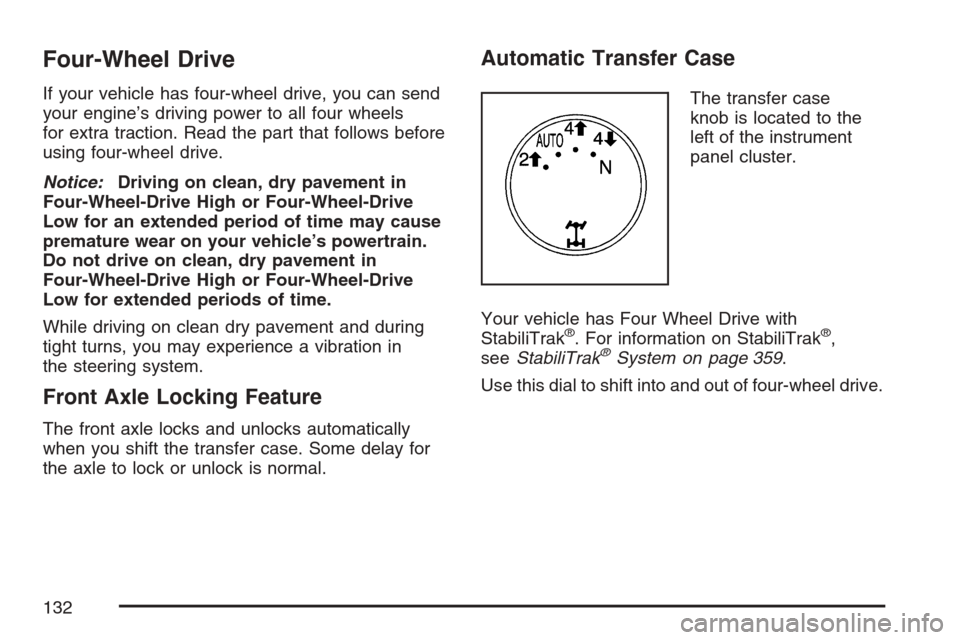
Automatic Transfer Case
The transfer case
knob is located to the
left of the instrument
panel cluster.
Your vehicle has Four Wheel Drive with
StabiliTrak
®. For information on StabiliTrak®,
seeStabiliTrak®System on page 359.
Use this dial to shift into and out of four-wheel drive.
132