Page 52 of 138

pads more frequently and replace
the brake pads in good time.Air pressure and damping
characteristics
The off-road settings for air
pressure in the Air Damping
System and the front and rear
shock-absorber damping char-
acteristics will impair the motor-
cycle's handling characteristics
on surfaced roads.
If you have been off-roading, re-
member to correct the air pres-
sure in the Air Damping System
and the shock-absorber damping
characteristics before you return
to surfaced roads.
Deactivatable ABS
OE
You can deactivate the BMW
Motorrad Integral ABS for off-
roading ( 33).
BrakesHow can stopping
distance be minimised?Each time the brakes are applied,
a load distribution shift takes
place with the load shifting for-
ward from the rear to the front
wheel. The sharper the motor-
cycle decelerates, the more load
is shifted to the front wheel. The
higher the wheel load, the more
braking force can be transmitted
without the wheel locking.
To optimise stopping distance,
apply the front brakes rapidly and
keep on increasing the force you
apply to the brake lever. This
makes the best possible use
of the dynamic increase in load
at the front wheel. Remember
to pull the clutch at the same
time. In the "panic braking situ-
ations" that are trained so fre-
quently braking force is applied
as rapidly as possible and withthe rider's full force applied to
the brake levers; under these cir-
cumstances the dynamic shift
in load distribution cannot keep
pace with the increase in de-
celeration and the tyres cannot
transmit the full braking force to
the surface of the road. ABS has
to intervene to keep the front
wheel from locking; this increases
stopping distance.
Descending mountain
passes
There is a danger of the
brakes fading if you use
only the rear brakes when des-
cending mountain passes. Under
extreme conditions, the brakes
could overheat and suffer severe
damage.
Use both front and rear brakes,
and make use of the engine's
braking effect as well.
550zRiding
Page 58 of 138

Brake system with
BMW Motorrad ABS
OE
How does ABS work?The amount of braking force that
can be transferred to the road
depends on factors hat include
the coefficient of friction of the
road surface. Loose stones, ice
and snow or a wet road all have
much lower coefficients of fric-
tion than a clean, dry asphalt sur-
face. The lower the coefficient
of friction, the longer the braking
distance.
If the rider increases braking
pressure to the extent that brak-
ing force exceeds the maxim-
um transferrable limit, the wheels
start to lock and the motorcycle
loses its directional stability; a fall
is imminent. Before this situation
can occur, ABS intervenes and
adapts braking pressure to the
maximum transferrable braking
force, so the wheels continueto turn and directional stability
is maintained irrespective of the
condition of the road surface.
What are the effects of
surface irregularities?Humps and surface irregularit-
ies can cause the wheels to lose
contact temporarily with the road
surface; if this happens the brak-
ing force that can be transmit-
ted to the road can drop to zero.
If the brakes are applied under
these circumstances the ABS
has to reduce braking force to
ensure that directional stability
is maintained when the wheels
regain contact with the road sur-
face. At this instant the BMW
Motorrad ABS must assume an
extremely low coefficient of fric-
tion, so that the wheels will con-
tinue to rotate under all imagin-
able circumstances, because this
is the precondition for ensuring
directional stability. As soon asis registers the actual circum-
stances, the system reacts in-
stantly and adjusts braking force
accordingly to achieve optimum
braking.
Rear wheel liftEven under severe braking, a
high level of tyre grip can mean
that the front wheel does not
lock up until very late, if at all.
Consequently, ABS does not in-
tervene until very late, if at all.
Under these circumstances the
rear wheel can lift off the ground,
and the outcome can be a high-
siding situation in which the mo-
torcycle can flip over.
Severe braking can cause
the rear wheel to lift off the
ground.
When you brake, bear in mind
that ABS control cannot be relied
on in all circumstances to prevent
the rear wheel from lifting clear of
the ground.
656zEngineering details
Page 63 of 138
Cable routingThe cables from the power sock-
et to the auxiliary device must be
routed in such a way that they:
Do not impede the rider
Do not restrict or obstruct the
steering angle and handling
characteristics
Cannot be trapped
Incorrectly routed cables
can impede the rider.
Route the cables as described
above.LuggageCorrect loading
Overloading and imbal-
anced loads can adversely
affect the motorcycle's handling.
Do not exceed the permissible
gross weight and be sure to
comply with the instructions on
loading.Set the air pressure in the Air
Damping System, the damp-
ing characteristic and the tyre
pressures to suit total weight.
Note the maximum permissible
payload of the luggage carrier.
Loading luggage carrier
max 5 kg
761zAccessories
Page 118 of 138
Front wheel
Front wheel, type Spoked wheel
Front wheel rim size 1.60" x 21"
Tyre designation, front 90 / 90 x 21
Rear wheel
Rear wheel type Spoked wheel
Rear wheel rim size 2.50" x 18"
Tyre designation, rear 140 / 80 x 18
Tyre pressures
Tyre pressure, front 1.8 bar, one-up, tyre cold
1.9 bar, two-up and/or with luggage, tyre cold
Tyre pressure, rear 2 bar, one-up, tyre cold
2.2 bar, two-up and/or with luggage, tyre cold
10116zTechnical data
Page 136 of 138
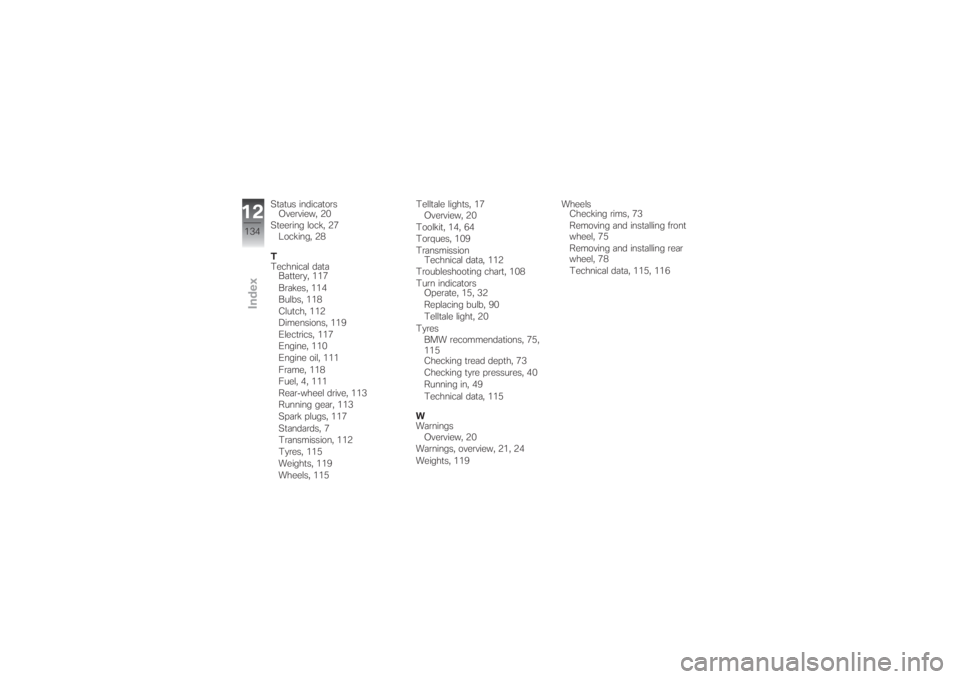
Status indicators
Overview, 20
Steering lock, 27
Locking, 28
T
Technical data
Battery, 117
Brakes, 114
Bulbs, 118
Clutch, 112
Dimensions, 119
Electrics, 117
Engine, 110
Engine oil, 111
Frame, 118
Fuel, 4, 111
Rear-wheel drive, 113
Running gear, 113
Spark plugs, 117
Standards, 7
Transmission, 112
Tyres, 115
Weights, 119
Wheels, 115Telltale lights, 17
Overview, 20
Toolkit, 14, 64
Torques, 109
Transmission
Technical data, 112
Troubleshooting chart, 108
Turn indicators
Operate, 15, 32
Replacing bulb, 90
Telltale light, 20
Tyres
BMW recommendations, 75,
115
Checking tread depth, 73
Checking tyre pressures, 40
Running in, 49
Technical data, 115
W
Warnings
Overview, 20
Warnings, overview, 21, 24
Weights, 119Wheels
Checking rims, 73
Removing and installing front
wheel, 75
Removing and installing rear
wheel, 78
Technical data, 115, 116
12134zIndex
Page 138 of 138
Important data for refuellingFuel
Recommended fuel grade 95 ROZ/RON, Super unleaded
Usable fuel capacity 9.5 l
Reserve fuel2l
Tyre pressures
Tyre pressure, front 1.8 bar, one-up, tyre cold
1.9 bar, two-up and/or with lug-
gage, tyre cold
Tyre pressure, rear 2 bar, one-up, tyre cold
2.2 bar, two-up and/or with lug-
gage, tyre cold
BMW recommends
Order No. 01 41 7 712 241
07.2007, 3rd edition
*01417712241*
*01417712241*
*01417712241*