63
Deployment of the airbags happens in a
fraction of a second, so the airbags must
inflate with considerable force. While the
system is designed to reduce serious inju-
ries, primarily to the head and chest, it
may also cause other, less severe injuries
to the face, chest, arms and hands. These
are usually in the nature of minor burns
or abrasions and swelling, but the force of
a deploying airbag can cause more seri-
ous injuries, especially if an occupant’s
hands, arms, chest or head is in close
proximity to the airbag module at the time
of deployment. This is why it is important
for the occupant to: avoid placing any
object or part of the body between the
occupant and the airbag module; sit
straight and well back into the seat; wear
the available seat belt properly; and sit as
far as possible from the airbag module,
while still maintaining control of the ve-
hicle.
Parts of the airbag module (steering wheel
hub, airbag cover and inflator) may be hot
for several minutes after deployment, so
do not touch! The airbags inflate only
once. The windshield may be damaged by
absorbing some of the force of the inflat-
ing airbag.CAUTION
The driver or front passenger who is
too close to the steering wheel or
dashboard during airbag deployment
can be killed or seriously injured.
Toyota strongly recommends that:
�The driver sit as far back as pos-
sible from the steering wheel while
still maintaining control of the ve-
hicle.
�The front passenger sit as far back
as possible from the dashboard.
�All vehicle occupants be properly
restrained using the available seat
belts.
�If the seat belt extender has been
connected to the driver ’s seat belt
buckle without wearing the seat belt
when using the extender in the
driver ’s seat, the SRS driver ’s air-
bag system will judge that the driv-
er wears the seat belt even if not
wearing it. In this case, the driver ’s
airbag may not activate correctly,
causing death or serious injury in
the event of collision. Be sure to
wear the seat belt with the seat belt
extender.
For instructions and precautions con-
cerning the seating position, see
“—Front seat precautions” on page
36.
71
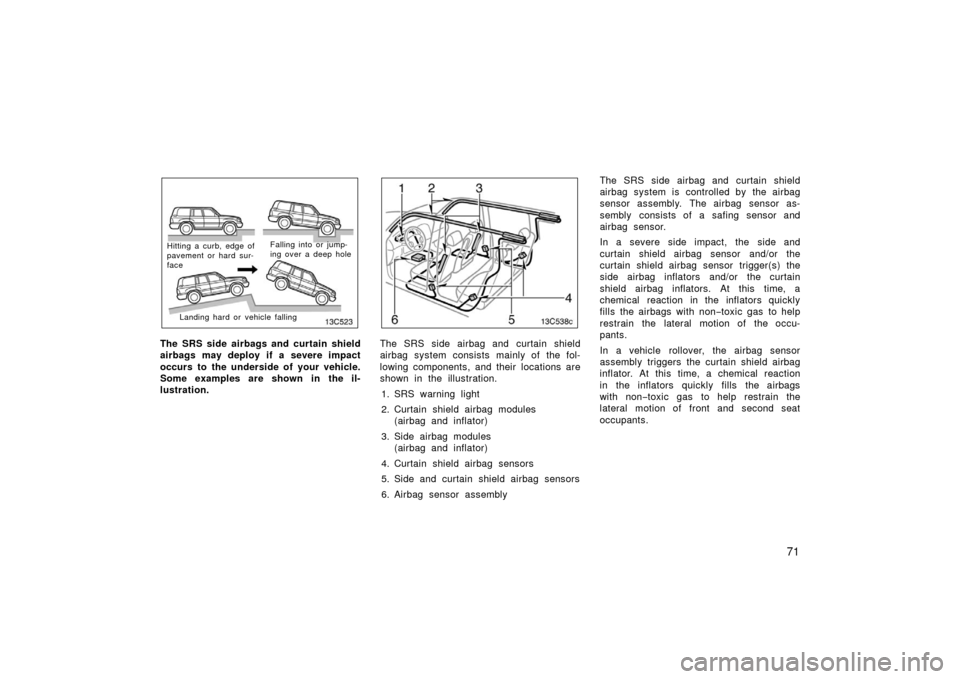
Hitting a curb, edge of
pavement or hard sur-
faceFalling into or jump-
ing over a deep hole
Landing hard or vehicle falling
The SRS side airbags and curtain shield
airbags may deploy if a severe impact
occurs to the underside of your vehicle.
Some examples are shown in the il-
lustration.
13c538c
The SRS side airbag and curtain shield
airbag system consists mainly of the fol-
lowing components, and their locations are
shown in the illustration.
1. SRS warning light
2. Curtain shield airbag modules (airbag and inflator)
3. Side airbag modules (airbag and inflator)
4. Curtain shield airbag sensors
5. Side and curtain shield airbag sensors
6. Airbag sensor assembly The SRS side airbag and curtain shield
airbag system is controlled by the airbag
sensor assembly. The airbag sensor as-
sembly consists of a safing sensor and
airbag sensor.
In a severe side impact, the side and
curtain shield airbag sensor and/or the
curtain shield airbag sensor trigger(s) the
side airbag inflators and/or the curtain
shield airbag inflators. At this time, a
chemical reaction in the inflators quickly
fills the airbags with non
−toxic gas to help
restrain the lateral motion of the occu-
pants.
In a vehicle rollover, the airbag sensor
assembly triggers the curtain shield airbag
inflator. At this time, a chemical reaction
in the inflators quickly fills the airbags
with non −toxic gas to help restrain the
lateral motion of front and second seat
occupants.