2006 SUZUKI SX4 Can
[x] Cancel search: CanPage 731 of 1556

Downloaded from www.Manualslib.com manuals search engine Automatic Transmission/Transaxle: 5A-83
7) Pull out fluid level gauge (1) again and check fluid
level indicated on it. The lowest fluid level should be
between FULL HOT (2) and LOW HOT (3). If it is
below LOW HOT, add SUZUKI ATF 3317 or Mobil
ATF 3309 up to FULL HOT.
Automatic transaxle fluid
SUZUKI ATF 3317 or Mobil ATF 3309
NOTE
• Do not race engine while checking fluid
level, even after the engine start.
• Do not overfill. Overfilling can cause
foaming and loss of fluid through breather.
Then slippage and transaxle failure can
result.
• Bringing the level from LOW HOT to FULL
HOT requires 0.4 liters (0.85 / 0.70 US/Imp.
pt).
• If vehicle was driven under high load such
as pulling a trailer, fluid level should be
checked about half an hour after it is
stopped.
Level Check at Room (Cold) Temperature – Cold
Check
Fluid level can be checked temporarily at room (cold)
temperature which correspond to 20 – 30 °C (68 – 86
°F). This level check is considered to be preparation
before performing level check under normal operating
(hot) temperature. Checking procedure itself is the same
as that described in “Level Check at Normal Operating
(Hot) Temperature – Hot Check: ”. If fluid level is
between “FULL COLD” (4) and “LOW COLD” (5),
proceed to test drive. And when fluid temperature has
reached normal operating temperature, check fluid level
again and adjust it as necessary.
CAUTION!
Fluid level check at room (cold) temperature
is recommended only for preparation of level
check under normal (hot) operating
condition.
Failure to perform fluid level check under
normal (hot) operating temperature may
result in damage to transaxle.
A/T Fluid ChangeS6RW0D5106003
CAUTION!
Do not use any fluid other than the specified
ATF. Use of any fluid other than the specified
ATF may cause juddering or some other
faulty condition to occur.
1) Lift up vehicle.
2) Remove left side engine under cover.
3) When engine is cool, remove drain plug (1) from oil
pan (2) and drain A/T fluid.
4) Install drain plug (1).
Tightening torque
A/T fluid drain plug (a): 17 N·m (1.7 kgf-m, 12.5
lb-ft)
4. “FULL COLD” mark 5. “LOW COLD” mark
1
54 321
I5RW0C510027-01
1. Fluid level gauge 3. “LOW HOT” mark
2. “FULL HOT” mark
1
54 321
I5RW0C510027-01
21, (a)I5RW0C510029-02
Page 735 of 1556

Downloaded from www.Manualslib.com manuals search engine Automatic Transmission/Transaxle: 5A-87
2) Remove adjuster (cable end) from select lever pin of
select lever assembly.
3) Remove adjuster (cable end) from select lever pin of
select lever assembly.
4) Release lock plate (1) which restrict moving of cable
end holder (2).
5) Push cable end holder (1) out from eye-end (2) using
an appropriate tool (3) to disengage cable.
6) Shift select lever to “N” position.
7) Apply grease to select lever pin and install adjuster
(cable end) to it.
: Grease 99000–25011 (SUZUKI Super Grease
A)
8) With both select lever and transmission range
sensor kept each “N” position, drive cable end holder
(1) in until it locks cable.
9) Slide lock plate (2) to secure cable end holder in
position.
10) After select cable was installed, check for the
following.
• Push vehicle with select lever shifted to “P” range.
Vehicle should not move.
• Vehicle can not be driven in “N” range.• Vehicle can be driven in “D”, “3”, “2” and “L”
ranges.
• Vehicle can be backed in “R” range.
Key Interlock Cable Removal and InstallationS6RW0D5106026
NOTE
Don’t bend interlock cable excessively when
removing and installing it, or system will not
operate correctly.
Removal
1) If the vehicle is equipped with air bag system,
disconnect negative cable at battery and disable air
bag system, referring to “Disabling Air Bag System in
Section 8B”.
2) Remove steering column cover.
3) Turn ignition switch to ACC position.
4) Pull out key interlock cable (1) from key cylinder
cover (2) while pressing checkhook with slotted
screwdriver (3) or the like.
5) Turn ignition switch to LOCK position.
6) Remove console box referring to “Console Box
Components in Section 9H”.
7) Detach cable end (1) from interlock cam (2) while
pressing claws (3) of interlock cam boss.
At this time, be careful not to cause damage to its
claws.
Detach cable casing cap (4) from bracket (5) while
pressing checkhook.
8) Remove interlock cable.
I2RH01510046-01
I2RH01510047-01
I3RM0B510037-01
2
13I5RW0C510045-01
4
5 3 12
4
I5RW0C510046-01
Page 737 of 1556

Downloaded from www.Manualslib.com manuals search engine Automatic Transmission/Transaxle: 5A-89
2) Turn ignition switch to ACC position.
3) Insert cable casing cap (1) into key cylinder cover (2)
securely.
4) Pull out lock button (1) of select lever side cable end
(2).
5) Shift select lever to “N” position.
NOTE
If select lever is in “P” position, shift select
lever referring to “Select Lever Inspection”.
6) Install cable casing cap (3) to bracket (4).
7) Connect cable end (1) to interlock cam (2) with
ignition switch turned to ACC position.
8) Drive lock button (5) in cable end until it locks cable
expansion and contraction.9) With select lever set at “P” position, turn ignition key
to ACC position and then check for the following
conditions.
• With knob button released, ignition key can be
turned from ACC position to LOCK position.
• With knob button pressed, ignition key cannot be
turned from ACC position to LOCK position.
10) Install knee protector to steering column.
11) Install steering column cover.
12) If the vehicle is equipped with air bag system,
connect negative cable at battery and enable air bag
system, referring to “Enabling Air Bag System in
Section 8B”.
Transmission Range Sensor Inspection and
Adjustment
S6RW0D5106009
1) Shift manual select lever (4) to “N” range.
2) Check that needle direction shaped on lock washer
(2) and “N” reference line (1) on transmission range
sensor are aligned. If not, loosen sensor bolts (3)
and align them.
Tightening torque
Transmission range sensor bolt (a): 5.5 N·m (
0.55 kgf-m, 4.0 lb-ft)
2
1I5RW0C510047-01
1 1
2
I2RH01510086-01
3
4 12
3 5
I5RW0C510048-01
1
3, (a) 4
2
I2RH0B510041-01
Page 738 of 1556

Downloaded from www.Manualslib.com manuals search engine 5A-90 Automatic Transmission/Transaxle:
3) Check that engine starts in “N” and “P” ranges but it
doesn’t start in “D”, “2”, “L” or “R” range. Also, check
that back-up lamp lights in “R” range.
If faulty condition cannot be corrected by adjustment,
disconnect transmission range sensor connector
and check that continuity exists as shown by moving
manual select lever.
Output Shaft Speed Sensor (VSS) Removal and
Installation
S6RW0D5106010
Removal
1) Disconnect negative cable at battery.
2) Disconnect output shaft speed sensor connector (2).
3) Remove output shaft speed sensor (VSS) (1) by
removing its bolt.
Installation
1) Apply A/T fluid to output shaft speed sensor O-ring.
2) Install output shaft speed sensor (VSS) (1) to A/T
case and tighten bolt to specified torque.
Tightening torque
Output shaft speed sensor (VSS) bolt (a): 13
N·m (1.3 kgf-m, 9.5 lb-ft)3) Connect output shaft speed sensor connector (2) to
output shaft speed sensor (VSS) (1).
4) Connect negative cable to battery.
Output Shaft Speed Sensor (VSS) InspectionS6RW0D5106011
1) Connect positive cable of 12 volt battery to “A”
terminal of sensor and ground cable to “C” terminal.
Then using voltmeter, check voltage between “B”
terminal and “C” terminal with output shaft speed
sensor (VSS) driven gear rotated.
If measured voltage (pulse signal) is not as
specified, replace sensor.
Output shaft speed sensor (VSS) output voltage
Pulse signal of alternating 0 – 1 V and 10 – 14 V
2) Check output shaft speed sensor (VSS) driven gear
(1) for wear.
Replace if necessary.
1 2
3
4
5
9
87
6
1
P
R
N
D
2
LTerminal No.
Sensor Position
23456789
I3RH0A510038-01
12I5RW0C510032-01
(a)
12
I5RW0C510033-01
I2RH0B510045-01
I2RH0B510046-01
Page 789 of 1556

Downloaded from www.Manualslib.com manuals search engine Automatic Transmission/Transaxle: 5A-141
3) Install new differential side oil seal to transaxle case
by using special tools.
Special tool
(A): 09913–75810
Differential side oil seal installing depth
“a”: 3.8 – 4.8 mm (0.15 – 0.19 in.)
4) Apply grease to oil seal lip.
“A”: Grease 99000–25030 (SUZUKI Super
Grease C)
Automatic Transaxle Unit Inspection and
Adjustment
S6RW0D5106057
Inspection
Brake discs
Dry and inspect them for pitting, burn flaking, significant
wear, glazing, cracking, charring and chips or metal
particles imbedded in lining.
If discs show any of the above conditions, replacement
is required.
NOTE
• If disc lining is exfoliated or discolored,
replace all discs.
• Before assembling new discs, soak them
in A/T fluid for at least two hours.
Brake separator plates and retaining plates
Dry plates and check for discoloration. If plate surface is
smooth and even color smear is indicated, plate should
be reused. If severe heat spot discoloration or surface
scuffing is indicated, plate must be replaced.
Brake return spring subassembly
Measure free length of each brake return springs.
Evidence of extreme heat or burning in the area of clutch
may have caused springs to take heat set and would
require their replacement.
Free length of 1st & reverse brake return spring
subassembly
“a”: 21.71 mm (0.855 in.)
Free length of 2nd brake return spring subassembly
“a”: 15.85 mm (0.624 in.)
NOTE
• Do not apply excessive force when
measuring spring free length.
• Perform measurement at several points.
(A)“a”
“A”
I5RW0C510066-02
I2RH01510147-01
I2RH0B510253-01
I2RH0B510173-01
Page 794 of 1556
Downloaded from www.Manualslib.com manuals search engine 5A-146 Automatic Transmission/Transaxle:
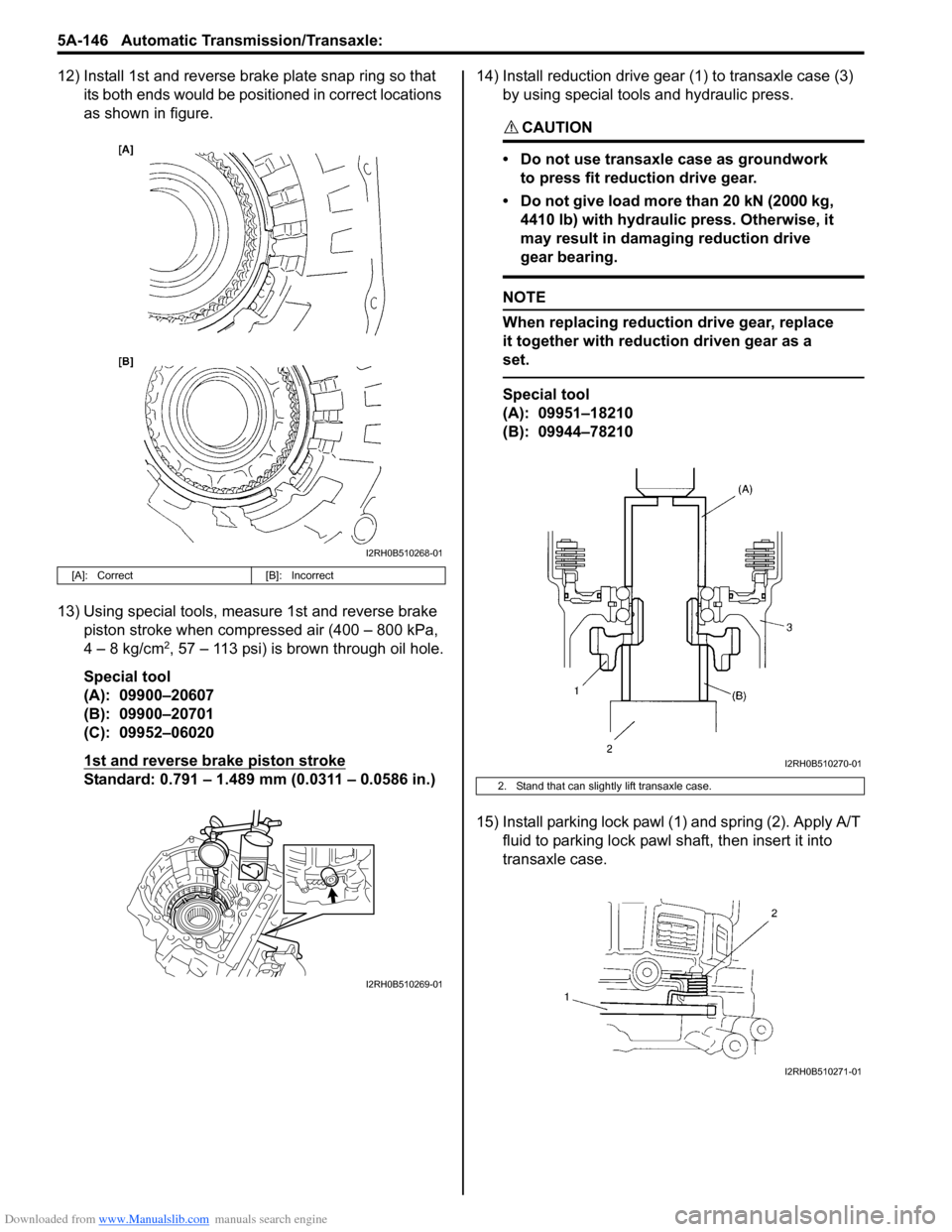
12) Install 1st and reverse brake plate snap ring so that
its both ends would be positioned in correct locations
as shown in figure.
13) Using special tools, measure 1st and reverse brake
piston stroke when compressed air (400 – 800 kPa,
4 – 8 kg/cm
2, 57 – 113 psi) is brown through oil hole.
Special tool
(A): 09900–20607
(B): 09900–20701
(C): 09952–06020
1st and reverse brake piston stroke
Standard: 0.791 – 1.489 mm (0.0311 – 0.0586 in.)14) Install reduction drive gear (1) to transaxle case (3)
by using special tools and hydraulic press.
CAUTION!
• Do not use transaxle case as groundwork
to press fit reduction drive gear.
• Do not give load more than 20 kN (2000 kg,
4410 lb) with hydraulic press. Otherwise, it
may result in damaging reduction drive
gear bearing.
NOTE
When replacing reduction drive gear, replace
it together with reduction driven gear as a
set.
Special tool
(A): 09951–18210
(B): 09944–78210
15) Install parking lock pawl (1) and spring (2). Apply A/T
fluid to parking lock pawl shaft, then insert it into
transaxle case.
[A]: Correct [B]: Incorrect
I2RH0B510268-01
I2RH0B510269-01
2. Stand that can slightly lift transaxle case.
I2RH0B510270-01
I2RH0B510271-01
Page 795 of 1556
Downloaded from www.Manualslib.com manuals search engine Automatic Transmission/Transaxle: 5A-147
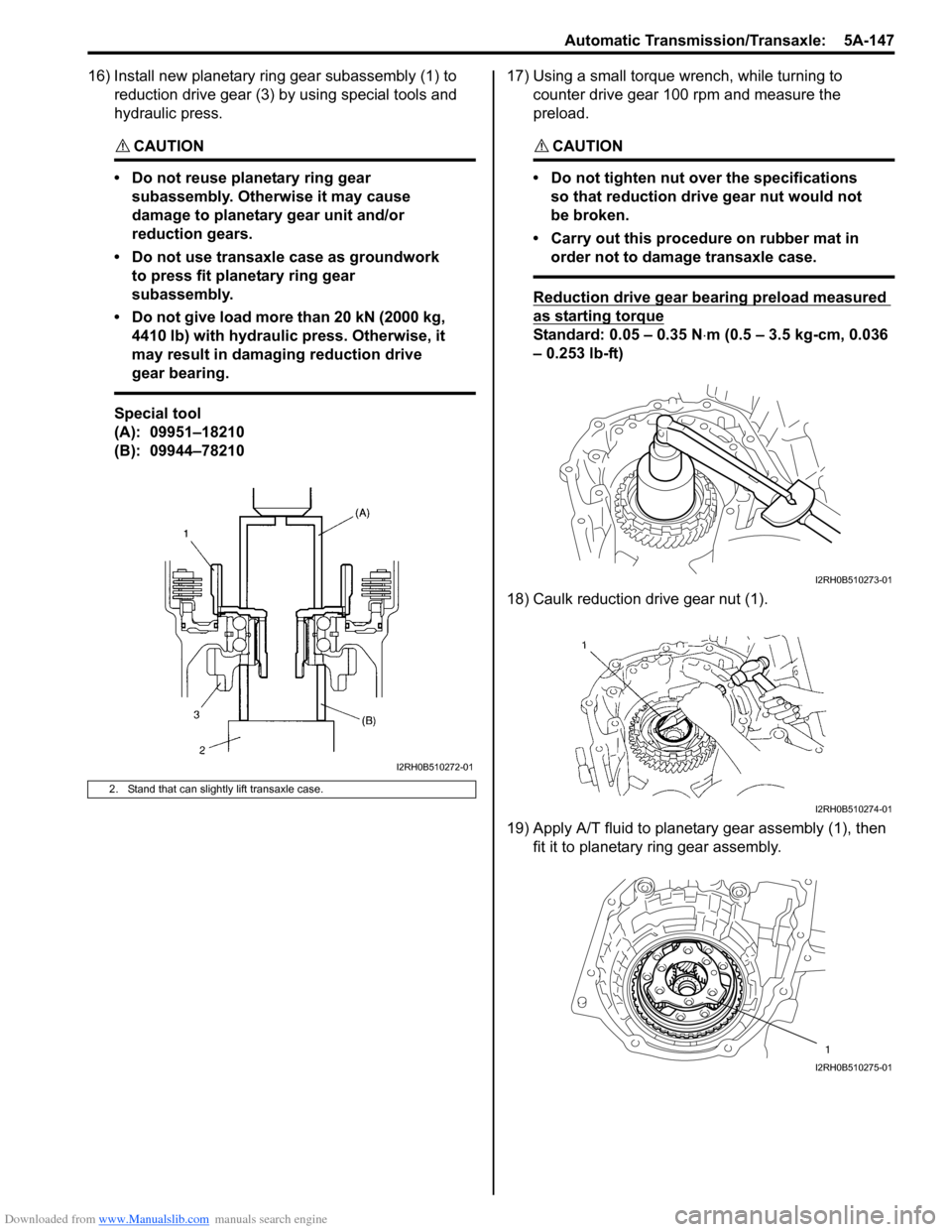
16) Install new planetary ring gear subassembly (1) to
reduction drive gear (3) by using special tools and
hydraulic press.
CAUTION!
• Do not reuse planetary ring gear
subassembly. Otherwise it may cause
damage to planetary gear unit and/or
reduction gears.
• Do not use transaxle case as groundwork
to press fit planetary ring gear
subassembly.
• Do not give load more than 20 kN (2000 kg,
4410 lb) with hydraulic press. Otherwise, it
may result in damaging reduction drive
gear bearing.
Special tool
(A): 09951–18210
(B): 09944–7821017) Using a small torque wrench, while turning to
counter drive gear 100 rpm and measure the
preload.
CAUTION!
• Do not tighten nut over the specifications
so that reduction drive gear nut would not
be broken.
• Carry out this procedure on rubber mat in
order not to damage transaxle case.
Reduction drive gear bearing preload measured
as starting torque
Standard: 0.05 – 0.35 N⋅m (0.5 – 3.5 kg-cm, 0.036
– 0.253 lb-ft)
18) Caulk reduction drive gear nut (1).
19) Apply A/T fluid to planetary gear assembly (1), then
fit it to planetary ring gear assembly.
2. Stand that can slightly lift transaxle case.
I2RH0B510272-01
I2RH0B510273-01
I2RH0B510274-01
1
I2RH0B510275-01
Page 812 of 1556

Downloaded from www.Manualslib.com manuals search engine 5A-164 Automatic Transmission/Transaxle:
09926–97620 09926–98310
Spring compressor Clutch spring compressor
) / )) / )
09928–06050 09942–15511
Differential preload adapter Sliding hammer
) / )) / ) / ) / )
09944–78210 09944–88220
Bearing installer support Oil seal installer
) / )) / ) / ) / )
09944–96011 09946–06710
Bearing outer race remover Transfer bearing dummy
) / ) / ) / )) / )
09951–18210 09952–06020
Oil seal remover & installer
No. 2Dial gauge plate No.2
) / )) / ) / ) / )
SUZUKI scan tool (SUZUKI-
SDT)
—
This kit includes following
items. 1. SUZUKI-SDT 2.
DLC3 cable 3. USB cable 4.
AC/DC power supply 5.
Voltage meter probe 6.
Storage case ) / )
1
2
34
56