2006 SUBARU TRIBECA warning
[x] Cancel search: warningPage 273 of 377
9-2 In case of emergency
In case of emergencyIf you park your vehicle in an
emergency
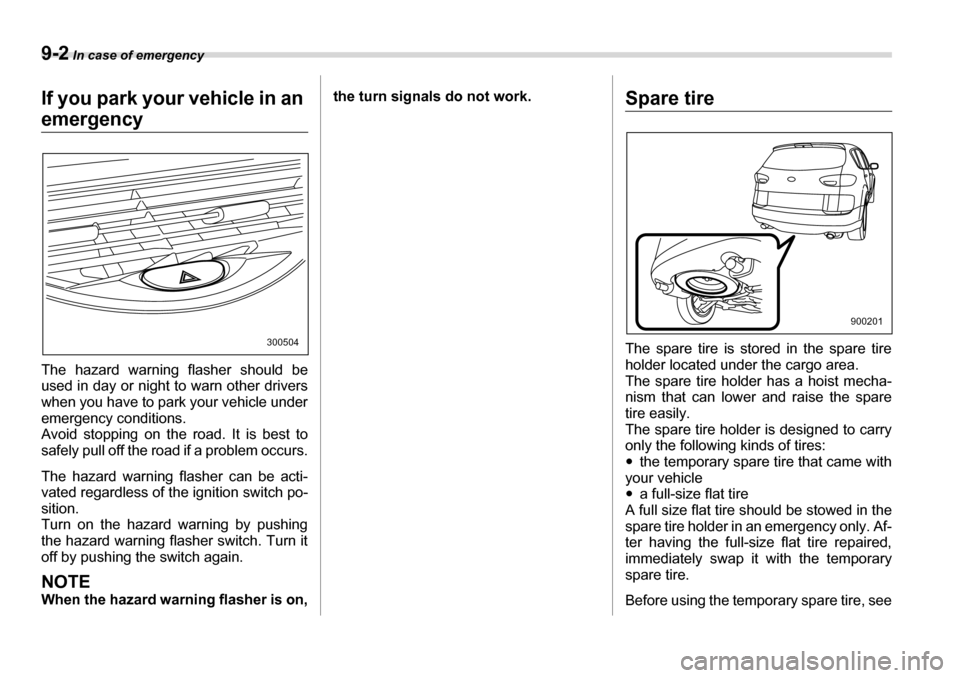
The hazard warning flasher should be
used in day or night to warn other drivers
when you have to park your vehicle under
emergency conditions.
Avoid stopping on the road. It is best to
safely pull off the road if a problem occurs.
The hazard warning flasher can be acti-
vated regardless of the ignition switch po- sition.
Turn on the hazard warning by pushing
the hazard warning flasher switch. Turn it
off by pushing the switch again.
NOTE
When the hazard warning flasher is on, the turn signals do not work.
Spare tire
The spare tire is stored in the spare tire
holder located under the cargo area.
The spare tire holder has a hoist mecha-
nism that can lower and raise the spare
tire easily.
The spare tire holder is designed to carry
only the following kinds of tires: y
the temporary spare tire that came with
your vehicle y a full-size flat tire
A full size flat tire should be stowed in the
spare tire holder in an emergency only. Af-
ter having the full-size flat tire repaired,
immediately swap it with the temporaryspare tire.
Before using the temporary spare tire, see
300504
900201
Page 277 of 377

9-6 In case of emergency
Temporary spare tire
The temporary spare tire is smaller and
lighter than a conventional tire and is de-
signed for emergency use only. Remove
the temporary spare tire and re-install the
conventional tire as soon as possible be-
cause the spare tire is designed only for
temporary use.
Check the inflation pressure of the tempo-
rary spare tire periodically to keep the tire
ready for use. The correct pressure is 60
psi (420 kPa, 4.2 kgf/cm 2
).
When using the temporary spare tire, note
the following.y Do not exceed 50 mph (80 km/h).
y Do not put a tire chain on the temporary
spare tire. Because of the smaller tire
size, a tire chain will not fit properly. y Do not use two or more temporary
spare tires at the same time. y Do not drive over obstacles. This tire
has a smaller diameter, so road clearance
is reduced. 1) Tread wear indicator bar
2) Indicator location mark
y When the wear indicator appears on the
tread, replace the tire. y The temporary spare tire must be used
only on a rear wheel. If a front wheel tire
gets punctured, replace the wheel with a
rear wheel and install the temporary spare
tire in place of the removed rear wheel.
y Never tow a trailer when the tem-
porary spare tire is used. The tem-
porary spare tire is not designed
to sustain the towing load. Use of
the temporary spare tire when
towing can result in failure of the
spare tire and/or less stability of
the vehicle and may lead to an ac-
cident.
yWhen a spare tire is mounted or a
wheel rim is replaced without the
original pressure sensor/trans-
mitter being transferred, the low
tire pressure warning light will
flash. This indicates the tire pres-
sure monitoring system (TPMS) is
unable to monitor all four road
wheels. Contact your SUBARU
dealer as soon as possible for tire
and sensor replacement and/or
system resetting.
Never use any temporary spare tire
other than the original. Using other
sizes may result in severe mechani-
cal damage to the drive train of your
vehicle.1
2
900209
Page 278 of 377
In case of emergency 9-7
– CONTINUED –
Flat tires
If you have a flat tire while driving, never
brake suddenly; keep driving straight
ahead while gradually reducing speed.
Then slowly pull off the road to a safe
place. „Changing a flat tire
1. Park on a hard, level surface, whenev-
er possible, then stop the engine.
2. Set the parking brake securely and
shift in the “P” (Park) position.
3. Turn on the hazard warning flasher and
have everyone get out of the vehicle.
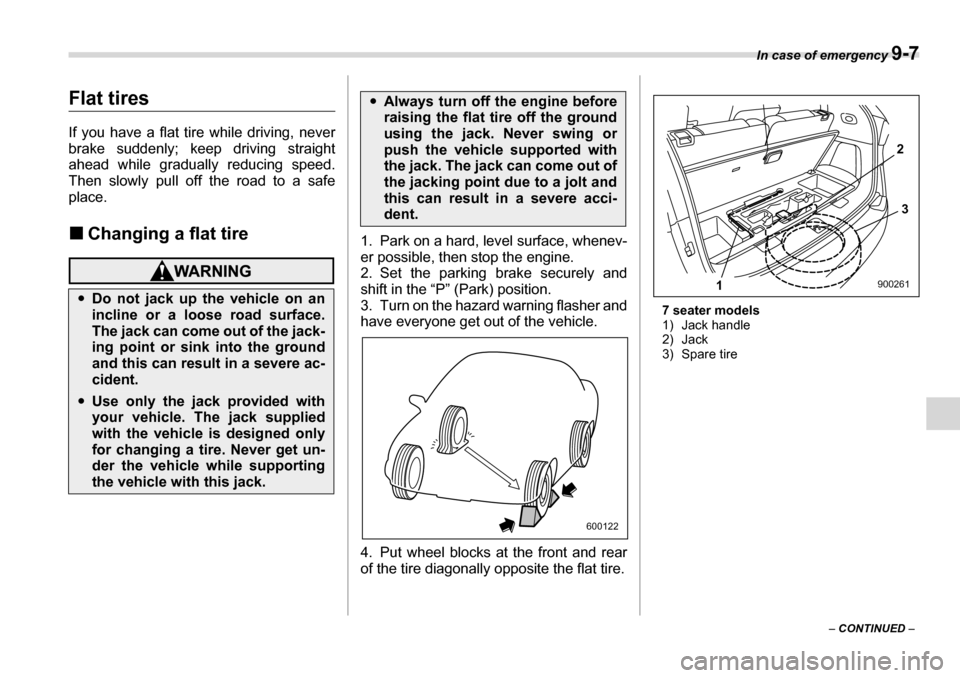
4. Put wheel blocks at the front and rear
of the tire diagonally opposite the flat tire. 7 seater models
1) Jack handle
2) Jack
3) Spare tire
y
Do not jack up the vehicle on an
incline or a loose road surface.
The jack can come out of the jack-
ing point or sink into the ground
and this can result in a severe ac-
cident.
yUse only the jack provided with
your vehicle. The jack supplied
with the vehicle is designed only for changing a tire. Never get un-
der the vehicle while supporting
the vehicle with this jack.
yAlways turn off the engine before
raising the flat tire off the ground
using the jack. Never swing or
push the vehicle supported with
the jack. The jack can come out of
the jacking point due to a jolt and
this can result in a severe acci-
dent.
600122
1 3
2900261
Page 281 of 377
9-10 In case of emergency
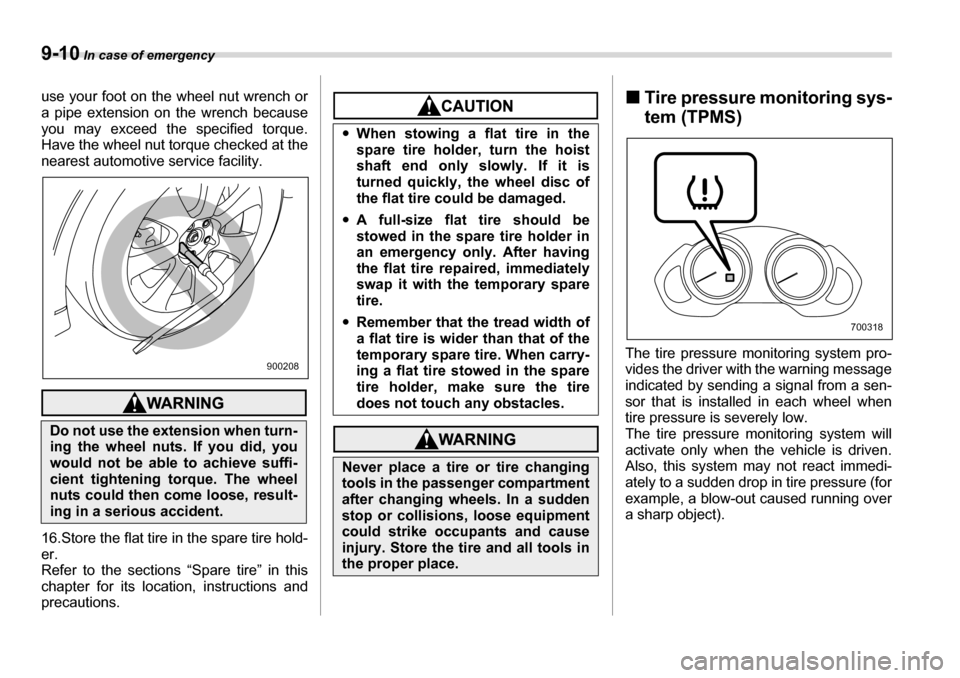
use your foot on the wheel nut wrench or
a pipe extension on the wrench because
you may exceed the specified torque.
Have the wheel nut torque checked at the
nearest automotive service facility.
16.Store the flat tire in the spare tire hold- er.
Refer to the sections “Spare tire” in this
chapter for its location, instructions and
precautions.
„Tire pressure monitoring sys- tem (TPMS)
The tire pressure monitoring system pro-
vides the driver with the warning message
indicated by sending a signal from a sen-
sor that is installed in each wheel when
tire pressure is severely low.
The tire pressure monitoring system will
activate only when the vehicle is driven.
Also, this system may not react immedi-
ately to a sudden drop in tire pressure (for
example, a blow-out caused running over
a sharp object).
Do not use the extension when turn-
ing the wheel nuts. If you did, you
would not be able to achieve suffi-
cient tightening torque. The wheel
nuts could then come loose, result-
ing in a serious accident.
900208
y When stowing a flat tire in the
spare tire holder, turn the hoist
shaft end only slowly. If it is
turned quickly, the wheel disc of
the flat tire could be damaged.
y A full-size flat tire should be
stowed in the spare tire holder in
an emergency only. After havingthe flat tire repaired, immediately
swap it with the temporary spare tire.
y Remember that the tread width of
a flat tire is wider than that of the
temporary spare tire. When carry-
ing a flat tire stowed in the spare
tire holder, make sure the tire
does not touch any obstacles.
Never place a tire or tire changing
tools in the passenger compartment
after changing wheels. In a sudden
stop or collisions, loose equipment
could strike occupants and cause
injury. Store the tire and all tools in
the proper place.
700318
Page 282 of 377

In case of emergency 9-11
– CONTINUED –
Jump starting
If the low tire pressure warning light
comes on while driving, never brake
suddenly and keep driving straight
ahead while gradually reducing
speed. Then slowly pull off the road
to a safe place. Otherwise an acci-
dent involving serious vehicle dam-
age and serious personal injury
could occur.
Check the pressure for all four tires
and adjust the pressure to the COLD
tire pressure shown on the vehicle
placard on the door pillar on the
driver’s side. If this light still comes
on while driving after adjusting the
tire pressure, a tire may have signif-
icant damage and a fast leak that
causes the tire to lose air rapidly. If
you have a flat tire, replace it with a
spare tire as soon as possible.
When a spare tire is mounted or a
wheel rim is replaced without the
original pressure sensor/transmitter
being transferred, the low tire pres-
sure warning light will flash. This in-
dicates the TPMS is unable to moni-
tor all four road wheels. Contact
your SUBARU dealer as soon as
possible for tire and sensor replace-
ment and/or system resetting.
Do not inject any tire liquid or aero-
sol tire sealant into the tires, as this
may cause a malfunction of the tire
pressure sensors.
If the light flashes, promptly contact
a SUBARU dealer to have the sys-
tem inspected.
yBattery fluid is SULFURIC ACID.
Do not let it come in contact with
the eyes, skin, clothing or the ve- hicle.
If battery fluid gets on you, thor-
oughly flush the exposed area
with water immediately. Get medi-
cal help if the fluid has entered
your eyes.
If battery fluid is accidentally
swallowed, immediately drink a
large amount of milk or water, and
obtain immediate medical help.
Keep everyone including children
away from the battery.
yThe gas generated by a battery ex-
plodes if a flame or spark is
brought near it. Do not smoke or
light a match while jump starting.
yNever attempt jump starting if the
discharged battery is frozen. It
could cause the battery to burst or
explode.
Page 320 of 377
Maintenance and service 11 - 2 3
– CONTINUED –
Parking brake stroke
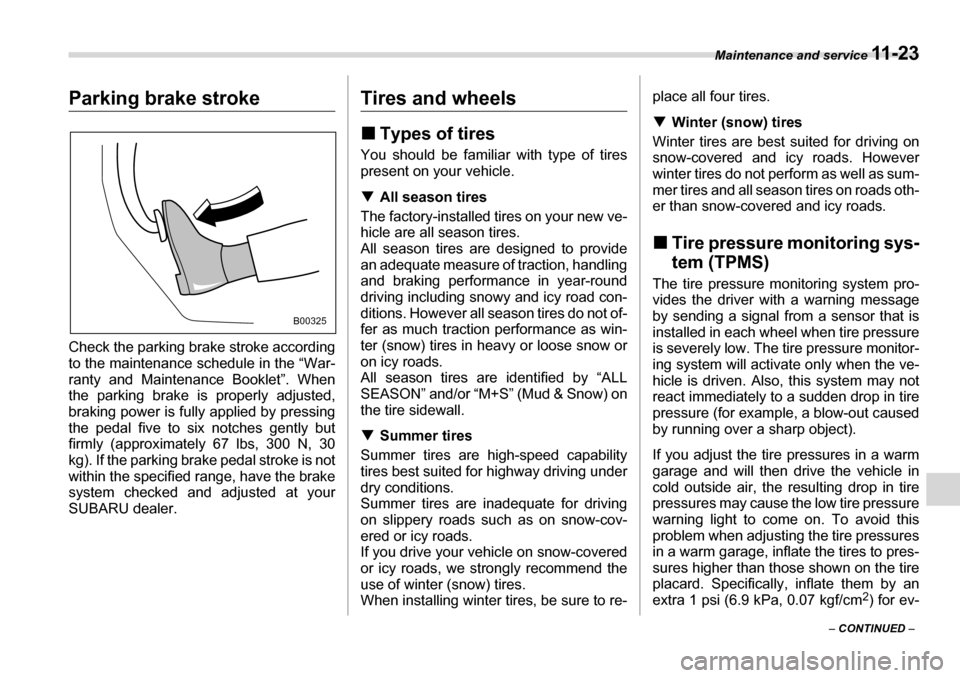
Check the parking brake stroke according
to the maintenance schedule in the “War-
ranty and Maintenance Booklet”. When
the parking brake is properly adjusted,
braking power is fully applied by pressing
the pedal five to six notches gently but
firmly (approximately 67 lbs, 300 N, 30
kg). If the parking brake pedal stroke is not
within the specified range, have the brake
system checked and adjusted at your
SUBARU dealer.Tires and wheels „Types of tires
You should be familiar with type of tires
present on your vehicle. T All season tires
The factory-installed tires on your new ve-
hicle are all season tires.
All season tires are designed to provide
an adequate measure of traction, handling
and braking performance in year-round
driving including snowy and icy road con-
ditions. However all season tires do not of-
fer as much traction performance as win-
ter (snow) tires in heavy or loose snow or
on icy roads.
All season tires are identified by “ALL
SEASON” and/or “M+S” (Mud & Snow) on
the tire sidewall. T Summer tires
Summer tires are high-speed capability
tires best suited for highway driving under
dry conditions.
Summer tires are inadequate for driving
on slippery roads such as on snow-cov-
ered or icy roads.
If you drive your vehicle on snow-covered
or icy roads, we strongly recommend the
use of winter (snow) tires.
When installing winter tires, be sure to re- place all four tires. T
Winter (snow) tires
Winter tires are best suited for driving on
snow-covered and icy roads. However
winter tires do not perform as well as sum-
mer tires and all season tires on roads oth-
er than snow-covered and icy roads. „ Tire pressure monitoring sys- tem (TPMS)
The tire pressure monitoring system pro-
vides the driver with a warning message
by sending a signal from a sensor that is
installed in each wheel when tire pressure
is severely low. The tire pressure monitor-
ing system will activate only when the ve-
hicle is driven. Also, this system may not
react immediately to a sudden drop in tire
pressure (for example, a blow-out caused
by running over a sharp object).
If you adjust the tire pressures in a warm
garage and will then drive the vehicle in
cold outside air, the resulting drop in tire
pressures may cause the low tire pressure
warning light to come on. To avoid this
problem when adjusting the tire pressures
in a warm garage, inflate the tires to pres-
sures higher than those shown on the tire
placard. Specifically, inflate them by an
extra 1 psi (6.9 kPa, 0.07 kgf/cm 2
) for ev-
B00325
Page 321 of 377

11 - 2 4 Maintenance and service
ery difference of 10 °F (5.6 °C) between the
temperature in the garage and the tem-
perature outside. By way of example, the
following table shows the required tire
pressures that correspond to various out-
side temperatures when the temperature
in the garage is 60 °F (15.6 °C).
Standard tire pressures:
Front: 33 psi (230 kPa, 2.3 kgf/cm 2
)
Rear: 32 psi (220 kPa, 2.2 kgf/cm 2
)
Garage temperature: 60 °F (15.6 °C)
If the low tire pressure warning light
comes on when you drive the vehicle in
cold outside air after adjusting the tire
pressures in a warm garage, re-adjust the
tire pressures using the method described
above. Then, increase the vehicle speed
to at least 20 mph (32 km/h) and check to
see that the low tire pressure warning light goes off a few minutes later. If the low tire
pressure warning light does not go off, the
tire pressure monitoring system may not
be functioning normally. In this event, go
to a SUBARU dealer to have the system
inspected as soon as possible.
While the vehicle is driven, friction be-
tween tires and the road surface causes
the tires to warm up. After illumination of
the low tire pressure warning light, any in-
crease in the tire pressures caused by an
increase in the outside air temperature or
by an increase in the temperature in the
tires can cause the low tire pressure warn-
ing light to go off.
System resetting is necessary when the
wheels are changed (for example, a
switch to snow tires) and new TPMS
valves are installed on the newly fitted
wheels. Have this work performed by a
SUBARU dealer following wheel replace- ment.
It may not be possible to install TPMS
valves on certain wheels that are on the
market. Therefore, if you change the
wheels (for example, a switch to snow
tires), use wheels that have the same part
number as the standard-equipment
wheels. Without four operational TPMS
valve/sensors on the wheels, the TPMS
will not fully function and the warning light
in the instrument panel will flash.
When a tire is replaced, adjustments are
necessary to ensure continued normal op- eration of the tire pressure monitoring sys-
tem. As with wheel replacement, there-
fore, you should have the work performed
by a SUBARU dealer.
Outside
temperature Adjusted pressure
[psi (kPa, kgf/cm 2
)]
front rear
30 °F (–1 °C) 36 (250, 2.5) 35 (240, 2.4)
10 °F (–12 °C) 38
(265, 2.65) 37
(255, 2.55)
–10 °F
(–23 °C) 40 (280, 2.8) 39 (270, 2.7)
If the low tire pressure warning light
does not come on briefly after the ig-
nition switch is turned ON or the
light is flashing, you should have
your Tire Pressure Monitoring Sys-
tem checked at a SUBARU dealer as
soon as possible.
If this light comes on while driving,
never brake suddenly and keep driv-
ing straight ahead while gradually
reducing speed. Then slowly pull off
the road to a safe place. Otherwise
an accident involving serious vehi-
cle damage and serious personal in-
jury could occur.
Page 322 of 377

Maintenance and service 11 - 2 5
– CONTINUED –
„
Tire inspection
Check on a daily basis that the tires are
free from serious damage, nails, and
stones. At the same time, check the tires
for abnormal wear.
Contact your SUBARU dealer immediate-
ly if you find any problem.
NOTE y When the wheels and tires strike curbs or are subjected to harsh treat-
ment as when the vehicle is driven on a
rough surface, they can suffer damage
that cannot be seen with the naked eye.
This type of damage does not become
evident until time has passed. Try not
to drive over curbs, potholes or on oth-
er rough surfaces. If doing so is un-
avoidable, keep the vehicle’s speed
down to a walking pace or less, and ap-
proach the curbs as squarely as possi-
ble. Also, make sure the tires are not
pressed against the curb when you
park the vehicle. y
If you feel unusual vibration while
driving or find it difficult to steer the ve-
hicle in a straight line, one of the tires
and/or wheels may be damaged. Drive
slowly to the nearest authorized
SUBARU dealer and have the vehicle
inspected. „ Tire pressures and wear
Maintaining the correct tire pressures
helps to maximize the tires’ service lives
and is essential for good running perfor-
mance. Check and, if necessary, adjust
the pressure of each tire (including the
spare) at least once a month (for example,
during a fuel stop) and before any long
journey. Check the tire pressures when the tires
are cold. Use a pressure gauge to adjust
the tire pressures to the values shown on
the tire placard. The tire placard is located
on the door pillar on the driver’s side.
Driving even a short distance warms up
the tires and increases the tire pressures. Also, the tire pressures are affected by the
outside temperature. It is best to check tire
pressure outdoors before driving the vehi- cle.
When a tire becomes warm, the air inside
it expands, causing the tire pressure to in-
crease. Be careful not to mistakenly re-
lease air from a warm tire to reduce its
pressure.
If this light still comes on while driv-
ing after adjusting the tire pressure,
a tire may have significant damage
and a fast leak that causes the tire to
lose air rapidly. If you have a flat tire,
replace it with a spare tire as soon
as possible.
When a spare tire is mounted or a
wheel rim is replaced without the
original pressure sensor/transmitter
being transferred, the low tire pres-
sure warning light will flash. This in-
dicates the TPMS is unable to moni-
tor all four road wheels. Contact
your SUBARU dealer as soon as
possible for tire and sensor replace-
ment and/or system resetting. If the
light flashes, promptly contact a
SUBARU dealer to have the system
inspected.
B00326