2006 SUBARU IMPREZA brake
[x] Cancel search: brakePage 280 of 365

11
Maintenance and service
Maintenance schedule ....................................... 11-3
Maintenance precautions ........................... ....... 11-3
Before checking or servicing in the engine compartment ....................................... ................. 11-4
When you do checking or servicing in the engine
compartment while the engine is running ......... 11 -4
Engine hood ....................................... ................ 11-4
Engine compartment overview ....................... .. 11-6
Non-turbo models .................................. ................. 11-6
Turbo models ...................................... .................... 11-7
Engine oil ........................................ .................... 11-8
Checking the oil level ............................ ................. 11-8
Changing the oil and oil filter ................... ............. 11-8
Recommended grade and viscosity ................... .. 11-10
Recommended grade and viscosity under severe driving conditions ......................... ........... 11-11
Synthetic oil ..................................... ....................... 11-11
Cooling system .................................... .............. 11-12
Cooling fan, hose and connections ................. ..... 11-12
Engine coolant .................................... .................... 11-12
Air cleaner element ............................... ............. 11-15
Replacing the air cleaner element ................. ........ 11-15
Spark plugs ....................................... .................. 11-17
Recommended spark plugs ........................... ........ 11-17
Drive belts ....................................... .................... 11-18
Manual transmission oil ........................... ......... 11-18
Checking the oil level ............................ ................. 11-18
Recommended grade and viscosity ................... .. 11-19Automatic transmission fluid ......................
...... 11-20
Checking the fluid level .......................... ................ 11-20
Recommended fluid ................................. .............. 11-21
Front differential gear oil (AT vehicles) ......... ... 11-21
Checking the oil level ............................ ................. 11-21
Recommended grade and viscosity ................... .. 11-22
Rear differential gear oil ........................ ............ 11-22
Checking the gear oil level ....................... ............. 11-22
Recommended grade and viscosity ................... .. 11-23
Power steering fluid .............................. ............. 11-24
Checking the fluid level .......................... ................ 11-24
Recommended fluid ................................. .............. 11-24
Brake fluid ....................................... .................... 11-25
Checking the fluid level .......................... ................ 11-25
Recommended brake fluid ........................... .......... 11-25
Clutch fluid (MT vehicles) ........................ .......... 11-26
Checking the fluid level .......................... ................ 11-26
Recommended clutch fluid .......................... .......... 11-26
Brake booster ..................................... ................ 11-27
Brake pedal ....................................... .................. 11-27
Checking the brake pedal free play ................ ...... 11-27
Checking the brake pedal reserve distance ......... 11-27
Clutch pedal (MT vehicles) ........................ ........ 11-28
Checking the clutch function ...................... .......... 11-28
Checking the clutch pedal free play ............... ...... 11-28
Replacement of brake pad and lining ............... 11-28
Breaking-in of new brake pads and linings ......... . 11-29
Parking brake stroke .............................. ............ 11-29
Page 283 of 365
11-4 Maintenance and service
Before checking or servicing
in the engine compartment
When you do checking or ser-
vicing in the engine compart-
ment while the engine is run-
ning
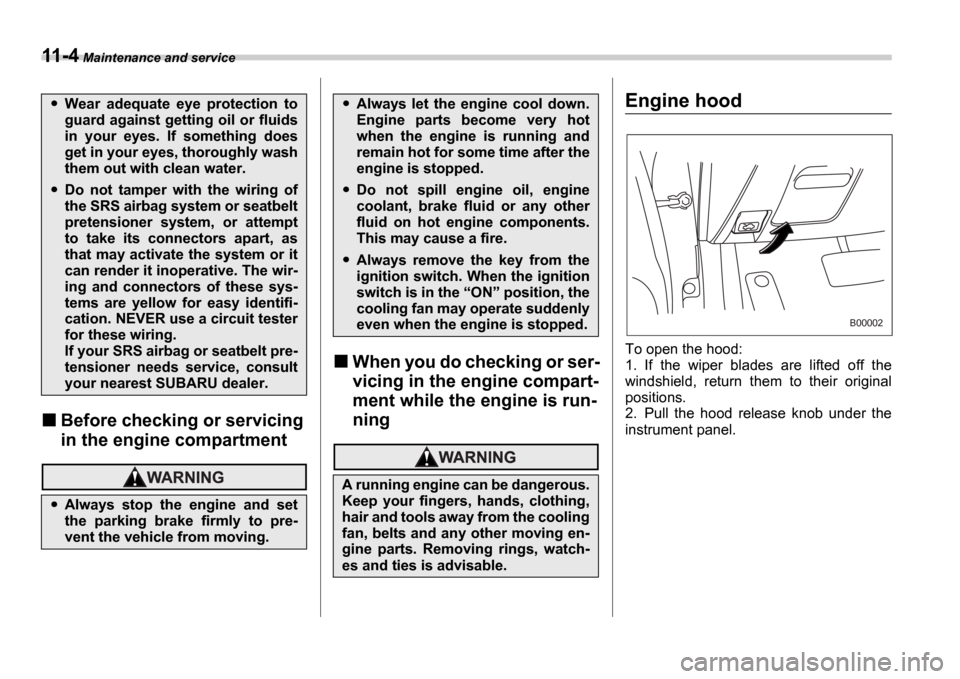
Engine hood
0
To open the hood:
1. If the wiper blades are lifted off the
windshield, return them to their original
positions.
2. Pull the hood release knob under the
instrument panel.
Wear adequate eye protection to
guard against getting oil or fluids
in your eyes. If something does
get in your eyes, thoroughly wash
them out with clean water.
Do not tamper with the wiring of
the SRS airbag system or seatbelt
pretensioner system, or attempt
to take its connectors apart, as
that may activate the system or it
can render it inoperative. The wir-
ing and connectors of these sys-
tems are yellow for easy identifi-
cation. NEVER use a circuit tester
for these wiring.
If your SRS airbag or seatbelt pre-
tensioner needs service, consult
your nearest SUBARU dealer.
Always stop the engine and set
the parking brake firmly to pre-
vent the vehicle from moving.
Always let the engine cool down.
Engine parts become very hot
when the engine is running and
remain hot for some time after the
engine is stopped.
Do not spill engine oil, engine
coolant, brake fluid or any other
fluid on hot engine components.
This may cause a fire.
Always remove the key from the
ignition switch. When the ignition
switch is in the ON position, the
cooling fan may operate suddenly
even when the engine is stopped.
A running engine can be dangerous.
Keep your fingers, hands, clothing,
hair and tools away from the cooling
fan, belts and any other moving en-
gine parts. Removing rings, watch-
es and ties is advisable.
B00002
Page 285 of 365

11-6 Maintenance and service
Engine compartment overview
Non-turbo models
1 2 3 4 5 6
7
8
9
10
11
13 12
B00464
1) Air cleaner element (page 11-15)
2) Manual transmission oil level gauge
(MT) (page 11-18) or Differential gear
oil level gauge (AT) (page 11-21)
3) Clutch fluid reservoir (page 11-26)
4) Automatic transmission fluid level gauge (page 11-20)
5) Brake fluid reservoir (page 11-25)
6) Fuse box (page 11-41)
7) Battery (page 11-40)
8) Windshield washer tank (page 11-36)
9) Engine coolant reservoir (page 11-
12)
10) Engine oil level gauge (page 11-8)
11) Engine oil filler cap (page 11-8)
12) Radiator cap (page 11-12)
13) Power steering fluid reservoir (page
11-24)
Page 286 of 365

Maintenance and service 11-7
Turbo models
1 2 3 4 5 6
7
8
9
10
11
12
13
B00466
1) Air cleaner element (page 11-15)
2) Manual transmission oil level gauge
(MT) (page 11-18) or Differential gear
oil level gauge (AT) (page 11-21)
3) Automatic transmission fluid level gauge (page 11-20)
4) Clutch fluid reservoir (page 11-26)
5) Brake fluid reservoir (page 11-25)
6) Fuse box (page 11-41)
7) Battery (page 11-40)
8) Windshield washer tank (page 11-36)
9) Engine oil filler cap (page 11-8)
10) Engine coolant reservoir (page 11- 12)
11) Engine oil level gauge (page 11-8)
12) Radiator cap (page 11-12)
13) Power steering fluid reservoir (page
11-24)
Page 299 of 365
11-20 Maintenance and service
Automatic transmission fluid
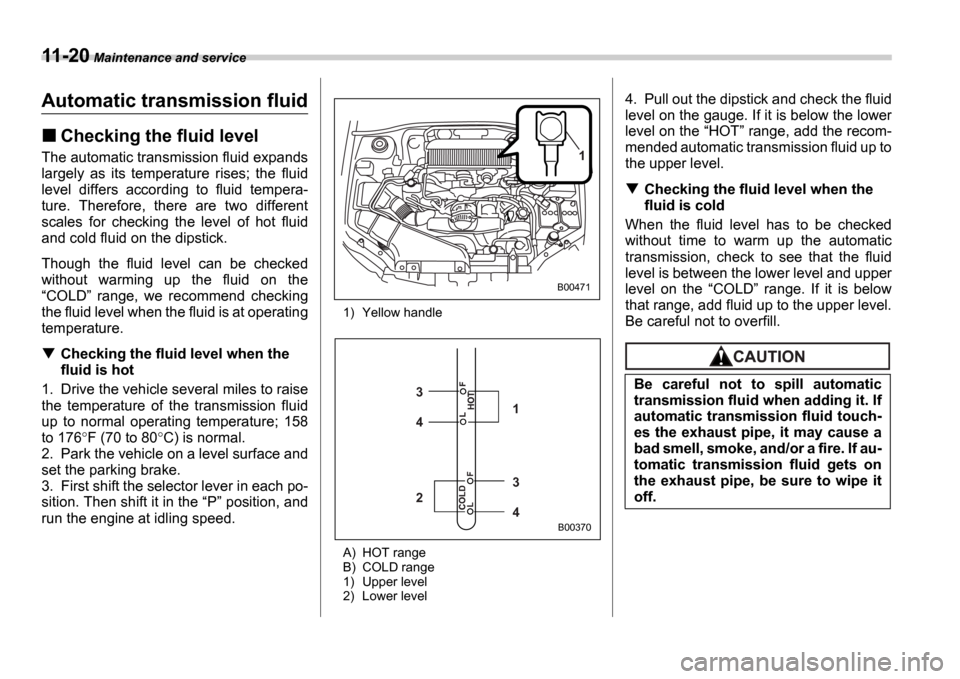
Checking the fluid level
The automatic transmission fluid expands
largely as its temperature rises; the fluid
level differs according to fluid tempera-
ture. Therefore, there are two different
scales for checking the level of hot fluid
and cold fluid on the dipstick.
Though the fluid level can be checked
without warming up the fluid on theCOLD range, we recommend checking
the fluid level when the fluid is at operating
temperature.
Checking the fluid level when the
fluid is hot
1. Drive the vehicle several miles to raise
the temperature of the transmission fluid
up to normal operating temperature; 158
to 176 F (70 to 80 C) is normal.
2. Park the vehicle on a level surface and
set the parking brake.
3. First shift the selector lever in each po-
sition. Then shift it in the P position, and
run the engine at idling speed.
1) Yellow handle
A) HOT range
B) COLD range
1) Upper level
2) Lower level
4. Pull out the dipstick and check the fluid
level on the gauge. If it is below the lower
level on the HOT range, add the recom-
mended automatic transmission fluid up to
the upper level.
Checking the fluid level when the
fluid is cold
When the fluid level has to be checked
without time to warm up the automatic
transmission, check to see that the fluid
level is between the lower level and upper
level on the COLD range. If it is below
that range, add fluid up to the upper level.
Be careful not to overfill.
1
B00471
3 4
34 2
1
B00370
Be careful not to spill automatic
transmission fluid when adding it. If
automatic transmission fluid touch-
es the exhaust pipe, it may cause a
bad smell, smoke, and/or a fire. If au-
tomatic transmission fluid gets on
the exhaust pipe, be sure to wipe it
off.
Page 304 of 365
Maintenance and service 11-25
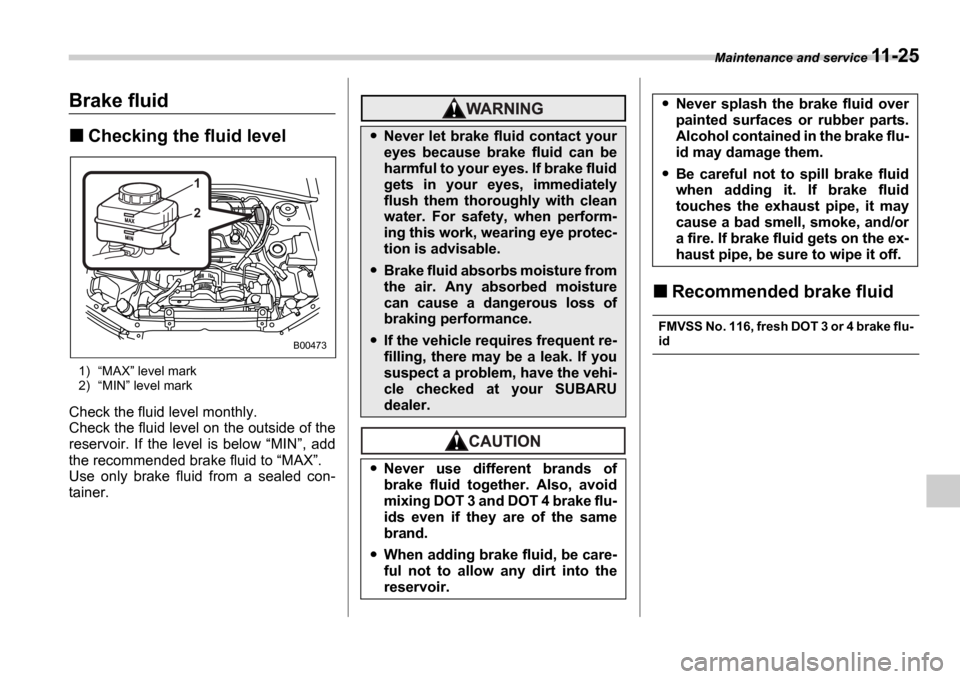
Brake fluid
Checking the fluid level
1) MAX level mark
2) MIN level mark
Check the fluid level monthly.
Check the fluid level on the outside of the
reservoir. If the level is below MIN , add
the recommended brake fluid to MAX .
Use only brake fluid from a sealed con-
tainer.
Recommended brake fluid
FMVSS No. 116, fresh DOT 3 or 4 brake flu-
id
1 2
B00473
Never let brake fluid contact your
eyes because brake fluid can be
harmful to your eyes. If brake fluid
gets in your eyes, immediately
flush them thoroughly with clean
water. For safety, when perform-
ing this work, wearing eye protec-
tion is advisable.
Brake fluid absorbs moisture from
the air. Any absorbed moisture
can cause a dangerous loss of
braking performance.
If the vehicle requires frequent re-
filling, there may be a leak. If you
suspect a problem, have the vehi-
cle checked at your SUBARU
dealer.
Never use different brands of
brake fluid together. Also, avoid
mixing DOT 3 and DOT 4 brake flu-
ids even if they are of the same
brand.
When adding brake fluid, be care-
ful not to allow any dirt into the
reservoir.
Never splash the brake fluid over
painted surfaces or rubber parts.
Alcohol contained in the brake flu-
id may damage them.
Be careful not to spill brake fluid
when adding it. If brake fluid
touches the exhaust pipe, it may
cause a bad smell, smoke, and/or
a fire. If brake fluid gets on the ex-
haust pipe, be sure to wipe it off.
Page 305 of 365
11-26 Maintenance and service
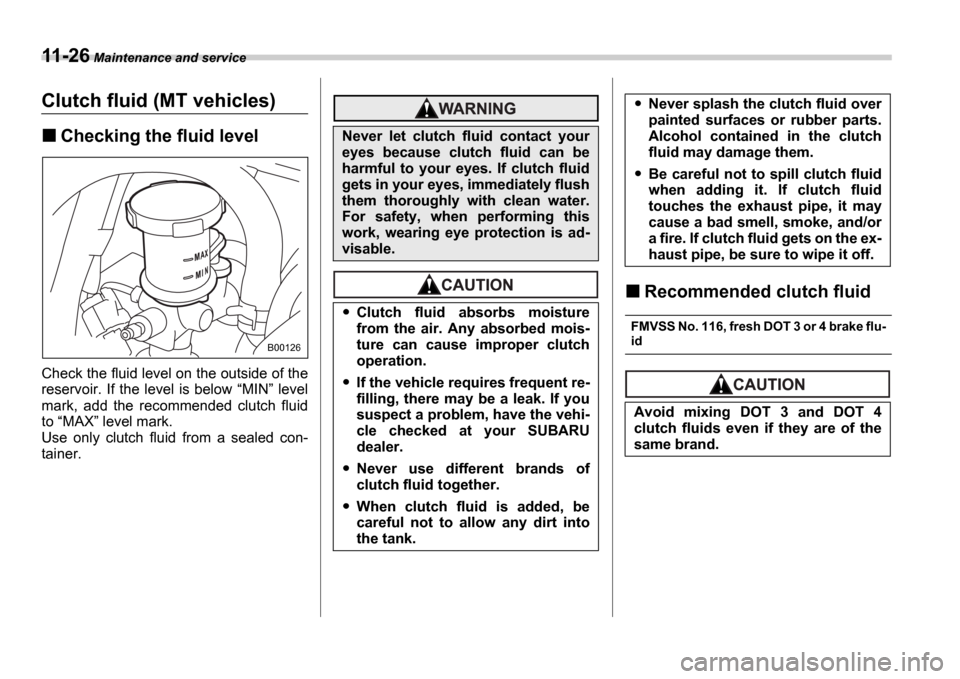
Clutch fluid (MT vehicles)
Checking the fluid level
Check the fluid level on the outside of the
reservoir. If the level is below MIN level
mark, add the recommended clutch fluid
to MAX level mark.
Use only clutch fluid from a sealed con-
tainer.
Recommended clutch fluid
FMVSS No. 116, fresh DOT 3 or 4 brake flu-
idB00126
Never let clutch fluid contact your
eyes because clutch fluid can be
harmful to your eyes. If clutch fluid
gets in your eyes, immediately flush
them thoroughly with clean water.
For safety, when performing this
work, wearing eye protection is ad-
visable.
Clutch fluid absorbs moisture
from the air. Any absorbed mois-
ture can cause improper clutch
operation.
If the vehicle requires frequent re-
filling, there may be a leak. If you
suspect a problem, have the vehi-
cle checked at your SUBARU
dealer.
Never use different brands of
clutch fluid together.
When clutch fluid is added, be
careful not to allow any dirt into
the tank.
Never splash the clutch fluid over
painted surfaces or rubber parts.
Alcohol contained in the clutch
fluid may damage them.
Be careful not to spill clutch fluid
when adding it. If clutch fluid
touches the exhaust pipe, it may
cause a bad smell, smoke, and/or
a fire. If clutch fluid gets on the ex-
haust pipe, be sure to wipe it off.
Avoid mixing DOT 3 and DOT 4
clutch fluids even if they are of the
same brand.
Page 306 of 365
Maintenance and service 11-27
Brake booster
If the brake booster does not operate as
described in the following, have it checked
by your SUBARU dealer.
1. With the engine off, depress the brake
pedal several times, applying the same
pedal force each time. The distance the
pedal travels should not vary.
2. With the brake pedal depressed, start
the engine. The pedal should move slight-
ly down to the floor.
3. With the brake pedal depressed, stop
the engine and keep the pedal depressed
for 30 seconds. The pedal height should
not change.
4. Start the engine again and run for ap-
proximately one minute then turn it off.
Depress the brake pedal several times to
check the brake booster. The brake boost-
er operates properly if the pedal stroke de-
creases with each depression.
Brake pedal
Check the brake pedal free play and re-
serve distance according to the mainte-
nance schedule in the Warranty and
Maintenance Booklet .
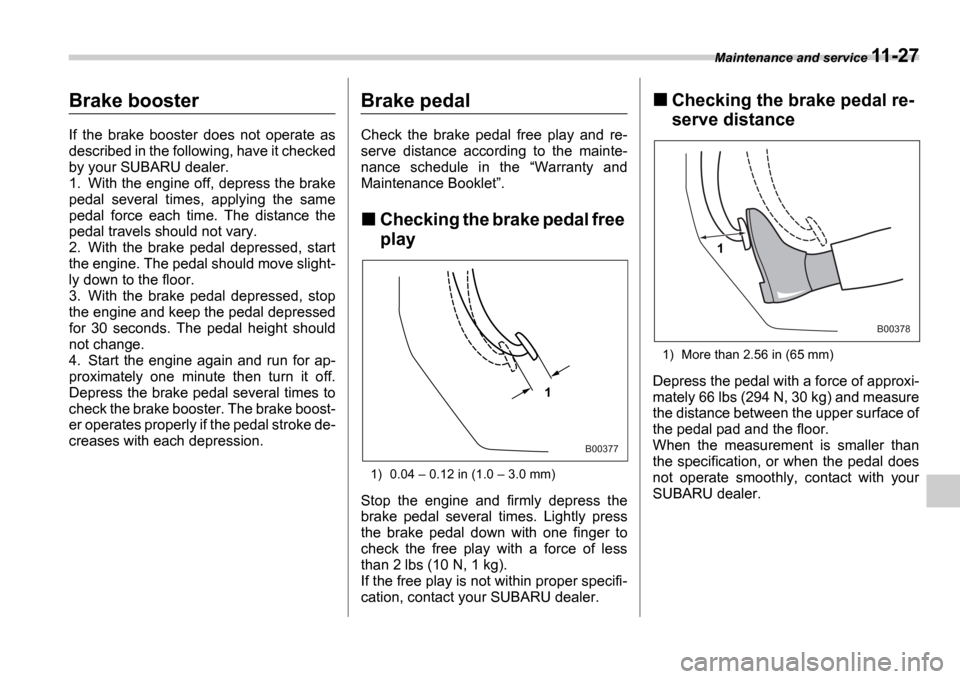
Checking the brake pedal free
play
1) 0.04 0.12 in (1.0 3.0 mm)
Stop the engine and firmly depress the
brake pedal several times. Lightly press
the brake pedal down with one finger to
check the free play with a force of less
than 2 lbs (10 N, 1 kg).
If the free play is not within proper specifi-
cation, contact your SUBARU dealer.
Checking the brake pedal re-
serve distance
1) More than 2.56 in (65 mm)
Depress the pedal with a force of approxi-
mately 66 lbs (294 N, 30 kg) and measure
the distance between the upper surface of
the pedal pad and the floor.
When the measurement is smaller than
the specification, or when the pedal does
not operate smoothly, contact with your
SUBARU dealer.1
B00377
1
B00378