2006 SUBARU IMPREZA light
[x] Cancel search: lightPage 41 of 365
1-14 Seat, seatbelt and SRS airbags
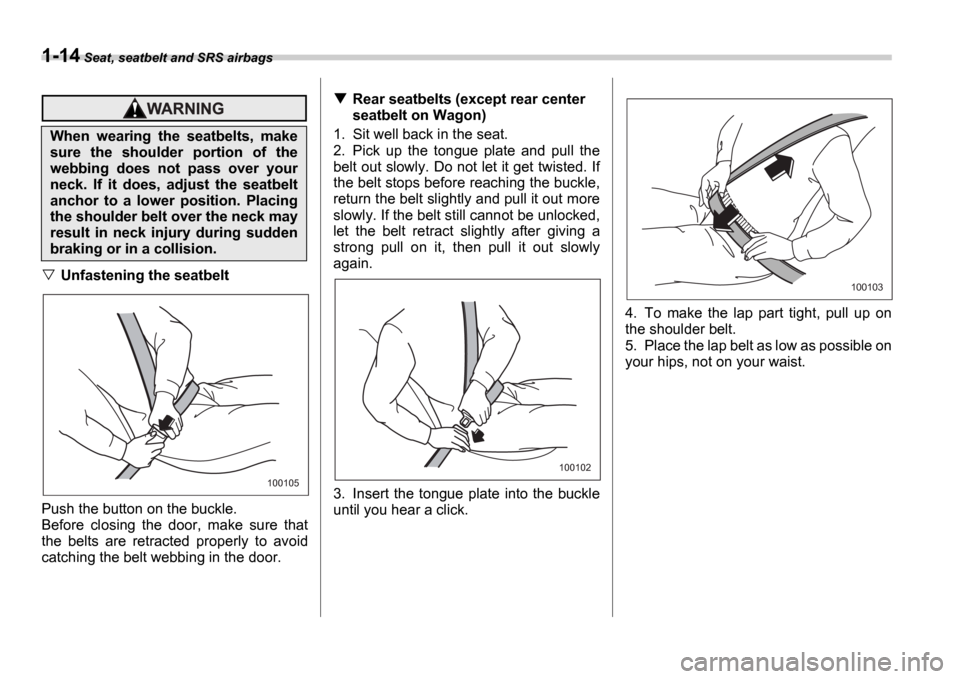
Unfastening the seatbelt
Push the button on the buckle.
Before closing the door, make sure that
the belts are retracted properly to avoid
catching the belt webbing in the door.
Rear seatbelts (except rear center
seatbelt on Wagon)
1. Sit well back in the seat.
2. Pick up the tongue plate and pull the
belt out slowly. Do not let it get twisted. If
the belt stops before reaching the buckle,
return the belt slightly and pull it out more
slowly. If the belt still cannot be unlocked,
let the belt retract slightly after giving a
strong pull on it, then pull it out slowly
again.
3. Insert the tongue plate into the buckle
until you hear a click. 4. To make the lap part tight, pull up on
the shoulder belt.
5. Place the lap belt as low as possible on
your hips, not on your waist.
When wearing the seatbelts, make
sure the shoulder portion of the
webbing does not pass over your
neck. If it does, adjust the seatbelt
anchor to a lower position. Placing
the shoulder belt over the neck may
result in neck injury during sudden
braking or in a collision.
100105
100102
100103
Page 44 of 365
Seat, seatbelt and SRS airbags 1-17
CONTINUED
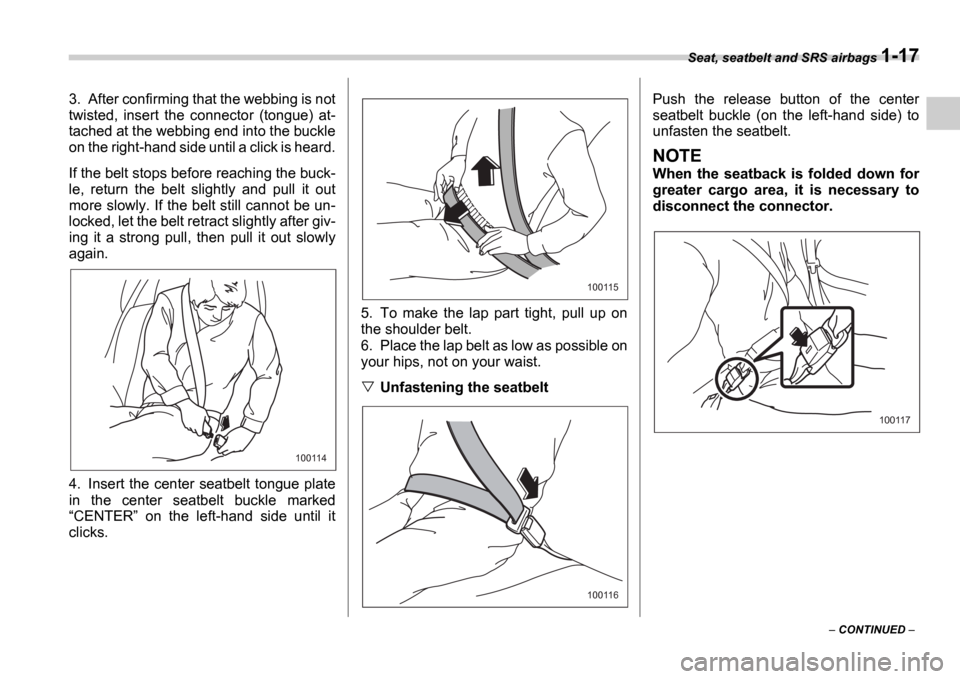
3. After confirming that the webbing is not
twisted, insert the connector (tongue) at-
tached at the webbing end into the buckle
on the right-hand side until a click is heard.
If the belt stops before reaching the buck-
le, return the belt slightly and pull it out
more slowly. If the belt still cannot be un-
locked, let the belt retract slightly after giv-
ing it a strong pull, then pull it out slowly
again.
4. Insert the center seatbelt tongue plate
in the center seatbelt buckle marked
CENTER on the left-hand side until it
clicks. 5. To make the lap part tight, pull up on
the shoulder belt.
6. Place the lap belt as low as possible on
your hips, not on your waist.
Unfastening the seatbeltPush the release button of the center
seatbelt buckle (on the left-hand side) to
unfasten the seatbelt.
NOTE
When the seatback is folded down for
greater cargo area, it is necessary to
disconnect the connector.
100114
100115
100116
100117
Page 48 of 365

Seat, seatbelt and SRS airbags 1-21
CONTINUED
System monitors
A diagnostic system continually monitors
the readiness of the seatbelt pretensioner
while the vehicle is being driven. The seat-
belt pretensioners share the control mod-
ule with the SRS airbag system. There-
fore, if any malfunction occurs in a seat-
belt pretensioner, the SRS airbag system
warning light will illuminate. The SRS air-
bag system warning light will show normal
system operation by lighting for approxi-
mately 6 seconds when the ignition switch is turned to the
ON position.
The following components are monitored
by the indicator:
Front sub sensor (Right-hand side)
Front sub sensor (Left-hand side)
Airbag control module (including impact
sensors)
Frontal airbag module (Driver s side)
Frontal airbag module (Front passen-
ger s side)
Side airbag sensor (Center pillar right
hand side)
Side airbag sensor (Center pillar left
hand side)
Side airbag module (Driver s side)
Side airbag module (Front passenger s
side)
Seatbelt pretensioner (Driver s side)
Seatbelt pretensioner (Front passen-
ger s side)
Seatbelt buckle switch (Driver s side)
Seatbelt buckle switch (Front passen-
ger s side)
Driver s seat position sensor
Front passenger s seatbelt tension sen-
sor
Front passenger s occupant detection
system weight sensor
Front passenger s occupant detection
control module
Front passenger s frontal airbag ON
and OFF indicator
All related wiringWhen discarding front seatbelt re-
tractor assemblies or scrapping
the entire vehicle due to collision
damage or for other reasons, con-
sult your SUBARU dealer.
100291
If the warning light exhibits any of
the following conditions, there may
be a malfunction in the seatbelt pre-
tensioners and/or SRS airbag sys-
tem. Immediately take your vehicle
to your nearest SUBARU dealer to
have the system checked. Unless
checked and properly repaired, the
seatbelt pretensioners and/or SRS
airbag will not operate properly in
the event of a collision, which may
increase the risk of injury.
Flashing or flickering of the indi-
cator light
No illumination of the warning
light when the ignition switch is
first turned to the ON position
Continuous illumination of the
warning light
Illumination of the warning light
while driving
Page 52 of 365
Seat, seatbelt and SRS airbags 1-25
CONTINUED
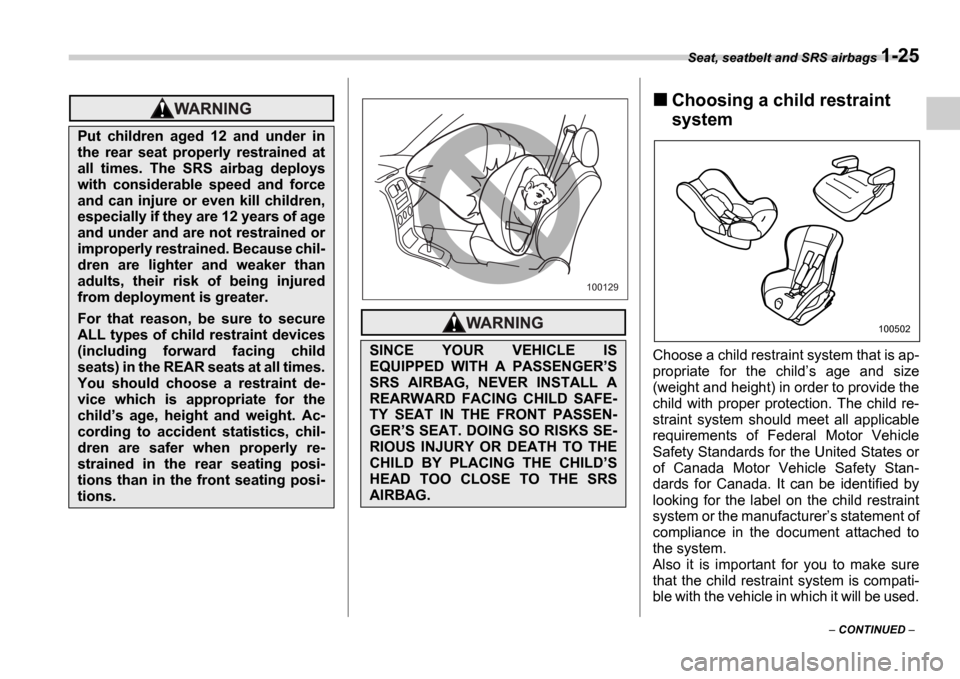
Choosing a child restraint
system
Choose a child restraint system that is ap-
propriate for the child s age and size
(weight and height) in order to provide the
child with proper protection. The child re-
straint system should meet all applicable
requirements of Federal Motor Vehicle
Safety Standards for the United States or
of Canada Motor Vehicle Safety Stan-
dards for Canada. It can be identified by
looking for the label on the child restraint
system or the manufacturer s statement of
compliance in the document attached to
the system.
Also it is important for you to make sure
that the child restraint system is compati-
ble with the vehicle in which it will be used.
Put children aged 12 and under in
the rear seat properly restrained at
all times. The SRS airbag deploys
with considerable speed and force
and can injure or even kill children,
especially if they are 12 years of age
and under and are not restrained or
improperly restrained. Because chil-
dren are lighter and weaker than
adults, their risk of being injured
from deployment is greater.
For that reason, be sure to secure
ALL types of child restraint devices
(including forward facing child
seats) in the REAR seats at all times.
You should choose a restraint de-
vice which is appropriate for the
child s age, height and weight. Ac-
cording to accident statistics, chil-
dren are safer when properly re-
strained in the rear seating posi-
tions than in the front seating posi-
tions.
SINCE YOUR VEHICLE IS
EQUIPPED WITH A PASSENGER S
SRS AIRBAG, NEVER INSTALL A
REARWARD FACING CHILD SAFE-
TY SEAT IN THE FRONT PASSEN-
GER S SEAT. DOING SO RISKS SE-
RIOUS INJURY OR DEATH TO THE
CHILD BY PLACING THE CHILD S
HEAD TOO CLOSE TO THE SRS
AIRBAG.
100129
100502
Page 64 of 365

Seat, seatbelt and SRS airbags 1-37
CONTINUED
NOTE
When you sell your vehicle, we urge
you to explain to the buyer that it is
equipped with SRS airbags by alerting
him or her to the applicable section in
this owners manual.
Put children aged 12 and under in
the rear seat properly restrained
at all times. The SRS airbag de-
ploys with considerable speed
and force and can injure or even
kill children, especially if they are
12 years of age and under and are
not restrained or improperly re-
strained. Because children are
lighter and weaker than adults,
their risk of being injured from de-
ployment is greater.
100082
For that reason, we strongly rec-
ommend that ALL children (in-
cluding those in child seats and
those that have outgrown child re-
straint devices) sit in the REAR
seat properly restrained at all
times in a child restraint device or
in a seatbelt, whichever is appro-
priate for the child s age, height
and weight.
Secure ALL types of child re-
straint devices (including forward
facing child seats) in the REAR
seats at all times.
According to accident statistics,
children are safer when properly
restrained in the rear seating posi-
tions than in the front seating po-
sitions.
For instructions and precautions
concerning the child restraint sys-
tem, see the Child restraint sys-
tems section in this chapter.
NEVER INSTALL A REARWARD
FACING CHILD SEAT IN THE
FRONT SEAT. DOING SO RISKS
SERIOUS INJURY OR DEATH TO
THE CHILD BY PLACING THE
CHILD S HEAD TOO CLOSE TO
THE SRS AIRBAG.
Never allow a child to stand up, or
to kneel on the front passenger s
seat, or never hold a child on your
lap or in your arms. The SRS air-
bag deploys with considerable
force and can injure or even kill
the child.
When the SRS airbag deploys,
some smoke will be released. This
smoke could cause breathing
problems for people with a history
of asthma or other breathing trou-
ble. If you or your passengers
have breathing problems after
SRS airbag deploys, get fresh air
promptly.
A deploying SRS airbag releases
hot gas. Occupants could get
burned if they come into direct
contact with the hot gas.
Page 65 of 365

1-38 Seat, seatbelt and SRS airbags
Components
1
2
3
4
5
6
14 15
2019
8
11 17
18
9
7 10
12
16
13
100701 1) Airbag control module (including impact
sensors)
2) Frontal airbag module (driver s side)
3) Frontal airbag module (front passen-
gers side)
4) Front sub sensor (left-hand side)
5) Front sub sensor (right-hand side)
6) Side airbag module (driver s side)
7) Side airbag module (front passenger s
side)
8) Side airbag sensor (center pillar left-
hand side)
9) Side airbag sensor (center pillar right- hand side)
10)Airbag wiring (yellow)
11)Seatbelt pretensioner (driver s side)
12) Seatbelt pretensioner (front passenger s
side)
13)Seatbelt buckle switch (front passen- gers side)
14)Seatbelt buckle switch (driver s side)
15) Driver s seat position sensor
16)Front passenger s seatbelt tension sen-
sor
17)Front passenger s occupant detection
system weight sensor
18)Front passenger s occupant detection
control module
19)Front passenger s frontal airbag ON and
OFF indicator
20)SRS airbag system warning light
Page 68 of 365

Seat, seatbelt and SRS airbags 1-41
CONTINUED
Drivers SRS frontal airbag
The driver s SRS frontal airbag uses a
dual stage inflator. The inflator operates in
different ways depending on the severity
of impact, backward-forward adjustment
of the driver s seat position and whether or
not he/she is wearing the seatbelt.
The backward-forward adjustment of the
driver s seat position is monitored by the
driver s seat position sensor under the driver
s seat.
Whether or not the driver is wearing the
seatbelt is monitored by the seatbelt buck-
le switch.
Observe the following precautions. Failure
to do so may cause the seatbelt buckle
switch and/or the seat position sensor to
malfunction, preventing the Subaru ad-
vanced frontal airbag system from func-
tioning correctly or causing the system to
fail.
Do not place articles/metal objects or in-
stall any accessory other than a genuine
SUBARU accessory under the driver s
seat. Do not allow the rear seat occupant
to kick the driver s seat or push up its bot-
tom surface with his/her feet.
Do not place a magnet near the seatbelt
buckle or under the driver s seat.
If the seatbelt buckle switch and/or the
driver s seat position sensor have failed,
the SRS airbag system warning light will il-
luminate. Although the driver s SRS fron-
tal airbag can deploy regardless of the
backward-forward adjustment of the driv-
er s seat position even when the warning
light is on, have the system inspected by
your SUBARU dealer immediately if the
SRS airbag system warning light comes
on.
NOTE
The driver s SRS side airbag and seat-
belt pretensioner are not controlled by
the Subaru advanced frontal airbag
system.
Front passenger s SRS frontal air-
bag
The front passenger s SRS frontal airbag
uses a dual stage inflator. The inflator op-
erates in different ways depending on the
severity of impact.
The total load on the seat is monitored by
the occupant detection system s weight
sensor located under the seat.
The system has another sensor that mon-
itors the tension of the front passenger
seatbelt. Using the total seat load and
seatbelt tension data from the sensors,
the occupant detection system deter-
mines whether the front passenger s SRS
frontal airbag should or should not be in-
flated.
The occupant detection system may not
inflate the front passenger s SRS frontal
airbag even when the driver s SRS frontal
airbag deploys. This is normal.
Observe the following precautions. Failure
to do so may prevent the Subaru ad-
vanced frontal airbag system from func-
tioning correctly or cause the system to
fail.
Do not attach accessories to the
windshield, or fit an extra-wide mir-
ror over the rear view mirror. If the
SRS airbag deploys, those objects
could become projectiles that could
seriously injure vehicle occupants.
100157
Page 69 of 365
1-42 Seat, seatbelt and SRS airbags
Do not apply any strong impact to the
front passenger s seat such as by kicking.
Do not spill liquid on the front passen-
ger s seat. If liquid is spilled, wipe it off im-
mediately.
Do not disassemble the front passen-
ger s seat.
Do not install any accessory (such as
an audio amplifier) other than a genuine
SUBARU accessory under the front pas-
senger s seat.
Do not place anything (shoes, umbrella,
etc.) under the front passenger s seat.
The front passenger s seat must not be
used with the head restraint removed.
Do not leave any article including a child
restraint system on the front passenger s
seat or the seatbelt tongue and buckle en-
gaged when you leave your vehicle.
Do not place a magnet near the seatbelt
buckle and the seatbelt retractor.
Do not use front seats with their back-
ward-forward position and seatback not
being locked into place securely. If any of
them are not locked securely, adjust them
again. For adjusting procedure, refer to
the Front seats section in this chapter.
If you use an optional seatbelt extender,
remove it after each use. (Refer to the Seatbelt extender section in this chap-
ter.)
If the seatbelt buckle switch and/or front passenger
s occupant detection system
have failed, the SRS airbag system warn-
ing light will illuminate. Have the system
inspected by your SUBARU dealer imme-
diately if the SRS airbag system warning
light comes on.
If your vehicle has sustained impact, this
may affect the proper function of the
Subaru advanced frontal airbag system.
Have your vehicle inspected at your
SUBARU dealer.
NOTE
The front passenger s SRS side airbag
and seatbelt pretensioner are not con-
trolled by the Subaru advanced frontal
airbag system.
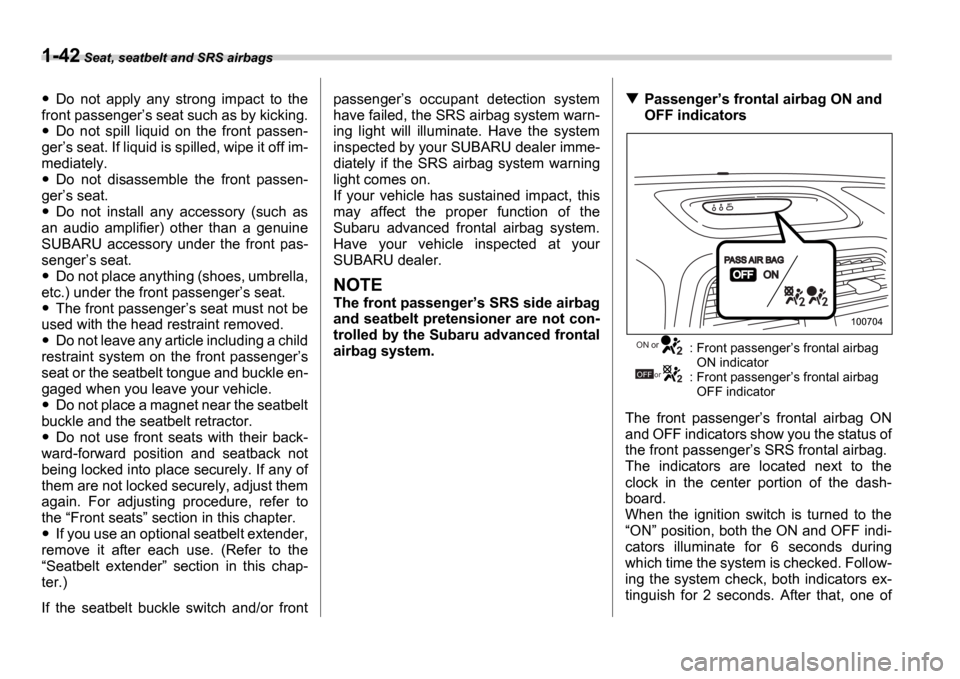
Passenger s frontal airbag ON and
OFF indicators
: Front passenger s frontal airbag
ON indicator
: Front passenger s frontal airbag
OFF indicator
The front passenger s frontal airbag ON
and OFF indicators show you the status of
the front passenger s SRS frontal airbag.
The indicators are located next to the
clock in the center portion of the dash-
board.
When the ignition switch is turned to the ON position, both the ON and OFF indi-
cators illuminate for 6 seconds during
which time the system is checked. Follow-
ing the system check, both indicators ex-
tinguish for 2 seconds. After that, one of
100704
ON or
OFF or