2006 SUBARU IMPREZA Fluid
[x] Cancel search: FluidPage 299 of 365
11-20 Maintenance and service
Automatic transmission fluid
Checking the fluid level
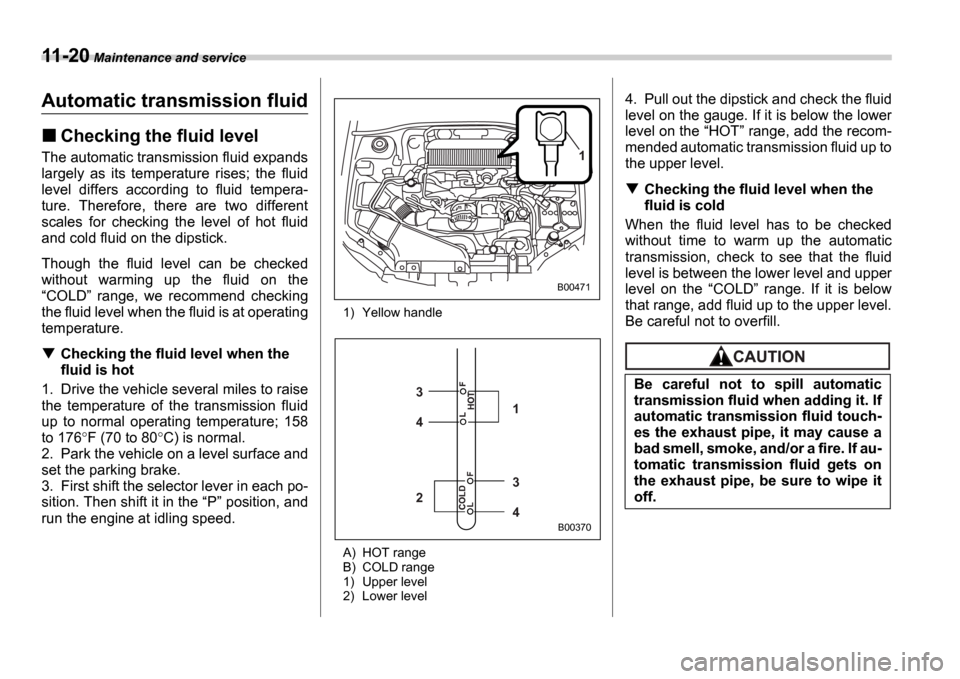
The automatic transmission fluid expands
largely as its temperature rises; the fluid
level differs according to fluid tempera-
ture. Therefore, there are two different
scales for checking the level of hot fluid
and cold fluid on the dipstick.
Though the fluid level can be checked
without warming up the fluid on theCOLD range, we recommend checking
the fluid level when the fluid is at operating
temperature.
Checking the fluid level when the
fluid is hot
1. Drive the vehicle several miles to raise
the temperature of the transmission fluid
up to normal operating temperature; 158
to 176 F (70 to 80 C) is normal.
2. Park the vehicle on a level surface and
set the parking brake.
3. First shift the selector lever in each po-
sition. Then shift it in the P position, and
run the engine at idling speed.
1) Yellow handle
A) HOT range
B) COLD range
1) Upper level
2) Lower level
4. Pull out the dipstick and check the fluid
level on the gauge. If it is below the lower
level on the HOT range, add the recom-
mended automatic transmission fluid up to
the upper level.
Checking the fluid level when the
fluid is cold
When the fluid level has to be checked
without time to warm up the automatic
transmission, check to see that the fluid
level is between the lower level and upper
level on the COLD range. If it is below
that range, add fluid up to the upper level.
Be careful not to overfill.
1
B00471
3 4
34 2
1
B00370
Be careful not to spill automatic
transmission fluid when adding it. If
automatic transmission fluid touch-
es the exhaust pipe, it may cause a
bad smell, smoke, and/or a fire. If au-
tomatic transmission fluid gets on
the exhaust pipe, be sure to wipe it
off.
Page 300 of 365
Maintenance and service 11-21
CONTINUED
Recommended fluid
Use one of the following types of automat-
ic transmission fluid.
Genuine Subaru Automatic Transmis-
sion Fluid Type-HP
IDEMITSU ATF HP
Castrol Transmax J
Pennzoil ATF-J*
* Available only in the USA (except
Alaska and Hawaii)
NOTE
Using any non-specified type of auto-
matic transmission fluid could result in
damage inside the transmission. When
replacing the automatic transmission
fluid, be sure to use a fluid of the types
specified above.
Front differential gear oil (AT
vehicles)
Checking the oil level
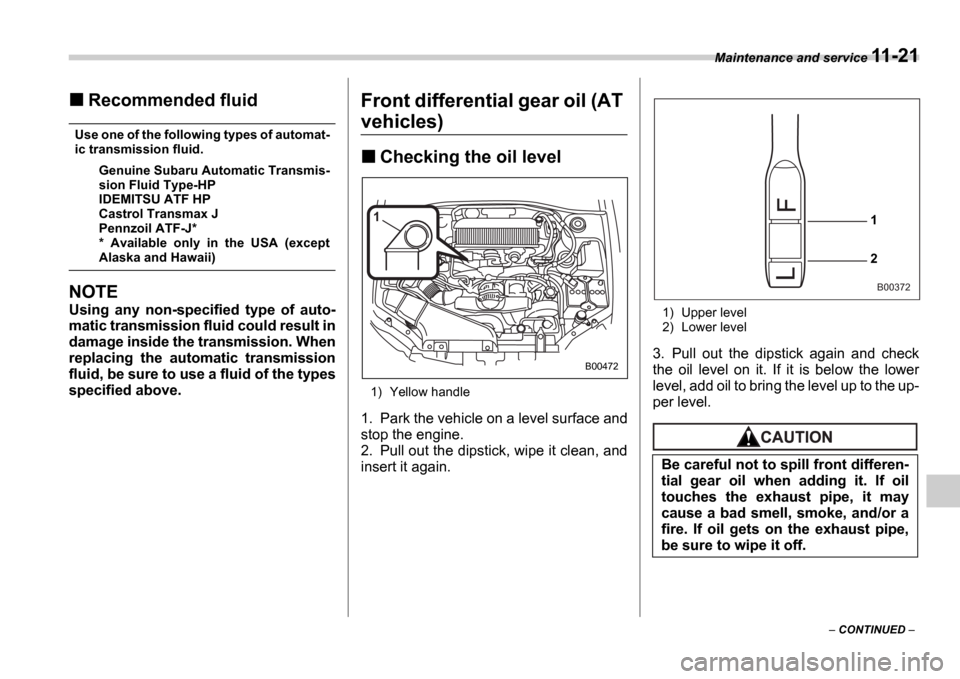
1) Yellow handle
1. Park the vehicle on a level surface and
stop the engine.
2. Pull out the dipstick, wipe it clean, and
insert it again.
1) Upper level
2) Lower level
3. Pull out the dipstick again and check
the oil level on it. If it is below the lower
level, add oil to bring the level up to the up-
per level.
1
B00472
Be careful not to spill front differen-
tial gear oil when adding it. If oil
touches the exhaust pipe, it may
cause a bad smell, smoke, and/or a
fire. If oil gets on the exhaust pipe,
be sure to wipe it off.
1 2
B00372
Page 303 of 365
11-24 Maintenance and service
Power steering fluid
Checking the fluid level
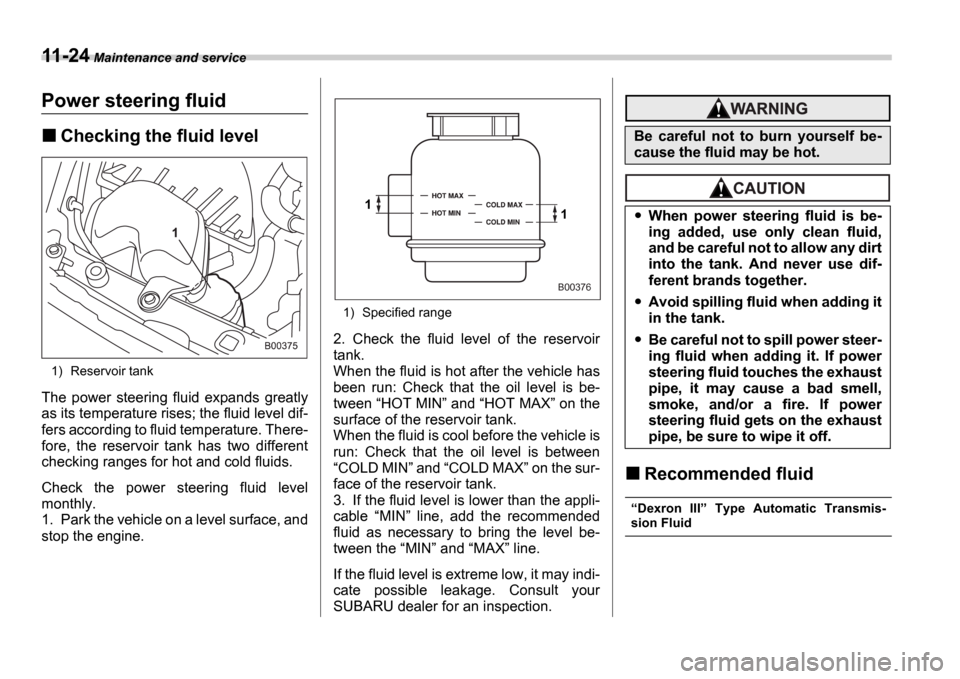
1) Reservoir tank
The power steering fluid expands greatly
as its temperature rises; the fluid level dif-
fers according to fluid temperature. There-
fore, the reservoir tank has two different
checking ranges for hot and cold fluids.
Check the power steering fluid level
monthly.
1. Park the vehicle on a level surface, and
stop the engine.
1) Specified range
2. Check the fluid level of the reservoir
tank.
When the fluid is hot after the vehicle has
been run: Check that the oil level is be-
tween HOT MIN and HOT MAX on the
surface of the reservoir tank.
When the fluid is cool before the vehicle is
run: Check that the oil level is between COLD MIN and COLD MAX on the sur-
face of the reservoir tank.
3. If the fluid level is lower than the appli-
cable MIN line, add the recommended
fluid as necessary to bring the level be-
tween the MIN and MAX line.
If the fluid level is extreme low, it may indi-
cate possible leakage. Consult your
SUBARU dealer for an inspection.
Recommended fluid
Dexron III Type Automatic Transmis-
sion Fluid
1
1
B00376
Be careful not to burn yourself be-
cause the fluid may be hot.
When power steering fluid is be-
ing added, use only clean fluid,
and be careful not to allow any dirt
into the tank. And never use dif-
ferent brands together.
Avoid spilling fluid when adding it
in the tank.
Be careful not to spill power steer-
ing fluid when adding it. If power
steering fluid touches the exhaust
pipe, it may cause a bad smell,
smoke, and/or a fire. If power
steering fluid gets on the exhaust
pipe, be sure to wipe it off.
Page 304 of 365
Maintenance and service 11-25
Brake fluid
Checking the fluid level
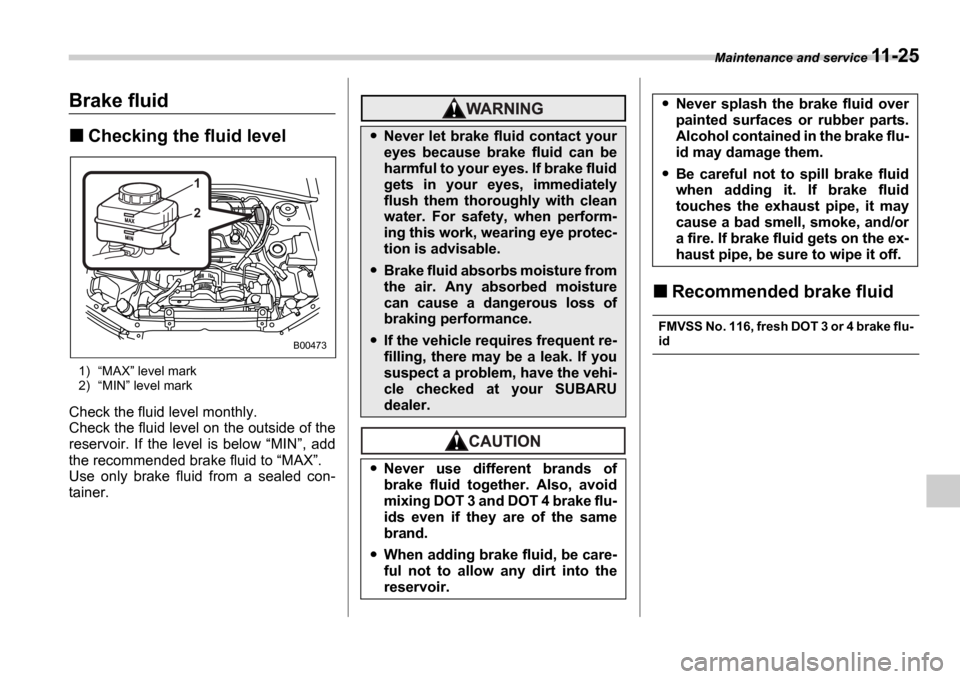
1) MAX level mark
2) MIN level mark
Check the fluid level monthly.
Check the fluid level on the outside of the
reservoir. If the level is below MIN , add
the recommended brake fluid to MAX .
Use only brake fluid from a sealed con-
tainer.
Recommended brake fluid
FMVSS No. 116, fresh DOT 3 or 4 brake flu-
id
1 2
B00473
Never let brake fluid contact your
eyes because brake fluid can be
harmful to your eyes. If brake fluid
gets in your eyes, immediately
flush them thoroughly with clean
water. For safety, when perform-
ing this work, wearing eye protec-
tion is advisable.
Brake fluid absorbs moisture from
the air. Any absorbed moisture
can cause a dangerous loss of
braking performance.
If the vehicle requires frequent re-
filling, there may be a leak. If you
suspect a problem, have the vehi-
cle checked at your SUBARU
dealer.
Never use different brands of
brake fluid together. Also, avoid
mixing DOT 3 and DOT 4 brake flu-
ids even if they are of the same
brand.
When adding brake fluid, be care-
ful not to allow any dirt into the
reservoir.
Never splash the brake fluid over
painted surfaces or rubber parts.
Alcohol contained in the brake flu-
id may damage them.
Be careful not to spill brake fluid
when adding it. If brake fluid
touches the exhaust pipe, it may
cause a bad smell, smoke, and/or
a fire. If brake fluid gets on the ex-
haust pipe, be sure to wipe it off.
Page 305 of 365
11-26 Maintenance and service
Clutch fluid (MT vehicles)
Checking the fluid level
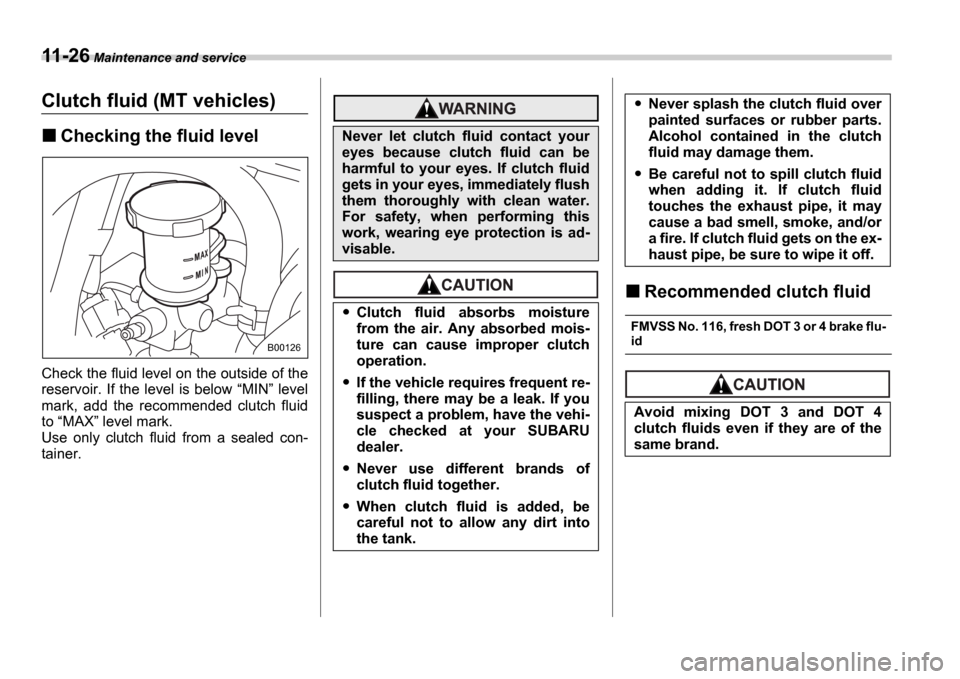
Check the fluid level on the outside of the
reservoir. If the level is below MIN level
mark, add the recommended clutch fluid
to MAX level mark.
Use only clutch fluid from a sealed con-
tainer.
Recommended clutch fluid
FMVSS No. 116, fresh DOT 3 or 4 brake flu-
idB00126
Never let clutch fluid contact your
eyes because clutch fluid can be
harmful to your eyes. If clutch fluid
gets in your eyes, immediately flush
them thoroughly with clean water.
For safety, when performing this
work, wearing eye protection is ad-
visable.
Clutch fluid absorbs moisture
from the air. Any absorbed mois-
ture can cause improper clutch
operation.
If the vehicle requires frequent re-
filling, there may be a leak. If you
suspect a problem, have the vehi-
cle checked at your SUBARU
dealer.
Never use different brands of
clutch fluid together.
When clutch fluid is added, be
careful not to allow any dirt into
the tank.
Never splash the clutch fluid over
painted surfaces or rubber parts.
Alcohol contained in the clutch
fluid may damage them.
Be careful not to spill clutch fluid
when adding it. If clutch fluid
touches the exhaust pipe, it may
cause a bad smell, smoke, and/or
a fire. If clutch fluid gets on the ex-
haust pipe, be sure to wipe it off.
Avoid mixing DOT 3 and DOT 4
clutch fluids even if they are of the
same brand.
Page 315 of 365
11-36 Maintenance and service
Windshield washer fluid
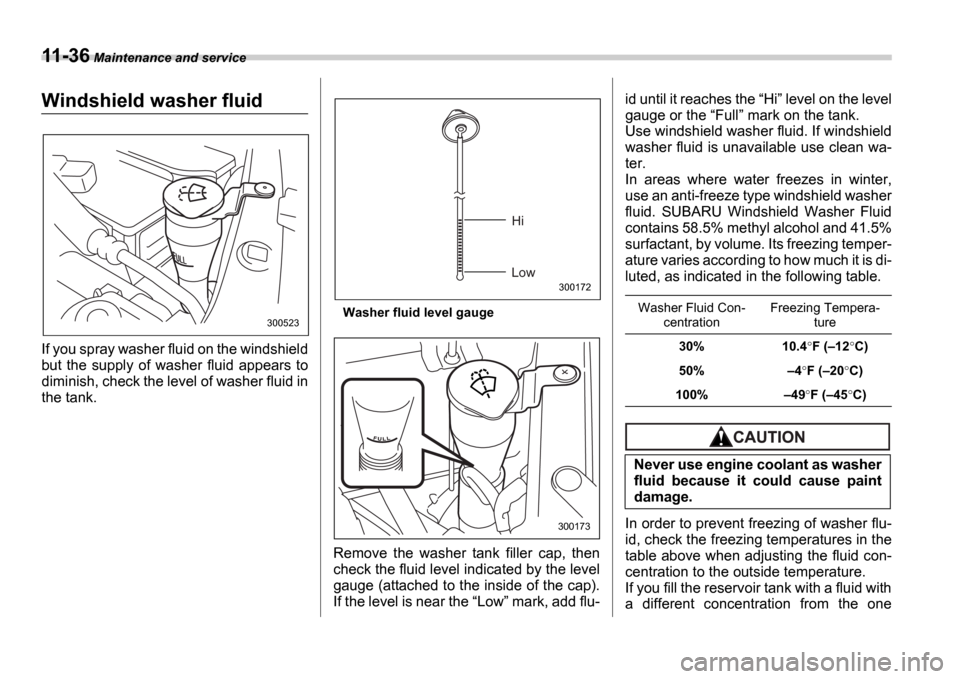
If you spray washer fluid on the windshield
but the supply of washer fluid appears to
diminish, check the level of washer fluid in
the tank.
Washer fluid level gauge
Remove the washer tank filler cap, then
check the fluid level indicated by the level
gauge (attached to the inside of the cap).
If the level is near the Low mark, add flu- id until it reaches the
Hi level on the level
gauge or the Full mark on the tank.
Use windshield washer fluid. If windshield
washer fluid is unavailable use clean wa-
ter.
In areas where water freezes in winter,
use an anti-freeze type windshield washer
fluid. SUBARU Windshield Washer Fluid
contains 58.5% methyl alcohol and 41.5%
surfactant, by volume. Its freezing temper-
ature varies according to how much it is di-
luted, as indicated in the following table.
In order to prevent freezing of washer flu-
id, check the freezing temperatures in the
table above when adjusting the fluid con-
centration to the outside temperature.
If you fill the reservoir tank with a fluid with
a different concentration from the one
300523
Hi
Low
300172
300173
Washer Fluid Con- centration Freezing Tempera-
ture
30% 10.4 F ( 12 C)
50% 4F ( 20 C)
100% 49 F ( 45 C)
Never use engine coolant as washer
fluid because it could cause paint
damage.
Page 316 of 365
Maintenance and service 11-37
CONTINUED
used previously, purge the old fluid from
the piping between the reservoir tank and
washer nozzles by operating the washer
for a certain period of time. Otherwise, if
the concentration of the fluid remaining in
the piping is too low for the outside tem-
perature, it may freeze and block the noz-
zles.
Replacement of wiper blades
Grease, wax, insects, or other material on
the windshield or the wiper blade results in
jerky wiper operation and streaking on the
glass. If you cannot remove the streaks af-
ter operating the windshield washer or if
the wiper operation is jerky, clean the out-
er surface of the windshield (or rear win-
dow) and the wiper blades using a sponge
or soft cloth with a neutral detergent or
mild-abrasive cleaner. After cleaning,
rinse the windshield and wiper blades with
clean water. The windshield is clean if
beads do not form when you rinse the
windshield with water.
If you cannot eliminate the streaking even
after following this method, replace the
wiper blades using the following proce-
dures:
Windshield wiper blades as-
sembly
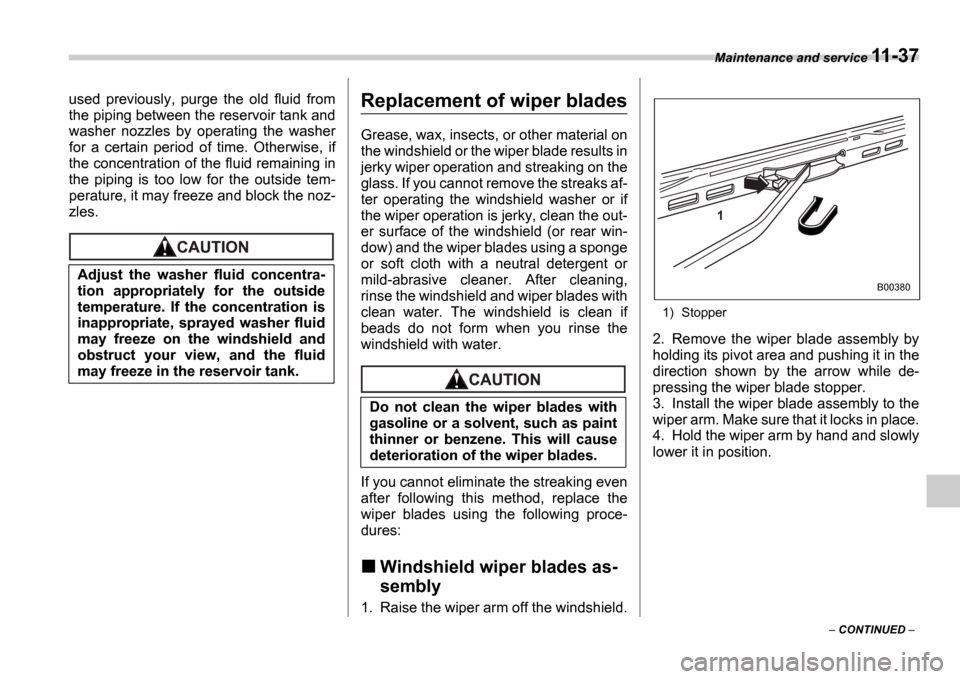
1. Raise the wiper arm off the windshield.
1) Stopper
2. Remove the wiper blade assembly by
holding its pivot area and pushing it in the
direction shown by the arrow while de-
pressing the wiper blade stopper.
3. Install the wiper blade assembly to the
wiper arm. Make sure that it locks in place.
4. Hold the wiper arm by hand and slowly
lower it in position.
Adjust the washer fluid concentra-
tion appropriately for the outside
temperature. If the concentration is
inappropriate, sprayed washer fluid
may freeze on the windshield and
obstruct your view, and the fluid
may freeze in the reservoir tank.
Do not clean the wiper blades with
gasoline or a solvent, such as paint
thinner or benzene. This will cause
deterioration of the wiper blades.
1
B00380
Page 319 of 365
11-40 Maintenance and service
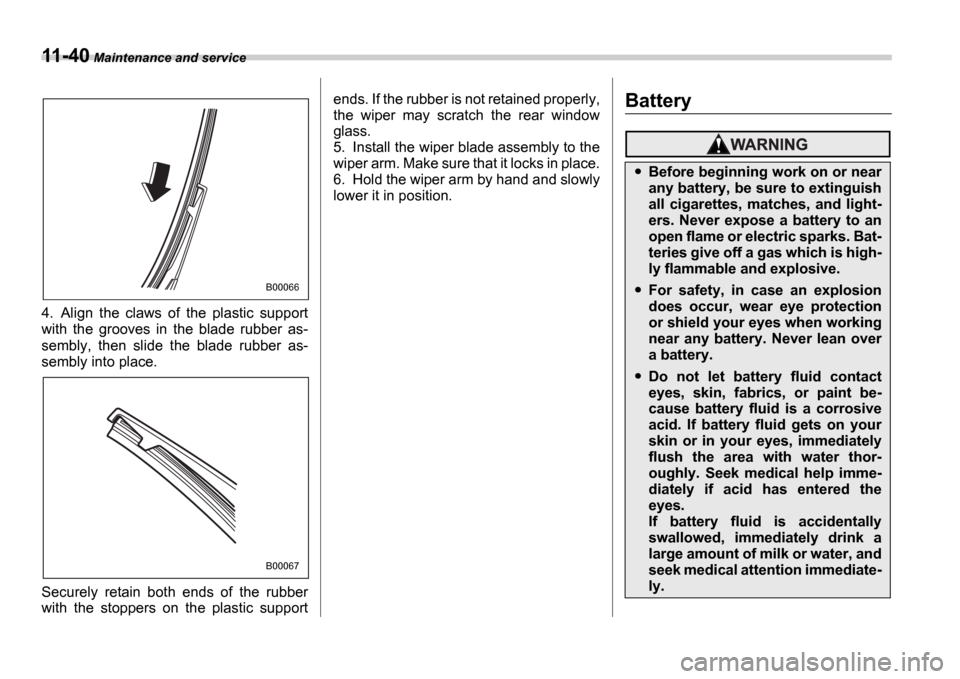
4. Align the claws of the plastic support
with the grooves in the blade rubber as-
sembly, then slide the blade rubber as-
sembly into place.
Securely retain both ends of the rubber
with the stoppers on the plastic support ends. If the rubber is not retained properly,
the wiper may scratch the rear window
glass.
5. Install the wiper blade assembly to the
wiper arm. Make sure that it locks in place.
6. Hold the wiper arm by hand and slowly
lower it in position.
Battery
B00066
B00067
Before beginning work on or near
any battery, be sure to extinguish
all cigarettes, matches, and light-
ers. Never expose a battery to an
open flame or electric sparks. Bat-
teries give off a gas which is high-
ly flammable and explosive.
For safety, in case an explosion
does occur, wear eye protection
or shield your eyes when working
near any battery. Never lean over
a battery.
Do not let battery fluid contact
eyes, skin, fabrics, or paint be-
cause battery fluid is a corrosive
acid. If battery fluid gets on your
skin or in your eyes, immediately
flush the area with water thor-
oughly. Seek medical help imme-
diately if acid has entered the
eyes.
If battery fluid is accidentally
swallowed, immediately drink a
large amount of milk or water, and
seek medical attention immediate-
ly.