2006 SUBARU IMPREZA towing
[x] Cancel search: towingPage 266 of 365
In case of emergency 9-11
CONTINUED
Engine overheating
If the engine overheats, safely pull off the
road and stop the vehicle in a safe place.
If steam is coming from the
engine compartment
Turn off the engine and get everyone
away from the vehicle until it cools down.
If no steam is coming from
the engine compartment
1. Keep the engine running at idling
speed.
2. Open the hood to ventilate the engine
compartment.
Confirm that the cooling fan is turning. If
the fan is not turning, immediately turn off the engine and contact your authorized
dealer for repair.
3. After the engine coolant temperature
has dropped, turn off the engine.
If the temperature gauge stays at the
overheated zone, turn off the engine.
4. After the engine has fully cooled down,
check the coolant level in the reserve
tank.
If the coolant level is below the
LOW
mark, add coolant up to the FULL mark.
5. If there is no coolant in the reserve
tank, add coolant to the reserve tank.
Then remove the radiator cap and fill the
radiator with coolant.
If you remove the radiator cap from a hot
radiator, first wrap a thick cloth around the
radiator cap, then turn the cap counter-
clockwise slowly without pressing down
until it stops. Release the pressure from
the radiator. After the pressure has been
fully released, remove the cap by pressing
down and turning it.
Towing
If towing is necessary, it is best done by
your SUBARU dealer or a commercial
towing service. Observe the following pro-
cedures for safety.
Never attempt to remove the radia-
tor cap until the engine has been
shut off and has fully cooled down.
When the engine is hot, the coolant
is under pressure. Removing the
cap while the engine is still hot
could release a spray of boiling hot
coolant, which could burn you very
seriously.
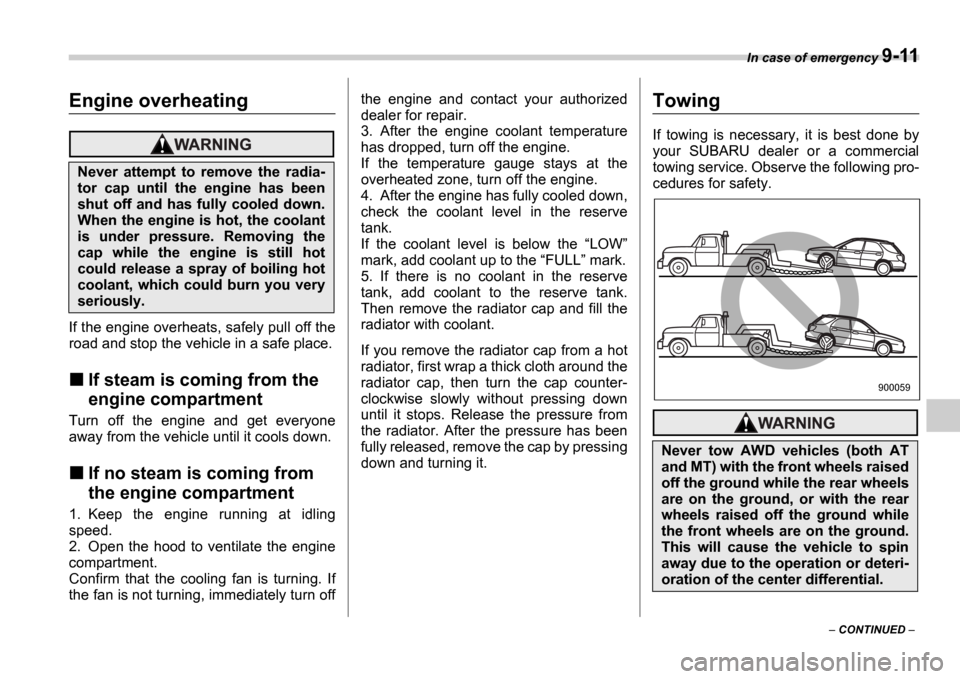
Never tow AWD vehicles (both AT
and MT) with the front wheels raised
off the ground while the rear wheels
are on the ground, or with the rear
wheels raised off the ground while
the front wheels are on the ground.
This will cause the vehicle to spin
away due to the operation or deteri-
oration of the center differential.
900059
Page 267 of 365
9-12 In case of emergency
Towing and tie-down hooks
The towing hooks should be used only in
an emergency (e.g., to free a stuck vehicle
from mud, sand or snow).
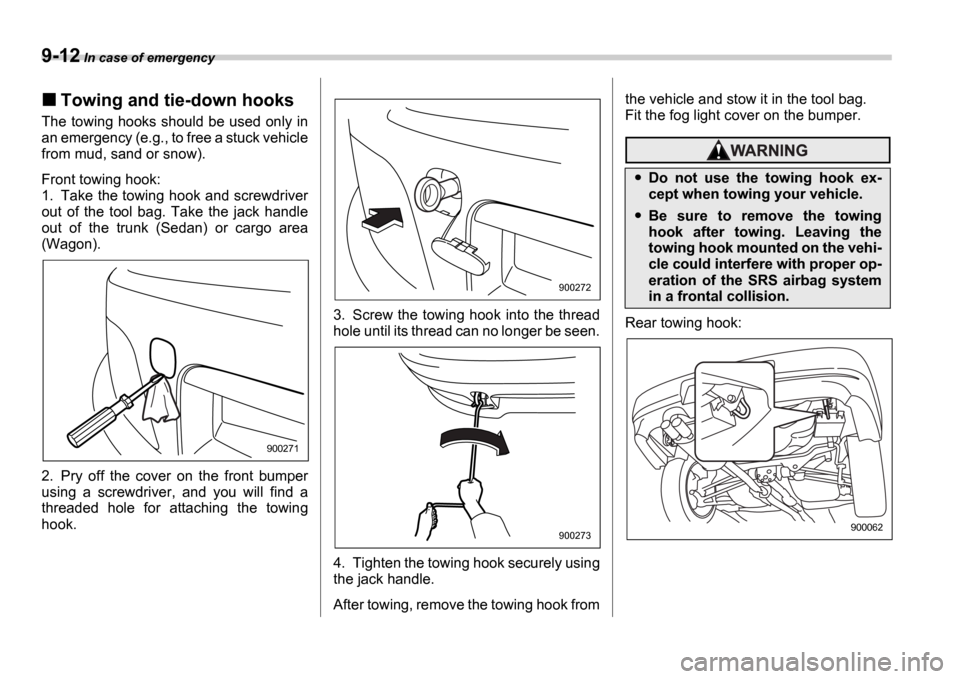
Front towing hook:
1. Take the towing hook and screwdriver
out of the tool bag. Take the jack handle
out of the trunk (Sedan) or cargo area
(Wagon).
2. Pry off the cover on the front bumper
using a screwdriver, and you will find a
threaded hole for attaching the towing
hook. 3. Screw the towing hook into the thread
hole until its thread can no longer be seen.
4. Tighten the towing hook securely using
the jack handle.
After towing, remove the towing hook fromthe vehicle and stow it in the tool bag.
Fit the fog light cover on the bumper.
Rear towing hook:
900271
900272
900273
Do not use the towing hook ex-
cept when towing your vehicle.
Be sure to remove the towing
hook after towing. Leaving the
towing hook mounted on the vehi-
cle could interfere with proper op-
eration of the SRS airbag system
in a frontal collision.
900062
Page 268 of 365
In case of emergency 9-13
CONTINUED
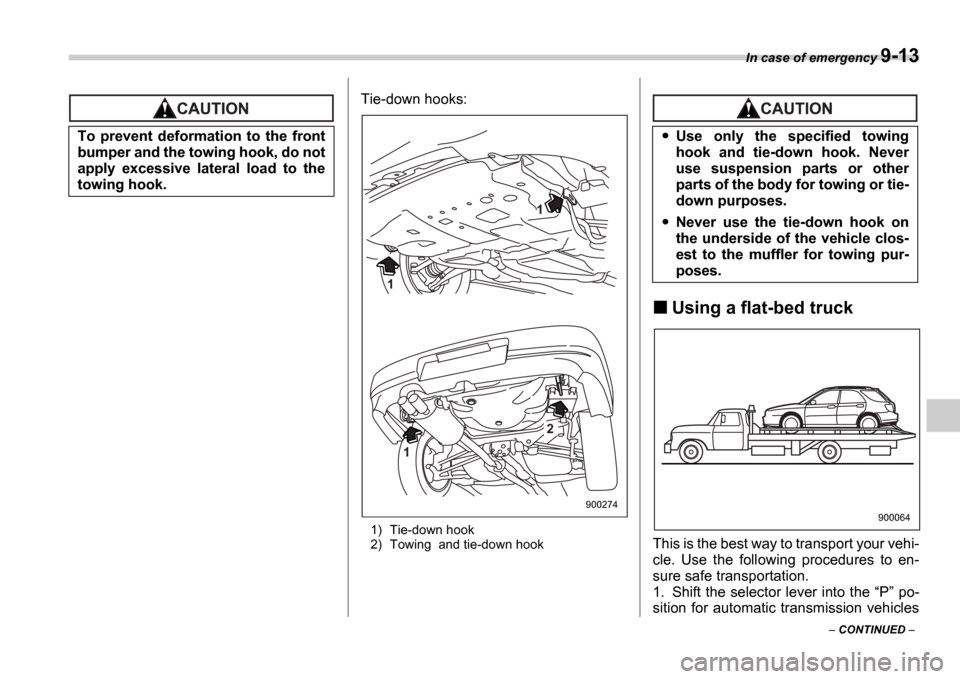
Tie-down hooks:
1) Tie-down hook
2) Towing and tie-down hook
Using a flat-bed truck
This is the best way to transport your vehi-
cle. Use the following procedures to en-
sure safe transportation.
1. Shift the selector lever into the P po-
sition for automatic transmission vehicles
To prevent deformation to the front
bumper and the towing hook, do not
apply excessive lateral load to the
towing hook.
1
1
1
2
900274
Use only the specified towing
hook and tie-down hook. Never
use suspension parts or other
parts of the body for towing or tie-
down purposes.
Never use the tie-down hook on
the underside of the vehicle clos-
est to the muffler for towing pur-
poses.
900064
Page 269 of 365
9-14 In case of emergency
or 1st for manual transmission vehicles.
2. Pull up the parking brake lever firmly.
3. Secure the vehicle onto the carrier
properly with safety chains. Each safety
chain should be equally tightened and
care must be taken not to pull the chains
so tightly that the suspension bottoms out.
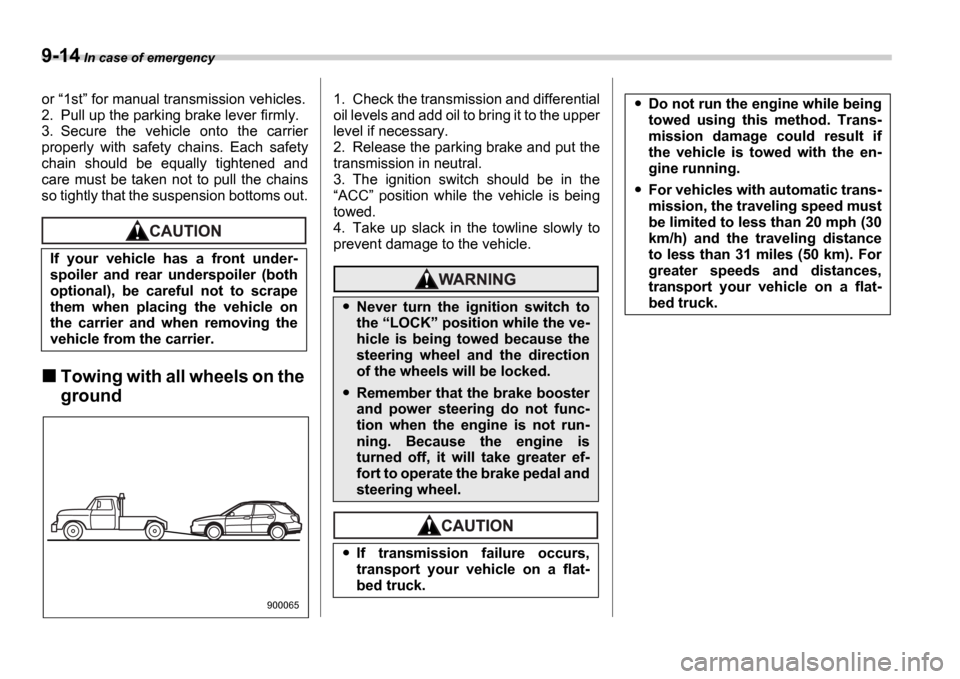
Towing with all wheels on the
ground
1. Check the transmission and differential
oil levels and add oil to bring it to the upper
level if necessary.
2. Release the parking brake and put the
transmission in neutral.
3. The ignition switch should be in the ACC position while the vehicle is being
towed.
4. Take up slack in the towline slowly to
prevent damage to the vehicle.
If your vehicle has a front under-
spoiler and rear underspoiler (both
optional), be careful not to scrape
them when placing the vehicle on
the carrier and when removing the
vehicle from the carrier.
900065
Never turn the ignition switch to
the LOCK position while the ve-
hicle is being towed because the
steering wheel and the direction
of the wheels will be locked.
Remember that the brake booster
and power steering do not func-
tion when the engine is not run-
ning. Because the engine is
turned off, it will take greater ef-
fort to operate the brake pedal and
steering wheel.
If transmission failure occurs,
transport your vehicle on a flat-
bed truck.
Do not run the engine while being
towed using this method. Trans-
mission damage could result if
the vehicle is towed with the en-
gine running.
For vehicles with automatic trans-
mission, the traveling speed must
be limited to less than 20 mph (30
km/h) and the traveling distance
to less than 31 miles (50 km). For
greater speeds and distances,
transport your vehicle on a flat-
bed truck.
Page 271 of 365
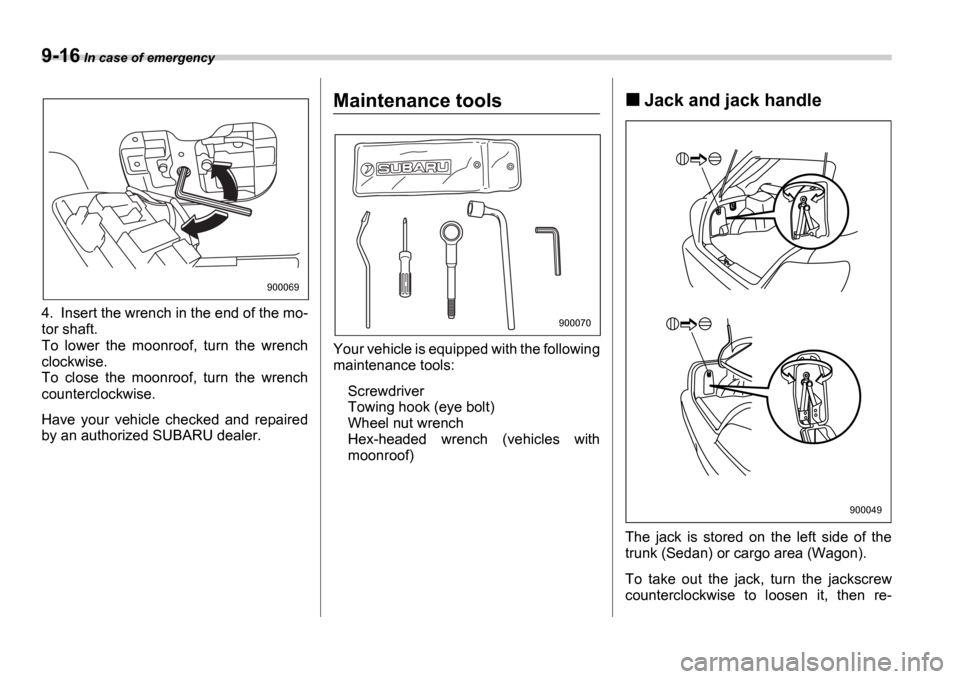
9-16 In case of emergency
4. Insert the wrench in the end of the mo-
tor shaft.
To lower the moonroof, turn the wrench
clockwise.
To close the moonroof, turn the wrench
counterclockwise.
Have your vehicle checked and repaired
by an authorized SUBARU dealer.
Maintenance tools
Your vehicle is equipped with the following
maintenance tools:
Screwdriver
Towing hook (eye bolt)
Wheel nut wrench
Hex-headed wrench (vehicles with
moonroof)
Jack and jack handle
The jack is stored on the left side of the
trunk (Sedan) or cargo area (Wagon).
To take out the jack, turn the jackscrew
counterclockwise to loosen it, then re-
900069
900070
900049
Page 311 of 365
11-32 Maintenance and service
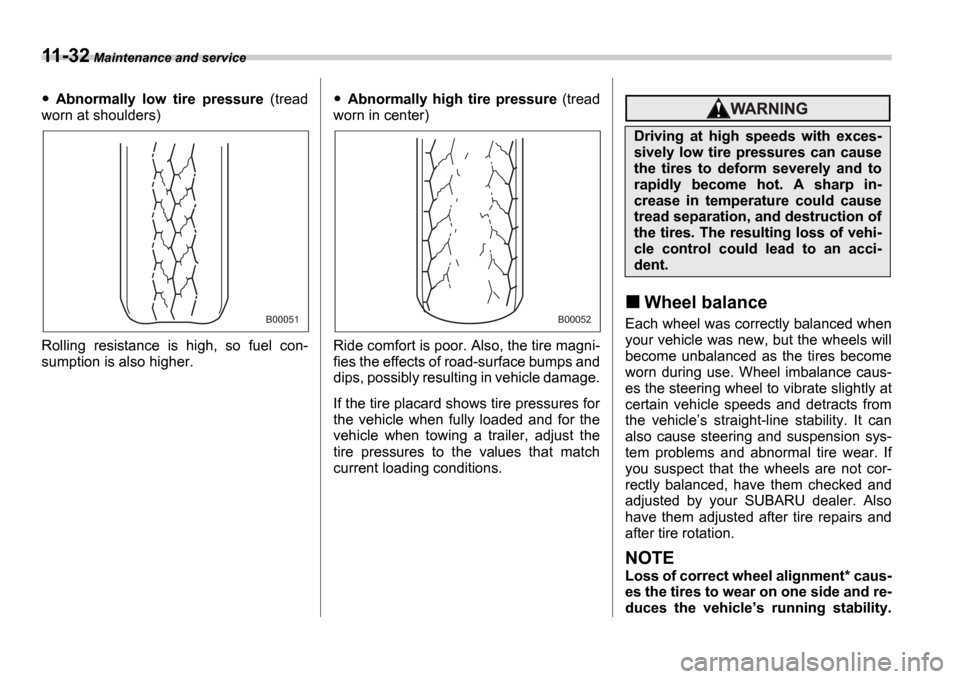
Abnormally low tire pressure (tread
worn at shoulders)
Rolling resistance is high, so fuel con-
sumption is also higher.Abnormally high tire pressure (tread
worn in center)
Ride comfort is poor. Also, the tire magni-
fies the effects of road-surface bumps and
dips, possibly resulting in vehicle damage.
If the tire placard shows tire pressures for
the vehicle when fully loaded and for the
vehicle when towing a trailer, adjust the
tire pressures to the values that match
current loading conditions.
Wheel balance
Each wheel was correctly balanced when
your vehicle was new, but the wheels will
become unbalanced as the tires become
worn during use. Wheel imbalance caus-
es the steering wheel to vibrate slightly at
certain vehicle speeds and detracts from
the vehicle s straight-line stability. It can
also cause steering and suspension sys-
tem problems and abnormal tire wear. If
you suspect that the wheels are not cor-
rectly balanced, have them checked and
adjusted by your SUBARU dealer. Also
have them adjusted after tire repairs and
after tire rotation.
NOTE
Loss of correct wheel alignment* caus-
es the tires to wear on one side and re-
duces the vehicle s running stability.
B00051B00052
Driving at high speeds with exces-
sively low tire pressures can cause
the tires to deform severely and to
rapidly become hot. A sharp in-
crease in temperature could cause
tread separation, and destruction of
the tires. The resulting loss of vehi-
cle control could lead to an acci-
dent.
Page 349 of 365
13-8 Consumer information and Reporting safety defects
Vehicle load limit how to de-
termine
The load capacity of your vehicle is
determined by weight, not by avail-
able cargo space. The load limit of
your vehicle is shown on the vehicle
placard attached to the driver s side
B-pillar. Locate the statement The
combined weight of occupants and
cargo should never exceed XXX kg or
XXX lbs on your vehicle s placard.
The vehicle placard also shows seat-
ing capacity of your vehicle.
The total load capacity includes the
total weight of driver and all passen-
gers and their belongings, any cargo,
any optional equipment such as a
trailer hitch, roof rack or bike carrier,
etc., and the tongue load of a trailer.
Therefore cargo capacity can be cal-
culated by the following method.
Cargo capacity = Load limit (total
weight of occupants + total weight of
optional equipment + tongue load of a
trailer (if applicable))
For towing capacity information and
weight limits, refer to Trailer towing
section in chapter 8.
Calculating total and load capac-
ities varying seating configura-
tions
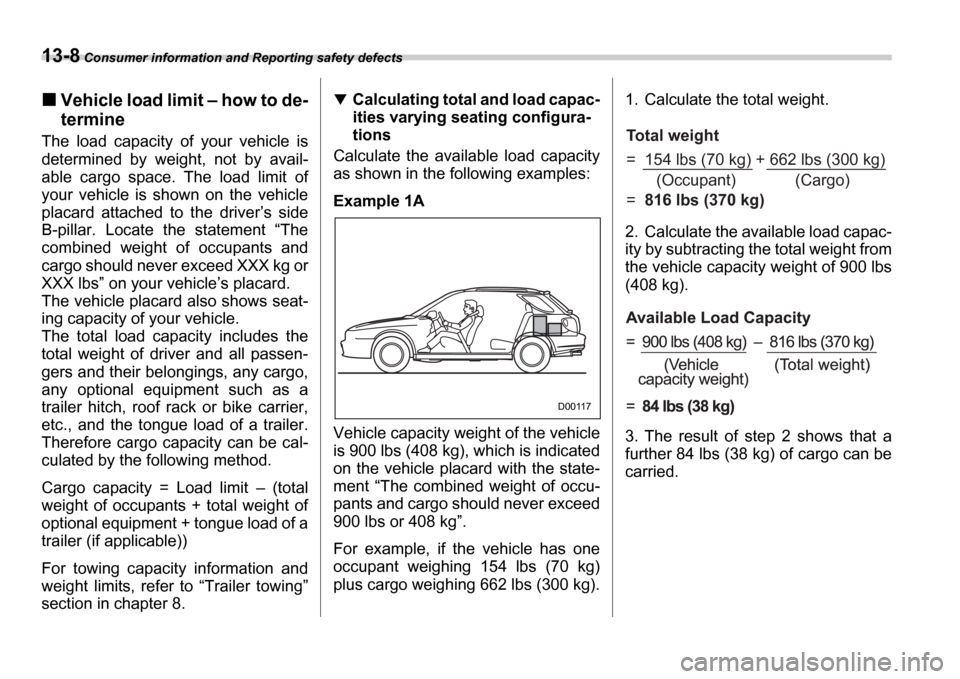
Calculate the available load capacity
as shown in the following examples:
Example 1A
Vehicle capacity weight of the vehicle
is 900 lbs (408 kg), which is indicated
on the vehicle placard with the state-
ment The combined weight of occu-
pants and cargo should never exceed
900 lbs or 408 kg .
For example, if the vehicle has one
occupant weighing 154 lbs (70 kg)
plus cargo weighing 662 lbs (300 kg). 1. Calculate the total weight.
2. Calculate the available load capac-
ity by subtracting the total weight from
the vehicle capacity weight of 900 lbs
(408 kg).
3. The result of step 2 shows that a
further 84 lbs (38 kg) of cargo can be
carried.
D00117
Total weight
= 154 lbs (70 kg) + 662 lbs (300 kg)
=
816 lbs (370 kg)(Occupant) (Cargo)
Page 352 of 365

Consumer information and Reporting safety defects 13-11
suspension, axles and other parts of
the body.
Therefore, this means that the vehicle
cannot necessarily be loaded up to
the tires maximum load rating on the
tire sidewall.
Adverse safety consequenc-
es of overloading on handling
and stopping and on tires
Overloading could affect vehicle han-
dling, stopping distance, vehicle and
tire as shown in the following. This
could lead to an accident and possibly
result in severe personal injury.
Vehicle stability will deteriorate.
Heavy and/or high-mounted loads
could increase the risk of rollover.
Stopping distance will increase.
Brakes could overheat and fail.
Suspension, bearings, axles and
other body parts could break or expe-
rience accelerated wear that will
shorten vehicle life.
Tires could fail.
Tread separation could occur.
Tire could separate from its rim.
Steps for Determining Cor-
rect Load Limit
1. Locate the statement The com-
bined weight of occupants and cargo
should never exceed XXX pounds on
your vehicle s placard.
2. Determine the combined weight of
the driver and passengers that will be
riding in your vehicle.
3. Subtract the combined weight of
the driver and passengers from XXX
kilograms or XXX pounds.
4. The resulting figure equals the
available amount of cargo and lug-
gage load capacity. For example, if
the XXX amount equals 1,400 lbs
(635 kg) and there will be five- 150 lbs
(68 kg) passengers in your vehicle,
the amount of available cargo and
luggage load capacity is 650 lbs.
(1,400 750 (5
150) = 650 lbs.)
5. Determine the combined weight of
luggage and cargo being loaded on
the vehicle. That weight may not safe-
ly exceed the available cargo and lug-
gage load capacity calculated in Step
4.
6. If your vehicle will be towing a trail-
er, load from your trailer will be trans- ferred to your vehicle. Consult this
manual to determine how this reduc-
es the available cargo and luggage
load capacity of your vehicle.