2006 SKODA SUPERB wheel
[x] Cancel search: wheelPage 255 of 281

Breakdown assistance
254
– Screw in the wheel bolts and tighten them slightly with the aid
of the hexagon socket.
– Unscrew the assembly pin and screw in the remaining wheel bolt also slightly.
The wheel bolts must be clean and must turn easily.
The hexagon socket in the handle of the screwdriver makes it simpler to
fit on the wheel bolts. The reversible blade should be pulled out for this
step.
When fitting on unidirectional tyres, ensure that the tyres rotate in the
correct direction ⇒page 241.
Note
Do not use the hexagon socket in the handle of the screwdriver for slack-
ening or tightening the wheel bolts.
Securing wheels against being stolen
You need a special adapter for slackening the safety
wheel bolts.
– Pull off the full wheel trim/cap from the wheel hub or cap from
the safety wheel bolt.
– Insert the adapter with its toothed side fully into the inner toothing of the safety wheel bolt right down in such a way
that only the outer hexagon is jutting out ⇒ fig. 198.
– Insert the wheel wrench fully onto the adapter .
– Slacken the wheel bolt, or tighten it firmly ⇒page 239.
– Reinstall the full wheel trim/wheel cap after removing the adapter or place the cap onto the safety wheel bolt.
Fig. 198 Safety wheel
bolt with adapter
AB
AA
AB
NKO B5 20.book Page 254 Monday, July 3, 2006 2:09 PM
Page 256 of 281
Breakdown assistance255
Using the systemSafetyDriving TipsGeneral MaintenanceBreakdown assistanceTechnical Data
– Have the tightening torque checked with a torque wrench as
soon as possible. The tightening torque must be 120 Nm.
The safety wheel bolts on vehicles fitted with them (one safety wheel bolt
per wheel) can only be loosened or tighten up by using the adapter
provided.
It is meaningful to note the code number hammered into the rear side of
the adapter or the rear side of the safety wheel bolts. You can obtain a
replacement adapter from a Škoda Service Partner, if necessary, by
quoting this number.
We recommend that you always carry the adapter for the wheel bolts with
you in the vehicle. It should be stowed in the vehicle tool kit.
Caution
•Damage can occur to the adapter and safety wheel bolt if the safety
wheel bolt is tightened up too much.
•On steel wheels, the theft-deterrent wheel bolt must always be
installed in the hole, which is close to the valve. Otherwise the full wheel
trim cannot be mounted and the full wheel trim can be damaged during the
assembly.
Note
The set of safety wheel bolts can be obtained from a Škoda Service
Partner.
Jump-starting
Initial steps
You can use the battery of another vehicle for jump-starting yours if the
engine does not start because the battery on your vehicle is flat. You will
require jump-start cables for this purpose.
Both batteries must have a rated voltage of 12 V. The capacity (Ah) of the
battery supplying the power must not be significantly less than the
capacity of the discharged battery in your vehicle.
Jump-start cables
Only use jump-start cables which have an adequately large cross-section
and insulated terminal clamps. Please pay attention to the manufacturer's
instructions.
Positive cable - colour coding in the majority of cases red.
Negative cable - colour coding in the majority of cases black.
WARNING
•A discharged battery may already freeze at temperatures just
below 0°C. In case of frozen battery carry out no jump-starting - risk
of explosion! Also after thawing of the battery there is a risk of
caustic burns due to leaking acid. Replace the frozen battery.
•Please pay attention to the warning instructions relating to
working in the engine compartment ⇒page 219.
Note
•There must not be any contact between the two vehicles otherwise
current may flow as soon as the negative terminals are connected.
NKO B5 20.book Page 255 Monday, July 3, 2006 2:09 PM
Page 258 of 281

Breakdown assistance257
Using the systemSafetyDriving TipsGeneral MaintenanceBreakdown assistanceTechnical Data
out the battery being ignited by the strong spark which results from
the engine being started.
•Do not affix the cable end to parts of the fuel and brake
system.
•Run the jump-start cables so that they cannot be caught by any
rotating parts in the engine compartment.
•Do not bend over the batteries - risk of caustic burns!
•The vent screws of the battery cells must be tightened firmly.
•Keep any sources of ignition (naked flame, smouldering ciga-
rettes etc.) away from the battery - risk of an explosion!
Tow-starting and towing vehicle
General
Please pay attention to the following instructions if you are going
to use a tow rope:
Driver of the towing vehicle
– Do not drive off until the tow rope is taught.
– Release the clutch particularly gently when starting off or depress the accelerator particularly gently if your vehicle is
fitted with an automatic gearbox. Driver of the towed vehicle
– Switch the ignition on so that the steering wheel is not blocked
and you can also operate the turn signal lights, the headlight
flasher, the windscreen wipers and windscreen washer
system.
– Take the vehicle out of gear or move the selector lever into position N if your vehicle is fitted with an automatic gearbox.
– Note that the brake servo unit and power steering only operate if the engine is running. You will require significantly greater
physical force to depress the brake pedal and to steer the
vehicle if the engine is not running.
– Ensure that the tow rope is always kept taught.
Tow rope or tow bar
A tow bar is safest way of towing a vehicle and also minimizes any
shocks. You can use a tow rope only if a suitable tow bar is not available.
The tow rope must be elastic to protect the vehicle. Thus one should only
use plastic fibre rope or a rope made out of a similarly elastic material.
Attach the tow rope or the tow bar only to the towing eyes provided for
this purpose ⇒page 258, “Front towing eye” and ⇒page 258, “Rear
towing eye”.
Driving style
Towing another vehicle requires a certain amount of practice. Both drivers
should be familiar with the particular points about towing a vehicle.
Unskilled drivers should not attempt to tow in another vehicle or to be
towed in.
One should be constantly vigilant not to allow impermissibly high towing
forces or jerky loadings. There is always a risk of excessive stresses and
WARNING (continued)
A4
NKO B5 20.book Page 257 Monday, July 3, 2006 2:09 PM
Page 259 of 281
Breakdown assistance
258
damage resulting at the points to which you attach the tow rope or tow bar
when you attempt to tow a vehicle which is not standing on a paved road.
Caution
If the gearbox of your vehicle no longer contains any oil because of a
defect, your vehicle must only be towed in with the driven wheels raised
clear of the ground, or on a special vehicle transporter or trailer.
Note
•Please comply with any legal requirements particularly regarding the
switched on signal systems, when towing in or tow-starting another
vehicle.
•The tow rope must not be twisted as it may in certain circumstances
result in the front towing eye being unscrewed out of your vehicle.
Front towing eye
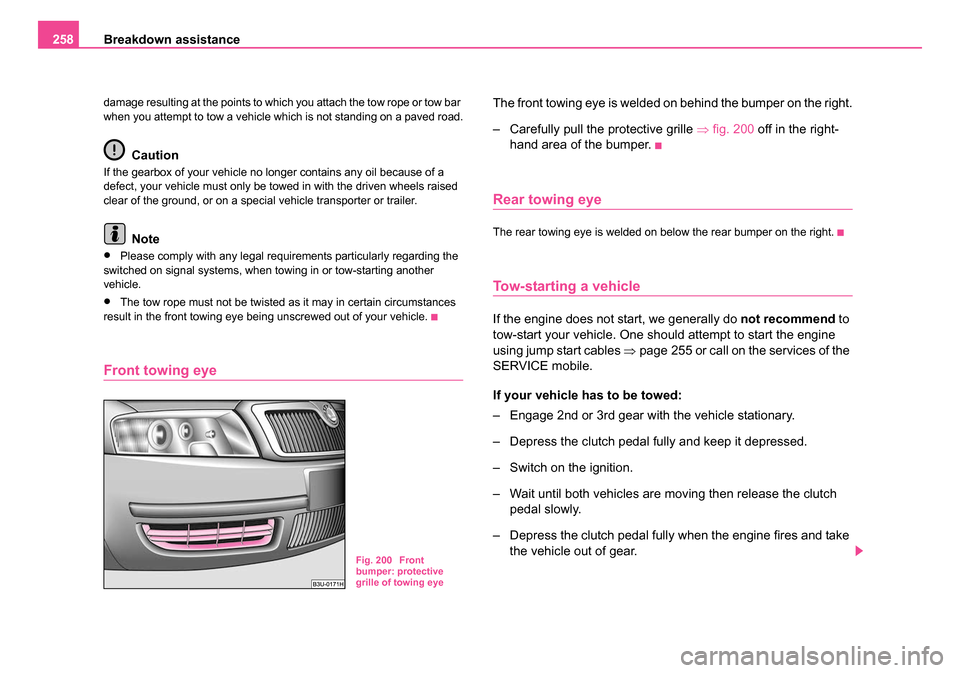
The front towing eye is welded on behind the bumper on the right.
– Carefully pull the protective grille ⇒fig. 200 off in the right-
hand area of the bumper.
Rear towing eye
The rear towing eye is welded on below the rear bumper on the right.
Tow-starting a vehicle
If the engine does not start, we generally do not recommend to
tow-start your vehicle. One should attempt to start the engine
using jump start cables ⇒page 255 or call on the services of the
SERVICE mobile.
If your vehicle has to be towed:
– Engage 2nd or 3rd gear with the vehicle stationary.
– Depress the clutch pedal fully and keep it depressed.
– Switch on the ignition.
– Wait until both vehicles are moving then release the clutch pedal slowly.
– Depress the clutch pedal fully when the engine fires and take the vehicle out of gear.
Fig. 200 Front
bumper: protective
grille of towing eye
NKO B5 20.book Page 258 Monday, July 3, 2006 2:09 PM
Page 260 of 281

Breakdown assistance259
Using the systemSafetyDriving TipsGeneral MaintenanceBreakdown assistanceTechnical Data
For technical reasons it is not possible to tow-start a car fitted with an
automatic gearbox
.
WARNING
There is high risk of having an accident when tow-starting a
vehicle, when for example the towed vehicle runs into the towing
vehicle.
Caution
Vehicles which are fitted with a catalytic converter should not be tow-
started over a distance of more than 50 metres. Unburnt fuel may get into
the catalytic converter and damage it.
Towing in a vehicle fitted with a manual gearbox
Please refer to the notes ⇒page 257.
The car can be towed in with a tow bar or a tow rope or with the front or
rear wheels raised. The maximum towing speed is 50 km/h.
Towing of a vehicle with an automatic gearbox
Please refer to the notes ⇒page 257.
The car can be towed in with a tow bar or a tow rope. Refer at the same
time to the following guidelines:
•Move selector lever into N .
•The maximum towing speed is 50 km/h.
•The maximum permissible towing distance is 50 km. The gear oil
pump does not operate when the engine is not running and the gear would
not be adequately lubricated at higher speeds and over longer towing
distance.
Caution
If the vehicle is towed in by a recovery vehicle, it should only be towed in
with the front wheels raised. If the vehicle is raised at rear, the automatic
gearbox is damaged!
Note
The vehicle must be transported on a special vehicle or trailer if it is not
possible to tow in the vehicle in the way described or if the towing distance
is greater than 50 km.
NKO B5 20.book Page 259 Monday, July 3, 2006 2:09 PM
Page 262 of 281

Fuses and light bulbs261
Using the systemSafetyDriving TipsGeneral MaintenanceBreakdown assistanceTechnical Data
Caution
•Never attempt to “repair” fuses and also do not replace them with a
fuse of a higher amperage - risk of fire! This may also cause damage at
another part of the electrical system.
•Have the electrical system checked as quickly as possible by a
specialist garage if a newly inserted fuse blows again after a short time.
Note
We recommend that you have these fuses replaced by a specialist
garage.
Fuse assignment
Certain electrical components are only standard on certain vehicle model
versions or only suppliable as optional equipment for certain models.
Fig. 202 Schematic
representation of fuse
carrier
No.Ampere
s
1Heatable windscreen washing nozzles5
2Turn signals10
3Not assigned
4Licence plate light5
5
Instrument cluster - warning lights, seat heaters, cruise
control system, exterior mirror adjustment, lighting of
controls and switches, outside temperature display, air
conditioning, audible parking aid, navigation system,
multifunction steering wheel
10
6Heating of the external mirror5
7ABS, EDS, ASR, ESP, cruise control system, engine
electronics10
8Automatic headlight beam adjustment5
9Parking aid5
10CD changer, mobile phone, multifunction steering
wheel5
11DVD player7,5
12Power supply for diagnostic socket10
13Brake lights10
14Central locking control unit, interior lighting10
15Instrument cluster, air conditioning, automatic gearbox,
exterior mirror adjustment memory and navigation sys-
tem10
16ESP5
17Two-way radio system, special vehicles (police etc.)10
NKO B5 20.book Page 261 Monday, July 3, 2006 2:09 PM
Page 272 of 281

Index271
Index
A
Abroad . . . . . . . . . . . . . . . . . . . . . . . . . . . . . 199
ABS . . . . . . . . . . . . . . . . . . . . . . . . . . . . . . . 189
Warning light . . . . . . . . . . . . . . . . . . . . . . 35
Accessories . . . . . . . . . . . . . . . . . . . . . . . . . 242
Adjusting seats . . . . . . . . . . . . . . . . . . . . . . 151 Adjusting front seats manually . . . . . . . . . 72
electrical . . . . . . . . . . . . . . . . . . . . . . . . . . 73
Adjusting the steering wheel . . . . . . . . . . . . 120
Air conditioning system Air conditioning system . . . . . . . . . . . . . 108
Climatronic . . . . . . . . . . . . . . . . . . . . . . . 113
Air outlet vents . . . . . . . . . . . . . . . . . . . . . . . 112
Airbag . . . . . . . . . . . . . . . . . . . . . . . . . . . . . 162 Deployment . . . . . . . . . . . . . . . . . . . . . . 163
Front airbag . . . . . . . . . . . . . . . . . . . . . . 164
Head airbag . . . . . . . . . . . . . . . . . . . . . . 169
Side airbag . . . . . . . . . . . . . . . . . . . . . . . 166
Warning light . . . . . . . . . . . . . . . . . . . . . . 29
Airbag system . . . . . . . . . . . . . . . . . . . . . . . 162 Warning light . . . . . . . . . . . . . . . . . . . . . . 29
Airbags . . . . . . . . . . . . . . . . . . . . . . . . . . . . 162
Alarm . . . . . . . . . . . . . . . . . . . . . . . . . . . . . . . 48
Alcantara . . . . . . . . . . . . . . . . . . . . . . . . . . . 212
Alternator Warning light . . . . . . . . . . . . . . . . . . . . . . 37
Antilock brake system . . . . . . . . . . . . . . . . . 189 Antilock brake system - ABS
Warning light . . . . . . . . . . . . . . . . . . . . . . 35
Anti-theft alarm system . . . . . . . . . . . . . . . . . 48
Ashtray . . . . . . . . . . . . . . . . . . . . . . . . . . . . . . 97
Attaching child safety seat . . . . . . . . . . . . . . . . . . . 181
Auto Check Control . . . . . . . . . . . . . . . . . . . . 24
Auto Computer . . . . . . . . . . . . . . . . . . . . . . . . 18
Automatic gearbox . . . . . . . . . . . . . . . . . . . . 131 Emergency programme . . . . . . . . . . . . . 136
Kickdown . . . . . . . . . . . . . . . . . . . . . . . . 134
Tiptronic . . . . . . . . . . . . . . . . . . . . . . . . . 135
Automatic seat adjustment . . . . . . . . . . . . . . 74
Automatic vehicle wash systems . . . . . . . . . 206
Automatic wiper/washer system . . . . . . . . . . 65
Avoiding damage to your vehicle . . . . . . . . . 199
B
B rake booster . . . . . . . . . . . . . . . . . . . . . . . 189
Battery . . . . . . . . . . . . . . . . . . . . . . . . . . 37, 228 change . . . . . . . . . . . . . . . . . . . . . . . . . . 233
Inspecting the electrolyte level . . . . . . . . 230
Operation in winter . . . . . . . . . . . . . . . . . 231
Before setting off . . . . . . . . . . . . . . . . . . . . . 150
Belt Warning light . . . . . . . . . . . . . . . . . . . . . . 37
Belt tensioners . . . . . . . . . . . . . . . . . . . . . . . 160 Belts . . . . . . . . . . . . . . . . . . . . . . . . . . . . . . . 155
Biofuel . . . . . . . . . . . . . . . . . . . . . . . . . . . . . 214
Blocking
seat belts . . . . . . . . . . . . . . . . . . . . . . . . 160
Bonnet . . . . . . . . . . . . . . . . . . . . . . . . . . . . . 218 Warning light . . . . . . . . . . . . . . . . . . . . . . . 32
Boot lid . . . . . . . . . . . . . . . . . . . . . . . . . . . . . . 45
Brake Handbrake . . . . . . . . . . . . . . . . . . . . . . . 125
Brake Assist . . . . . . . . . . . . . . . . . . . . . . . . . 190
Brake booster . . . . . . . . . . . . . . . . . . . . . . . . 189
Brake fluid . . . . . . . . . . . . . . . . . . . . . . . . . . 227
Brake pads Warning light . . . . . . . . . . . . . . . . . . . . . . . 32
Brake system Warning light . . . . . . . . . . . . . . . . . . . . . . . 36
Brakes . . . . . . . . . . . . . . . . . . . . . . . . . . . . . 188
Bulbs . . . . . . . . . . . . . . . . . . . . . . . . . . . . . . 262
Button on the driver's door Central locking system . . . . . . . . . . . . . . . 43
Buttons on the driver's door Power windows . . . . . . . . . . . . . . . . . . . . . 49
C
Car jack . . . . . . . . . . . . . . . . . . . . . . . . . . . . 246
Car state . . . . . . . . . . . . . . . . . . . . . . . . . . . . 24
CargoFlex . . . . . . . . . . . . . . . . . . . . . . . . . . . 91
NKO B5 20.book Page 271 Monday, July 3, 2006 2:09 PM
Page 273 of 281

Index
272
CargoFlex folding box . . . . . . . . . . . . . . . . . . 91
Catalytic converter . . . . . . . . . . . . . . . . . . . 193
CD changer . . . . . . . . . . . . . . . . . . . . . . . . . 141
Central locking system . . . . . . . . . . . . . . . . . 41
lock . . . . . . . . . . . . . . . . . . . . . . . . . . . . . 43
unlock . . . . . . . . . . . . . . . . . . . . . . . . . . . 42
Changing Engine oil . . . . . . . . . . . . . . . . . . . . . . . 223
Changing a wheel . . . . . . . . . . . . . . . . . . . . 248
Changing bulbs . . . . . . . . . . . . . . . . . . . . . . 262
Changing oil . . . . . . . . . . . . . . . . . . . . . . . . 223
Changing wheels around . . . . . . . . . . . . . . 238
Charging the battery . . . . . . . . . . . . . . . . . . . . . . . . . . 231
Charging the battery . . . . . . . . . . . . . . . . . . 231 Warning light . . . . . . . . . . . . . . . . . . . . . . 37
Chassis number . . . . . . . . . . . . . . . . . . . . . 269
Check engine oil level . . . . . . . . . . . . . . . . . 222
Child safety . . . . . . . . . . . . . . . . . . . . . . . . . 174 Side airbag . . . . . . . . . . . . . . . . . . . . . . 177
Child safety lock . . . . . . . . . . . . . . . . . . . . . . 40
Child safety seat on the front passenger seat . . . . . . . . . 176
Safety information . . . . . . . . . . . . . . . . . 174
Use of child safety seats . . . . . . . . . . . . 178
Child seat . . . . . . . . . . . . . . . . . . . . . . . . . . 178 Child seat protection . . . . . . . . . . . . . . . 181
Classification into groups . . . . . . . . . . . 178
ISOFIX system . . . . . . . . . . . . . . . . . . . 182
Children and safety . . . . . . . . . . . . . . . . . . . 174 Chrome parts . . . . . . . . . . . . . . . . . . . . . . . 208
Cigarette lighter . . . . . . . . . . . . . . . . . . . . . . . 99
Cleaning . . . . . . . . . . . . . . . . . . . . . . . . . . . 205
Climatronic
Air outlet vents . . . . . . . . . . . . . . . . . . . . 118
Blower . . . . . . . . . . . . . . . . . . . . . . . . . . 117
Defrosting windows . . . . . . . . . . . . . . . . 114
economic use . . . . . . . . . . . . . . . . . . . . 114
Keeping windows demisted . . . . . . . . . . 115
Operational faults . . . . . . . . . . . . . . . . . 114
Recirculated air mode . . . . . . . . . . . . . . 116
Setting temperature . . . . . . . . . . . . . . . . 117
Climatronic (automatic air conditioning) . . . 113
Clock . . . . . . . . . . . . . . . . . . . . . . . . . . . . . . . 15
Clothes hooks . . . . . . . . . . . . . . . . . . . . . . . 107
Cockpit General view . . . . . . . . . . . . . . . . . . . . . . 11
Coming Home . . . . . . . . . . . . . . . . . . . . . . . . 60
Compartments . . . . . . . . . . . . . . . . . . . . . . 101
Computer . . . . . . . . . . . . . . . . . . . . . . . . . . . 18
Convenience operation . . . . . . . . . . . . . . . . . 51
Converting/masking over headlights . . . . . . 199
Cool box . . . . . . . . . . . . . . . . . . . . . . . . . . . . 88
Coolant . . . . . . . . . . . . . . . . . . . . . . . . . . . . 224 replenishing . . . . . . . . . . . . . . . . . . . . . . 226
Warning light . . . . . . . . . . . . . . . . . . . . . . 32
Coolant level Warning light . . . . . . . . . . . . . . . . . . . . . . 32
Coolant quantity Warning light . . . . . . . . . . . . . . . . . . . . . . 32 Coolant temperature gauge . . . . . . . . . . . . . . 14
Coolant temperature/coolant level
Warning light . . . . . . . . . . . . . . . . . . . . . . 32
Cooling Air conditioning system . . . . . . . . . . . . . 108
Climatronic . . . . . . . . . . . . . . . . . . . . . . . 113
Correct seated position . . . . . . . . . . . . . . . . 151
Counter for distance driven . . . . . . . . . . . . . . 16
Cruise control . . . . . . . . . . . . . . . . . . . . . . . 128
Cruise control system . . . . . . . . . . . . . . . . . 128
D
Deactivating an airbag . . . . . . . . . . . . . . . . . . . . . . . . 171
Deactivating an airbag . . . . . . . . . . . . . . . . . 171
Defrosting rear window . . . . . . . . . . . . . . . . . 63
Defrosting windows Air conditioning system . . . . . . . . . . . . . 110
Defrosting windscreen . . . . . . . . . . . . . . . . . . 63
De-icing the windows . . . . . . . . . . . . . . . . . 208
Detachable towing device . . . . . . . . . . . . . . 202
Diesel . . . . . . . . . . . . . . . . . . . . . . . . . . . . . 214
Diesel engines Starting the engine . . . . . . . . . . . . . . . . . 123
Diesel particle filter . . . . . . . . . . . . . . . . . . . . 30
Digital clock . . . . . . . . . . . . . . . . . . . . . . . . . . 15
Direction indicators . . . . . . . . . . . . . . . . . . . . 59 Warning light . . . . . . . . . . . . . . . . . . . . . . 28
NKO B5 20.book Page 272 Monday, July 3, 2006 2:09 PM