2006 SKODA SUPERB wheel
[x] Cancel search: wheelPage 243 of 281

Accessories, changes and replacement of parts
242
Accessories, changes an d replacement of parts
Accessories and replacement parts
Škoda vehicles have been built according to the latest discoveries in
safety engineering. Thus one should not change the condition in which the
vehicle was delivered from the manufacturer without some thought.
The following guidelines should be observed when a vehicle is to be retro-
fitted with accessories, have technical changes made to it or a part has to
be replaced at some time in the future.
•Advise should always be obtained from a Škoda Service Partner
before buying any accessories and before making any technical changes
⇒ .
•This is particularly the case when accessories are bought in a foreign
country.
•Škoda Genuine Accessories which have been released for use and
Skoda original parts can be obtained from Škoda Service Partners. They
will install them professionally and correctly.
•All Škoda original accessory which is listed in the catalogue such as
tilting roofs, spoilers, wheels etc. must have an official stamp of approval.
•Radios, aerials and other electrical accessories should only be
installed by an authorised workshop.
•The guidelines issued by Škoda Auto a.s. must be observed when
making technical changes.
•This is to ensure that no technical damage occurs to the vehicle, that
travelling and operating safety are maintained and that the chnages are
permissible. Škoda Service Partners undertake this work professionally or
refer it to an specialist company in special cases. Any damage which is done caused by technical changes made
without consulting a Skoda a.s. dealer is excluded from the guar-
antee.
WARNING
•We advise you, in your own interest, to only use Škoda Genuine
Accessories and Škoda original parts which have been expressly
approved for use on your Škoda. Reliability, safety and suitabiliity
have been established for these Škoda original parts.
•We cannot guarantee suitability of installation into your vehicle
of other products despite keeping a constant eye on market devel-
opments (also not in the case where there is an attestation or
permission can be produced).
Technical changes
Interference on the electronic components and their software can lead to
operational faults. This interference can also impair not directly affected
systems because of the networking of the electronic components. This
means that the operating safety of your vehicle can be considerably jeop-
ardized, a greater wear of vehicle parts can occur and finally the vehicle
registration documents expire.
We trust that you will understand that your Škoda Service Partner cannot
be liable for damage resulting from unprofessional work.
We therefore recommend that you have all work carried out with Škoda
original parts at your authorised Škoda Service Partners.
NKO B5 20.book Page 242 Monday, July 3, 2006 2:09 PM
Page 248 of 281

Breakdown assistance247
Using the systemSafetyDriving TipsGeneral MaintenanceBreakdown assistanceTechnical Data
•Hook for pulling off a full wheel trim,
•Plastic clip for a wheel bolt cover,
•Wheel wrench,
•Assembly pin for changing wheel,
•Screwdriver with reversible blade,
•Adapter for the wheel bolts lock.
After using the lifting jack, screw in the arm of the lifting jack fully before
placing it back in its stowage area.
WARNING
•The hexagon socket in the handle of the screwdriver should
only be used to fit on the wheel bolts. Never use the hexagon
socket of the screwdriver for tightening the wheel bolts because
you will not be able to achieve the necessary tightening torque with
the hexagon socket - risk of accident!
•The factory-supplied lifting jack is only intended for your model
of vehicle. On no account attempt to lift a heavier vehicle or other
loads - risk of injury!
•Ensure that the vehicle tool kit is safely attached in the luggage
compartment.
Spare wheel
The spare wheel is stowed in the spare wheel well in the
luggage compartment below the floor covering.
The spare wheel lies in a well in the luggage compartment under floor
covering and is fixed in place using special screws ⇒fig. 191 .
One should check the inflation pressure in the spare wheel (at best when
generally checking the tyre air pressures - see sign on the fuel filler flap
⇒ page 236) to ensure that the spare wheel is always ready to use.
Temporary spare wheel*
If you have such tyres on your vehicle, please refer to the notes below:
•The spare wheel provided with a car fitted with unidirectional tyres has
different dimensions. The wheel is provided with a warning sticker.
•After fitting on the wheel, the warning sticker must not be concealed
(e.g. by the wheel trim).
Fig. 191 Luggage
compartment: Spare
wheel
NKO B5 20.book Page 247 Monday, July 3, 2006 2:09 PM
Page 249 of 281

Breakdown assistance
248
•Do not drive with this spare wheel at more than 80 km/h - risk of acci-
dent. Avoid accelerating at full throttle, sharp braking and fast cornering.
•The inflation pressure for this spare wheel is identical to the inflation
pressure of the standard tyres.
•Use this spare wheel only to reach the nearest specialist garage as it
is not intended for continuous use.
Changing a wheel
Preliminary work
The following steps should be carried out before actually
changing the wheel.
– If it is necessary to change a wheel, park the vehicle as far away as possible from the traffic flow. The place you choose
should be level.
– Have all the occupants get out. While changing a wheel, the
occupants of the vehicle should not stand on the road (e.g.
behind a crash barrier).
– Apply the handbrake firmly.
– Engage 1st gear or if your vehicle is fitted with an automatic
gearbox, position the selector lever into position P .
– If a trailer is coupled, uncouple it.
– Take the vehicle tool kit and the spare wheel ⇒ page 247
out of the luggage compartment.
WARNING
•If you find yourself in flowing traffic switch on the hazard
warning lights system and place the warning triangle on the side of
the road at the prescribed distance from your vehicle while
observing all national legal provisions. In this way you are
protecting not only yourself but also other road users.
•Never start the engine with the vehicle sitting on the raised jack
- danger of suffering injury!
Caution
If you have to change a wheel on a slope first block the opposite wheel
with a stone or similar object in order to secure the vehicle from unexpect-
edly rolling away.
Note
Comply with the national legal regulations.
Changing a wheel
Always change a wheel on a level surface as far as possible.
– Take off the full wheel trim* ⇒page 249 or the caps
⇒ page 251.
– In the case of light alloy wheels remove the wheel trim cap ⇒page 250.
– Slacken the wheel bolts ⇒page 251.
NKO B5 20.book Page 248 Monday, July 3, 2006 2:09 PM
Page 250 of 281

Breakdown assistance249
Using the systemSafetyDriving TipsGeneral MaintenanceBreakdown assistanceTechnical Data
– Jack up the vehicle until the wheel to be changed is clear of
the ground ⇒page 252.
– Unscrew the wheel bolts and place them on a clean surface (cloth, paper etc.).
– Take off the wheel.
– Fit on the spare wheel and tighten the wheel bolts slightly.
– Lower the car.
– Tighten the wheel bolts firmly, alternately and diagonally using the wheel wrench ⇒page 251.
– Mount the full wheel trim/wheel trim cap or the caps.
Note
•All bolts must be clean and must turn easily.
•You must never grease or oil the wheel bolts!
•When fitting on unidirectional tyres, ensure that the tyres rotate in the
correct direction ⇒page 235.
Subsequent steps
After changing the wheel, you must perform the following steps.
– Stow and attach the replaced wheel in the spare wheel well.
– Stow the vehicle tool kit in the space provided. –
Check the tyre pressure on the spare wheel just mounted as
soon as possible.
– Have the tightening torque of the wheel bolts checked with
a torque wrench as soon as possible. The tightening torque for
steel and light alloy wheels must be 120 Nm.
– Have the defective tyre repaired as soon as possible.
WARNING
It is necessary to observe the guidelines given on ⇒ page 238,
“New tyres and wheels” if the vehicle is subsequently fitted with
tyres which are different to those it was fitted with at the works.
Note
•If you find, when changing the wheel, that the wheel bolts are corroded
and difficult to turn, the bolts must be replaced before checking the tight-
ening torque.
•Drive cautiously and only at a moderate speed to a workshop where
the tightening torque can be checked.
Full wheel trim*
Pulling off
– Hook the clamp (found in the vehicle toolkit) into the reinforced edge of the full wheel trim.
– Push the wheel key through the clamp, support the wheel key at the tyre and pull off the wheel trim.
NKO B5 20.book Page 249 Monday, July 3, 2006 2:09 PM
Page 251 of 281

Breakdown assistance
250
Installing
– First press the full wheel trim onto the wheel at the valve opening provided. Then press the full wheel trim into the
wheel in such a way that its entire circumference locks
correctly in place.
Caution
•Use the pressure of your hand, do not knock on the full wheel trim!
Heavy knocks mainly on the points where the full wheel trim has not been
inserted into the wheel, can result in damage to the guide and centering
elements of the full wheel trim.
•First check for yourself that the theft-deterrent wheel bolt is located
⇒ page 254, “Securing wheels against being stolen” in the hole in the
area of the valve before fitting the full wheel trim onto a steel wheel which
is attached with a theft-deterrent wheel bolt.
Wheel trim caps*
Pulling off
– Carefully ⇒fig. 192 lever off the wheel trim cap using the
removal hook .
Fig. 192 Changing a
wheel: Pulling off the
wheel trim cap
NKO B5 20.book Page 250 Monday, July 3, 2006 2:09 PM
Page 252 of 281
Breakdown assistance251
Using the systemSafetyDriving TipsGeneral MaintenanceBreakdown assistanceTechnical Data
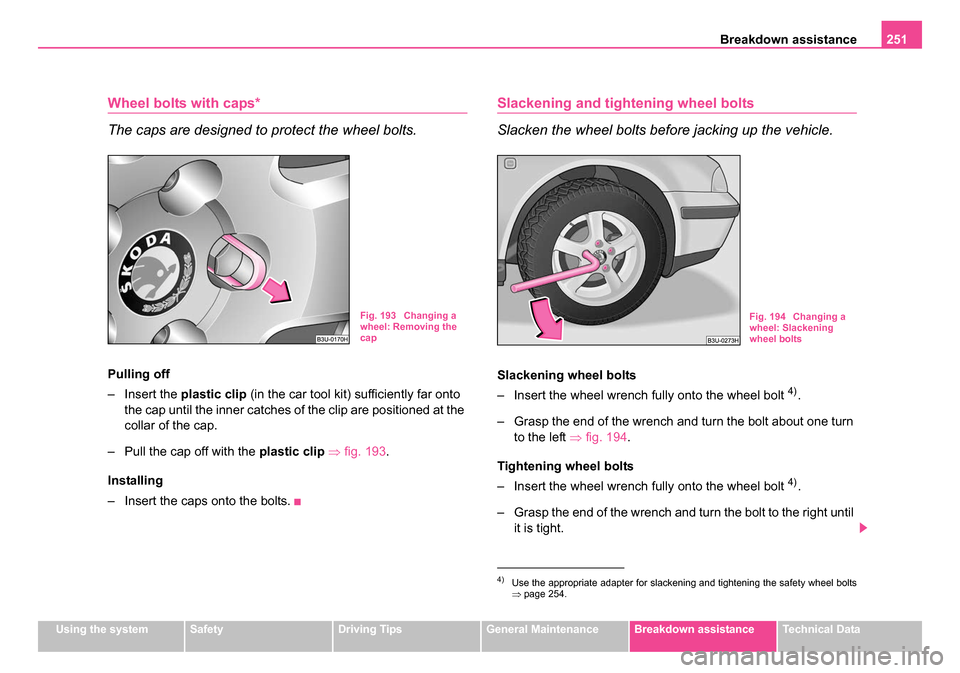
Wheel bolts with caps*
The caps are designed to protect the wheel bolts.
Pulling off
– Insert the plastic clip (in the car tool kit) sufficiently far onto
the cap until the inner catches of the clip are positioned at the
collar of the cap.
– Pull the cap off with the plastic clip ⇒ fig. 193 .
Installing
– Insert the caps onto the bolts.
Slackening and tightening wheel bolts
Slacken the wheel bolts before jacking up the vehicle.
Slackening wheel bolts
– Insert the wheel wrench fully onto the wheel bolt
4).
– Grasp the end of the wrench and turn the bolt about one turn to the left ⇒fig. 194.
Tightening wheel bolts
– Insert the wheel wrench fully onto the wheel bolt
4).
– Grasp the end of the wrench and turn the bolt to the right until it is tight.
Fig. 193 Changing a
wheel: Removing the
cap
4)Use the appropriate adapter for slackening and tightening the safety wheel bolts
⇒page 254.
Fig. 194 Changing a
wheel: Slackening
wheel bolts
NKO B5 20.book Page 251 Monday, July 3, 2006 2:09 PM
Page 253 of 281

Breakdown assistance
252
WARNING
Slacken the wheel bolts only a little (about one turn) as long as the
vehicle has not yet been jacked up - risk of an accident!.
Note
•Do not use the hexagon socket in the handle of the screwdriver for
slackening or tightening the wheel bolts.
•apply pressure carefully with your foot to the end of the wheel wrench
if it proves difficult to slacken the wheel bolts. Hold tight on the vehicle
when doing this and ensure that you have a steady position.
Raise vehicle
You have to raise the vehicle with a lifting jack in order to
be able to take off the wheel.
– Position the lifting jack by selecting the jacking point - lower sill - which is closest to the wheel to be removed ⇒ fig. 195.
– Position the lifting jack below the jacking point and move it up until its claw is positioned directly below the vertical web of the
lower sill.
– Align the lifting jack so that its claw grasps the web of the lower sill and the moving base plate of the jack is resting flat
against firm ground.
– Turn the lifting jack up further until the wheel is just clear of the ground.
Ground below the lifting jack which is soft and slippery can cause the
vehicle to slip off the jack. It is therefore always necessary to place the
lifting jack on a solid surface. Use a wide, stable base, if necessary. Use
a non-slip base (e.g. a rubber foot mat) if the surface is smooth, such as
cobbled stones, a tiled floor, etc.
WARNING
•Always raise the vehicle with the doors closed - risk of injury.
•Take suitable measures to prevent the base of the lifting jack
from slipping off - risk of injury!
•Place the lifting jack only on a solid and even surface.
•Not positioning the lifting jack at the specified points can result
in damage to the vehicle. The jack can also slip off if it does not
have sufficient grip - risk of injury!
•Never start the engine if the vehicle is lifted - risk of accident.
•Never lie under the vehicle if the vehicle is only lifted with the
vehicle lifting jack.Fig. 195 Changing a
wheel: Points for posi-
tioning car jack
AAAB
NKO B5 20.book Page 252 Monday, July 3, 2006 2:09 PM
Page 254 of 281

Breakdown assistance253
Using the systemSafetyDriving TipsGeneral MaintenanceBreakdown assistanceTechnical Data
•It is important to support the vehicle with suitable supporting
blocks if you wish to work under the lifted vehicle - risk of injury!
Taking off and fitting on wheel
After you have slackened the wheel bolts and have raised the car
with the car jack, replace the wheel as follows:
Changing a wheel
– Turn the wheel bolt which is farthest to the top fully out with
the hexagon socket in the screwdriver handle (car tool kit)
and place the bolt down on a clean surface ⇒fig. 196 .
– Screw the assembly pin (car tool kit) into the vacant hole ⇒fig. 197.
– Unscrew the remaining wheel bolts as described above.
– Take off the wheel.
Fitting on wheel
– Push the spare wheel over the assembly pin.
WARNING (continued)
Fig. 196 Changing a
wheel: Remove bolts
with hexagon in screw-
driver
Fig. 197 Changing a
wheel: assembly pin
NKO B5 20.book Page 253 Monday, July 3, 2006 2:09 PM