2006 SKODA SUPERB towing
[x] Cancel search: towingPage 204 of 281

Towing a trailer203
Using the systemSafetyDriving TipsGeneral MaintenanceBreakdown assistanceTechnical Data
WARNING
Do not use any aids or tools for installing or removing the ball head.
This might result in damage to the locking mechanism to the extent
that the safety of the towing device is no longer assured - risk of an
accident.
Note
•Do not carry out any modifications or repairs to the ball head or to any
other components on the towing device.
•Contact a specialist garage if you encounter any problems using the
device.
•Never unlock the ball head with a trailer coupled to it.
•You should take off the ball head if you drive without towing a trailer.
Inspect whether the end cover properly seals off the mounting shaft.
•Remove the ball head beforehand if you wish to clean your vehicle
using a steam jet. Ensure that the end cover properly seals the mounting
shaft.
•It is recommended to wear gloves when installing and removing.
NKO B5 20.book Page 203 Monday, July 3, 2006 2:09 PM
Page 205 of 281

Towing a trailer
204
NKO B5 20.book Page 204 Monday, July 3, 2006 2:09 PM
Page 223 of 281

Inspecting and Replenishing
222
Note
•Before a long drive we recommend that you purchase and carry with
you engine oil which complies with the specification for your vehicle.
Consequently, you will always have the correct engine oil for refilling.
•We recommend using a preservative from the Škoda original accesso-
ries offered by your Škoda dealer.
•For further information - see Service shedule.
Check engine oil level
The dipstick indicates the level of oil in the engine.
Checking the oil level
– Park the vehicle on a horizontal surface.
– Switch the engine off. – Open the bonnet
⇒ in “Working in the engine compart-
ment” on page 219.
– Wait a few minutes and pull out the oil dipstick.
– Wipe off the dipstick with a clean cloth and insert it again fully.
– After this, once again withdraw the dipstick and read off the oil level ⇒fig. 175 .
Oil level within range
– You must not top up the oil.
Oil level within range
–You may top up the oil. It is possible that the oil level may then
be within range after doing this.
Oil level within range
–You must top up the oil ⇒page 223. It is sufficient, once this
is done, to keep the oil level is within range .
It is normal for the engine to consume oil. The oil consumption may be as
much as 0.5 l/1 000 km depending on your style of driving and the condi-
tions under which you operate your vehicle. The oil consumption may be
slightly higher than this during the first 5 000 kilometres.
One should therefore check the oil level at regular intervals, preferably
every time after the fuel tank is filled or after driving for long stretches.
We recommend maintaining the oil level within the range if the engine
has been operating at high loads, for example during a lengthy motorway
trip during the summer months, towing a trailer or negotiating a high
mountain pass, but not above this .
Fig. 175 Dipstick
Aa
Ab
Aa
Ac
Ab
Aa
NKO B5 20.book Page 222 Monday, July 3, 2006 2:09 PM
Page 246 of 281

Breakdown assistance245
Using the systemSafetyDriving TipsGeneral MaintenanceBreakdown assistanceTechnical Data
Breakdown assistance
Breakdown assistance
First-aid box*
First-aid box
The compartment for stowing the first-aid box is located in the left of the
luggage compartment ⇒fig. 187 .
Note
Pay attention to the use-by-date of the contents of the first-aid box.
Warning triangle
– To remove the warning triangle, turn the rotary lock in direction
of arrow ⇒fig. 188 and fold the fixture down.
Fig. 187 Compartment
for stowing first-aid
boxFig. 188 Warning
triangle fitted inside
boot lid
NKO B5 20.book Page 245 Monday, July 3, 2006 2:09 PM
Page 247 of 281

Breakdown assistance
246
Fire extinguisher*
The fire extinguisher is located in the sheath below the driver's seat
⇒ fig. 189 (the installation position of the fire extinguisher differs on vehi-
cles fitted with electrically adjustable seats).
Please read carefully the instructions which are attached to the fire
extinguisher.
The fire extinguisher must be checked by an authorised person or
company annually (please observe the differing legal requirements).
WARNING
If the fire extinguisher is not correctly attached, in case of sudden
manoeuvres or an accident it can be “thrown” through the interior
compartment and cause injuries.
Note
•The fire extinguisher must comply with the relevant and valid legal
requirements.
•Pay attention to the expiration date of the fire extinguisher. If the fire
extinguisher is used after the expiration date, its proper function is no
longer assured.
•The fire extinguisher is only supplied in certain countries within the
scope of delivery.
Vehicle tool kit
The car tool kit and the car jack are stowed in the left of the luggage
compartment ⇒ fig. 190 below the floor covering.
The vehicle tool kit contains the following parts (depending on equipment
fitted):
Fig. 189 Front seat:
Fire extinguisher
Fig. 190 Luggage
compartment:
Compartment for
stowing the tool kit
NKO B5 20.book Page 246 Monday, July 3, 2006 2:09 PM
Page 258 of 281

Breakdown assistance257
Using the systemSafetyDriving TipsGeneral MaintenanceBreakdown assistanceTechnical Data
out the battery being ignited by the strong spark which results from
the engine being started.
•Do not affix the cable end to parts of the fuel and brake
system.
•Run the jump-start cables so that they cannot be caught by any
rotating parts in the engine compartment.
•Do not bend over the batteries - risk of caustic burns!
•The vent screws of the battery cells must be tightened firmly.
•Keep any sources of ignition (naked flame, smouldering ciga-
rettes etc.) away from the battery - risk of an explosion!
Tow-starting and towing vehicle
General
Please pay attention to the following instructions if you are going
to use a tow rope:
Driver of the towing vehicle
– Do not drive off until the tow rope is taught.
– Release the clutch particularly gently when starting off or depress the accelerator particularly gently if your vehicle is
fitted with an automatic gearbox. Driver of the towed vehicle
– Switch the ignition on so that the steering wheel is not blocked
and you can also operate the turn signal lights, the headlight
flasher, the windscreen wipers and windscreen washer
system.
– Take the vehicle out of gear or move the selector lever into position N if your vehicle is fitted with an automatic gearbox.
– Note that the brake servo unit and power steering only operate if the engine is running. You will require significantly greater
physical force to depress the brake pedal and to steer the
vehicle if the engine is not running.
– Ensure that the tow rope is always kept taught.
Tow rope or tow bar
A tow bar is safest way of towing a vehicle and also minimizes any
shocks. You can use a tow rope only if a suitable tow bar is not available.
The tow rope must be elastic to protect the vehicle. Thus one should only
use plastic fibre rope or a rope made out of a similarly elastic material.
Attach the tow rope or the tow bar only to the towing eyes provided for
this purpose ⇒page 258, “Front towing eye” and ⇒page 258, “Rear
towing eye”.
Driving style
Towing another vehicle requires a certain amount of practice. Both drivers
should be familiar with the particular points about towing a vehicle.
Unskilled drivers should not attempt to tow in another vehicle or to be
towed in.
One should be constantly vigilant not to allow impermissibly high towing
forces or jerky loadings. There is always a risk of excessive stresses and
WARNING (continued)
A4
NKO B5 20.book Page 257 Monday, July 3, 2006 2:09 PM
Page 259 of 281
Breakdown assistance
258
damage resulting at the points to which you attach the tow rope or tow bar
when you attempt to tow a vehicle which is not standing on a paved road.
Caution
If the gearbox of your vehicle no longer contains any oil because of a
defect, your vehicle must only be towed in with the driven wheels raised
clear of the ground, or on a special vehicle transporter or trailer.
Note
•Please comply with any legal requirements particularly regarding the
switched on signal systems, when towing in or tow-starting another
vehicle.
•The tow rope must not be twisted as it may in certain circumstances
result in the front towing eye being unscrewed out of your vehicle.
Front towing eye
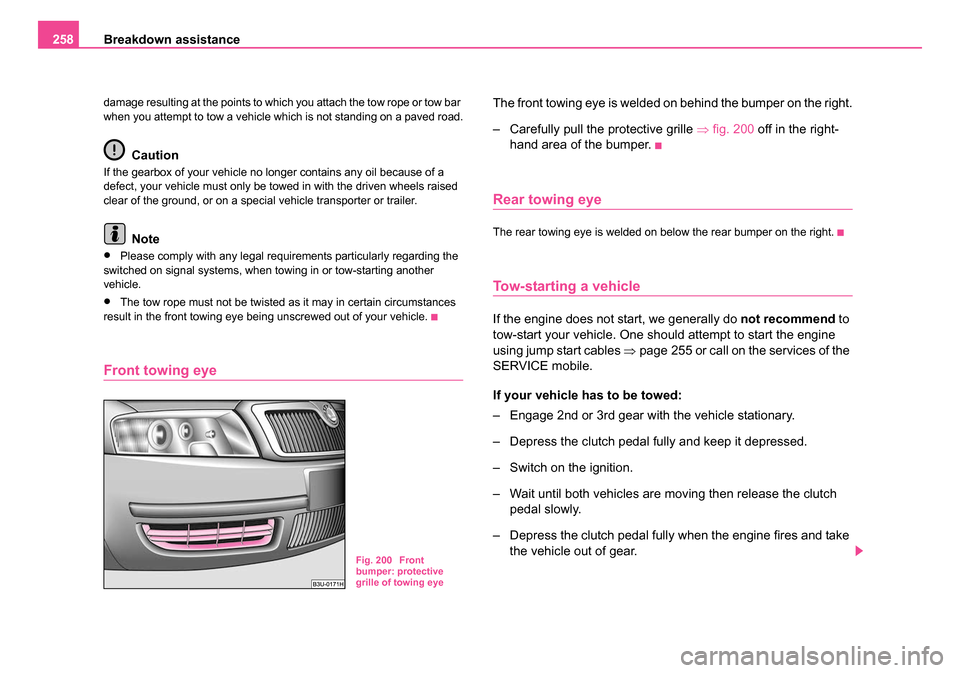
The front towing eye is welded on behind the bumper on the right.
– Carefully pull the protective grille ⇒fig. 200 off in the right-
hand area of the bumper.
Rear towing eye
The rear towing eye is welded on below the rear bumper on the right.
Tow-starting a vehicle
If the engine does not start, we generally do not recommend to
tow-start your vehicle. One should attempt to start the engine
using jump start cables ⇒page 255 or call on the services of the
SERVICE mobile.
If your vehicle has to be towed:
– Engage 2nd or 3rd gear with the vehicle stationary.
– Depress the clutch pedal fully and keep it depressed.
– Switch on the ignition.
– Wait until both vehicles are moving then release the clutch pedal slowly.
– Depress the clutch pedal fully when the engine fires and take the vehicle out of gear.
Fig. 200 Front
bumper: protective
grille of towing eye
NKO B5 20.book Page 258 Monday, July 3, 2006 2:09 PM
Page 260 of 281

Breakdown assistance259
Using the systemSafetyDriving TipsGeneral MaintenanceBreakdown assistanceTechnical Data
For technical reasons it is not possible to tow-start a car fitted with an
automatic gearbox
.
WARNING
There is high risk of having an accident when tow-starting a
vehicle, when for example the towed vehicle runs into the towing
vehicle.
Caution
Vehicles which are fitted with a catalytic converter should not be tow-
started over a distance of more than 50 metres. Unburnt fuel may get into
the catalytic converter and damage it.
Towing in a vehicle fitted with a manual gearbox
Please refer to the notes ⇒page 257.
The car can be towed in with a tow bar or a tow rope or with the front or
rear wheels raised. The maximum towing speed is 50 km/h.
Towing of a vehicle with an automatic gearbox
Please refer to the notes ⇒page 257.
The car can be towed in with a tow bar or a tow rope. Refer at the same
time to the following guidelines:
•Move selector lever into N .
•The maximum towing speed is 50 km/h.
•The maximum permissible towing distance is 50 km. The gear oil
pump does not operate when the engine is not running and the gear would
not be adequately lubricated at higher speeds and over longer towing
distance.
Caution
If the vehicle is towed in by a recovery vehicle, it should only be towed in
with the front wheels raised. If the vehicle is raised at rear, the automatic
gearbox is damaged!
Note
The vehicle must be transported on a special vehicle or trailer if it is not
possible to tow in the vehicle in the way described or if the towing distance
is greater than 50 km.
NKO B5 20.book Page 259 Monday, July 3, 2006 2:09 PM