2006 SKODA SUPERB child lock
[x] Cancel search: child lockPage 126 of 281
Starting-off and Driving125
Using the systemSafetyDriving TipsGeneral MaintenanceBreakdown assistanceTechnical Data
The reversing lights will come on once reverse gear is engaged, provided
the ignition is on.
WARNING
Never engage the reverse gear when driving - risk of accident!
Note
•One should not lay the hand on the shift lever while driving the vehicle.
The pressure of the hand will be transferred to the gearshift forks in the
gearbox. This can, over a period of time, lead to early wear of the gearshift
forks.
•Depress the clutch pedal fully when changing gears, in order to avoid
unnecessary wear and damage.
Handbrake
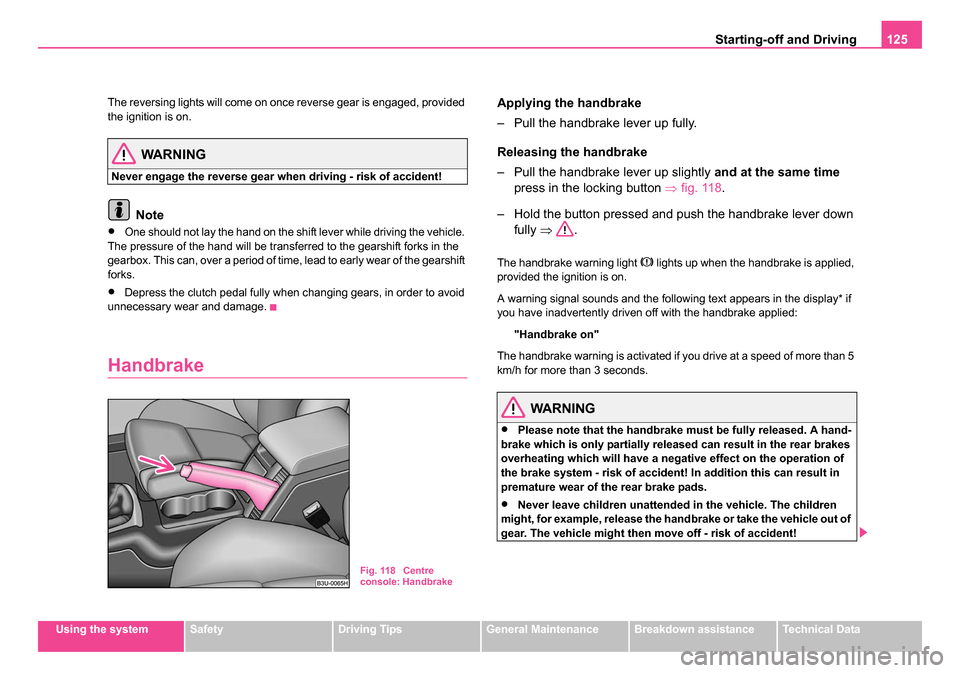
Applying the handbrake
– Pull the handbrake lever up fully.
Releasing the handbrake
– Pull the handbrake lever up slightly and at the same time
press in the locking button ⇒fig. 118 .
– Hold the button pressed and push the handbrake lever down fully ⇒ .
The handbrake warning light lights up when the handbrake is applied,
provided the ignition is on.
A warning signal sounds and the following text appears in the display* if
you have inadvertently driven off with the handbrake applied:
"Handbrake on"
The handbrake warning is activated if you drive at a speed of more than 5
km/h for more than 3 seconds.
WARNING
•Please note that the handbrake must be fully released. A hand-
brake which is only partially released can result in the rear brakes
overheating which will have a nega tive effect on the operation of
the brake system - risk of accident! In addition this can result in
premature wear of the rear brake pads.
•Never leave children unattended in the vehicle. The children
might, for example, release the handbrake or take the vehicle out of
gear. The vehicle might then move off - risk of accident!
Fig. 118 Centre
console: Handbrake
NKO B5 20.book Page 125 Monday, July 3, 2006 2:09 PM
Page 158 of 281

Seat belts157
Using the systemSafetyDriving TipsGeneral MaintenanceBreakdown assistanceTechnical Data
Important safety information regarding
the use of seat belts
The correct use of the seat belts considerably reduces the
risk of injury!
WARNING
•The belt webbing must not be jammed in-between at any point
or twisted, or chafe against any sharp edges.
•It is important that the belt webb ing is properly routed if the seat
belts are to offer their maximum protection ⇒page 158, “How are
seat belts correctly fastened?”.
•No two persons (also not children) should ever use a single seat
belt together.
•The maximum protection which seat belts can offer is only
achieved if you are correctly seated ⇒page 151, “Correct seated
position”.
•The belt webbing must not run across solid or fragile objects
(e.g. spectacles, ball-point pens, keys etc.) as this may be a cause
of injuries.
•Bulky, loose clothing (e.g. a winter coat over a jacket) does not
allow you to be correctly seated and impairs proper operation of
the seat belts.
•It is prohibited to use clamps or other objects to adjust seat
belts (e.g. for shortening the belts for smaller persons).
•The lock tongue should only be inserted into the lock which is
the correct one for your seat. Wrong use of the safety belt will
reduce its capacity to protect and the risk of injury increases.
•The backrests of the front seats must not be tilted too far to the
rear otherwise the seatbelts can lose their effectiveness.
•The belt webbing must always be kept clean. Soiled belt
webbing may impair proper operation of the inertia reel
⇒ page 213, “Seat belts”.
•The slot of the belt tongue must not be blocked by paper or
similar objects otherwise the belt tongue will not lock in place prop-
erly.
•Inspect the seat belts regularly to ensure they are in good condi-
tion. If you find seat belts which have damage to the seat belt
webbing, seat belt connections, to the inertia reels or to the lock,
the relevant safety belt must be replaced by a specialist garage.
•The seat belts must not be removed or changed in any way. Do
not make an attempt to repair the seat belts yourself.
•Damaged seat belts which have been subjected to stress in an
accident and were therefore stretched, must be replaced - this is
best done by a specialist garage. The anchorage points of the belts
must also be inspected. The anchorage points for the belts should
also be checked.
•In certain countries it is possible to use seat belts which differ
in terms of their operation from the seat belts which are described
on the pages which follow.
WARNING (continued)
NKO B5 20.book Page 157 Monday, July 3, 2006 2:09 PM
Page 161 of 281

Seat belts
160
– Press the red button in the belt lock ⇒fig. 144. The spring
force causes the tongue of the lock to jump out.
– Guide the belt back with your hand to enable the inertia reel to wind up the belt webbing more easily.
A plastic knob in the belt webbing holds the belt tongue in a position which
is easy to get hold of.
Three-point safety belt for the middle rear seat
Your car is equipped as standard with the three-point seat belt in the
middle rear seat. It is used in the same way as the three-point seat belts
on the left and right (at front and rear). The three-point seat belt for the rear
middle seat must be put on first to allow the pelvic part of the belt to run
between the belt lock for the right three-point seat belt and the backrest,
while avoiding crossing the belt webbing of the right and middle seat belts.
WARNING
The three-point safety belt for the rear middle seat can only fulfil its
function reliably when the backrests are correctly locked into posi-
tion ⇒page 85.
Blocking seat belts
The three-point seat belts for the front passenger and for the rear seats
can be blocked for attaching a child safety seat ⇒page 181, “Attaching
child safety seat”. Blocking the belt in this way ensures that the child seat
is held firmly in position in the car.
WARNING
Never attach a child safety seat on the front passenger seat if the
child is seated with its back facing in direction of travel when the
front passenger airbag is still activated ⇒page 176, “Use of child
safety seats on the front passenger seat”. Risk of severe or even
fatal injuries!
Belt tensioners
Safety for the driver and passengers wearing their seat belts, is
enhanced by the belt tensioners fitted to the inertia reels of the front and
rear side three-point seat belts, in addition to the protection afforded by the
airbag system.
The fastened three-point seat belts are automatically tensioned in the
event of a frontal collision of a certain severity. The rear outside belt
tensioners are also deployed if the seat belt is not fastened.
The belt tensioner is deployed in the event of a frontal collision of major
severity. A powder charge is ignited in the inertia reels during deployment.
The belt webbing is pulled into the inertia reels by a mechanical system
and the belt is tensioned.
Belt tensioners are not activated in the event of minor frontal collisions,
side and rear-end collisions, in the case of a rollover and also not in acci-
dents in which no major forces are produced from the front.
WARNING
•The service life of seat belts and belt tensioners is 15 years from
the date of manufacture of the vehicle. It is then necessary to have
the seat belts replaced by a specialist garage.
NKO B5 20.book Page 160 Monday, July 3, 2006 2:09 PM
Page 182 of 281

Transporting children safely 181
Using the systemSafetyDriving TipsGeneral MaintenanceBreakdown assistanceTechnical Data
•Please comply with any differin g national legal regulations
regarding the use of child safety seats.
Child safety seats in Group 3
For children of about 7 years of age weighing between 22 and 36 kg and
of a height of less than 150 cm, the optimal solution is a child safety seat
(seat bolster) in combination with the three-point seat belt ⇒fig. 161 .
Children of more than 150 cm in height may use the seat belts fitted to the
vehicle without a seat bolster.
WARNING
•When transporting a child on the front passenger seat, please
comply with the appropriate nation al regulations regarding the use of child safety seats. Switch off the front passenger airbag if
necessary at a specialist garage or switch it off with the switch for
front passenger airbag*
⇒page 172.
•The shoulder part of the seat belt must run approximately
across the middle of the shoulder and fit snugly against the chest.
It must on no account run across the neck. The lap part of the seat
belt must run across the pelvis and fits snugly; it must not run over
the belly. Tighten the belt webbing over your hip if necessary.
•Please comply with any differ ing national legal regulations
regarding the use of child safety seats.
Attaching child safety seat
Child seat protection
You can block the three-point seat belt in order to attach a
child safety seat.
You can permanently block the three-point seat belt in order to
attach a child safety seat. Blocking the belt in this way ensures
that the child seat is held firmly in position in the car.
Activating child seat protection
– Attach the child safety seat with the three-point seat belt as stated in the instructions of the manufacturer of the child seat.
– Now, pull the shoulder part of the belt out fully.
WARNING (continued)
Fig. 161 Child seat in
Group 3 installed on
the rear seat facing the
direction of travel
WARNING (continued)
NKO B5 20.book Page 181 Monday, July 3, 2006 2:09 PM
Page 183 of 281

Transporting children safely
182
– Insert the tongue of the lock into the seat belt buckle belonging to the seat until it is heard to lock in place.
– Reel up the belt webbing until it is fitted snugly against the child seat. When the belt is reeled up, this can be detected by
a “clicking” noise.
– Pull on the belt in order to check that it is no longer possible to pull out the webbing. The child seat protection is now switched
on.
Deactivating child seat protection
– Press the red button on the seat belt buckle. The tongue of the lock jumps out of the buckle as a result of the spring force
when this is done.
– Guide the belt back with your hand to enable the inertia reel to wind up the belt webbing more easily. The child safety lock is
deactivated after the full reeling up of the belt.
WARNING
It is essential to always switch off ⇒page 171 the airbag (airbags)
when attaching a child safety seat on the front passenger seat
where the child is seated with its back facing in direction of travel
(in some countries also when the child is facing the direction of
travel). If this is not done, there is a risk of the child suffering severe
or even fatal injuries if the front passenger airbag is deployed. In
certain countries national legal provisions also require that the
side and head airbags be deactivated. When transporting a child on
the front passenger seat, please comply with the appropriate
national regulations regarding the use of child safety seats.
Attaching a child seat using the “ISOFIX” system
There are two fixing eyes between the backrest and the seat itself
on both of the outer rear seats for fixing the “ISOFIX” system child
seat in place.
Fig. 162 Locking eyes
(ISOFIX system)
Fig. 163 The ISOFIX
child seat is pushed
into the mounting
funnels
NKO B5 20.book Page 182 Monday, July 3, 2006 2:09 PM
Page 184 of 281

Transporting children safely 183
Using the systemSafetyDriving TipsGeneral MaintenanceBreakdown assistanceTechnical Data
– Insert the mounting funnels onto the locking eyes
between the backrest and seat cushion ⇒page 182, fig. 162 .
– Push the notched arms of the child seat over the mounting funnels into the locking eyes, until it is heard to lock
⇒page 182, fig. 163 .
– Pull on both sid es of the child seat!
One can mount a child safety seat using the “ISOFIX” system quickly,
easily and reliably. Please pay close attention to instructions from the
manufacturer of the child safety seat when installing and removing the
seat.
Child seats fitted with the “ISOFIX” clamping system can only be mounted
and fixed in a vehicle fitted with an “ISOFIX system” when these child
seats have been released for your type of vehicle according to the ECE-
R 44 standard.
You can obtain child seats with the “ISOFIX” attachment system from
Škoda Service Partners who will also installed it as well.
Complete installation instructions are enclosed with the child safety seat.
WARNING
•The locking eyes have just be en developed for child safety
seats which use the “ISOFIX” system. You should therefore never
attach other child safety seats, seat belts or objects to the locking
eyes - hazard!
•Ask a Škoda Service Partner whether a child seat which you
bought for another vehicle is recommended for use in a Škoda
before using an “ISOFIX” system.
•Certain child seats which use the “ISOFIX” system can be
attached with standard three-point seat belts. Please pay close attention to instructions from the manufacturer of the child safety
seat when installing and removing the seat.
Note
Child seats which use the “ISOFIX” system are currently available for chil-
dren weighing from 9 up to 18 kg. This corresponds to an age range of
from approx. 9 months to 4 years.
AAABWARNING (continued)
NKO B5 20.book Page 183 Monday, July 3, 2006 2:09 PM
Page 220 of 281

Inspecting and Replenishing219
Using the systemSafetyDriving TipsGeneral MaintenanceBreakdown assistanceTechnical Data
– Allow the bonnet to drop from a height of about 30 cm into the
lock - bonnet do not press down on it!
The bonnet is held in the opened position by a pressurized gas spring.
WARNING
•Never open the bonnet if you see that steam or coolant is
flowing out of the engine compartmen t - risk of scalding! Wait long
enough until the steam or coolant has stopped escaping.
•For safety reasons, the bonnet must always be properly closed
when driving. One should therefore check that the lock has in fact
engaged properly after closing the bonnet.
•Stop your vehicle immediately while driving if you notice that
the lock is not properly engaged and close the bonnet properly -
risk of an accident!
Caution
•Never open the bonnet using the handle - danger of causing damage.
•Before opening the bonnet, ensure that the arms of the windscreen
wipers are correctly in place against the windscreen. Otherwise, there is
a risk of damage to the paintwork.
Working in the en gine compartment
Particular care is required when carrying out any work in
the engine compartment!
There is a risk of injuries, scalding , accidents and fire when working
in the engine compartment, e.g. inspecting and replenishing oil and
other fluids. For this reason, it is essential to comply with the warning instructions stated below and with the general applicable
rules of safety. The engine compartment of your car is a hazardous
area
⇒ .
WARNING
•Never open the bonnet if you see that steam or coolant is
flowing out of the engine compartment - risk of scalding! Wait long
enough until the steam or coolant has stopped escaping.
•Switch off the engine and pull out the ignition key.
•Apply the handbrake firmly.
•If your vehicle is fitted with a manual gearbox, move the gear-
shift lever into Neutral, or if it is fitted with automatic gearbox, move
the selector lever into position P.
•Allow the engine to cool down.
•Keep children clear of the engine compartment.
•Do not touch any hot engine parts - risk of burns!
•Never spill oil and other fluids over the hot engine. Such fluids
(e.g. the antifreeze contained in the coolant) may ignite!
•Avoid short circuits in the electrical system - particularly on the
battery.
•Never place your hand into the radiator fan as long as the
engine is still warm. The fan might suddenly start running!
•Never open the cap of the coolant expansion bottle as long as
the engine is still warm. The cooling system is pressurized!
•Cover over the cap of the coolant expansion reservoir with a
large cloth when opening it as protection for your face, hands and
arms from hot steam or hot coolant.
•Do not let objects, such as e.g cleaning cloth or tools lie in the
engine compartment.
NKO B5 20.book Page 219 Monday, July 3, 2006 2:09 PM
Page 227 of 281

Inspecting and Replenishing
226
Replenishing the coolant
– Switch the engine off.
– Allow the engine to cool down.
– Place a cloth over the cap of the coolant expansion reservoir
⇒page 225, fig. 176 and unscrew the cap carefully by
turning it to the left ⇒.
– Top up the coolant.
– Screw the cap tight until it is heard to lock.
The coolant which you use for replenishing the system, must comply with
one specific specification ⇒page 224, “Coolant”. Do not use an alterna-
tive additive if the coolant additive G12 PLUS is not available in excep-
tional cases. Just top up the system with water and as soon as possible
arrange adjustment to correct the mixing ratio of water and coolant addi-
tive again by a specialist garage.
Only use fresh coolant for topping up the system.
Do not fill up over the “MAX” marking! Excess coolant which is heated up
is forced out of the cooling system through the pressure relief valve in the
cap of the coolant compensation bottle.
Wait until the engine has cooled down for a system which has suffered a
major loss of coolant before pouring in coolant. This is necessary to avoid
engine damage.
WARNING
•The cooling system is pressurized! Do not open the cap of the
coolant expansion bottle if the engine is still hot - risk of scalding!
•The coolant additive and thus all of the coolant is harmful to
your health. Avoid contact with the coolant. Coolant vapours are
also harmful to the health. It is important, therefore, to always
safely store any coolant additive in its original container out of the
reach of children - risk of poisoning!
•If any splashes of coolant get into your eyes, rinse out your eyes
immediately with clear water and contact a doctor as soon as
possible.
•You should also consult a doctor without delay if you have inad-
vertently swallowed coolant.
Caution
Do not continue your journey if for some reason it is not possible
under the conditions prevailing to top up with coolant. Switch the
engine off and obtain professional assistance from a specialist garage,
otherwise it could lead to severe engine damage.
For the sake of the environment
Do not re-use coolant if it is necessary to drain the coolant in the system.
It should be collected and disposed of in compliance with environmental
protection regulations.
Radiator fan
The radiator fan may switch on suddenly.
The radiator fan is driven by an electric motor and controlled by a thermo-
stat according to the coolant temperature.
WARNING (continued)
NKO B5 20.book Page 226 Monday, July 3, 2006 2:09 PM