2006 SKODA FABIA warning lights
[x] Cancel search: warning lightsPage 36 of 258

Instruments and Indicator/Warning Lights35
Using the systemSafetyDriving TipsGeneral MaintenanceBreakdown assistanceTechnical Data
The following text will be displayed in the information display*:
STOP BRAKE FLUID SERVICE MANUAL
If there is a fault in the ABS which also influences the function of the normal brake system (e.g. distribution of br ake pressure), the ABS warning light comes on together with the brake system warning light . Be aware that not only the ABS but also another part of th brake system is defective ⇒.
3 peeps sound as an additional warning signal.
One should get used to high pedal forces, long braking distances and long free play of the brake pedal when drivin g to the next specialist garage.
The following text will be displayed in the information display*:
STOP BRAKE FAULT OWNER'S MANUAL!
For further information on the brake system ⇒page 168, “Brakes”.
Handbrake applied
The warning light also comes on if the handbrake is applied. An audible warning is also given if you drive the vehicle for at least 3 seconds at a speed of more than 6 km/h.
The following text will be displayed in the information display*:
HANDBRAKE ON
WARNING
•Pay attention to the following instructions ⇒page 198, “Working in the engine compartment” before ch ecking the brake fluid level and opening the bonnet.
•If the brake system warning light does not go out a few seconds after switching on the ignition or comes on when driving, stop immedi- ately and check the brake fluid in the reservoir ⇒page 206, “Brake fluid”. If the fluid level has dropped below the MIN marking, do not drive any
further - risk of accident! Contact a Škoda dealer to obtain professional assistance.
Airbag system
Monitoring the airbag system
The warning light comes on for a few seconds when the ignition is switched on.
There is a fault in the system if the warning light does not go out or comes on or flashes while driving ⇒. This also applies if the warning light does not come on after the ignition is switched on.
The following text will be displayed in the information display*:
AIRBAG FAULT
The functionality of the airbag system is also monitored electronically, when one airbag has been switched off
The passenger front airbag and also possibly the passenger side airbag which have been switched off us ing the vehicle system tester:
•The warning light lights up for 3 seconds after switching on the ignition and then flashes for 12 seconds afterwards in 2 second intervals.
The passenger front airbag and also possibly the passenger side airbag which have been switched off using the switch (for switching off airbags)* in the end face of the dash panel on the front passenger side:
•The warning light comes on for 3 seconds after the ignition has been switched on.
•Switching off airbags is indicated in the middle of the dash panel by the lighting up of the indicator light (airbag switched off) ⇒ page 153.
WARNING (continued)
NKO A05Fabia 20.book Page 35 Tuesday, September 26, 2006 8:38 AM
Page 37 of 258

Instruments and Indicator/Warning Lights36
WARNING
Have the airbag system checked immediately by a specialist garage if a fault exists. Otherwise, there is a risk of the airbag not being activated in the event of an accident.
Note
Further information about switching off airbags ⇒page 152, “Deactivating an airbag”.
Diesel particle filter* (diesel engine)
In the diesel particle filter the resulting soot particles are
collected and burnt during the combustion of diesel fuel.
Code 7GG on the vehicle data sticker ⇒fig. 16 indicates that your
vehicle is equipped with a diesel particle filter. The vehicle data sticker
⇒ page 247, fig. 182 is located on the floor of the luggage compart-
ment and is also stated in the Service schedule.
The soot particles, which result from the combustion of diesel fuel, are collected in the diesel particle filter. The diesel particle filter filters the soot particles completely from the exhaust. If th e filter is full, it is cleaned automati- cally in favourable conditions by burning the soot particle. To assist this proce- dure, we recommend not to drive regularl y over short distances. If the engine control unit detects that the operating co nditions for a cleaning (combustion of deposited soot particles) of the diesel particle fiter are not optimal, e.g. slow city driving, a warning light in the instrument cluster is illuminated .
In order to clean the diesel particle filter, the vehicle should be driven at an even speed of at least 60 km/h for 15 minutes when the traffic situation permits it. Always pay attention to the valid speed limi ts. The diesel particle filter is most effectively cleaned if the vehicle is driven in the 4th or 5th gear with an engine speed of approx. of 2 000 rpm. The soot ca n be burned in the filter due to this temperature increase.
As long as the warning light lights up, one must take into account an increased fuel consumption and in certain circumstances a power reduction of the engine.
In addition a message can be shown in th e display of the instrument cluster, which informs you or requests necessary actions.
Have the vehicle inspected without delay by your specialist garage.
WARNING
•If you do not pay attention to the warning lights coming on and the corresponding descriptions and warning notes, this increases the risk of an accident. This may result in bo dy injuries or major vehicle damage.
•Always adjust your speed to suit weather, road, region and traffic conditions. The route indicated by th e warning light must not tempt you to disregard the national regulations for road traffic.
Fig. 16 Vehicle data sticker
NKO A05Fabia 20.book Page 36 Tuesday, September 26, 2006 8:38 AM
Page 38 of 258

Instruments and Indicator/Warning Lights37
Using the systemSafetyDriving TipsGeneral MaintenanceBreakdown assistanceTechnical Data
•The diesel particle filter achieves very high temperatures. Therefore park the vehicle in such a way that the diesel particle filter does not come into contact with dry grass or other combustible materials - risk of fire!
•Use neither protective paint for chassis nor anti-corrosion agent, in order to treat the exhaust system, the heat shields or the diesel particle filter. The high temperatures ca n cause the coating to ignite!
Note
•When using diesel fuel with high sulphur content the life of the diesel particle filter is clearly reduced. A specia list garage will be able to tell you which countries use only diesel fuel with high sulphur content.
Seat belt warning light*
The warning light comes on after the ignition is switched on as a reminder to fasten the seat belt.
If the seat belts are not fastened when the speed of the car increases to more than 25km/h, the warning light flashes and an acoustic warning signal sounds for approx. 90 seconds.
The following text will be displayed in the information display*:
FASTEN SEAT BELT
For further information on the seat belts ⇒page 138, “Why seat belts?”.
WARNING (continued)
NKO A05Fabia 20.book Page 37 Tuesday, September 26, 2006 8:38 AM
Page 43 of 258

Unlocking and locking42
Indicator light in the driver's door on vehicles with anti-theft alarm system
After locking the vehicle the indicator light flashes for 2 seconds fast, then more slowly.
If the vehicle is locked and the safe securing system ⇒page 42 is not operating, the indicator light in the driver door flashes for about 2 seconds fast, goes out and starts to flash slowly after about 30 seconds.
If the indicator light first of all flashes fast for about 2 seconds, afterwards lights up for about 30 seconds and then flashes slowly, there is a fault in the system of the central locking or the interior monitor* ⇒page 49. Contact a specialist garage to obtain assistance.
Convenience operation of windows
One can open and close the electrically powered windows when unlocking and locking the vehicle ⇒page 52, “Window convenience operation”.
Opening a single door*
This function allows one to just unlock the driver's door. The other doors remain locked and are only unlocked when the command is repeated. The single door opening function can be first activate d by recoding the control unit of the central locking system. This work is und ertaken by a Škoda Service Partner can give you more information.
Automatic locking*
All the doors and the tailgate are locked automatically once the car reaches a speed of about 15 km/h.
If the ignition key is withdrawn, the ca r is then automatically unlocked again. In addition, it is possible for the driver to unlock the car by pressing the central locking button or by pulling the door opening lever.
If you wish, your Škoda Service Partner can convert the central locking system of your car to the automatic locking mode.
WARNING
•Locking the doors prevents involu ntary opening in an exceptional situation (an accident). Locked doors prevent unwanted entry into the vehicle from outside, for example at road crossings. Locked doors do, however, make it more difficult for rescuers to get into the vehicle in an emergency - danger to life!
Note
•In the event of an accident in which the airbags are deployed, the locked doors are automatically unlocked in order to enable rescuers to gain access to the vehicle.
•Only the front doors can be unlocked an d locked using the key if the central locking system fails. You can operate the rear door manually.
− Emergency locking of the door ⇒page 45.
Safe securing
The central locking system is equipped with a safe securing system. Locking the vehicle from the outside causes the d oor locks to be automatically blocked. The indicator light in the driver's door fl ashes. It is not possible to open the doors with the door handle either from th e inside or from the outside. This acts as an effective deterrent for atte mpts to break into your vehicle.
You can deactivate the safe securing syst em. This is done by locking the vehicle with the key or radio-operated key twice within 2 seconds.
The safe securing system is again activate d the next time the vehicle is unlocked and locked again.
The doors can be opened from the inside if the vehicle is locked and the safe securing system is deactivated:
NKO A05Fabia 20.book Page 42 Tuesday, September 26, 2006 8:38 AM
Page 44 of 258
Unlocking and locking43
Using the systemSafetyDriving TipsGeneral MaintenanceBreakdown assistanceTechnical Data
•The door is unlocked by actuating the door-opening lever.
•The door opens upon actuating the door-opening lever again.
WARNING
If the vehicle is locked from the outside and the safe securing system is activated, there must not be any person and animals in the vehicle as it is then not possible to open either a door or a window from the inside. The locked doors make it more difficult for rescuers to get into the vehicle in an emergency - hazard!
Unlocking the vehicle using the key
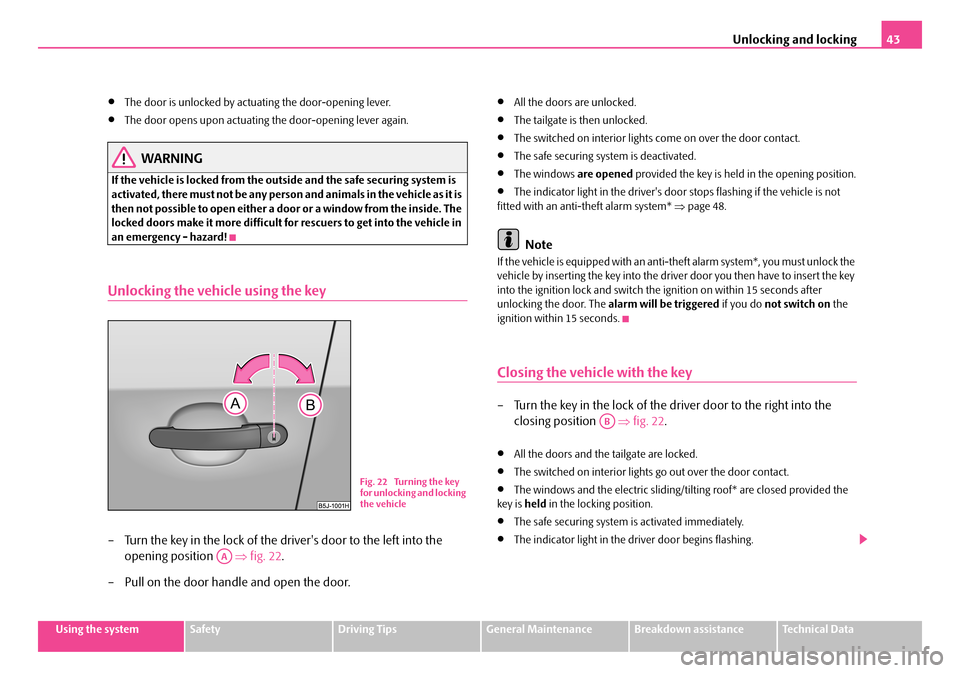
– Turn the key in the lock of the dr iver's door to the left into the
opening position ⇒fig. 22.
– Pull on the door handle and open the door.
•All the doors are unlocked.
•The tailgate is then unlocked.
•The switched on interior lights come on over the door contact.
•The safe securing system is deactivated.
•The windows are opened provided the key is held in the opening position.
•The indicator light in the driver's door stops flashing if the vehicle is not fitted with an anti-theft alarm system* ⇒page 48.
Note
If the vehicle is equipped with an anti-theft alarm system*, you must unlock the vehicle by inserting the key into the driver door you then have to insert the key into the ignition lock and switch th e ignition on within 15 seconds after unlocking the door. The alarm will be triggered if you do not switch on the ignition within 15 seconds.
Closing the vehicle with the key
– Turn the key in the lock of the dr iver door to the right into the
closing position ⇒fig. 22.
•All the doors and the tailgate are locked.
•The switched on interior lights go out over the door contact.
•The windows and the electric sliding/tilting roof* are closed provided the key is held in the locking position.
•The safe securing system is activated immediately.
•The indicator light in the driver door begins flashing.
Fig. 22 Turning the key for unlocking and locking the vehicle
AA
AB
NKO A05Fabia 20.book Page 43 Tuesday, September 26, 2006 8:38 AM
Page 45 of 258
Unlocking and locking44
Note
The opened driver door cannot be locked. It must be locked separately after closing it.
Button for the central locking system*
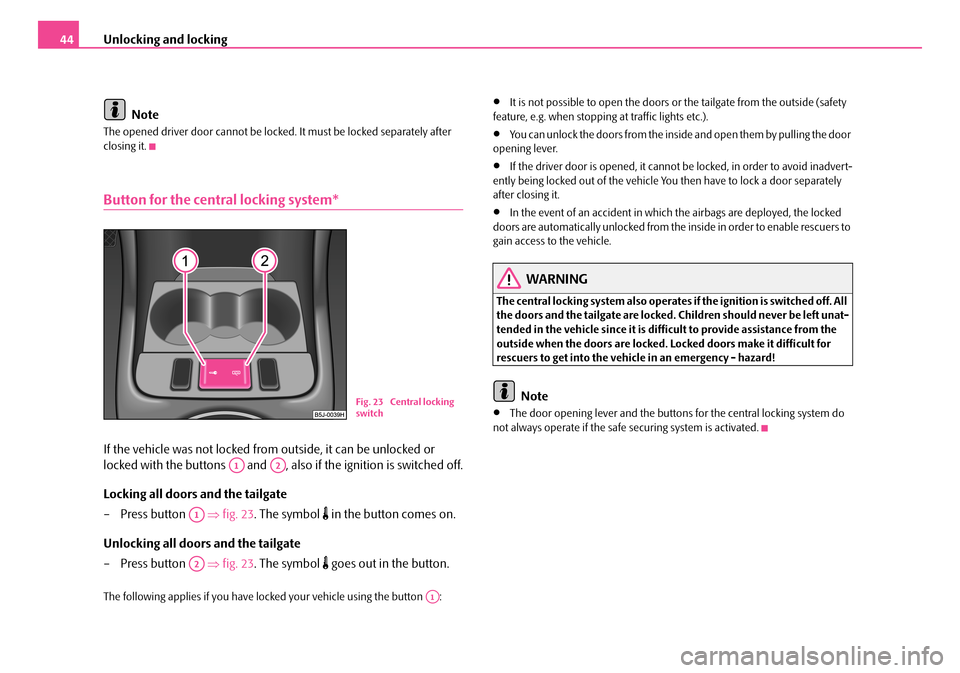
If the vehicle was not locked from outside, it can be unlocked or
locked with the buttons and , also if the ignition is switched off.
Locking all doors and the tailgate
– Press button ⇒fig. 23. The symbol in the button comes on.
Unlocking all doors and the tailgate
– Press button ⇒fig. 23. The symbol goes out in the button.
The following applies if you have locked your vehicle using the button :
•It is not possible to open the doors or the tailgate from the outside (safety feature, e.g. when stopping at traffic lights etc.).
•You can unlock the doors from the inside and open them by pulling the door opening lever.
•If the driver door is opened, it cannot be locked, in order to avoid inadvert-ently being locked out of the vehicle You then have to lock a door separately after closing it.
•In the event of an accident in which the airbags are deployed, the locked doors are automatically unlocked from the inside in order to enable rescuers to gain access to the vehicle.
WARNING
The central locking system also operates if the ignition is switched off. All the doors and the tailgate are locked. Children should never be left unat- tended in the vehicle since it is difficult to provide assistance from the outside when the doors are locked. Locked doors make it difficult for rescuers to get into the vehicle in an emergency - hazard!
Note
•The door opening lever and the buttons for the central locking system do not always operate if the safe securing system is activated.
Fig. 23 Central locking switch
A1A2
A1
A2
A1
NKO A05Fabia 20.book Page 44 Tuesday, September 26, 2006 8:38 AM
Page 49 of 258
Unlocking and locking48
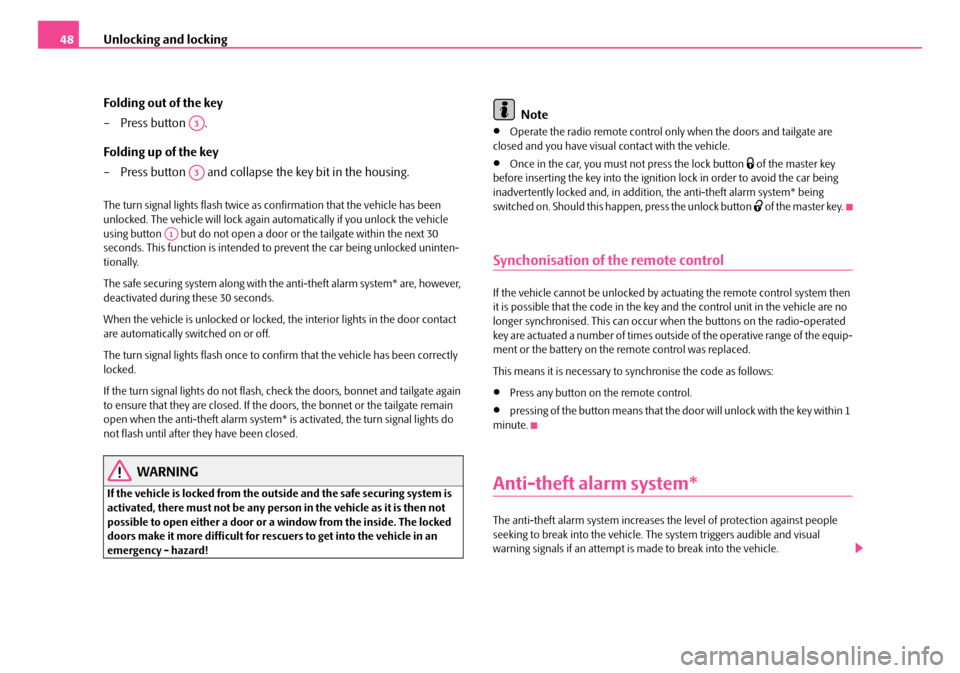
Folding out of the key
– Press button .
Folding up of the key
– Press button and collapse the key bit in the housing.
The turn signal lights flash twice as confirmation that the vehicle has been unlocked. The vehicle will lock again au tomatically if you unlock the vehicle using button but do not open a door or the tailgate within the next 30 seconds. This function is intended to prevent the car being unlocked uninten- tionally.
The safe securing system along with the anti-theft alarm system* are, however, deactivated during these 30 seconds.
When the vehicle is unlocked or locked, th e interior lights in the door contact are automatically switched on or off.
The turn signal lights flas h once to confirm that the vehicle has been correctly locked.
If the turn signal lights do not flash, check the doors, bonnet and tailgate again to ensure that they are closed. If the doors, the bonnet or the tailgate remain open when the anti-theft alarm system* is activated, the turn signal lights do not flash until after th ey have been closed.
WARNING
If the vehicle is locked from the outside and the safe securing system is activated, there must not be any person in the vehicle as it is then not possible to open either a door or a window from the inside. The locked doors make it more difficult for rescuers to get into the vehicle in an emergency - hazard!
Note
•Operate the radio remote control only when the doors and tailgate are closed and you have visual contact with the vehicle.
•Once in the car, you must not press the lock button of the master key before inserting the key into the ignition lock in order to avoid the car being inadvertently locked and, in addition , the anti-theft alarm system* being switched on. Should this happe n, press the unlock button of the master key.
Synchonisation of the remote control
If the vehicle cannot be unlocked by actuating the remote control system then it is possible that the code in the key and the control unit in the vehicle are no longer synchronised. This can occur when the buttons on the radio-operated key are actuated a number of times outsid e of the operative range of the equip- ment or the battery on the remote control was replaced.
This means it is necessary to synchronise the code as follows:
•Press any button on the remote control.
•pressing of the button means that the door will unlock with the key within 1 minute.
Anti-theft alarm system*
The anti-theft alarm system increases the level of protection against people seeking to break into the vehicle. The system triggers audible and visual warning signals if an attempt is made to break into the vehicle.
A3
A3
A1
NKO A05Fabia 20.book Page 48 Tuesday, September 26, 2006 8:38 AM
Page 52 of 258

Unlocking and locking51
Using the systemSafetyDriving TipsGeneral MaintenanceBreakdown assistanceTechnical Data
The power windows operate only when ignition is switched on.
Opening a window
– A window is opened by pressing lightly on the respective button in
the door. The process stops when one releases the button.
– Additionally you can open the window automatically (fully
opened) by pressing the button up to the stop. Renewed pressing
of the button causes the window to stop immediately.
Closing a window
– A window is closed through pullin g lightly on the respective button
in the door. The closing process stops when one releases the
button.
– Additionally you can close the window automatically (fully closed)
by pulling the button up to the stop. Renewed pulling of the button
causes the window to stop immediately.
The switches for the individual windows are located in the operating part in the driver's door ⇒page 50, fig. 29, front passenger door and in the rear doors*.
If the buttons for the rear doors ar e deactivated, the indicator light in the safety switch lights up.
The switch for the power window in th e operating part in the driver's door
Button for the power window in the driver's door
Button for the power window in the front passenger's door
Button for the power window in the rear door on the right*
Button for the power window in the rear door on the left*
Safety pushbutton*
Safety pushbutton*
You can deactivate the switches for powe r windows at rear doors by pressing the safety pushbutton ⇒page 50, fig. 29. The buttons for power windows at rear doors are activated again by pre ssing the safety pushbutton again.
WARNING
•If you lock the vehicle from the outside, do not leave any person in the vehicle since it is no longer possible to open the windows from the inside in an emergency.
•The system is fitted wi th a force limiter. The closing process will be stop if an obstruction is detected and the window will open again. You should then take particular care when closing the windows! You may otherwise suffer severe injuries as a re sult of getting an arm, for example, jammed in the window!
•It is recommended to deactivate the electrically operated power windows in the rear doors (safety pushbutton) ⇒page 50, fig. 29 when children are being transported on the rear seats.
•In the event of a freezing up of th e windscreen, first of all eliminate the ice ⇒page 188 and then operate the power windows otherwise the power window mechanism could be damaged.
Note
•After switching the ignition off, it is still possible to open or close the windows for a further 10 minutes. The automatic closing and opening functions will not operate during this time. The power windows are switched off completely once you open the driver or front passenger door.
•When driving always use the existing heating, air conditioning and ventila- tion system for ventilating the interior of the vehicle. If the windows are opened, dust as well as other dirt can get into the vehicle and in addition the wind noise is more at certain speeds.
AS
AA
AB
AC
AD
AS
ASAS
AS
NKO A05Fabia 20.book Page 51 Tuesday, September 26, 2006 8:38 AM