2006 SKODA FABIA wheel
[x] Cancel search: wheelPage 70 of 258

Seats and Stowage69
Using the systemSafetyDriving TipsGeneral MaintenanceBreakdown assistanceTechnical Data
Seats and Stowage
Front seats
Basic information
The front seats have a wide range of different settings and can thus be matched to the physical characteristics of the driver and front passenger. Correct adjust-ment of the seats is particularly important for
•safely and quickly reaching the controls,
•a relaxed, fatigue-free body position,
•achieving the maximum protection offered by the seat belts and the airbag system.
The chapters which follow describe th e procedure which you should adopt for adjusting the seats.
WARNING
•Never transport more occupants than the maximum seating in the vehicle.
•Each occupant must correctly fasten the seat belt belonging to the seat. Children must be fastened ⇒page 155, “Transporting children safely” with a suitable restraint system.
•The front seats and the head restraints must always be adjusted to match the body size of the seat occupant as well as the seat belts must always be correctly fastened in order to provide an optimal protection for you and your occupants.
•Always keep your feet in the footwell when the car is being driven - never place your feet on the instrument panel, out of the window or on the surfaces of the seats. This is particularly important for the front seat
passenger. You will be exposed to increased risk of injury if it becomes necessary to apply the brake or in the ev ent of an accident. If an airbag is deployed, you may suffer fatal injuries when adopting an incorrect seated position!
•It is important for the driver and front passenger to maintain a distance of at least 25 cm from the steering wheel or dash panel. Not maintaining this minimum distance will mean that the airbag system will not be able to properly protect you - hazard! The front seats and the head restraints must always also be correctly adjusted to match the body size of the occupant.
•Ensure that there are no objects in the footwell as any objects may get behind the pedals during a drivin g or braking manoeuvre. You would then no longer be able to operate the clutch, to brake or accelerate.
WARNING (continued)
NKO A05Fabia 20.book Page 69 Tuesday, September 26, 2006 8:38 AM
Page 71 of 258

Seats and Stowage70
Adjusting the front seats
Adjusting a seat in a forward/back direction
– Pull the lever ⇒page 70, fig. 49 up and push the seat into the
desired position.
– Release the lever and push the seat further until the lock is
heard to engage.
Adjusting height of seat*
– Lift the seat if required by pulling or pumping lever upwards.
– Lower the seat if required by pushing or pumping lever down-
wards.
Adjust the angle of the seat backrest
– Relieve any pressure on the backrest (do not lean on it) and turn
the handwheel to adjust the angle of the backrest.
The driver's seat should be adjusted in such a way that the pedals can be pressed to the floor with slightly bent legs.
The backrest on the driver's seat should be adjusted in such a way that the upper point of the steering wheel can be easily reached with slightly bent arms.
WARNING
•Only adjust the driver seat when the vehicle is stationary - risk of injury!
•Take care when adjusting the seat ! Adjusting the seat without care can lead to bruises or injuries.
•The backrests must not be angled too far back when driving other- wise this will affect proper operation of the seat belts and of the airbag system - risk of injury!Fig. 49 Controls at seat
A1
A1
A2
A2
A3
NKO A05Fabia 20.book Page 70 Tuesday, September 26, 2006 8:38 AM
Page 87 of 258

Seats and Stowage86
Storage compartment on the driver's side
Unlockable compartment below the steering wheel on the left.
Stowage compartment for spectacles*
– Press on the lid of the stowage compartment, the stowage
compartment opens downwards ⇒fig. 72.
WARNING
The storage compartment must always be closed when driving for safety reasons - risk of head injury.
Fig. 71 Dash panel: Storage compartment on the driver's side
Fig. 72 Detail of the headliner: Stowage compartment for specta-cles
NKO A05Fabia 20.book Page 86 Tuesday, September 26, 2006 8:38 AM
Page 104 of 258

Starting-off and Driving103
Using the systemSafetyDriving TipsGeneral MaintenanceBreakdown assistanceTechnical Data
Starting-off and Driving
Setting steering wheel position*You can set the height and the forward/back position of the steering
wheel to the desired position.
– Adjust the driver seat ⇒page 69.
– Pull the lever below the steering column ⇒fig. 87 down ⇒.
– Set the steering wheel to the desired position (concerning height
and forward/back position).
– Then push the lever up against the steering column until it locks
into place.
WARNING
•You must not adjust the steering wh eel when the vehicle is moving!
•The driver must maintain a distance of at least 25 cm to the steering wheel ⇒fig. 88. Not maintaining this minimum distance will mean that the airbag system will not be able to properly protect you - hazard!
•For safety reasons the lever must always be firmly pushed up to avoid the steering wheel altering its positi on unintentionally when driving - risk of accident!
•If you adjust the steering wheel fu rther towards the head, you will reduce the protection offered by the driver airbag in the event of an acci- dent. Check that the steering wh eel is aligned to the chest.
•When driving, hold the steering wheel with both hands firmly on the outer edge in the 9 o'clock and 3 o'cl ock position. Never hold the steering wheel firmly in the 12 o'clock position or in another way (e.g. in the middle of the steering wheel or at th e inner steering wheel edge). In such cases, injuries to the arms, the hands and the head can occur when the driver airbag is deployed.
Fig. 87 Adjustable steering wheel: Lever below steering column
Fig. 88 Safe distance to steering wheel
NKO A05Fabia 20.book Page 103 Tuesday, September 26, 2006 8:38 AM
Page 105 of 258
Starting-off and Driving104
Ignition lock
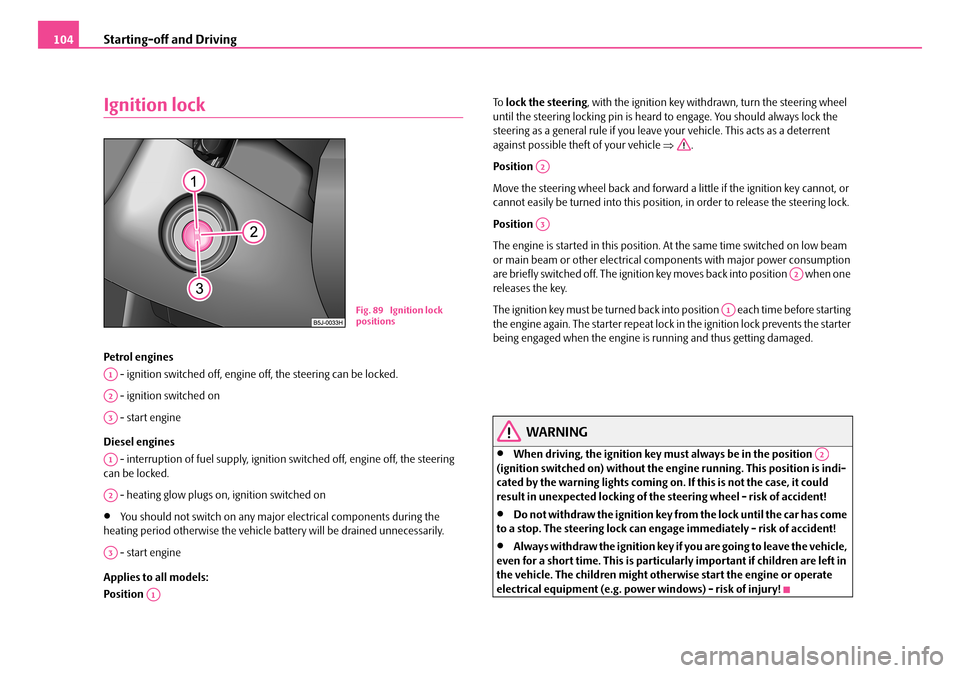
Petrol engines
- ignition switched off, engine off, the steering can be locked.
- ignition switched on
- start engine
Diesel engines
- interruption of fuel supply, ignition switched off, engine off, the steering can be locked.
- heating glow plugs on, ignition switched on
•You should not switch on any major electrical components during the heating period otherwise the vehicle ba ttery will be drained unnecessarily.
- start engine
Applies to all models:
Position
To lock the steering, with the ignition key withdrawn, turn the steering wheel until the steering locking pin is heard to engage. You should always lock the steering as a general rule if you leave your vehicle. This acts as a deterrent against possible thef t of your vehicle ⇒.
Position
Move the steering wheel back and forward a little if the ignition key cannot, or cannot easily be turned into this position, in order to release the steering lock.
Position
The engine is started in this position. At the same time switched on low beam or main beam or other electrical co mponents with major power consumption are briefly switched off. The ignition key moves back into position when one releases the key.
The ignition key must be turned back into position each time before starting the engine again. The starter repeat lock in the ignition lock prevents the starter being engaged when the engine is running and thus getting damaged.
WARNING
•When driving, the ignition key must always be in the position (ignition switched on) without the engine running. This position is indi- cated by the warning lights coming on. If this is not the case, it could result in unexpected locking of the steering wheel - risk of accident!
•Do not withdraw the ignition key from the lock until the car has come to a stop. The steering lock can enga ge immediately - risk of accident!
•Always withdraw the ignition key if you are going to leave the vehicle, even for a short time. This is particularly important if children are left in the vehicle. The children might othe rwise start the engine or operate electrical equipment (e.g. power windows) - risk of injury!
Fig. 89 Ignition lock positions
A1
A2
A3
A1
A2
A3
A1
A2
A3
A2
A1
A2
NKO A05Fabia 20.book Page 104 Tuesday, September 26, 2006 8:38 AM
Page 114 of 258
Automatic gearbox113
Using the systemSafetyDriving TipsGeneral MaintenanceBreakdown assistanceTechnical Data
WARNING
•Do not depress the accelerator when changing the position of the selector lever if the car is stationary and the engine is running - risk of accident!
•Never move the selector lever into position R or P when driving - risk of an accident!
•When the engine is running and the vehicle is stationary, it is neces- sary to hold the car with the brake pedal in all the positions of the selector lever (except P and N) since the power transmission is never completely interrupted, also not when the engine is idling - the vehicle "creeps".
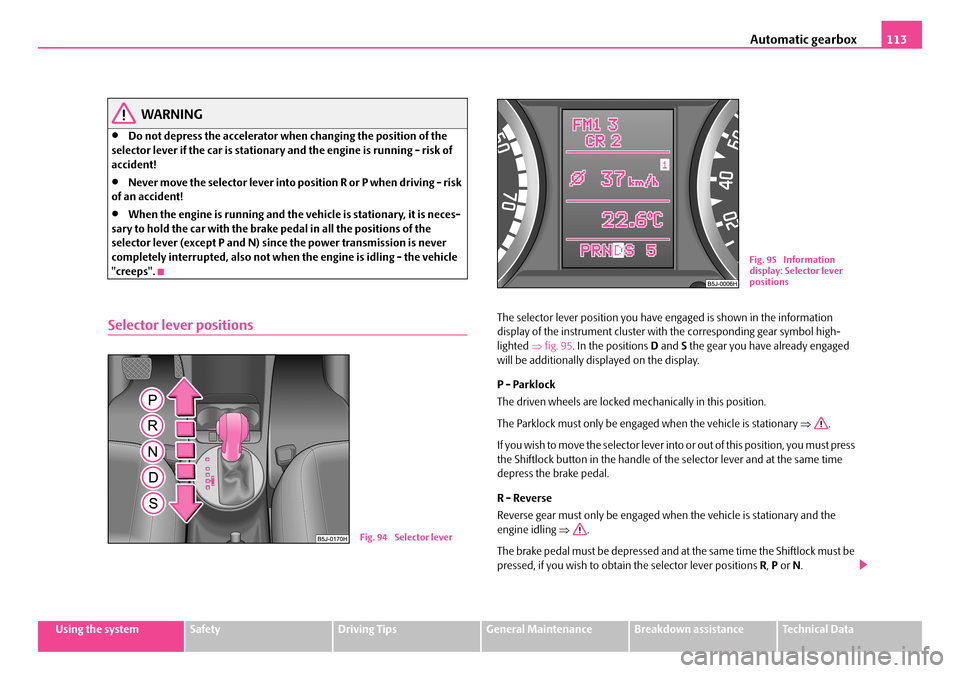
Selector lever positionsThe selector lever position you have engaged is shown in the information display of the instrument cluster with the corresponding gear symbol high- lighted ⇒fig. 95. In the positions D and S the gear you have already engaged will be additionally displayed on the display.
P - Parklock
The driven wheels are locked me chanically in this position.
The Parklock must only be engaged when the vehicle is stationary ⇒.
If you wish to move the sele ctor lever into or out of this position, you must press the Shiftlock button in the handle of the selector lever and at the same time depress the brake pedal.
R - Reverse
Reverse gear must only be engaged when the vehicle is stationary and the engine idling ⇒.
The brake pedal must be depressed and at the same time the Shiftlock must be pressed, if you wish to obtain the selector lever positions R, P or N.
Fig. 94 Selector lever
Fig. 95 Information display: Selector lever positions
NKO A05Fabia 20.book Page 113 Tuesday, September 26, 2006 8:38 AM
Page 116 of 258

Automatic gearbox115
Using the systemSafetyDriving TipsGeneral MaintenanceBreakdown assistanceTechnical Data
one to seesaw out a stuck vehicle. The sele ctor lever lock will click into place if the lever is in the N position for more than 2 seconds without the brake pedal being pressed.
The selector lever lock is only active if the vehicle is stationary or moving at speed of less than 5 km/hour. The lock is switched off automatically into posi- tion N when the car is travelling at a higher speed.
Shiftlock button
The Shiftlock button in the handle of selector lever prevents certain selector lever positions being engaged inadvertently. The selector lever lock is cancelled when you press the Shiftlock button.
Kickdown function
The kickdown function provides you with maximum accelera-
tion power.
Depressing the accelerator pedal allows th e kickdown function to be activated in the desired driving program. This function has precedence over the driving programme and serves for maximum a cceleration of the vehicle when exploiting the maximum power potential of the engine without taking into account the current selector lever position ( D, S or Tiptronic). The gearbox shifts down to one or several gears in line with the driving state and the vehicle accelerates. The gearbox does not shift up into the highest gear until the engine has reached its maximum revolutions for this gear range.
WARNING
Please note that using the kickdown function can result in the driven wheels spinning on a smooth or slippery road surface - risk of skidding!
Dynamic shift programme
The automatic gearbox of your vehicle is controlled electronically. Shifting up and down through the gears is performe d automatically on the basis of pre- defined driving programmes.
Adopting a moderate style of driving will cause the gearbox to select the most economical driving programme. Shifting up into a higher gear as soon as possible and shifting down as late as possible will have a favourable effect on your fuel consumption.
Adopting a sporty style of driving with rapid movements of the accelerator pedal combined with sharp accelerati on and frequent changes in speed, exploiting the top speed of the car or depressing the accelerator pedal (kick- down function), will cause the gearbox to sw itch over to this style of driving and shift down earlier with frequent changes in gears in comparison to the moderate style of driving.
Selecting the most appropriate driving programme for the particular style of driving is a continuous process. Irrespective of this it is, however, possible to switch or shift down into a dynamic sh ift programme by depressing the accel- erator rapidly. The gearbox shifts down into a lower gear matching the speed of the car and this allows you to accelerate rapidly (e.g. when overtaking) without having to depress the accelerator pedal fu lly into the kickdown range. The orig- inal programme will be reactivated to ma tch your particular style of driving once the gearbox has shifted up again.
When driving in hilly regions, the gears are selected to match uphill and down- hill sections. This avoids the gearbox fr equently shifting up and down when negotiating an uphill stretch. When driving downhill, it is possible to shift down into the Tiptronic position, in order to exploit the engine brake torque.
NKO A05Fabia 20.book Page 115 Tuesday, September 26, 2006 8:38 AM
Page 119 of 258

Communication118
Communication
Operating the radio
The driver can set the basic functions of the radio system by simply operating the buttons on the multi-functional modu le* behind the steering wheel so that he can concentrate on the traffic situation without being distracted as little as possible by operating the radio system ⇒fig. 98.
This applies only if your radio equipment has been installed at the factory. You can of course operate the radio system at the appliance. You will find a descrip- tion in the operating instructions of your radio system.
By pressing the buttons, you can ca rry out the following functions:
The buttons apply for the respective operating mode of the current radio system.
Note
The loudspeakers in the vehicle are matched to a power output of 30 W.
Fig. 98 Multi-functional module: Buttons for the operation of the radio
ButtonRadioCD
Thumbwheel for stored transmitter
forward
back
Title search
forward
back
Increase volume
Decrease volume
Frequency search back Reading the
previous CD
Frequency search forward
Reading the
following CD
Mute switch
A1
A2
A3
A4
A5
A6
NKO A05Fabia 20.book Page 118 Tuesday, September 26, 2006 8:38 AM