2006 SKODA FABIA light
[x] Cancel search: lightPage 193 of 258
Taking care of your vehicle and cleaning the vehicle192
– Apply only a small amount of the care product.
– Dry the leather off with a soft cloth
We recommend that you consult your Šk oda Service Partner, if you have any questions regarding cleaning and care of the leather interior.
Caution
•You must on no account treat the le ather with solvents (e.g. gasoline, turpentine), floor wax, shoe cream or such like.
•Avoid leaving your vehicle for lengthy pe riods in bright sunlight in order to avoid bleaching the leather. If you leav e your vehicle parked in the open for lengthy periods, protect the leather from the direct rays of the sun by covering it over.
•Sharp-edged objects on items of clothi ng such as zip fasteners, rivets, sharp-edged belts may leave permanent scratches or signs of rubbing on the surface.
Note
•Use a care cream with light blocker and impregnation effect regularly and each time after cleaning the leather. Th e cream nourishes the leather, allows it to breathe and keeps it supple and also provides moisture. It also creates surface protection.
•Clean the leather every 2 to 3 months, remove fresh soiling each time this occurs.
•Remove fresh stains such as those from ball-point pens, ink, lipstick, shoe cream etc., as quickly as possible.
•Care also for the leather dye. Refreshe n areas which have lost their colour with a special coloured leather cream as required.
Seat belts
– Keep the seat belts clean!
– Wash seat belts which have become soiled using a mild soapy
solution.
– Inspect the seat belts regularly to ensure they are in good condi-
tion.
Belt webbing which has become severely soiled may prevent the inertia reel from reeling up the belt properly.
WARNING
•The seat belts must not be removed for cleaning.
•Never clean the seat belts chemically as dry cleaning may destroy the fabric. The seat belts must also not be allowed to come into contact with corrosive liquids (such as acids etc.).
•We recommend that seat belts which have damage to the webbing, the connections, the inertia reel or the lock should be replaced by a Škoda Service Partner.
•Inertia reel belts must be completely dried before being reeled up.
NKO A05Fabia 20.book Page 192 Tuesday, September 26, 2006 8:38 AM
Page 194 of 258

Fuel193
Using the systemSafetyDriving TipsGeneral MaintenanceBreakdown assistanceTechnical Data
Fuel
Petrol
Grades of petrol
There are various grades of petrol. Please read the brochure “Technical Data” in order to know which grade of petrol your vehicle requires. You will also find the same information affixed to the inside of the fuel filler flap of your vehicle ⇒ page 195, fig. 140.
A distinction is made between unleaded and leaded petrol. All Škoda vehicles with petrol engines are equipped with a catalytic converter and must therefore be only driven with unleaded petrol. Unleaded petrol complies with the standard EN 228 .
The individual grades of petrol are distinguished by their octane number (RON). Please adopt the following procedure if the grade of petrol which you normally use is not be availabl e in exceptional circumstances:
•Engines which need unleaded premium petrol 95 RON can also be run on unleaded regular petrol 91 RON. This does, however, result in a slight loss in performance.
•Engines which need unleaded premium plus petrol 98 RON can also be run on unleaded regular petrol 95 RON. Th is does, however, result in a slight loss in performance. You can in exceptional circumstances also use unleaded regular petrol of 91 RON in the event that neither unleaded premium petrol of 98 RON nor 95 RON is available. Refuel as soon as possible with unleaded premium plus of 98 RON or unleaded premium petrol of 95 RON.
If, in an emergency, the only fuel av ailable is one which has a lower octane number than that required by the engine then only drive at medium engine speeds and lower engine loadings.
You can make unlimited use of fuel which has a higher octane number than that required by the engine. There will, however, be no advantages gained by this in terms of engine performance and fuel consumption!
The handling, performance and life of yo ur engine are determined to a signifi- cant extent by the quality of the fu el. Do not use any petrol additives. Use a fuel complying with the standard.
You can find further info rmation on refuelling ⇒page 195.
Caution
•Filling the tank even only once with leaded petrol will result in the catalytic converter being destroyed.
•Operating the engine with petrol of a low octane number than that required can result in engine damage at high revolutions or severe engine loading.
Diesel
Diesel fuel
Your vehicle can be operated with diesel fuel, which complies with the standard EN 590.
It is prohibited to use biofuel (RME) and diesel fuel mixture.
Fuel additives
You must not use fuel additives, so-called “flow improvers” (petrol and similar products) in diesel fuel.
NKO A05Fabia 20.book Page 193 Tuesday, September 26, 2006 8:38 AM
Page 199 of 258

Inspecting and Replenishing198
Opening the bonnet
– Unlock the bonnet ⇒page 197, fig. 141.
– Ensure that the arms of the windscreen wipers are correctly in
place against the windscreen before opening the bonnet other-
wise damage could occur to the paintwork.
– Press the locking button ⇒page 197, fig. 142, the bonnet unlocks
itself.
– Grip the bonnet and lift it up.
– Take the bonnet support out of its holder and set it in the opening
designed for it ⇒page 197, fig. 143.
Closing the bonnet
– Lift the bonnet slightly and unhook the bonnet support. Press the
bonnet support into the holder designed to hold it.
– Allow the bonnet to drop from a height of about 30 cm into the lock
- bonnet do not press down on it!
WARNING
•Never open the bonnet if you see that steam or coolant is flowing out of the engine compartment - risk of scalding! Wait long enough until the steam or coolant has stopped escaping.
•For safety reasons, the bonnet must always be properly closed when driving. One should therefore check that the lock has in fact engaged properly after closing the bonnet.
•Stop your vehicle immediately whil e driving if you notice that the lock is not properly engaged and close the bonnet properly - risk of an accident!
Caution
•Before opening the bonnet, ensure that the arms of the windscreen wipers are correctly in place against the windscreen. Otherwise, there is a risk of damage to the paintwork.
Working in the engine compartment
Particular care is required when carrying out any work in the
engine compartment!
There is a risk of injuries, scalding, accidents and fire when working in the engine compartment, e.g. inspecting and replenishing oil and other fluids. For this reason, it is essential to comply with the warning instructions stated below and with the general appl icable rules of safety. The engine compartment of your car is a hazardous area ⇒.
WARNING
•Never open the bonnet if you see that steam or coolant is flowing out of the engine compartment - risk of scalding! Wait long enough until the steam or coolant has stopped escaping.
•Switch off the engine and pull out the ignition key.
•Apply the handbrake firmly.
•If your vehicle is fitted with a manual gearbox, move the gearshift lever into Neutral, or if it is fitted with automatic gearbox, move the selector lever into position P.
•Allow the engine to cool down.
•Keep children clear of the engine compartment.
•Do not touch any hot engine parts - risk of burns!
NKO A05Fabia 20.book Page 198 Tuesday, September 26, 2006 8:38 AM
Page 202 of 258

Inspecting and Replenishing201
Using the systemSafetyDriving TipsGeneral MaintenanceBreakdown assistanceTechnical Data
Note
•Before a long drive we recommend that you purchase and carry with you engine oil which complies with the specif ication for your vehicle. Consequently, you will always have the correct engine oil for refilling.
•We recommend using a preservative fr om the Škoda original accessories offered by your Škoda dealer.
•For further information - see Service shedule.
Check engine oil level
The dipstick indicates the level of oil in the engine.
Checking the oil level
– Park the vehicle on a horizontal surface.
– Switch the engine off.
– Open the bonnet ⇒ in “Working in the engine compartment”
on page 198.
– Wait a few minutes and pull out the oil dipstick ⇒.
– Wipe off the dipstick with a clean cloth and insert it again fully.
– Then withdraw the dipstick again and read off the oil level.
Oil level within range
– You must not top up the oil.
Oil level within range
– You may top up the oil. It is possible that the oil level may then be
within range after doing this.
Oil level within range
– You must top up the oil. It is sufficient, once this is done, to keep
the oil level is within range .
It is normal for the engine to consume oil. The oil consumption may be as much as 0.5 l/1 000 km depending on your style of driving and the conditions under which you operate your vehicle. The oi l consumption may be slightly higher than this during the first 5 000 kilometres.
One should therefore check the oil level at regular intervals, preferably every time after the fuel tank is filled or after driving for long stretches.
We recommend maintaining the oil level within the range if the engine has been operating at high loads, for ex ample during a lengthy motorway trip during the summer months, towing a tr ailer or negotiating a high mountain pass, but not above this.
Fig. 145 Dipstick
Aa
Ab
Aa
Ac
Ab
Ab
NKO A05Fabia 20.book Page 201 Tuesday, September 26, 2006 8:38 AM
Page 203 of 258

Inspecting and Replenishing202
The warning light in the instrument cluster* will indicate ⇒page 31 whether the oil level is too low. In this case, check the oil level as soon as possible. Top up with an appropriate quantity of oil.
WARNING
Read and observe the warning notes ⇒page 198, “Working in the engine compartment” before working in the engine compartment.
Caution
•Always check the oil level on vehicles with engine 1.2 l/47 kW when the engine is warm. Otherwise the measuring result is incorrect und oil could be incorrectly replenished - risk of engine damage!
•The oil level must on no account ex tend beyond the range . Danger of damaging the catalytic converter.
•Do not continue your journey if for some reason it is not possible under the conditions prevailing to top up with oil. Switch the engine off and obtain professional assistance from a specialist garage, otherwise it could lead to severe engine damage.
Replenishing engine oil
– Inspect the oil level ⇒page 201.
– Unscrew the cap of the engine oil filler opening.
– Pour in a suitable grade of oil in portions of 0.5 litres ⇒page 200,
“Engine oil specifications”.
– Inspect the oil level ⇒page 201.
– Carefully screw on the cap of the filler opening and push the
dipstick in fully.
WARNING
•Avoid dripping oil onto hot parts of the engine when topping up will oil - a risk of fire!
•Read and observe the warning notes ⇒page 198, “Working in the engine compartment” before work ing in the engine compartment.
For the sake of the environment
The oil level must on no account be above the range ⇒page 201. Oil will otherwise be drawn in through the cran kcase ventilation and may pass through the exhaust system to atmosphere. The oil may combust in the catalytic converter and damage it.
Changing engine oil
The engine oil must be changed at the intervals stated in the Service schedule or according to the service interval indicator ⇒page 16.
WARNING
•Only carry out the engine oil change, if you have the required profes- sional knowledge!
•Read and observe the warning notes ⇒page 198, “Working in the engine compartment” before work ing in the engine compartment.
•Let the engine cool down - risk of burning from hot oil.
•Wear an eye protection - risk of caustic burns due to oil splashes.
Aa
Aa
NKO A05Fabia 20.book Page 202 Tuesday, September 26, 2006 8:38 AM
Page 205 of 258
Inspecting and Replenishing204
Inspecting the coolant level
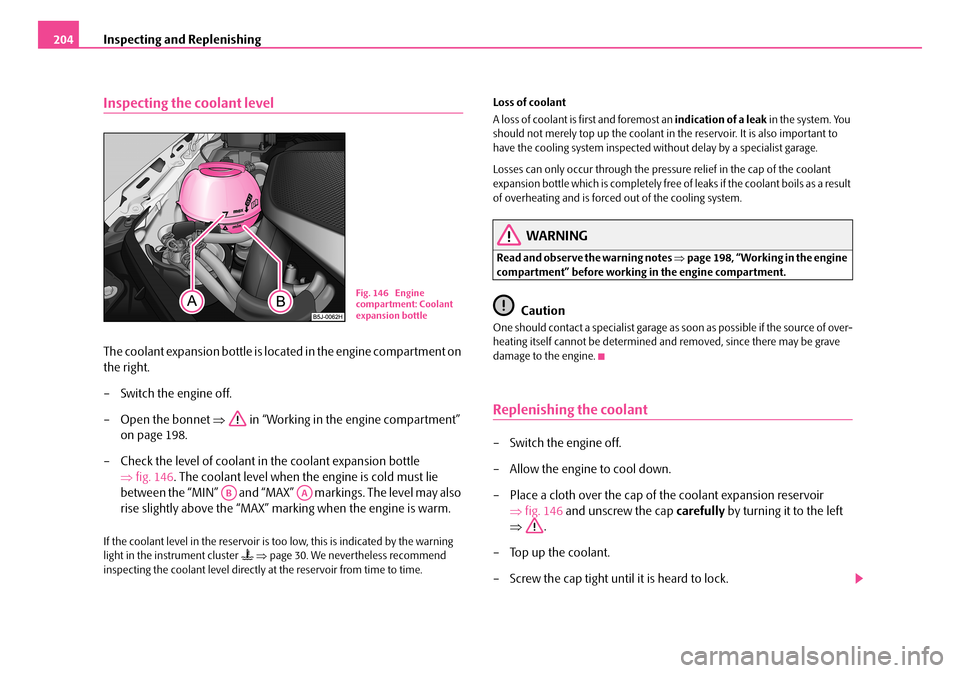
The coolant expansion bottle is located in the engine compartment on
the right.
– Switch the engine off.
– Open the bonnet ⇒ in “Working in the engine compartment”
on page 198.
– Check the level of coolant in the coolant expansion bottle
⇒ fig. 146. The coolant level when the engine is cold must lie
between the “MIN” and “MAX” markings. The level may also
rise slightly above the “MAX” ma rking when the engine is warm.
If the coolant level in the reservoir is too low, this is indicated by the warning light in the instrument cluster ⇒page 30. We nevertheless recommend inspecting the coolant level directly at the reservoir from time to time.
Loss of coolant
A loss of coolant is first and foremost an indication of a leak in the system. You should not merely top up the coolant in the reservoir. It is also important to have the cooling system inspected without delay by a specialist garage.
Losses can only occur through the pressure relief in the cap of the coolant expansion bottle which is completely free of leaks if the coolant boils as a result of overheating and is forced out of the cooling system.
WARNING
Read and observe the warning notes ⇒page 198, “Working in the engine compartment” before working in the engine compartment.
Caution
One should contact a specialist garage as soon as possible if the source of over- heating itself cannot be determined an d removed, since there may be grave damage to the engine.
Replenishing the coolant
– Switch the engine off.
– Allow the engine to cool down.
– Place a cloth over the cap of the coolant expansion reservoir
⇒ fig. 146 and unscrew the cap carefully by turning it to the left
⇒ .
– Top up the coolant.
– Screw the cap tight until it is heard to lock.
Fig. 146 Engine compartment: Coolant expansion bottle
ABAA
NKO A05Fabia 20.book Page 204 Tuesday, September 26, 2006 8:38 AM
Page 206 of 258
Inspecting and Replenishing205
Using the systemSafetyDriving TipsGeneral MaintenanceBreakdown assistanceTechnical Data
The coolant which you use for replenishing the system, must comply with one specific specification ⇒page 203, “Coolant”. Do not use an alternative additive if the coolant additive G12 PLUS is not available in exceptional cases. Just top up the system with water and as soon as possible arrange adjustment to correct the mixing ratio of water and coolant a dditive again by a specialist garage.
Only use fresh coolant for topping up the system.
Do not fill up over the “MAX” marking! Excess coolant which is heated up is forced out of the cooling system through the pressure relief valve in the cap of the coolant compensation bottle.
Wait until the engine has cooled down for a system which has suffered a major loss of coolant before pouring in cool ant. This is necessary to avoid engine damage.
WARNING
•The cooling system is pressurized! Do not open the cap of the coolant expansion bottle if the engine is still hot - risk of scalding!
•The coolant additive and thus all of the coolant is harmful to your health. Avoid contact with the coolan t. Coolant vapours are also harmful to the health. It is important, therefore, to always safely store any coolant additive in its original container out of the reach of children - risk of poisoning!
•If any splashes of coolant get into your eyes, rinse out your eyes immediately with clear water and cont act a doctor as soon as possible.
•You should also consult a doctor without delay if you have inadvert- ently swallowed coolant.
Caution
Do not continue your journey if for some reason it is not possible under the conditions prevailing to top up with coolant. Switch the engine off and obtain professional assistance from a specialist garage, otherwise it could lead to severe engine damage.
For the sake of the environment
Do not re-use coolant if it is necessary to drain the coolant in the system. It should be collected and disposed of in compliance with environmental protec- tion regulations.
Radiator fan
The radiator fan may switch on suddenly.
The radiator fan is driven by an electr ic motor and controlled by a thermostat according to the coolant temperature.
The radiator fan may continue running fo r up to 10 minutes after the engine has been switched off - even if the ignition is also off. It may also switch on suddenly after a certain time, if:
•the coolant temperature has risen beca use of an accumulation of heat or
•the warm engine compartment is heated up additionally by strong sunlight.
WARNING
You must therefore be aware when working in the engine compartment that the fan may switch on suddenly - risk of injury!
NKO A05Fabia 20.book Page 205 Tuesday, September 26, 2006 8:38 AM
Page 207 of 258

Inspecting and Replenishing206
Brake fluid
Inspecting the brake fluid level
The brake fluid reservoir is located on the left of the engine compart-
ment. The brake fluid reservoir on right-hand steering models is posi-
tioned on the other side of the engine compartment.
– Switch the engine off.
– Open the bonnet ⇒ in “Working in the engine compartment”
on page 198.
– Inspect the brake fluid level in the reservoir ⇒fig. 147. The level
must be between the “MIN” and “MAX” markings.
A slight drop in the fluid level results when driving due to normal wear-and-tear and automatic adjustment of the br ake pads, and is perfectly normal.
There may be an indication of a leak in the brake system, however, if the fluid level drops significantly within a short time or if it drops below the “MIN” marking. A situation where the brake flui d level is too low is indicated by the warning light lighting up in th e instrument cluster ⇒page 34. In this case stop the car immediately and do not drive any further! Contact a Škoda Dealer to obtain professional assistance.
WARNING
•Read and observe the warning notes ⇒page 198, “Working in the engine compartment” before work ing in the engine compartment.
•If the fluid level has dropped below the MIN marking, do not drive any further - risk of accident! Contact a Škoda dealer to obtain profes- sional assistance.
Replacing brake fluid
Brake fluid absorbs moisture. This causes the fluid to absorb moisture from the surrounding air over a period of time. Excessive water in the brake fluid may be the cause of corrosion in the brake syst em. The water content also lowers the boiling point of the brake fluid. This is why brake fluid must be replaced every two years.
One may only use new genuine brake fluid from Škoda Auto a.s. The specifica- tion for the brake fluid is “FMVSS 116 DOT 4”.
We recommend that you have th e brake fluid replaced by a Škoda Service Par tner as part of an Inspection Service.
Fig. 147 Engine compartment: Brake fluid reservoir
NKO A05Fabia 20.book Page 206 Tuesday, September 26, 2006 8:38 AM