2006 SAAB 9-7X lock
[x] Cancel search: lockPage 398 of 434

(e)Make sure the safety belt reminder light and all your
belts, buckles, latch plates, retractors, and anchorages
are working properly. Look for any other loose or
damaged safety belt system parts. If you see anything
that might keep a safety belt system from doing its job,
have it repaired. Have any torn or frayed safety belts
replaced. Also look for any opened or broken airbag
coverings, and have them repaired or replaced. The
airbag system does not need regular maintenance.
(f)Lubricate all key lock cylinders, hood latch assembly,
secondary latch, pivots, spring anchor, release pawl, rear
compartment hinges, outer liftgate handle pivot points,
rear door detent link, roller mechanism, liftgate handle
pivot points, latch bolt, fuel door hinge, cargo door
hinge, locks, and folding seat hardware. More frequent
lubrication may be required when exposed to a corrosive
environment. Applying silicone grease on weatherstrips
with a clean cloth will make them last longer, seal better
and not stick or squeak.
(g)Inspect hoses for cracks, chang, leaks, kinks, and
proper installation.(h)Change automatic transmission uid and lter if the
vehicle is mainly driven under one or more of these
conditions:
In heavy city traffic where the outside temperature
regularly reaches 90°F (32°C) or higher.
In hilly or mountainous terrain.
When doing frequent trailer towing.
Uses such as found in taxi, police, or delivery
service.
(i)Drain, ush, and rell cooling system. This service can
be complex; you should have your dealer perform this
service. See Engine Coolant on page 5-24 for what to
use. Inspect hoses. Clean radiator, condenser, pressure
cap, and ller neck. Pressure test the cooling system and
pressure cap.
(j)A uid loss in any vehicle system could indicate a
problem. Have the system inspected and repaired and
the uid level checked. Add uid if needed.
(k)If you drive regularly under dusty conditions, inspect
the lter at each engine oil change.
(l)Visually inspect belt for fraying, excessive cracks, or
obvious damage. Replace belt if necessary.
6-8
ProCarManuals.com
Page 400 of 434

At Least Once a Year
Starter Switch Check
{CAUTION:
When you are doing this inspection, the
vehicle could move suddenly. If the vehicle
moves, you or others could be injured.
1. Before you start, be sure you have enough room
around the vehicle.
2. Firmly apply both the parking brake and the regular
brake. SeeParking Brake on page 2-27.
Do not use the accelerator pedal, and be ready to
turn off the engine immediately if it starts.
3. Try to start the engine in each gear. The vehicle
should start only in PARK (P) or NEUTRAL (N). If
the vehicle starts in any other position, contact your
dealer for service.
Automatic Transmission Shift Lock
Control System Check
{CAUTION:
When you are doing this inspection, the
vehicle could move suddenly. If the vehicle
moves, you or others could be injured.
1. Before you start, be sure you have enough room
around the vehicle. It should be parked on a level
surface.
2. Firmly apply the parking brake. SeeParking Brake
on page 2-27.
Be ready to apply the regular brake immediately if
the vehicle begins to move.
3. With the engine off, turn the ignition to RUN, but do
not start the engine. Without applying the regular
brake, try to move the shift lever out of PARK (P)
with normal effort. If the shift lever moves out
of PARK (P), contact your dealer for service.
6-10
ProCarManuals.com
Page 401 of 434

Ignition Transmission Lock Check
While parked, and with the parking brake set, try to turn
the ignition to LOCK in each shift lever position.
The ignition should turn to LOCK only when the
shift lever is in PARK (P).
The key should come out only in LOCK.
Contact your dealer if service is required.
Parking Brake and Automatic
Transmission Park (P) Mechanism Check
{CAUTION:
When you are doing this check, your vehicle
could begin to move. You or others could be
injured and property could be damaged. Make
sure there is room in front of your vehicle in
case it begins to roll. Be ready to apply the
regular brake at once should the vehicle begin
to move.Park on a fairly steep hill, with the vehicle facing downhill.
Keeping your foot on the regular brake, set the parking
brake.
To check the parking brake’s holding ability: With the
engine running and transmission in NEUTRAL (N),
slowly remove foot pressure from the regular brake
pedal. Do this until the vehicle is held by the parking
brake only.
To check the PARK (P) mechanism’s holding ability:
With the engine running, shift to PARK (P). Then
release the parking brake followed by the regular
brake.
Contact your dealer if service is required.
Underbody Flushing Service
At least every spring, use plain water to ush any
corrosive materials from the underbody. Take care to
clean thoroughly any areas where mud and other debris
can collect.
6-11
ProCarManuals.com
Page 402 of 434
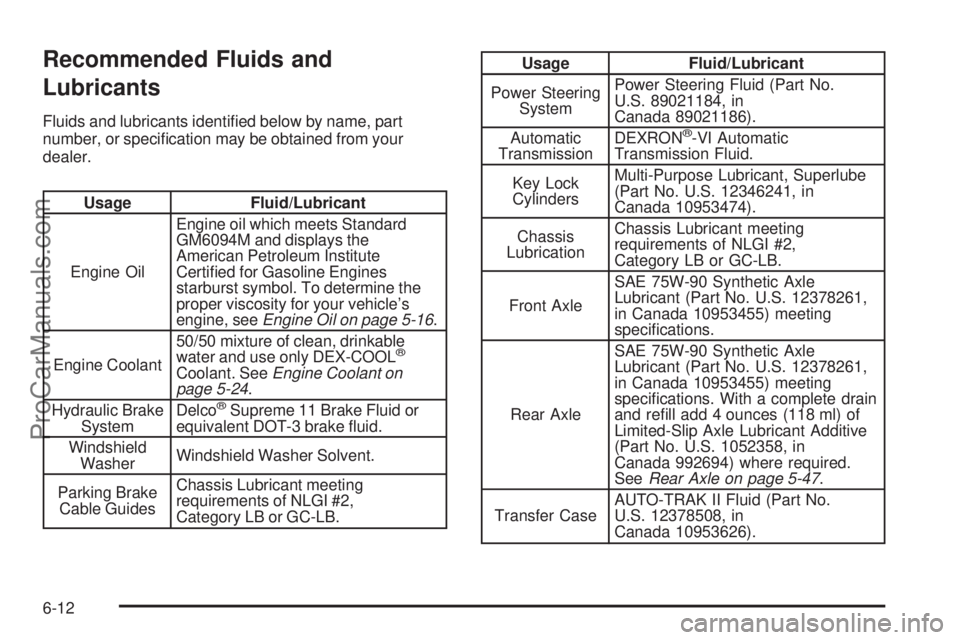
Recommended Fluids and
Lubricants
Fluids and lubricants identied below by name, part
number, or specication may be obtained from your
dealer.
Usage Fluid/Lubricant
Engine OilEngine oil which meets Standard
GM6094M and displays the
American Petroleum Institute
Certied for Gasoline Engines
starburst symbol. To determine the
proper viscosity for your vehicle’s
engine, seeEngine Oil on page 5-16.
Engine Coolant50/50 mixture of clean, drinkable
water and use only DEX-COOL
®
Coolant. SeeEngine Coolant on
page 5-24.
Hydraulic Brake
SystemDelco
®Supreme 11 Brake Fluid or
equivalent DOT-3 brake uid.
Windshield
WasherWindshield Washer Solvent.
Parking Brake
Cable GuidesChassis Lubricant meeting
requirements of NLGI #2,
Category LB or GC-LB.
Usage Fluid/Lubricant
Power Steering
SystemPower Steering Fluid (Part No.
U.S. 89021184, in
Canada 89021186).
Automatic
TransmissionDEXRON
®-VI Automatic
Transmission Fluid.
Key Lock
CylindersMulti-Purpose Lubricant, Superlube
(Part No. U.S. 12346241, in
Canada 10953474).
Chassis
LubricationChassis Lubricant meeting
requirements of NLGI #2,
Category LB or GC-LB.
Front AxleSAE 75W-90 Synthetic Axle
Lubricant (Part No. U.S. 12378261,
in Canada 10953455) meeting
specications.
Rear AxleSAE 75W-90 Synthetic Axle
Lubricant (Part No. U.S. 12378261,
in Canada 10953455) meeting
specications. With a complete drain
and rell add 4 ounces (118 ml) of
Limited-Slip Axle Lubricant Additive
(Part No. U.S. 1052358, in
Canada 992694) where required.
SeeRear Axle on page 5-47.
Transfer CaseAUTO-TRAK II Fluid (Part No.
U.S. 12378508, in
Canada 10953626).
6-12
ProCarManuals.com
Page 412 of 434

Canada — Customer Assistance
General Motors of Canada, Limited
Customer Assistance Centre
1908 Colonel Sam Drive
Oshawa, Ontario L1H 8P7
1-800-263-1999 (English and French)
1-800-263-3830 (For Text Telephone devices (TTYs))
Roadside Assistance: 1-800-268-6800
Roadside Assistance Program
Roadside Assistance
Saab has a strong commitment to customer satisfaction
and has established the Saab Roadside Assistance
Program. As the owner of a new Saab vehicle, you are
automatically enrolled in the Program. This service is
intended to provide you with peace of mind as you
drive in the city or coast-to-coast throughout the
4 year/50,000 mile term of your New Car Limited
Warranty.
24 Hour Roadside Assistance Number
Roadside Assistance is available 24 hours a day,
365 days a year. Our advisors have access to a
nationwide network of recommended service providers.
The following services are available to handle related
emergencies.
Towing
Locksmith Service
Flat tire change
Gas delivery
Battery jump starting
If it is necessary to tow your disabled Saab, it will be
taken to the nearest authorized Saab dealer, whenever
possible. The cost of towing will be covered by Roadside
Assistance if necessitated by a mechanical breakdown
covered under the New Car Limited Warranty.
If your 2005 Saab is disabled due to a failure covered
by the New Car Limited Warranty “Bumper-to-Bumper
Coverage” and you are more than 100 miles from
home, Saab will reimburse you for certain expenses
in conjunction with the trip interruption. These expenses
include only reasonable and customary daily cost
for emergency lodging, meals, care rental or other
transportation to your destination incurred within
three days of the disablement, NOT to exceed $1000.
7-4
ProCarManuals.com
Page 414 of 434

Vehicle Data Collection and Event
Data Recorders
Your vehicle, like other modern motor vehicles, has a
number of sophisticated computer systems that monitor
and control several aspects of the vehicle’s performance.
Your vehicle uses on-board vehicle computers to monitor
emission control components to optimize fuel economy,
to monitor conditions for airbag deployment and, if so
equipped, to provide anti-lock braking and to help the
driver control the vehicle in difficult driving situations.
Some information may be stored during regular
operations to facilitate repair of detected malfunctions;
other information is stored only in a crash event by
computer systems, such as those commonly called
event data recorders (EDR).
In a crash event, computer systems, such as the Airbag
Sensing and Diagnostic Module (SDM) in your vehicle
may record information about the condition of the vehicle
and how it was operated, such as data related to engine
speed, brake application, throttle position, vehicle speed,
safety belt usage, airbag readiness, airbag performance,
and the severity of a collision. If your vehicle is equipped
with StabiliTrak
®, steering performance, including yaw
rate, steering wheel angle, and lateral acceleration, is
also recorded. This information has been used to improve
vehicle crash performance and may be used to improve
crash performance of future vehicles and driving safety.Unlike the data recorders on many airplanes, these
on-board systems do not record sounds, such as
conversation of vehicle occupants.
To read this information, special equipment is needed
and access to the vehicle or the device that stores
the data is required. Saab will not access information
about a crash event or share it with others other than:
with the consent of the vehicle owner or, if the
vehicle is leased, with the consent of the lessee,
in response to an official request of police or similar
government office,
as part of Saab’s defense of litigation through the
discovery process, or
as required by law.
In addition, once Saab collects or receives data,
Saab may:
use the data for Saab research needs,
make it available for research where appropriate
condentiality is to be maintained and need is
shown, or
share summary data which is not tied to a specic
vehicle with non-Saab organizations for research
purposes.
7-6
ProCarManuals.com
Page 421 of 434

A
Accessories and Modications............................ 5-3
Accessory Inator...........................................5-72
Accessory Power Outlet(s)...............................3-18
Adding Equipment to Your
Airbag-Equipped Vehicle...............................1-66
Additives, Fuel................................................. 5-6
Add-On Electrical Equipment............................5-98
Adjustable Throttle and Brake Pedal..................2-22
Air Cleaner/Filter, Engine.................................5-21
Air Conditioning..............................................3-19
Air Suspension...............................................4-39
Airbag
Passenger Status Indicator...........................3-30
Readiness Light..........................................3-29
Airbag Sensing and Diagnostic Module (SDM)...... 7-6
Airbag System................................................1-51
Adding Equipment to Your
Airbag-Equipped Vehicle............................1-66
How Does an Airbag Restrain?......................1-59
Passenger Sensing System...........................1-61
Servicing Your Airbag-Equipped Vehicle..........1-65
What Makes an Airbag Inate?......................1-59Airbag System (cont.)
What Will You See After an Airbag Inates?....1-60
When Should an Airbag Inate?....................1-57
Where Are the Airbags?...............................1-54
All-Wheel Drive...............................................5-46
All-Wheel-Drive (AWD) System.........................4-13
All-Wheel-Drive Service Light............................3-41
Antenna, Fixed Mast......................................3-100
Antenna, XM™ Satellite Radio Antenna System . . . 3-100
Anti-Lock Brake System (ABS)........................... 4-7
Anti-Lock Brake, System Warning Light..............3-34
Appearance Care
Aluminum Wheels........................................5-94
Care of Safety Belts....................................5-92
Chemical Paint Spotting...............................5-95
Cleaning Exterior Lamps/Lenses....................5-93
Cleaning the Inside of Your Vehicle................5-89
Fabric/Carpet..............................................5-90
Finish Care.................................................5-93
Finish Damage............................................5-95
Instrument Panel, Vinyl, and
Other Plastic Surfaces..............................5-91
Leather......................................................5-91
Sheet Metal Damage...................................5-95
1
ProCarManuals.com
Page 422 of 434

Appearance Care (cont.)
Tires..........................................................5-95
Underbody Maintenance...............................5-95
Vehicle Care/Appearance Materials................5-96
Washing Your Vehicle...................................5-92
Weatherstrips..............................................5-92
Windshield, Backglass, and Wiper Blades.......5-94
Audio System(s).............................................3-58
Audio Steering Wheel Controls......................3-98
Care of Your CD and DVD Player................3-100
Care of Your CDs and DVDs........................3-99
Fixed Mast Antenna...................................3-100
Navigation/Radio System,
see Navigation Manual..............................3-84
Radio with CD............................................3-60
Radio with Six-Disc CD................................3-73
Rear Seat Audio (RSA)................................3-96
Setting the Time..........................................3-59
Theft-Deterrent Feature................................3-97
Understanding Radio Reception.....................3-99
XM™ Satellite Radio Antenna System...........3-100
Automatic Headlamp System............................3-15
Automatic Transmission
Fluid..........................................................5-22
Operation...................................................2-24B
Battery..........................................................5-40
Run-Down Protection...................................3-18
Before Leaving on a Long Trip.........................4-25
Brake
Anti-Lock Brake System (ABS)........................ 4-7
Emergencies................................................ 4-8
Parking......................................................2-27
System Warning Light..................................3-33
Brake Pedal, Throttle.......................................2-22
Brakes..........................................................5-37
Braking........................................................... 4-6
Braking in Emergencies..................................... 4-8
Break-In, New Vehicle.....................................2-20
Bulb Replacement...........................................5-49
Halogen Bulbs............................................5-50
Headlamp Aiming........................................5-49
Headlamps, Front Turn Signal, Sidemarker,
and Parking Lamps..................................5-50
High Intensity Discharge (HID) Lighting...........5-49
Replacement Bulbs......................................5-53
Taillamps, Turn Signal, Sidemarker,
Stoplamps, and Back-Up Lamps.................5-52
Buying New Tires...........................................5-67
2
ProCarManuals.com