2006 PONTIAC GRAND PRIX parking brake
[x] Cancel search: parking brakePage 75 of 472

Keys...............................................................2-2
Remote Keyless Entry System.........................2-3
Remote Keyless Entry System Operation...........2-4
Doors and Locks............................................2-10
Door Locks..................................................2-10
Power Door Locks........................................2-11
Delayed Locking...........................................2-11
Programmable Automatic Door Locks..............2-12
Rear Door Security Locks..............................2-12
Lockout Protection........................................2-13
Trunk..........................................................2-13
Windows........................................................2-15
Power Windows............................................2-16
Sun Visors...................................................2-17
Theft-Deterrent Systems..................................2-17
Content Theft-Deterrent.................................2-17
PASS-Key
®III ..............................................2-19
PASS-Key®III Operation...............................2-20
Starting and Operating Your Vehicle................2-21
New Vehicle Break-In....................................2-21
Ignition Positions..........................................2-22
Retained Accessory Power (RAP)...................2-22
Starting the Engine.......................................2-23
Engine Coolant Heater..................................2-24Displacement on Demand™ (DoD™)
(5.3L Engine)............................................2-25
Automatic Transaxle Operation.......................2-25
Parking Brake..............................................2-30
Shifting Into Park (P).....................................2-31
Shifting Out of Park (P).................................2-32
Parking Over Things That Burn.......................2-33
Engine Exhaust............................................2-33
Running the Engine While Parked...................2-34
Mirrors...........................................................2-35
Manual Rearview Mirror with OnStar
®..............2-35
Automatic Dimming Rearview Mirror with
Compass and Temperature Display..............2-35
Outside Power Mirrors...................................2-37
Outside Convex Mirror...................................2-38
OnStar
®System.............................................2-38
Storage Areas................................................2-40
Glove Box...................................................2-40
Cupholder(s)................................................2-41
Overhead Console........................................2-42
Front Seat Storage Net.................................2-42
Center Console Storage Area.........................2-42
Assist Handles.............................................2-42
Convenience Net..........................................2-43
Sunroof.........................................................2-43
Section 2 Features and Controls
2-1
Page 100 of 472

PARK (P):This position locks the front wheels. It is the
best position to use when the engine is started
because the vehicle cannot move easily.
{CAUTION:
It is dangerous to get out of your vehicle if the
shift lever is not fully in PARK (P) with the
parking brake rmly set. Your vehicle can roll.
Do not leave your vehicle when the engine is
running unless you have to. If you have left the
engine running, the vehicle can move
suddenly. You or others could be injured. To
be sure your vehicle will not move, even when
you are on fairly level ground, always set your
parking brake and move the shift lever to
PARK (P). SeeShifting Into Park (P) on
page 2-31. If you are pulling a trailer, see
Towing a Trailer on page 4-40.
Make sure the shift lever is fully in PARK (P) before
starting the engine. The vehicle has an automatic
transaxle shift lock control system.The regular brakes must be fully applied and the shift
control button, located on the front of the shift lever,
must be pressed before the vehicle can be shifted from
PARK (P) when the ignition is in RUN. If the vehicle
cannot be shifted out of PARK (P), ease pressure on the
shift lever by pushing it all the way into PARK (P)
while keeping the brake pedal pushed down. Release
the shift lever button. Then move the shift lever out
of PARK (P), being sure to press the shift lever button.
SeeShifting Out of Park (P) on page 2-32.
REVERSE (R):Use this gear to back up.
Notice:Shifting to REVERSE (R) while your vehicle
is moving forward could damage the transaxle. The
repairs would not be covered by your warranty. Shift
to REVERSE (R) only after your vehicle is stopped.
To rock the vehicle back and forth to get out of snow, ice
or sand without damaging the transaxle, seeIf Your
Vehicle is Stuck in Sand, Mud, Ice or Snow on
page 4-32.
NEUTRAL (N):In this position, the engine does not
connect with the wheels. To restart when the vehicle is
already moving, use NEUTRAL (N) only. Also, use
NEUTRAL (N) when the vehicle is being towed.
2-26
Page 102 of 472
SECOND (2):This position gives the vehicle more
power but lower fuel economy than THIRD (3).
SECOND (2) can be used on hills. It can help control
the vehicle’s speed as it goes down steep mountain
roads, but then you would also want to use the brakes
off and on.
Notice:Driving in SECOND (2) for more than
25 miles (40 km) or at speeds over 55 mph (90 km/h),
can cause damage to your engine and/or transaxle.
Also, shifting into SECOND (2) at speeds above
65 mph (105 km/h) can cause damage. Drive
in AUTOMATIC OVERDRIVE (D) instead of
SECOND (2).
FIRST (1):This position gives the vehicle even more
power but lower fuel economy than SECOND (2). It can
be used on very steep hills, or in deep snow or mud.
If the shift lever is moved to FIRST (1), the transaxle
will not shift into rst gear until the vehicle is going
slowly enough.
Notice:Spinning the tires or holding the vehicle in
one place on a hill using only the accelerator
pedal may damage the transaxle. If you are stuck,
do not spin the tires. When stopping on a hill,
use the brakes, or parking brake to hold the
vehicle in place.Performance Shifting with TAP-Shift®
If the vehicle is equipped with the 3800 V6
Supercharged engine or the 5.3L V8 engine, your
vehicle may have this feature. It allows you to change
gears similar to a manual transaxle.
To fully use this feature, do the following:
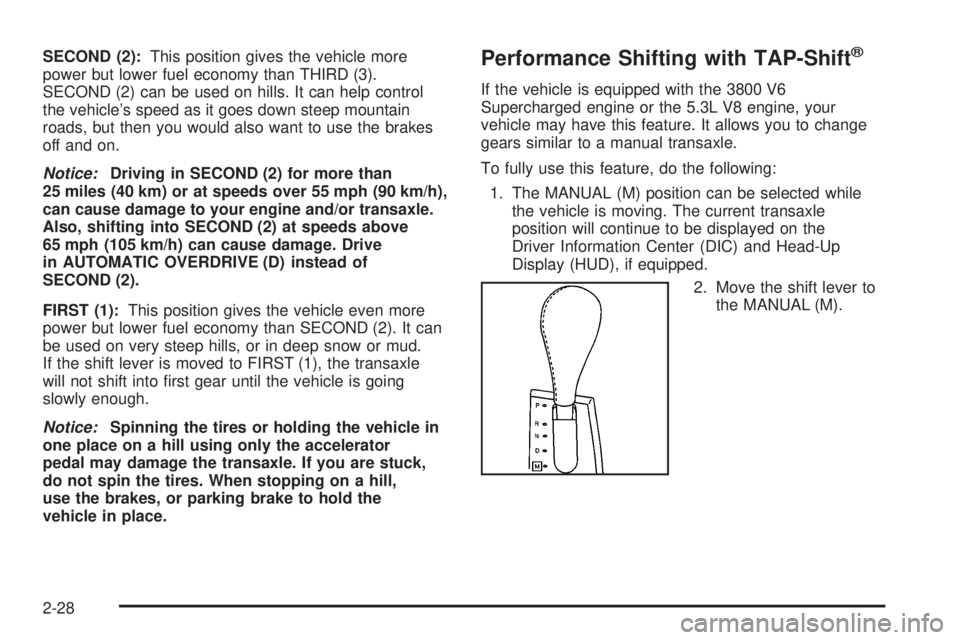
1. The MANUAL (M) position can be selected while
the vehicle is moving. The current transaxle
position will continue to be displayed on the
Driver Information Center (DIC) and Head-Up
Display (HUD), if equipped.
2. Move the shift lever to
the MANUAL (M).
2-28
Page 104 of 472
Parking Brake
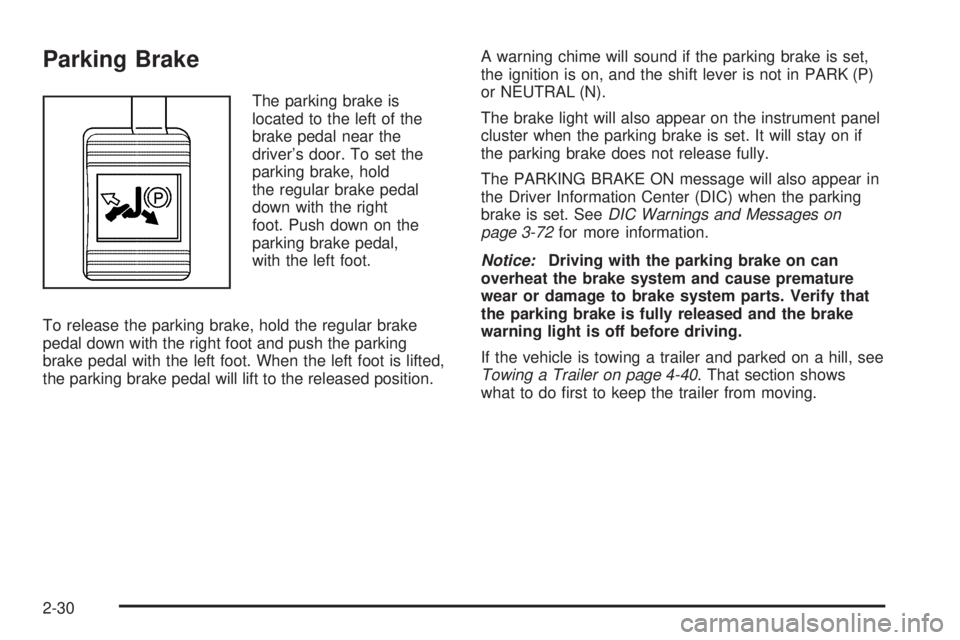
The parking brake is
located to the left of the
brake pedal near the
driver’s door. To set the
parking brake, hold
the regular brake pedal
down with the right
foot. Push down on the
parking brake pedal,
with the left foot.
To release the parking brake, hold the regular brake
pedal down with the right foot and push the parking
brake pedal with the left foot. When the left foot is lifted,
the parking brake pedal will lift to the released position.A warning chime will sound if the parking brake is set,
the ignition is on, and the shift lever is not in PARK (P)
or NEUTRAL (N).
The brake light will also appear on the instrument panel
cluster when the parking brake is set. It will stay on if
the parking brake does not release fully.
The PARKING BRAKE ON message will also appear in
the Driver Information Center (DIC) when the parking
brake is set. SeeDIC Warnings and Messages on
page 3-72for more information.
Notice:Driving with the parking brake on can
overheat the brake system and cause premature
wear or damage to brake system parts. Verify that
the parking brake is fully released and the brake
warning light is off before driving.
If the vehicle is towing a trailer and parked on a hill, see
Towing a Trailer on page 4-40. That section shows
what to do rst to keep the trailer from moving.
2-30
Page 105 of 472

Shifting Into Park (P)
{CAUTION:
It can be dangerous to get out of your vehicle if
the shift lever is not fully in PARK (P) with the
parking brake rmly set. Your vehicle can roll. If
you have left the engine running, the vehicle
can move suddenly. You or others could be
injured. To be sure your vehicle will not move,
even when you are on fairly level ground, use
the steps that follow. If you are pulling a trailer,
seeTowing a Trailer on page 4-40.
1. Hold the brake pedal down with your right foot and
set the parking brake.
2. Move the shift lever into PARK (P) by holding in the
button on the shift lever and pushing the shift lever
all the way toward the front of the vehicle.
3. Turn the ignition key to OFF.
4. Remove the key and take it with you. If you can
leave your vehicle with the ignition key in your
hand, your vehicle is in PARK (P).
Leaving Your Vehicle With the
Engine Running
{CAUTION:
It can be dangerous to leave your vehicle with
the engine running. Your vehicle could move
suddenly if the shift lever is not fully in
PARK (P) with the parking brake rmly set.
And, if you leave the vehicle with the engine
running, it could overheat and even catch re.
You or others could be injured. Do not leave
your vehicle with the engine running.
If you have to leave your vehicle with the engine
running, be sure your vehicle is in PARK (P) and your
parking brake is rmly set before you leave it. After you
have moved the shift lever into PARK (P), hold the
regular brake pedal down. Then, see if you can move
the shift lever away from PARK (P) without rst pushing
the button.
If you can, it means that the shift lever was not fully
locked in PARK (P).
2-31
Page 106 of 472

Torque Lock
If you are parking on a hill and you do not shift your
transaxle into PARK (P) properly, the weight of the
vehicle may put too much force on the parking pawl in
the transaxle. You may nd it difficult to pull the shift
lever out of PARK (P). This is called torque lock.
To prevent torque lock, set the parking brake and then
shift into PARK (P) properly before you leave the
driver’s seat. To nd out how, seeShifting Into Park (P)
on page 2-31.
When you are ready to drive, move the shift lever out of
PARK (P)beforeyou release the parking brake.
If torque lock does occur, you may need to have another
vehicle push your vehicle a little uphill to take some of
the pressure from the parking pawl in the transaxle,
so you can pull the shift lever out of PARK (P).
Shifting Out of Park (P)
The vehicle has an automatic transaxle shift lock control
system which locks the shift lever in PARK (P) when
the ignition is in OFF. In addition, the regular brakes
must be fully applied before shifting from PARK (P) while
the ignition is in RUN. SeeAutomatic Transaxle
Operation on page 2-25.
If the vehicle cannot be shifted out of PARK (P), ease
pressure on the shift lever and push the shift lever all the
way up into PARK (P) as brake application is maintained.
Then move the shift lever into the desired gear.
If the brake pedal is held down but the vehicle still
cannot be shifted out of PARK (P), try this:
1. Turn the key to ACC.
2. Apply and hold the brake until the end of Step 4.
3. Shift the transaxle to NEUTRAL (N).
4. Start the vehicle and then shift to the desired
transaxle gear.
5. Have the system xed as soon as possible.
2-32
Page 108 of 472

Running the Engine While Parked
It is better not to park with the engine running. But if you
ever have to, here are some things to know.
{CAUTION:
Idling the engine with the climate control
system off could allow dangerous exhaust into
your vehicle. See the earlier caution under
Engine Exhaust on page 2-33.
Also, idling in a closed-in place can let deadly
carbon monoxide (CO) into your vehicle even if
the climate control fan is at the highest setting.
One place this can happen is a garage.
Exhaust — with CO — can come in easily.
NEVER park in a garage with the engine
running.
Another closed-in place can be a blizzard. See
Winter Driving on page 4-28.
{CAUTION:
It can be dangerous to get out of your vehicle
if the shift lever is not fully in PARK (P) with
the parking brake rmly set. Your vehicle can
roll. Do not leave your vehicle when the engine
is running unless you have to. If you have left
the engine running, the vehicle can move
suddenly. You or others could be injured. To
be sure your vehicle will not move, even when
you are on fairly level ground, always set your
parking brake and move the shift lever to
PARK (P).
Follow the proper steps to be sure your vehicle will not
move. SeeShifting Into Park (P) on page 2-31.
If you are parking on a hill and if you are pulling a
trailer, also seeTowing a Trailer on page 4-40.
2-34
Page 130 of 472

Cruise control will not work if your parking brake is set,
or if the master cylinder brake uid level is low.
{CAUTION:
Cruise control can be dangerous where you
cannot drive safely at a steady speed. So, do
not use your cruise control on winding roads
or in heavy traffic.
Cruise control can be dangerous on slippery
roads. On such roads, fast changes in tire
traction can cause needless wheel spinning,
and you could lose control. Do not use cruise
control on slippery roads.
If your vehicle is in cruise control when the traction
control system (if equipped) begins to limit wheel spin,
the cruise control will automatically disengage. See
Traction Control System (TCS) on page 4-9. When road
conditions allow you to safely use it again, you may
turn cruise control back on.
Setting Cruise Control
{CAUTION:
If you leave your cruise control on when you
are not using cruise, you might hit a button
and go into cruise when you do not want to.
You could be startled and even lose control.
Keep the cruise control switch off until you
want to use cruise control.
1. Move the cruise control switch to on.
2. Get up to the speed you want.
3. Press in the set button at the end of the lever and
release it.
4. Take your foot off the accelerator pedal.
This symbol, along with
the CRUISE SET
message, will briey
appear in the Driver
Information Center (DIC)
when the cruise
control is set.
3-12