2006 MERCEDES-BENZ SPRINTER instrument cluster
[x] Cancel search: instrument clusterPage 130 of 2305
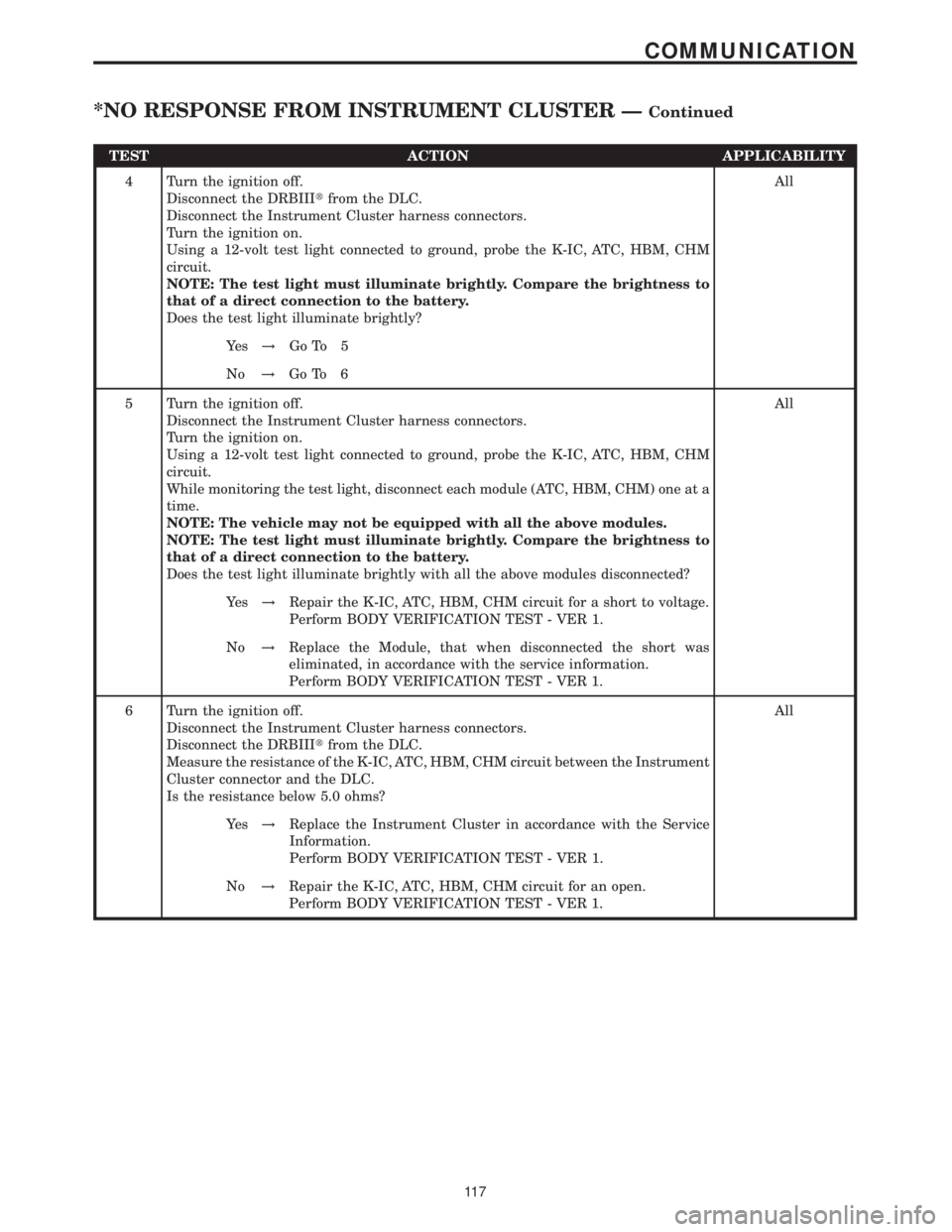
TEST ACTION APPLICABILITY
4 Turn the ignition off.
Disconnect the DRBIIItfrom the DLC.
Disconnect the Instrument Cluster harness connectors.
Turn the ignition on.
Using a 12-volt test light connected to ground, probe the K-IC, ATC, HBM, CHM
circuit.
NOTE: The test light must illuminate brightly. Compare the brightness to
that of a direct connection to the battery.
Does the test light illuminate brightly?All
Ye s!Go To 5
No!Go To 6
5 Turn the ignition off.
Disconnect the Instrument Cluster harness connectors.
Turn the ignition on.
Using a 12-volt test light connected to ground, probe the K-IC, ATC, HBM, CHM
circuit.
While monitoring the test light, disconnect each module (ATC, HBM, CHM) one at a
time.
NOTE: The vehicle may not be equipped with all the above modules.
NOTE: The test light must illuminate brightly. Compare the brightness to
that of a direct connection to the battery.
Does the test light illuminate brightly with all the above modules disconnected?All
Ye s!Repair the K-IC, ATC, HBM, CHM circuit for a short to voltage.
Perform BODY VERIFICATION TEST - VER 1.
No!Replace the Module, that when disconnected the short was
eliminated, in accordance with the service information.
Perform BODY VERIFICATION TEST - VER 1.
6 Turn the ignition off.
Disconnect the Instrument Cluster harness connectors.
Disconnect the DRBIIItfrom the DLC.
Measure the resistance of the K-IC, ATC, HBM, CHM circuit between the Instrument
Cluster connector and the DLC.
Is the resistance below 5.0 ohms?All
Ye s!Replace the Instrument Cluster in accordance with the Service
Information.
Perform BODY VERIFICATION TEST - VER 1.
No!Repair the K-IC, ATC, HBM, CHM circuit for an open.
Perform BODY VERIFICATION TEST - VER 1.
11 7
COMMUNICATION
*NO RESPONSE FROM INSTRUMENT CLUSTER ÐContinued
Page 144 of 2305
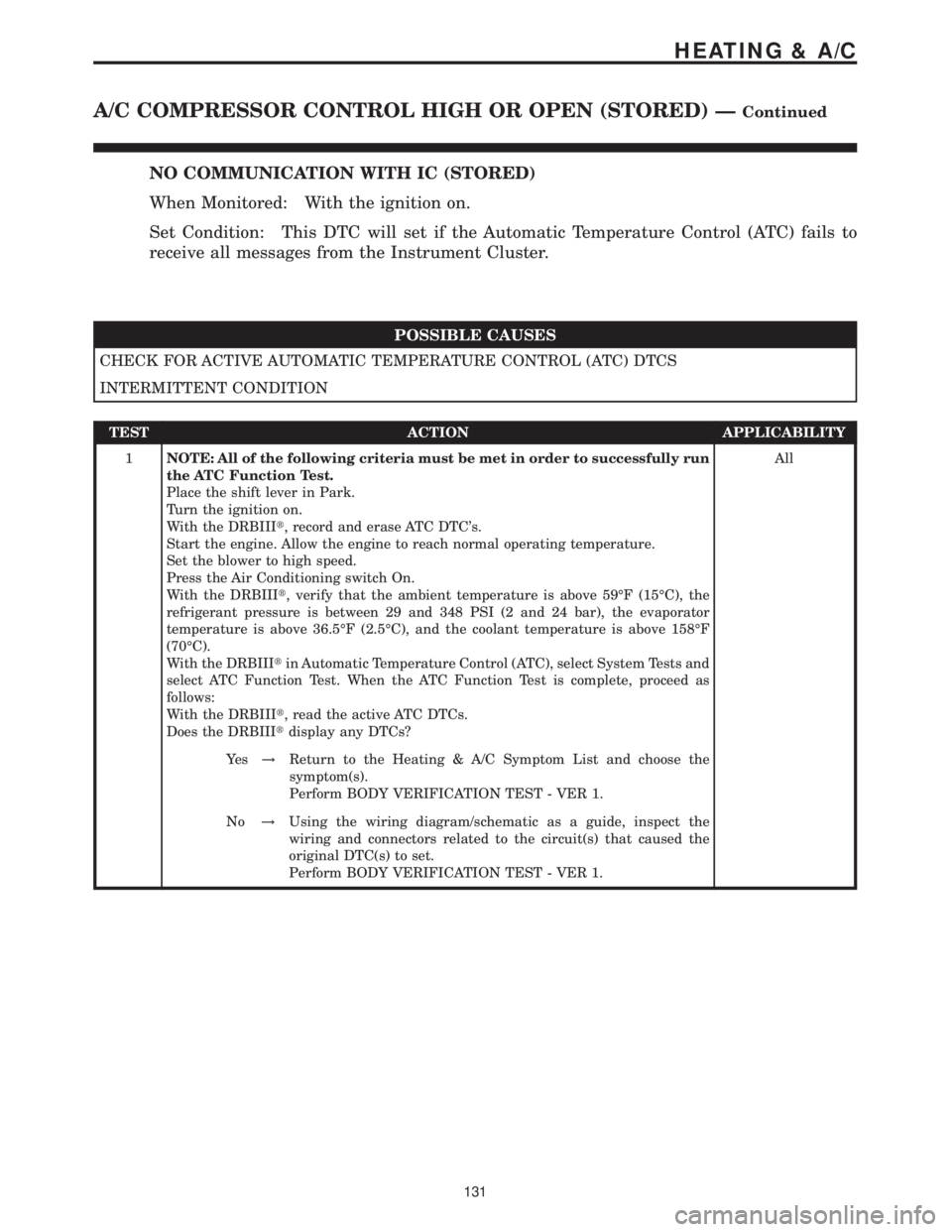
NO COMMUNICATION WITH IC (STORED)
When Monitored: With the ignition on.
Set Condition: This DTC will set if the Automatic Temperature Control (ATC) fails to
receive all messages from the Instrument Cluster.
POSSIBLE CAUSES
CHECK FOR ACTIVE AUTOMATIC TEMPERATURE CONTROL (ATC) DTCS
INTERMITTENT CONDITION
TEST ACTION APPLICABILITY
1NOTE: All of the following criteria must be met in order to successfully run
the ATC Function Test.
Place the shift lever in Park.
Turn the ignition on.
With the DRBIIIt, record and erase ATC DTC's.
Start the engine. Allow the engine to reach normal operating temperature.
Set the blower to high speed.
Press the Air Conditioning switch On.
With the DRBIIIt, verify that the ambient temperature is above 59ÉF (15ÉC), the
refrigerant pressure is between 29 and 348 PSI (2 and 24 bar), the evaporator
temperature is above 36.5ÉF (2.5ÉC), and the coolant temperature is above 158ÉF
(70ÉC).
With the DRBIIItin Automatic Temperature Control (ATC), select System Tests and
select ATC Function Test. When the ATC Function Test is complete, proceed as
follows:
With the DRBIIIt, read the active ATC DTCs.
Does the DRBIIItdisplay any DTCs?All
Ye s!Return to the Heating & A/C Symptom List and choose the
symptom(s).
Perform BODY VERIFICATION TEST - VER 1.
No!Using the wiring diagram/schematic as a guide, inspect the
wiring and connectors related to the circuit(s) that caused the
original DTC(s) to set.
Perform BODY VERIFICATION TEST - VER 1.
131
HEATING & A/C
A/C COMPRESSOR CONTROL HIGH OR OPEN (STORED) ÐContinued
Page 173 of 2305
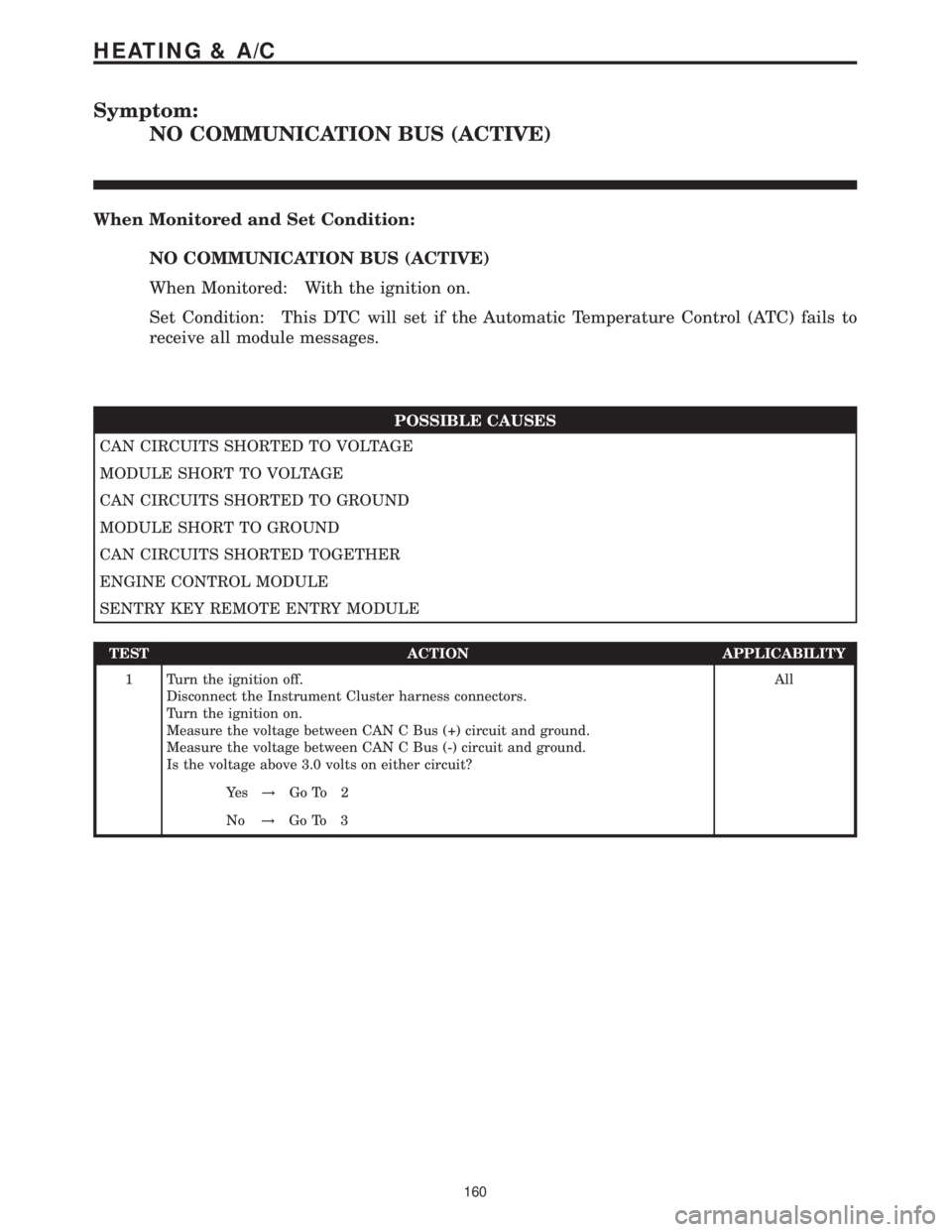
Symptom:
NO COMMUNICATION BUS (ACTIVE)
When Monitored and Set Condition:
NO COMMUNICATION BUS (ACTIVE)
When Monitored: With the ignition on.
Set Condition: This DTC will set if the Automatic Temperature Control (ATC) fails to
receive all module messages.
POSSIBLE CAUSES
CAN CIRCUITS SHORTED TO VOLTAGE
MODULE SHORT TO VOLTAGE
CAN CIRCUITS SHORTED TO GROUND
MODULE SHORT TO GROUND
CAN CIRCUITS SHORTED TOGETHER
ENGINE CONTROL MODULE
SENTRY KEY REMOTE ENTRY MODULE
TEST ACTION APPLICABILITY
1 Turn the ignition off.
Disconnect the Instrument Cluster harness connectors.
Turn the ignition on.
Measure the voltage between CAN C Bus (+) circuit and ground.
Measure the voltage between CAN C Bus (-) circuit and ground.
Is the voltage above 3.0 volts on either circuit?All
Ye s!Go To 2
No!Go To 3
160
HEATING & A/C
Page 174 of 2305
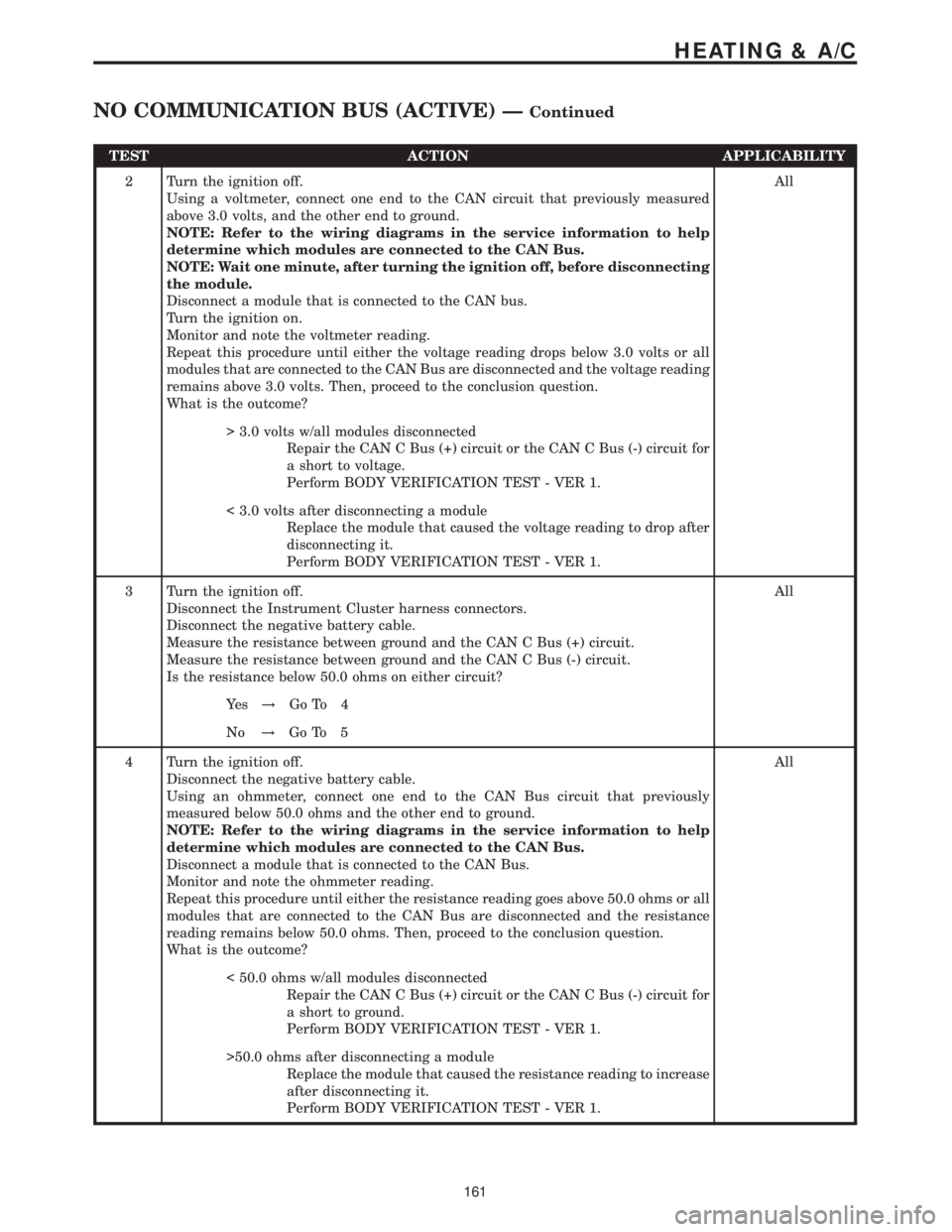
TEST ACTION APPLICABILITY
2 Turn the ignition off.
Using a voltmeter, connect one end to the CAN circuit that previously measured
above 3.0 volts, and the other end to ground.
NOTE: Refer to the wiring diagrams in the service information to help
determine which modules are connected to the CAN Bus.
NOTE: Wait one minute, after turning the ignition off, before disconnecting
the module.
Disconnect a module that is connected to the CAN bus.
Turn the ignition on.
Monitor and note the voltmeter reading.
Repeat this procedure until either the voltage reading drops below 3.0 volts or all
modules that are connected to the CAN Bus are disconnected and the voltage reading
remains above 3.0 volts. Then, proceed to the conclusion question.
What is the outcome?All
> 3.0 volts w/all modules disconnected
Repair the CAN C Bus (+) circuit or the CAN C Bus (-) circuit for
a short to voltage.
Perform BODY VERIFICATION TEST - VER 1.
< 3.0 volts after disconnecting a module
Replace the module that caused the voltage reading to drop after
disconnecting it.
Perform BODY VERIFICATION TEST - VER 1.
3 Turn the ignition off.
Disconnect the Instrument Cluster harness connectors.
Disconnect the negative battery cable.
Measure the resistance between ground and the CAN C Bus (+) circuit.
Measure the resistance between ground and the CAN C Bus (-) circuit.
Is the resistance below 50.0 ohms on either circuit?All
Ye s!Go To 4
No!Go To 5
4 Turn the ignition off.
Disconnect the negative battery cable.
Using an ohmmeter, connect one end to the CAN Bus circuit that previously
measured below 50.0 ohms and the other end to ground.
NOTE: Refer to the wiring diagrams in the service information to help
determine which modules are connected to the CAN Bus.
Disconnect a module that is connected to the CAN Bus.
Monitor and note the ohmmeter reading.
Repeat this procedure until either the resistance reading goes above 50.0 ohms or all
modules that are connected to the CAN Bus are disconnected and the resistance
reading remains below 50.0 ohms. Then, proceed to the conclusion question.
What is the outcome?All
< 50.0 ohms w/all modules disconnected
Repair the CAN C Bus (+) circuit or the CAN C Bus (-) circuit for
a short to ground.
Perform BODY VERIFICATION TEST - VER 1.
>50.0 ohms after disconnecting a module
Replace the module that caused the resistance reading to increase
after disconnecting it.
Perform BODY VERIFICATION TEST - VER 1.
161
HEATING & A/C
NO COMMUNICATION BUS (ACTIVE) ÐContinued
Page 178 of 2305
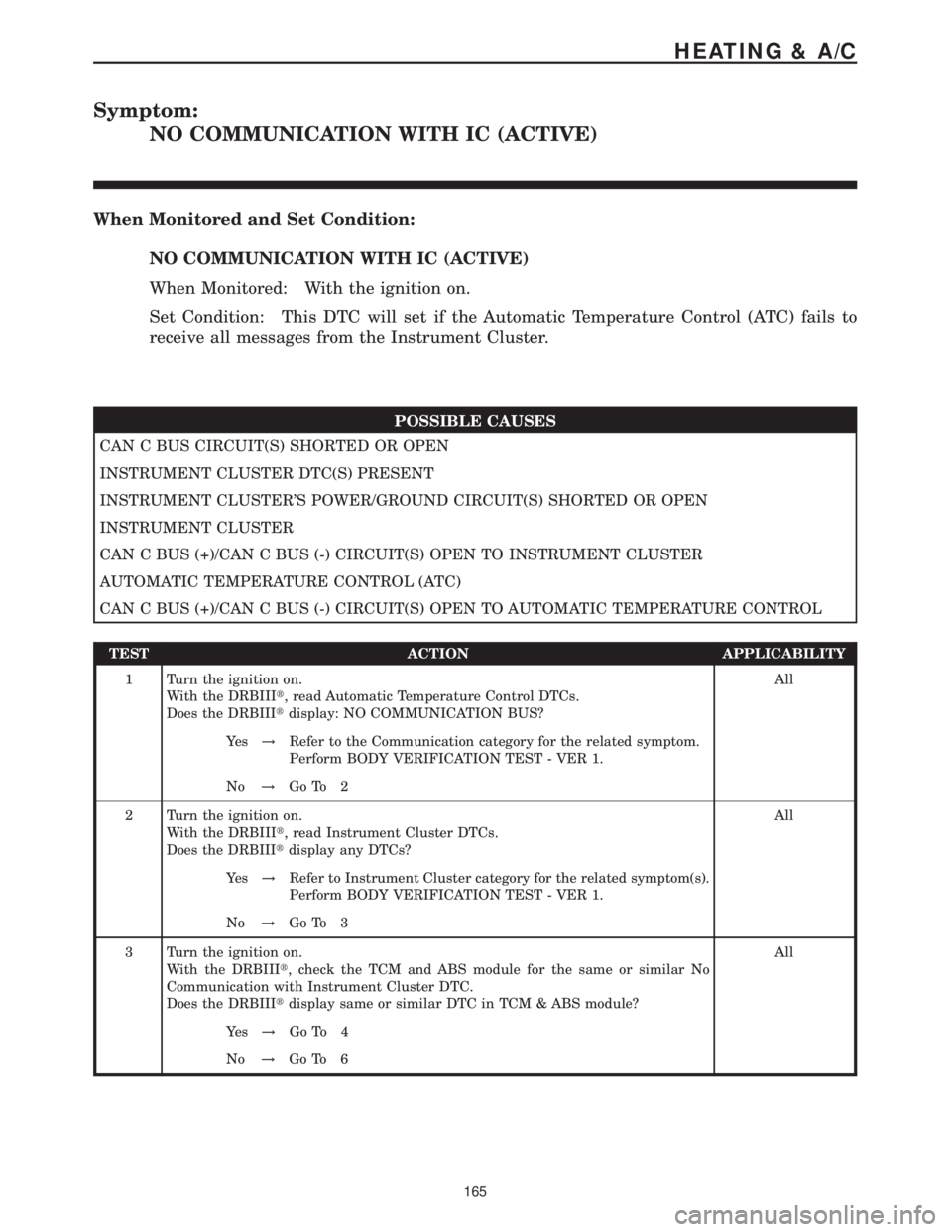
Symptom:
NO COMMUNICATION WITH IC (ACTIVE)
When Monitored and Set Condition:
NO COMMUNICATION WITH IC (ACTIVE)
When Monitored: With the ignition on.
Set Condition: This DTC will set if the Automatic Temperature Control (ATC) fails to
receive all messages from the Instrument Cluster.
POSSIBLE CAUSES
CAN C BUS CIRCUIT(S) SHORTED OR OPEN
INSTRUMENT CLUSTER DTC(S) PRESENT
INSTRUMENT CLUSTER'S POWER/GROUND CIRCUIT(S) SHORTED OR OPEN
INSTRUMENT CLUSTER
CAN C BUS (+)/CAN C BUS (-) CIRCUIT(S) OPEN TO INSTRUMENT CLUSTER
AUTOMATIC TEMPERATURE CONTROL (ATC)
CAN C BUS (+)/CAN C BUS (-) CIRCUIT(S) OPEN TO AUTOMATIC TEMPERATURE CONTROL
TEST ACTION APPLICABILITY
1 Turn the ignition on.
With the DRBIIIt, read Automatic Temperature Control DTCs.
Does the DRBIIItdisplay: NO COMMUNICATION BUS?All
Ye s!Refer to the Communication category for the related symptom.
Perform BODY VERIFICATION TEST - VER 1.
No!Go To 2
2 Turn the ignition on.
With the DRBIIIt, read Instrument Cluster DTCs.
Does the DRBIIItdisplay any DTCs?All
Ye s!Refer to Instrument Cluster category for the related symptom(s).
Perform BODY VERIFICATION TEST - VER 1.
No!Go To 3
3 Turn the ignition on.
With the DRBIIIt, check the TCM and ABS module for the same or similar No
Communication with Instrument Cluster DTC.
Does the DRBIIItdisplay same or similar DTC in TCM & ABS module?All
Ye s!Go To 4
No!Go To 6
165
HEATING & A/C
Page 179 of 2305
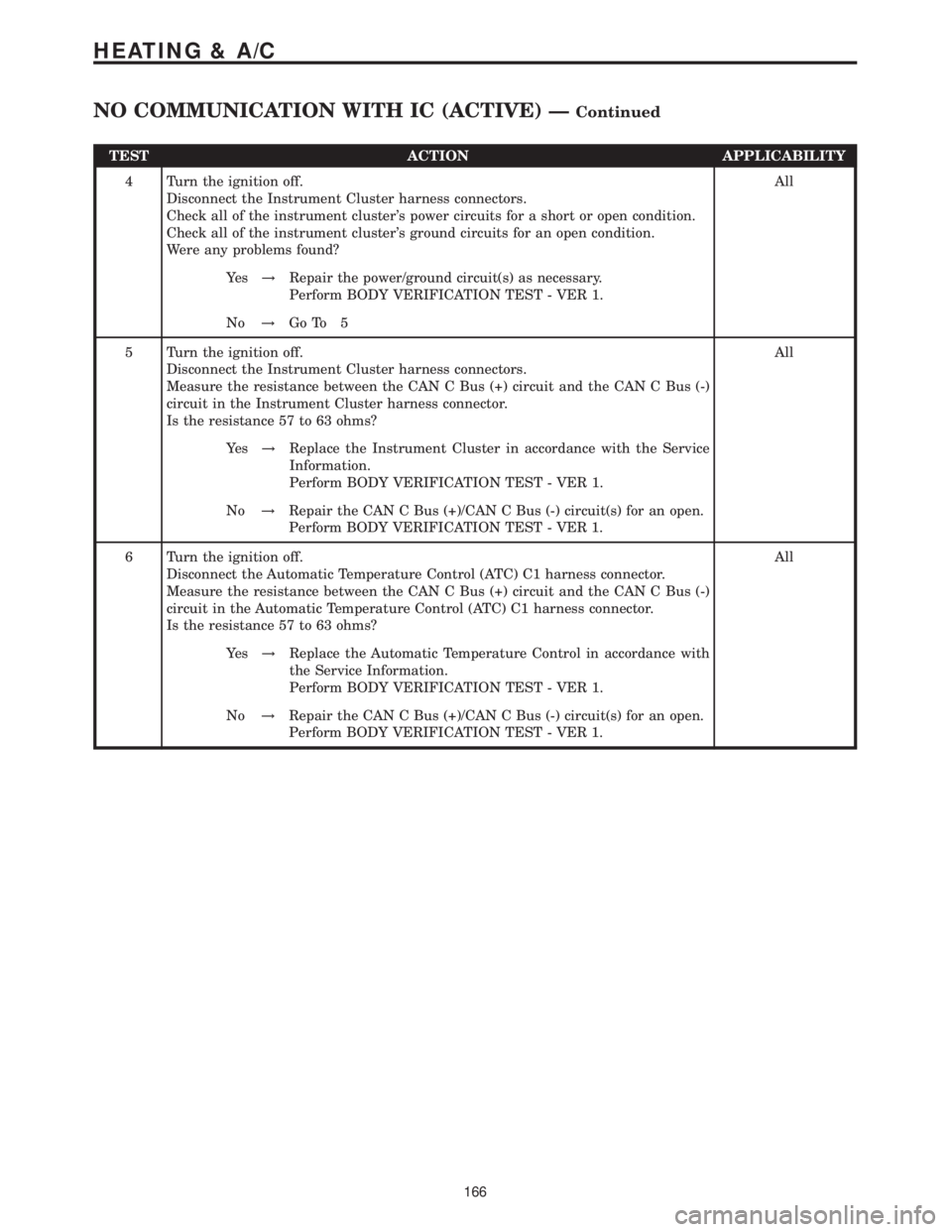
TEST ACTION APPLICABILITY
4 Turn the ignition off.
Disconnect the Instrument Cluster harness connectors.
Check all of the instrument cluster's power circuits for a short or open condition.
Check all of the instrument cluster's ground circuits for an open condition.
Were any problems found?All
Ye s!Repair the power/ground circuit(s) as necessary.
Perform BODY VERIFICATION TEST - VER 1.
No!Go To 5
5 Turn the ignition off.
Disconnect the Instrument Cluster harness connectors.
Measure the resistance between the CAN C Bus (+) circuit and the CAN C Bus (-)
circuit in the Instrument Cluster harness connector.
Is the resistance 57 to 63 ohms?All
Ye s!Replace the Instrument Cluster in accordance with the Service
Information.
Perform BODY VERIFICATION TEST - VER 1.
No!Repair the CAN C Bus (+)/CAN C Bus (-) circuit(s) for an open.
Perform BODY VERIFICATION TEST - VER 1.
6 Turn the ignition off.
Disconnect the Automatic Temperature Control (ATC) C1 harness connector.
Measure the resistance between the CAN C Bus (+) circuit and the CAN C Bus (-)
circuit in the Automatic Temperature Control (ATC) C1 harness connector.
Is the resistance 57 to 63 ohms?All
Ye s!Replace the Automatic Temperature Control in accordance with
the Service Information.
Perform BODY VERIFICATION TEST - VER 1.
No!Repair the CAN C Bus (+)/CAN C Bus (-) circuit(s) for an open.
Perform BODY VERIFICATION TEST - VER 1.
166
HEATING & A/C
NO COMMUNICATION WITH IC (ACTIVE) ÐContinued
Page 192 of 2305

Symptom:
AMBIENT TEMP SENSOR OPEN/SHORT TO BATTERY
POSSIBLE CAUSES
AMBIENT TEMPERATURE SENSOR SIGNAL (+) CIRCUIT SHORT TO VOLTAGE
AMBIENT TEMPERATURE SENSOR
AMBIENT TEMPERATURE SENSOR SIGNAL RETURN CIRCUIT OPEN
AMBIENT TEMPERATURE SENSOR SIGNAL (+) CIRCUIT OPEN
INSTRUMENT CLUSTER
TEST ACTION APPLICABILITY
1 Turn the ignition off.
Disconnect the Ambient Temperature Sensor harness connector.
Disconnect the Instrument Cluster C1 harness connector.
Measure the voltage between the Ambient Temperature Sensor Signal (+) circuit and
ground.
Is the voltage above 0.2 volts?All
Ye s!Repair the Ambient Temperature Sensor Signal (+) circuit for a
short to voltage.
Perform BODY VERIFICATION TEST - VER 1.
No!Go To 2
2 Disconnect the Ambient Temperature Sensor harness connector.
Connect a jumper wire between the Ambient Temperature Sensor Signal (+) and
Ambient Temperature Sensor Signal Return circuit.
Turn the ignition on, with the DRBIIIt, read DTCs.
Does the DRBIIItdisplay Ambient Temperature Sensor Short to Ground?All
Ye s!Replace the Ambient Temperature Sensor.
Perform BODY VERIFICATION TEST - VER 1.
No!Go To 3
3 Turn the ignition off.
Disconnect the Ambient Temperature Sensor harness connector.
Disconnect the Instrument Cluster C1 harness connector.
Measure the resistance of the Ambient Temperature Sensor Signal Return circuit
between the Instrument Cluster C1 harness connector and the Ambient Temperature
Sensor harness connector.
Is the resistance above 10 ohms?All
Ye s!Repair the Ambient Temperature Sensor Signal Return circuit for
an open.
Perform BODY VERIFICATION TEST - VER 1.
No!Go To 4
179
INSTRUMENT CLUSTER
Page 193 of 2305

TEST ACTION APPLICABILITY
4 Turn the ignition off.
Disconnect the Instrument Cluster C1 harness connector.
Disconnect the Ambient Temperature Sensor harness connector.
Measure the resistance of the Ambient Temperature Sensor Signal (+) circuit
between the Instrument Cluster C1 harness connector and the Ambient Temperature
Sensor harness connector.
Is the resistance above 10 ohms?All
Ye s!Repair the Ambient Temperature Sensor Signal (+) circuit for an
open.
Perform BODY VERIFICATION TEST - VER 1.
No!Replace the Instrument Cluster in accordance with the Service
Information.
Perform BODY VERIFICATION TEST - VER 1.
180
INSTRUMENT CLUSTER
AMBIENT TEMP SENSOR OPEN/SHORT TO BATTERY ÐContinued