Page 595 of 651

CHASSIS
574
1Tire size: For details, see “Tire size” on page
575.
2DOT and Tire Identification Number (TIN): For
details, see “DOT and Tire Identification Number
(TIN)” on page 575.
3Location of the tread wear indicators: For
details, see “Checking and replacing tires” on
page 585.
4Tire ply composition and materials: Plies mean
a layer of rubber −coated parallel cords. Cords
mean the strands forming the plies in the tire.
5Radial tires or biasply tires — A radial tire has
“RADIAL” on the sidewall. A tire not marked with
“RADIAL” is a bias−ply tire.
6“TUBELESS” or “TUBE TYPE”: A tubeless tire
does not have a tube inside the tire and air is
directly filled in the tire. A tube type tire has a
tube inside the tire and the tube maintains the
air pressure.
7Load limit at maximum cold tire inflation
pressure: For details, see “Checking and
replacing tires” on page 585.
8Maximum cold tire inflation pressure: This
means the pressure to which a tire may be
inflated. For details about recommended cold tire
inflation pressure, see “Specifications” on page
564.
9Uniform tire quality grading — For details, see
“Uniform tire quality grading” that follows.
10Summer tire or all season tire: An all season
tire has “M+S” on the sidewall. The tire not
marked with “M+S” is a summer tire. For details,
see “Types of tires” on page 583.
Page 599 of 651
CHASSIS
578
Temperature A, B, C — The temperature grades are
A (the highest), B, and C, representing the tire’s
resistance to the generation of heat and its ability to
dissipate heat when tested under controlled conditions
on a specified indoor laboratory test wheel. Sustained
high temperature can cause the material of the tire
to degenerate and reduce tire life, and excessive
temperature can lead to sudden tire failure. The
grade C corresponds to a level of performance which
all passenger car tires must meet under the Federal
Motor Vehicle Safety Standard No. 109. Grades B
and A represent higher levels of performance on the
laboratory test wheel than the minimum required by
law.
Warning: The temperature grades for this tire are
established for a tire that is properly inflated and not
overloaded. Excessive speed, underinflation, or
excessive loading, either separately or in combination,
can cause heat buildup and possible tire failure.
Page 600 of 651

of automatic transmission, power steer")
CHASSIS
579
Glossary of tire terminology
Tire related termMeaning
Accessory weightthe combined weight (in excess of those standard items which may be rep\
laced)
of automatic transmission, power steering, power brakes, power windows, \
power
seats, radio, and heater, to the extent that these items are available as
factory−installed equipment (whether installed or not)
Cold tire inflation
pressuretire inflation pressure when the vehicle has been parked for at least 3 \
hours or
more, or it has not been driven more than 1.5 km or 1 mile under that co\
ndition
Curb weightthe weight of a motor vehicle with standard equipment including the maxi\
mum
capacity of fuel, oil, and coolant, and, if so equipped, air conditionin\
g and
additional weight optional engine
Intended outboard
sidewall(a) the sidewall that contains a whitewall, bears white lettering or bearsmanufacturer, brand, and/or model name molding that is higher or deeper
than the same molding on the other sidewall of the tire, or
(b) the outward facing sidewall of an asymmetrical tire that has a particula\
r side that must always face outward when mounted on a vehicle
Maximum inflation
pressurethe maximum cold inflation pressure to which a tire may be inflated and \
it is
shown on the sidewall of the tire
Maximum loaded
vehicle weightthe sum of —
(a) curb weight;
(b) accessory weight;
(c) vehicle capacity weight; and
(d) production options weight
Page 601 of 651
 times the number of occupants specified in the second \
column of
Table 1 that follows
Occupant distributiondistribution of o")
CHASSIS
580
Tire related termMeaning
Normal occupant
weight68 kg (150 lb.) times the number of occupants specified in the second \
column of
Table 1 that follows
Occupant distributiondistribution of occupants in a vehicle as specified in the third column \
of Table 1
that follows
Production options
weightthe combined weight of those installed regular production options weighi\
ng over
2.3 kg (5 lb.) in excess of those standard items which they replace, n\
ot
previously considered in curb weight or accessory weight, including heav\
y duty
brakes, ride levelers, roof rack, heavy duty battery, and special trim
Recommended
inflation pressurecold tire inflation pressure recommended by a manufacturer
Rima metal support for a tire or a tire and tube assembly upon which the ti\
re beads
are seated
Rim diameter (Wheel
diameter)nominal diameter of the bead seat
Rim size designationrim diameter and width
Rim type designationthe industry of manufacturer’s designation for a rim by style or code
Rim widthnominal distance between rim flanges
Page 602 of 651
CHASSIS
581
Tire related termMeaning
Vehicle capacity
weight
(Total load capacity)the rated cargo and luggage load plus 68 kg (150 lb.) times the vehicl\
e’s
designated seating capacity
Vehicle maximum
load on the tirethe load on an individual tire that is determined by distributing to eac\
h axle its
share of the maximum loaded vehicle weight and dividing by two
Vehicle normal load
on the tirethe load on an individual tire that is determined by distributing to eac\
h axle its
share of the curb weight, accessory weight, and normal occupant weight
(distributed in accordance with Table 1 that follows) and dividing by two
Weather sidethe surface area of the rim not covered by the inflated tire
Page 606 of 651
CHASSIS
585
CHECKING AND REPLACING TIRES
When to replace your tires
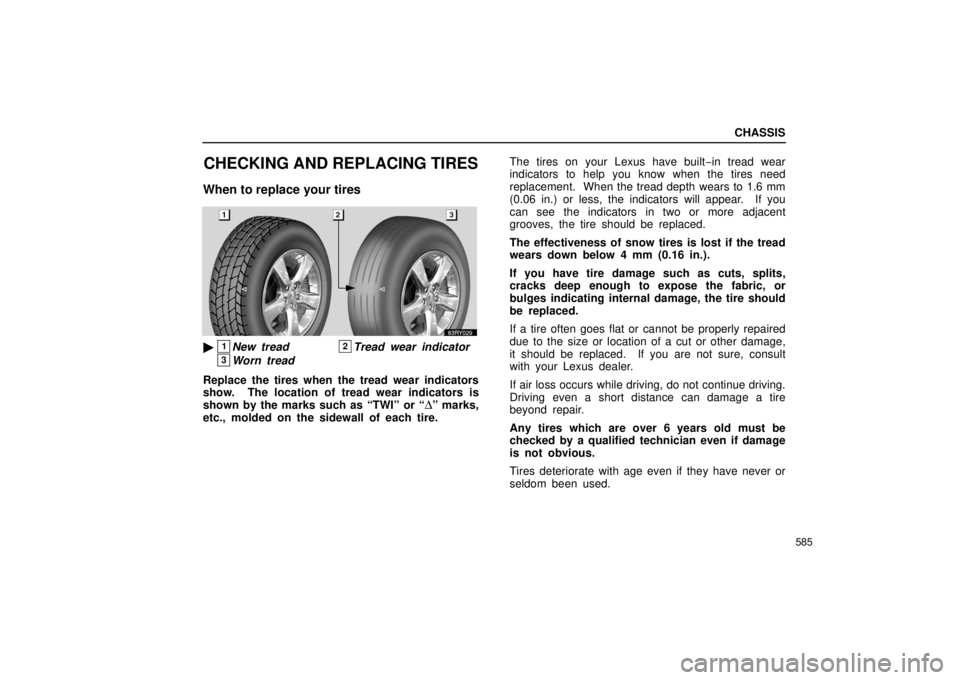
�1New tread2Tread wear indicator
3Worn tread
Replace the tires when the tread wear indicators
show. The location of tread wear indicators is
shown by the marks such as “TWI” or “
Δ” marks,
etc., molded on the sidewall of each tire. The tires on your Lexus have built
−in tread wear
indicators to help you know when the tires need
replacement. When the tread depth wears to 1.6 mm
(0.06 in.) or less, the indicators will appear. If you
can see the indicators in two or more adjacent
grooves, the tire should be replaced.
The effectiveness of snow tires is lost if the tread
wears down below 4 mm (0.16 in.).
If you have tire damage such as cuts, splits,
cracks deep enough to expose the fabric, or
bulges indicating internal damage, the tire should
be replaced.
If a tire often goes flat or cannot be properly repaired
due to the size or location of a cut or other damage,
it should be replaced. If you are not sure, consult
with your Lexus dealer.
If air loss occurs while driving, do not continue driving.
Driving even a short distance can damage a tire
beyond repair.
Any tires which are over 6 years old must be
checked by a qualified technician even if damage
is not obvious.
Tires deteriorate with age even if they have never or
seldom been used.
Page 607 of 651

CHASSIS
586
This applies also to the spare tire and tires stored
for future use.
Tire selection
When replacing a tire, use a tire of the same size
and construction, and the same or greater
maximum load as the originally installed tires.
Also, on fourwheel drive models, all the tires
must be the same brand and have the same tread
patterns.
Using any other size or type of tire may seriously
affect handling, ride, speedometer/odometer
calibration, ground clearance, and clearance between
the body and tires or snow chains.
Check that the maximum load of the replaced tire is
greater than 1/2 of the Gross Axle Weight Ratings
(GAWR) of either the front axle or the rear axle,
whichever is greater. As for the maximum load of
the tire, see the load limit at maximum cold tire
inflation pressure mentioned on the sidewall of the tire,
and as for the Gross Axle Weight Ratings (GAWR),
see the Certification Label. For details about
Certification Label and sidewall of the tire, see pages
536 and 573.
CAUTION
Observe the following instructions. Otherwise,
an accident may occur resulting in death or
serious injuries.
�Do not mix radial, bias belted, or biasply tires
on your vehicle, as this may cause dangerous
handling characteristics resulting in loss of
control.
� Do not use tires other than the manufacturer’s
recommended size, as this may cause
dangerous handling characteristics resulting
in loss of control.
� Fourwheel drive models:
Do not use tires of different brands, sizes,
construction or tread patterns, as this may
cause dangerous handling characteristics
resulting in loss of control.
Page 609 of 651
CHASSIS
588
Snow tire installation
Snow tires should be installed on all wheels.
Installing snow tires on the front wheels only can lead to an
excessive difference in road grip capability between the front
and rear tires which could cause loss of vehicle control.
CAUTION
�Snow tires should be inflated to the same pressure as
the original tires.
� Never drive over 120 km/h (75 mph) with any type of
snow tires.
Tire chain selection
�1Side chain2Cross chain
Use the tire chains of correct size.
For 225/65R17 101S or P235/55R18 99V tires, use the
following type chains. mm (in.)
A: Diameter of side chain 3.0 (0.12)
B: Width of side chain 10.0 (0.39)
C: Length of side chain 30.0 (1.18)
D: Width of cross chain 14.0 (0.55)
E: Length of cross chain 25.0 (0.98)
F: Diameter of cross chain 4.0 (0.16)

the rated cargo and luggage load plus 68 kg (150 lb.) times the vehicl\
e’s
designated seating capacity
Vehicle maxi")
