Page 535 of 651
IN CASE OF AN EMERGENCY
514
CAUTION
Before driving, make sure all the tools, jack and
flat tire are securely in place in their storage
location to reduce the possibility of personal
injury during a collision or sudden braking.
IF YOUR VEHICLE BECOMESSTUCK
If your vehicle becomes stuck in snow, mud, sand, etc.,
then you may attempt to rock the vehicle free by moving
it forward and backward.
Twowheel drive models — Turn off the traction control
system to become unstuck to allow the tires to spin
enough to remove the vehicle from the obstruction. (For
details, see “Traction control system” on page 449.)
CAUTION
Do not attempt to rock the vehicle free by moving it
forward and backward if people or objects are anywhere
near the vehicle. During the rocking operation the
vehicle may suddenly move forward or backward as it
becomes unstuck, causing injury or damage to nearby
people or objects.
Page 553 of 651

MAINTENANCE
532
Tire inflation pressure
Check the pressure with a gauge every two weeks,
or at least once a month and adjust as shown on the
tire and loading information label. See page 570 for
additional information.
Tire surface
Check the tires carefully for cuts, damage or
excessive wear. See page 585 for additional
information.
Tire rotation
Rotate the tires according to the maintenance
schedule. (For scheduled maintenance information,
please refer to the “Owner’s Manual Supplement /
Scheduled Maintenance”.) See “Rotating tires” on
page 584.DOES YOUR VEHICLE NEEDREPAIRING?
Be on the alert for changes in performance and sounds, and
visual tip −offs that indicate service is needed. Some important
clues are:
� Engine missing, stumbling, or pinging
� Appreciable loss of power
� Strange engine noises
� A fluid leak under the vehicle (However, water dripping from
the air conditioning after use is normal.)
� Change in exhaust sound (This may indicate a dangerous
carbon monoxide leak. Drive with the windows open and
have the exhaust system checked immediately.)
� Flat−looking tires, excessive tire squeal when cornering,
uneven tire wear
� Vehicle pulls to one side when driving straight on a level
road
� Strange noises related to suspension movement
� Loss of brake effectiveness, spongy feeling brake pedal,
pedal almost touches floors, vehicle pulls to one side when
braking
� Engine coolant temperature continually higher than normal
If you notice any of these clues, take your vehicle to your Lexus
dealer as soon as possible. It probably needs adjustment or
repair.
Page 584 of 651

SECTION 6 – 3
563
SERVICE PROCEDURES AND
SPECIFICATIONS
Chassis
Specifications564
. . . . . . . . . . . . . . . . . . . . . . . . . . . . . . . . . . . . .\
. . . . . .
Checking brake fluid 568
. . . . . . . . . . . . . . . . . . . . . . . . . . . . . . . . . . . . .\
.
Checking power steering fluid 569
. . . . . . . . . . . . . . . . . . . . . . . . . . . . .
Checking tire inflation pressure 570
. . . . . . . . . . . . . . . . . . . . . . . . . . . .
Tire Information 573
. . . . . . . . . . . . . . . . . . . . . . . . . . . . . . . . . . . . .\
. . . . .
Types of tires 583
. . . . . . . . . . . . . . . . . . . . . . . . . . . . . . . . . . . . .\
. . . . . . .
Rotating tires 584
. . . . . . . . . . . . . . . . . . . . . . . . . . . . . . . . . . . . .\
. . . . . . .
Checking and replacing tires 585
. . . . . . . . . . . . . . . . . . . . . . . . . . . . . .
Installing snow tires and chains 587
. . . . . . . . . . . . . . . . . . . . . . . . . . . .
Replacing wheels 590
. . . . . . . . . . . . . . . . . . . . . . . . . . . . . . . . . . . . .\
. . .
Aluminum wheel precautions 591
. . . . . . . . . . . . . . . . . . . . . . . . . . . . . .
Suspension and chassis 591
. . . . . . . . . . . . . . . . . . . . . . . . . . . . . . . . . .
Page 587 of 651
CHASSIS
566
— TIRES AND WHEELS (type A)Tire size
225/65R17 101S
Tire inflation pressure Recommended cold tire inflation
pressure
Front 210 kPa (2.1 kgf/cm2 or bar, 30 psi)
Rear 210 kPa (2.1 kgf/cm2 or bar, 30 psi)
Spare 210 kPa (2.1 kgf/cm2 or bar, 30 psi)
For sustained high speeds above 160 km/h (100 mph), in
countries where such speeds are permitted by law, add 10
kPa (0.1 kgf/cm
2 or bar, 1.5 psi) to the front tires and rear
tires, but never exceed the maximum cold tire pressure
molded on the tire sidewall.
Wheel size17 � 6 1/2 J
Wheel nut torque103 N·m (10.5 kgf·m, 76 ft·lbf)
NOTE:
For complete information on tires (e.g. replacing tires or replacing wh\
eels), see “Checking tire inflation pressure”
through “Aluminum wheel precautions” on pages 570 through 591.
Page 588 of 651
CHASSIS
567
— TIRES AND WHEELS (type B)Tire size
P235/55R18 99V
Tire inflation pressure Recommended cold tire inflation
pressure
Front 210 kPa (2.1 kgf/cm2 or bar, 30 psi)
Rear 210 kPa (2.1 kgf/cm2 or bar, 30 psi)
Spare 210 kPa (2.1 kgf/cm2 or bar, 30 psi)
Wheel size18 x 7 JJ
Wheel nut torque103 N·m (10.5 kgf·m, 76 ft·lbf)
NOTE:
For complete information on tires (e.g. replacing tires or replacing wh\
eels), see “Checking tire inflation pressure”
through “Aluminum wheel precautions” on pages 570 through 591.
Page 591 of 651
CHASSIS
570
CAUTION
The reservoir may be hot so be careful not to burn
yourself.
NOTICE
Avoid overfilling, or the power steering could be
damaged.
CHECKING TIRE INFLATIONPRESSURE
Page 592 of 651

CHASSIS
571
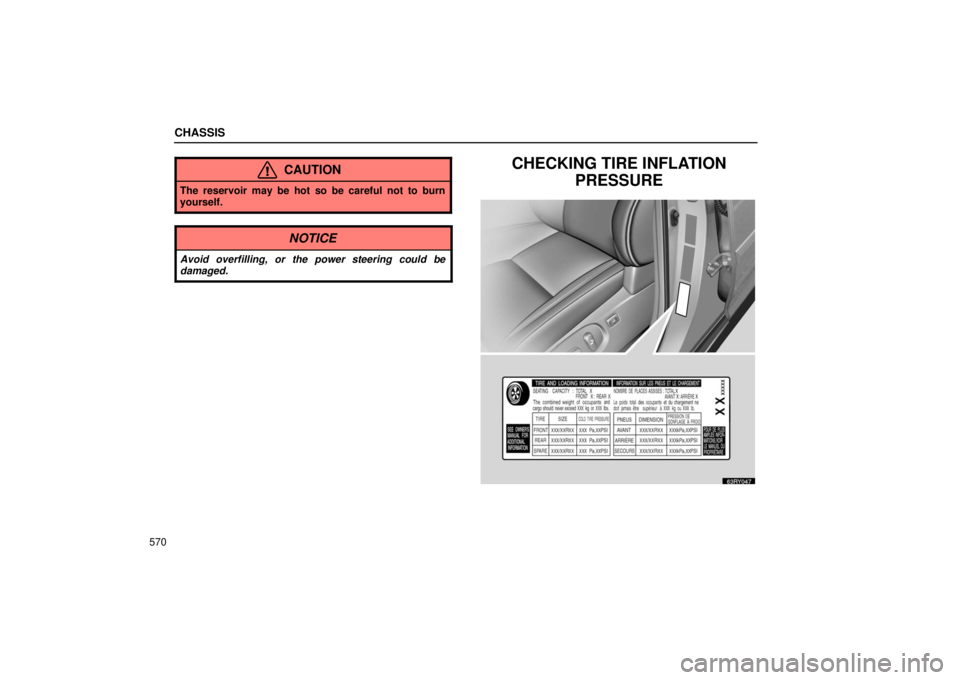
The recommended cold tire inflation pressures,
tire sizes and the combined weight of occupants
and cargo (vehicle capacity weight) are described
on pages 566 and 616. They are also described
on the tire and loading information label as
shown.
You should check the tire inflation pressure every two
weeks, or at least once a month. And do not forget
the spare!
The following instructions for checking tire
inflation pressure should be observed:
�The pressure should be checked only when the
tires are cold. If your vehicle has been parked
for at least 3 hours and has not been driven for
more than 1.5 km or 1 mile since, you will get an
accurate cold tire inflation pressure reading.
� Always use a tire pressure gauge. The
appearance of a tire can be misleading. Besides,
tire inflation pressures that are even just a few
pounds off can degrade handling and ride.
� Do not bleed or reduce tire inflation pressure
after driving. It is normal for the tire inflation
pressure to be higher after driving. �
Never exceed the vehicle capacity weight.
Passengers and luggage weight should be located
so that the vehicle is balanced.
Inspection and adjustment procedure
�1Tire valve
2Tire pressure gauge
1. Remove the tire valve cap.
2. Press the tip of the tire pressure gauge to the tire
valve.
3. Read the pressure using the graduations of the
gauge.
Page 593 of 651

CHASSIS
572
4. In case the tire inflation pressure is not within the
prescribed range, insert the compressed air from the
valve. In case of applying too much air, press the
center of the valve and release the air to adjust.
5. After completing the tire inflation pressure
measurement and adjustment, apply soapy water to
the valve and check for leakage.
6. Install the tire valve cap.
If a gauge and air pump are not available, have your
vehicle checked by your Lexus dealer.
CAUTION
Be sure to reinstall the tire valve caps. Without
the valve caps, dirt or moisture could get into
the valve core and cause air leakage. If the caps
have been lost, have new ones put on as soon
as possible.
Incorrect tire inflation pressure may waste fuel, reduce
the comfort of driving, reduce tire life and make your
vehicle less safe to drive.
If a tire frequently needs refilling, have it checked by
your Lexus dealer.
CAUTION
Keep your tires properly inflated. Otherwise, the
following conditions may occur and cause an
accident resulting in death or serious injuries.
Low tire pressure (underinflation) —
�Excessive wear
� Uneven wear
� Poor handling
� Possibility of blowouts from an overheated
tire
� Poor sealing of the tire bead
� Wheel deformation and/or tire separation
� A greater possibility of tire damage from road
hazards
High tire pressure (overinflation) —
� Poor handling
� Excessive wear
� Uneven wear
� A greater possibility of tire damage from road
hazards