Page 348 of 651

AUDIO
327
(c) Selecting a desired track
�1Remote control button
2DVD player unit
To select a desired track: Push the “
” or “”
(TUNE/TRACK) button until the number of the track you want
to listen to appears on the screen. If you want to return to the
beginning of the current track, quickly push the “
”
(TUNE/TRACK) button or switch one time.
“Fast forward” button: Push the “
” (TUNE/TRACK) button
and hold it to fast forward the CD. When you release the
button, the CD player will resume playing from that position.
“Reverse” button: Push the “
” (TUNE/TRACK) button and
hold it to reverse the CD. When you release the button, the CD
player will resume playing.
Replacing remote control battery
For replacement, use 3 AA batteries.
CAUTION
Special care should be taken that small children do not
swallow the removed battery or components.
NOTICE
� When replacing the battery, be ca reful not to lose the
components.
� Replace only with the same or equivalent type of
battery recommended by a Lexus dealer.
� Dispose of used batteries according to local
regulations.
Page 349 of 651
AUDIO
328
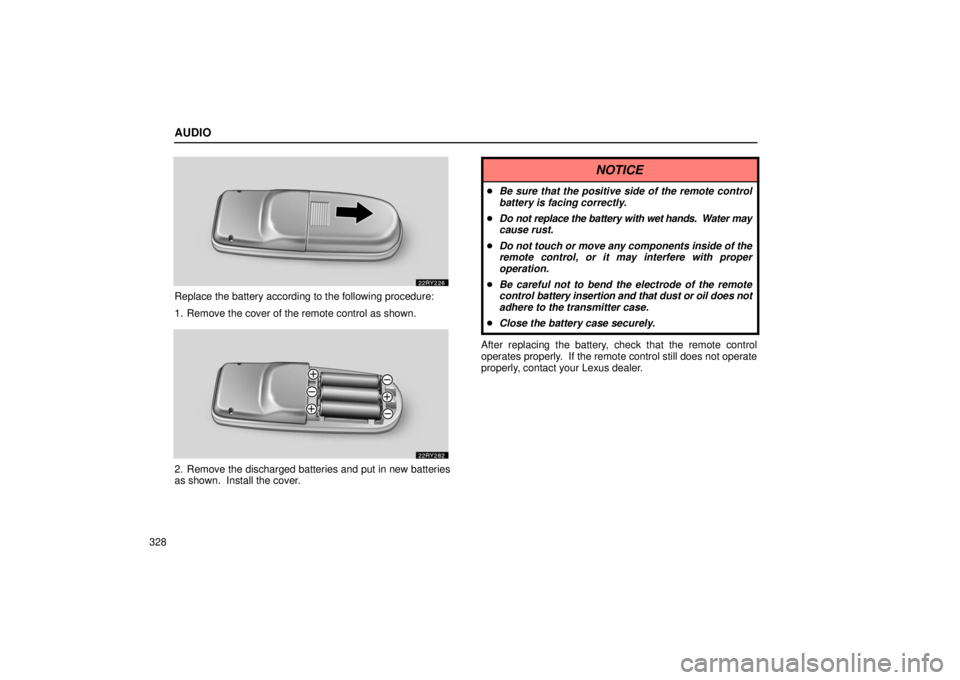
Replace the battery according to the following procedure:
1. Remove the cover of the remote control as shown.
2. Remove the discharged batteries and put in new batteries
as shown. Install the cover.
NOTICE
�Be sure that the positive side of the remote control
battery is facing correctly.
� Do not replace the battery with wet hands. Water may
cause rust.
� Do not touch or move any components inside of the
remote control, or it may interfere with proper
operation.
� Be careful not to bend the electrode of the remote
control battery insertion and that dust or oil does not
adhere to the transmitter case.
� Close the battery case securely.
After replacing the battery, check that the remote control
operates properly. If the remote control still does not operate
properly, contact your Lexus dealer.
Page 391 of 651

AUDIO
370
Power outlet (115 VAC)
This power outlet is designed for use as a power supply
for the audio device connected to the input terminal
adapter.
The key must be in the “ON” position for the power outlet to be
used.
The maximum capacity for this power outlet is 115 VAC/100W.
If you attempt to use an appliance that requires more than 115
VAC or 100W, the protection circuit will activate and cut the
power supply. The power supply will restart automatically
when you use an appliance that operates within the 115
VAC/100W limits.
� Main switch
To use the power outlet, push the main switch on the
instrument panel.
An indicator light will illuminate to indicate that the power outlet
is ready for use.
Push the main switch once again to turn the power outlet off.
When the power outlet is not in use, make sure that the main
switch is turned off.
NOTICE
� To prevent the battery from being discharged, do not
use the power outlet longer than necessary when the
engine is not running.
Page 406 of 651
STARTING AND DRIVING
385
BEFORE STARTING THE ENGINE
1. Check the area around the vehicle before entering it.
2. Adjust seat position, seatback angle, seat cushion height,
seat cushion angle, head restraint height and steering wheel
angle.
3. Adjust the inside and outside rear view mirrors.
4. Lock all doors.
5. Fasten seat belts.
Remember to check that the service reminder indicators
function when turning the key to “ON”, and check the fuel
gauge to see that you have sufficient fuel.
IGNITION SWITCH
“START” — Starter motor on. The key will return to the
“ON” position when released.
For starting tips, see page 388.
“ON” — Engine on and all accessories on.
This is the normal driving position.
NOTICE
Do not leave the key in the “ON” position if the engine
is not running. The battery will discharge and the
electronic ignition system could be damaged.
Page 495 of 651
DRIVING TIPS
474
WINTER DRIVING TIPS
Make sure your coolant is properly protected against
freezing.
Only use “Toyota Super Long Life Coolant” or similar high
quality ethylene glycol based non−silicate, non −amine,
non− nitrite, and non −borate coolant with long− life hybrid
organic acid technology. (Coolant with long −life hybrid organic
acid technology is a combination of low phosphates and
organic acids.)
See “Checking the engine coolant level” on page 559 for
details of coolant type selection.
For the U.S.A. — “T oyota Super Long Life Coolant” is a mixture
of 50% coolant and 50% deionized water. This coolant
provides protection down to about −35�C (− 31�F).
For Canada — “Toyota Super Long Life Coolant” is a mixture
of 55% coolant and 45% deionized water. This coolant
provides protection down to about −42�C (− 44�F).
NOTICE
Do not use plain water alone.
Check the condition of the battery and cables.
Cold temperatures reduce the capacity of any battery, so it
must be in top shape to provide enough power for winter
starting. Page 601 tells you how to visually inspect the battery.
Your Lexus dealer and most service stations will be pleased to
check the battery charge level.
Make sure the engine oil viscosity is suitable for the cold
weather.
See page 558 for recommended viscosity. Leaving a heavy
summer oil in your vehicle during winter months may cause
harder starting. If you are not sure about which oil to use, call
your Lexus dealer — they will be pleased to help.
Check the electronic ignition system for loose
connections or obvious damage.
Keep the door locks from freezing.
Squirt lock de− icer or glycerine into the locks to keep them from
freezing.
Use a washer fluid containing an antifreeze solution.
This product is available at your Lexus dealer and most auto
parts stores. Follow the manufacturer’s directions for how
much to mix with water.
NOTICE
Do not use engine antifreeze or any other substitute
because it may damage your vehicle’s paint.
Page 515 of 651
IN CASE OF AN EMERGENCY
494
IF YOUR ENGINE STALLS WHILEDRIVING
If your engine stalls while driving...
1. Reduce your speed gradually, keeping a straight line. Move
cautiously off the road to a safe place.
2. Turn on your emergency flashers.
3. Turn the ignition key to “ACC” or “LOCK”, and try starting the
engine again.
If the engine will not start, see “If your vehicle will not start”\
.
CAUTION
If the engine is not running, the power assist for the
brakes and steering will not work, so steering and
braking will be much harder than usual.
IF YOUR VEHICLE WILL NOT START
(a) Simple checks
Before making these checks, make sure you have followed the
correct starting procedure instructions in “How to start the
engine” on page 388 and that you have sufficient fuel. Since
your vehicle is equipped with the engine immobilizer system,
also check whether the other keys will start the engine. If they
work, your key may be broken. Have the key checked at your
Lexus dealer. If none of your keys work, there may be a
malfunction in the immobilizer system. Call your Lexus dealer.
See “Keys” on page 12.
If the engine is not turning over or is turning over too
slowly —
1. Check that the battery terminals are tight and clean.
2. If the battery terminals are O.K., switch on the interior light.
3. If the light is out, dim or goes out when the starter is cranked,
the battery is discharged. You may try jump starting. See “(c)
Jump starting” for further instruction.
If the light is O.K., but the engine still will not start, it needs
adjustment or repair. Call a Lexus dealer, Roadside
Assistance or Customer Service. (See “Foreword”.)
Page 517 of 651

IN CASE OF AN EMERGENCY
496
(c) Jump starting
Before jump starting, remove the engine compartment
cover. (See “Removing the engine compartment cover”
on page 540.)
To avoid serious personal injury and damage to your
vehicle which might result from battery explosion, acid
burns, electrical burns, or damaged electronic
components, these instructions must be followed
precisely.
If you are unsure about how to follow this procedure, we
strongly recommend that you seek help from your Lexus
dealer, Roadside Assistance or Customer Service. (See
“Foreword”.)
CAUTION
�Batteries contain sulfuric acid which is poisonous
and corrosive. Wear protective safety glasses when
jump starting, and avoid spilling acid on your skin,
clothing, or vehicle.
�If you should accidentally get acid on yourself or in
your eyes, remove any contaminated clothing and
flush the affected area with water immediately. Then
get immediate medical attention. If possible,
continue to apply water with a sponge or cloth while
en route to the medical office.
� The gas normally produced by a battery will explode
if a flame or spark is brought near. Use only
standardized jumper cables and do not smoke or
light a match while jump starting.
NOTICE
The battery used for boosting must be 12 V. Do not jump
start unless you are sure that the booster battery is
correct.
Page 518 of 651

IN CASE OF AN EMERGENCY
497
�5Discharged battery6Booster batteryJUMP STARTING PROCEDURE
1. If the booster battery is installed in another vehicle, make
sure the vehicles are not touching. Turn off all unnecessary
lights and accessories.
When boosting, use the battery of matching or higher quality.
Any other battery may be difficult to jump start with.
If jump starting is difficult, charge the battery for several
minutes.
2. If required, remove all the vent plugs from the booster
battery. Lay a cloth over the open vents on the booster battery.
(This
helps reduce the explosion hazard, personal injuries and
burns.)
If the booster battery is an extended maintenance interval
battery, it is not necessary to remove the vent plugs.
3. If the engine in the vehicle with the booster battery is not
running, start it and let it run for about 5 minutes. During jump
starting, run the engine at about 2000 rpm with the accelerator
pedal lightly depressed.
4. Locate positive (+) and negative (−) terminals of each
battery. Connect the jumper cables in the exact order (
1 23 4) shown in the illustration.
1Connect a positive (red) jumper cable clamp to the
positive (+) terminal of the discharged battery.
2Connect the clamp at the other end of the positive (red)
cable to the positive (+) terminal of the booster battery.
3Connect a negative (black) cable clamp to the negative
(−) terminal of the booster battery.