Page 521 of 651

IN CASE OF AN EMERGENCY
500B: If no steam is coming from your engine:
Leave the engine running and turn off the air conditioning.
Check the following.
�
Is the cooling fan operating?
� Is the coolant in the acceptable range?
� Is the engine drive belt O.K.?
CAUTION
�When the engine is running, keep hands and clothing
away from the moving fan and engine drive belt.
� Do not attempt to remove the radiator cap when the
engine and radiator are hot. Serious injury could
result from scalding hot fluid and steam blown out
under pressure.
If the cooling fan is not operating or the coolant is not in the
acceptable range, turn off the engine and call your Lexus
dealer.
If both conditions are O.K., after the engine coolant
temperature has cooled to normal, continue driving your
vehicle.
If the engine coolant temperature does not cool down, or your
vehicle overheats again, have it checked as soon as possible
by your Lexus dealer.
IF YOU HAVE A FLAT TIRE
1. Reduce your speed gradually, keeping a straight
line. Move cautiously off the road to a safe place
— well away from the traffic. Avoid stopping on the
center divider of a highway. Park on a level spot with
firm ground.
2. Stop the engine and turn on your emergency
flashers.
3. F i r m l y s e t t h e p a r k i n g b r a k e a n d p u t t h e
transmission in “P”.
4. Have everyone get out of the vehicle on the side
away from traffic.
5. Read the following instructions thoroughly.
Page 534 of 651
IN CASE OF AN EMERGENCY
513
9. After changing the wheel, check the air pressure
of the replaced tire.
If the pressure of the replaced tire is low, drive slowly
to the nearest service station and fill to the correct
pressure.
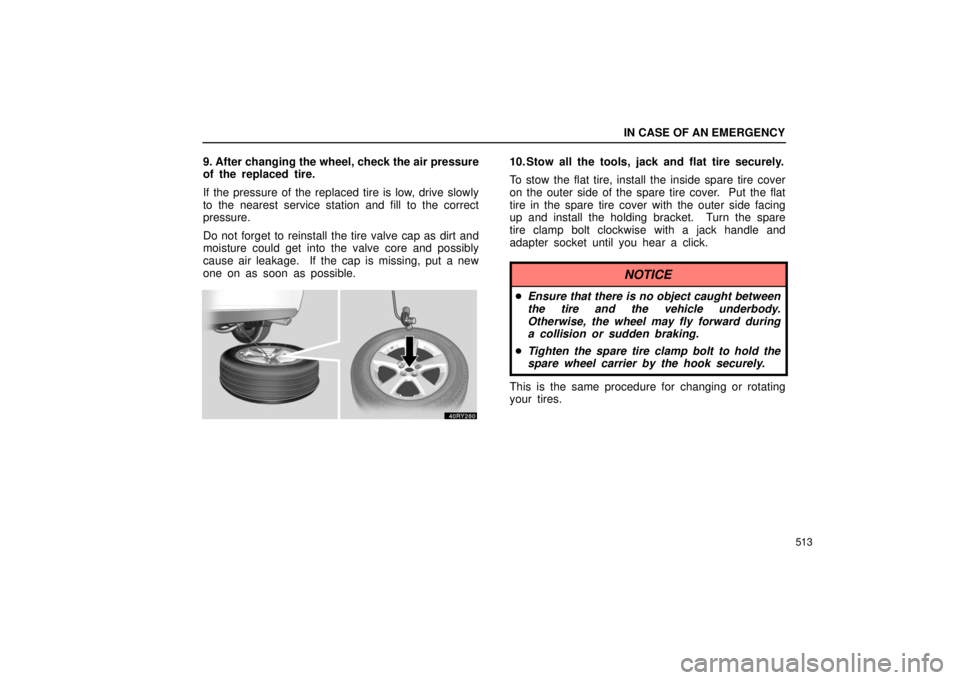
Do not forget to reinstall the tire valve cap as dirt and
moisture could get into the valve core and possibly
cause air leakage. If the cap is missing, put a new
one on as soon as possible.10. Stow all the tools, jack and flat tire securely.
To stow the flat tire, install the inside spare tire cover
on the outer side of the spare tire cover. Put the flat
tire in the spare tire cover with the outer side facing
up and install the holding bracket. Turn the spare
tire clamp bolt clockwise with a jack handle and
adapter socket until you hear a click.
NOTICE
�Ensure that there is no object caught between
the tire and the vehicle underbody.
Otherwise, the wheel may fly forward during
a collision or sudden braking.
� Tighten the spare tire clamp bolt to hold the
spare wheel carrier by the hook securely.
This is the same procedure for changing or rotating
your tires.
Page 553 of 651

MAINTENANCE
532
Tire inflation pressure
Check the pressure with a gauge every two weeks,
or at least once a month and adjust as shown on the
tire and loading information label. See page 570 for
additional information.
Tire surface
Check the tires carefully for cuts, damage or
excessive wear. See page 585 for additional
information.
Tire rotation
Rotate the tires according to the maintenance
schedule. (For scheduled maintenance information,
please refer to the “Owner’s Manual Supplement /
Scheduled Maintenance”.) See “Rotating tires” on
page 584.DOES YOUR VEHICLE NEEDREPAIRING?
Be on the alert for changes in performance and sounds, and
visual tip −offs that indicate service is needed. Some important
clues are:
� Engine missing, stumbling, or pinging
� Appreciable loss of power
� Strange engine noises
� A fluid leak under the vehicle (However, water dripping from
the air conditioning after use is normal.)
� Change in exhaust sound (This may indicate a dangerous
carbon monoxide leak. Drive with the windows open and
have the exhaust system checked immediately.)
� Flat−looking tires, excessive tire squeal when cornering,
uneven tire wear
� Vehicle pulls to one side when driving straight on a level
road
� Strange noises related to suspension movement
� Loss of brake effectiveness, spongy feeling brake pedal,
pedal almost touches floors, vehicle pulls to one side when
braking
� Engine coolant temperature continually higher than normal
If you notice any of these clues, take your vehicle to your Lexus
dealer as soon as possible. It probably needs adjustment or
repair.
Page 584 of 651

SECTION 6 – 3
563
SERVICE PROCEDURES AND
SPECIFICATIONS
Chassis
Specifications564
. . . . . . . . . . . . . . . . . . . . . . . . . . . . . . . . . . . . .\
. . . . . .
Checking brake fluid 568
. . . . . . . . . . . . . . . . . . . . . . . . . . . . . . . . . . . . .\
.
Checking power steering fluid 569
. . . . . . . . . . . . . . . . . . . . . . . . . . . . .
Checking tire inflation pressure 570
. . . . . . . . . . . . . . . . . . . . . . . . . . . .
Tire Information 573
. . . . . . . . . . . . . . . . . . . . . . . . . . . . . . . . . . . . .\
. . . . .
Types of tires 583
. . . . . . . . . . . . . . . . . . . . . . . . . . . . . . . . . . . . .\
. . . . . . .
Rotating tires 584
. . . . . . . . . . . . . . . . . . . . . . . . . . . . . . . . . . . . .\
. . . . . . .
Checking and replacing tires 585
. . . . . . . . . . . . . . . . . . . . . . . . . . . . . .
Installing snow tires and chains 587
. . . . . . . . . . . . . . . . . . . . . . . . . . . .
Replacing wheels 590
. . . . . . . . . . . . . . . . . . . . . . . . . . . . . . . . . . . . .\
. . .
Aluminum wheel precautions 591
. . . . . . . . . . . . . . . . . . . . . . . . . . . . . .
Suspension and chassis 591
. . . . . . . . . . . . . . . . . . . . . . . . . . . . . . . . . .
Page 587 of 651
CHASSIS
566
— TIRES AND WHEELS (type A)Tire size
225/65R17 101S
Tire inflation pressure Recommended cold tire inflation
pressure
Front 210 kPa (2.1 kgf/cm2 or bar, 30 psi)
Rear 210 kPa (2.1 kgf/cm2 or bar, 30 psi)
Spare 210 kPa (2.1 kgf/cm2 or bar, 30 psi)
For sustained high speeds above 160 km/h (100 mph), in
countries where such speeds are permitted by law, add 10
kPa (0.1 kgf/cm
2 or bar, 1.5 psi) to the front tires and rear
tires, but never exceed the maximum cold tire pressure
molded on the tire sidewall.
Wheel size17 � 6 1/2 J
Wheel nut torque103 N·m (10.5 kgf·m, 76 ft·lbf)
NOTE:
For complete information on tires (e.g. replacing tires or replacing wh\
eels), see “Checking tire inflation pressure”
through “Aluminum wheel precautions” on pages 570 through 591.
Page 588 of 651
CHASSIS
567
— TIRES AND WHEELS (type B)Tire size
P235/55R18 99V
Tire inflation pressure Recommended cold tire inflation
pressure
Front 210 kPa (2.1 kgf/cm2 or bar, 30 psi)
Rear 210 kPa (2.1 kgf/cm2 or bar, 30 psi)
Spare 210 kPa (2.1 kgf/cm2 or bar, 30 psi)
Wheel size18 x 7 JJ
Wheel nut torque103 N·m (10.5 kgf·m, 76 ft·lbf)
NOTE:
For complete information on tires (e.g. replacing tires or replacing wh\
eels), see “Checking tire inflation pressure”
through “Aluminum wheel precautions” on pages 570 through 591.
Page 591 of 651
CHASSIS
570
CAUTION
The reservoir may be hot so be careful not to burn
yourself.
NOTICE
Avoid overfilling, or the power steering could be
damaged.
CHECKING TIRE INFLATIONPRESSURE
Page 592 of 651

CHASSIS
571
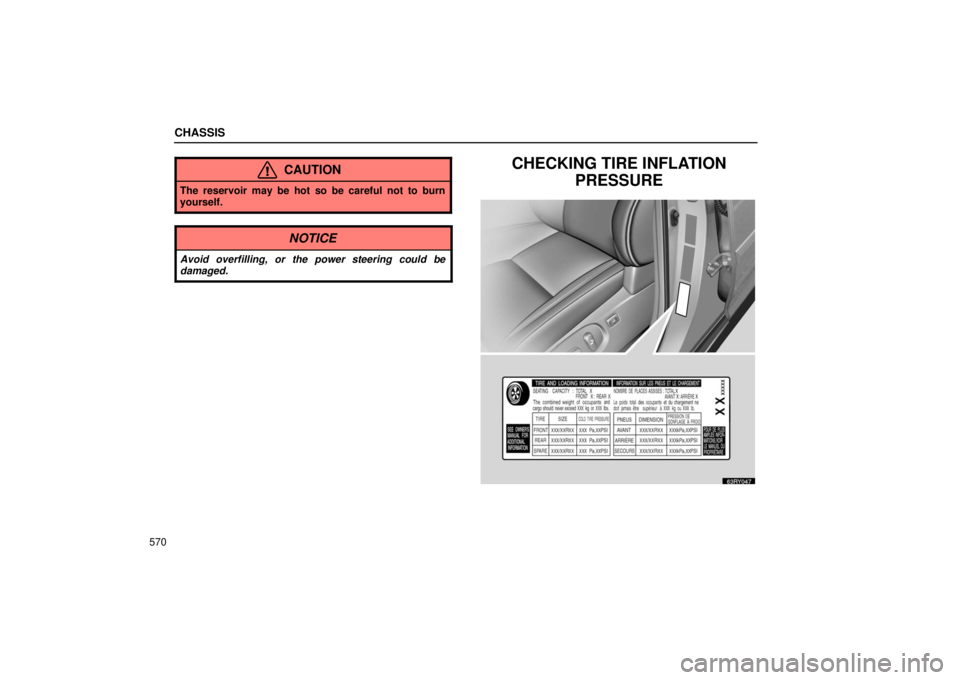
The recommended cold tire inflation pressures,
tire sizes and the combined weight of occupants
and cargo (vehicle capacity weight) are described
on pages 566 and 616. They are also described
on the tire and loading information label as
shown.
You should check the tire inflation pressure every two
weeks, or at least once a month. And do not forget
the spare!
The following instructions for checking tire
inflation pressure should be observed:
�The pressure should be checked only when the
tires are cold. If your vehicle has been parked
for at least 3 hours and has not been driven for
more than 1.5 km or 1 mile since, you will get an
accurate cold tire inflation pressure reading.
� Always use a tire pressure gauge. The
appearance of a tire can be misleading. Besides,
tire inflation pressures that are even just a few
pounds off can degrade handling and ride.
� Do not bleed or reduce tire inflation pressure
after driving. It is normal for the tire inflation
pressure to be higher after driving. �
Never exceed the vehicle capacity weight.
Passengers and luggage weight should be located
so that the vehicle is balanced.
Inspection and adjustment procedure
�1Tire valve
2Tire pressure gauge
1. Remove the tire valve cap.
2. Press the tip of the tire pressure gauge to the tire
valve.
3. Read the pressure using the graduations of the
gauge.