Page 503 of 651

DRIVING TIPS
482
Brakes and safety chains
�Lexus recommends trailers with brakes that conform to
any applicable federal and state/provincial regulations.
� A safety chain must always be used between the towing
vehicle and the trailer. Leave sufficient slack in the
chain for turns. The chain should cross under the
trailer tongue to prevent the tongue from dropping to
the ground in case it becomes damaged or separated.
For correct safety chain procedures, follow the hitch or
trailer manufacturer’s recommendations.
CAUTION
� If the total trailer weight exceeds 450 kg (1000 lb.),
trailer brakes are required.
� Never tap into your vehicle’s hydraulic system as it
will lower its braking effectiveness.
� Never tow a trailer without using a safety chain
securely attached to both the trailer and the vehicle.
If damage occurs to the coupling unit or hitch ball,
there is possible danger of the trailer wandering over
into another lane.
Tires
�Ensure that your vehicle’s tires are properly inflated. Adjust
the tire pressure to the recommended cold tire pressure
indicated below:
Tire pressure, kPa (kgf/cm
2 or bar, psi)
Front 210 (2.1, 30) Rear 210 (2.1, 30)
� The trailer tires should be inflated to the pressure
recommended by the trailer manufacturer in respect to the
total trailer weight.
Page 505 of 651

DRIVING TIPS
484
Disconnecting a trailer (models with
electronically modulated air suspension)
Stop your vehicle and trailer so they are in line and perform the
following:
1. Place the electronically modulated air suspension in “LO”
mode. (Make sure the vehicle height is in “LO” mode by
pushing the height select switch on the “
” [lower] side.)
2. Push the height control switch to turn off the electronically
modulated air suspension. The height control “OFF” indicator
light will come on.
3. Turn the ignition switch off.
4. Set the supporting leg of the trailer on the ground and raise
the hitch by 100 mm (4 in.).
5. Turn the ignition switch on.
6. Push the height control switch to turn on the electronically
modulated air suspension. The height control “OFF” indicator
will go out.
7. Wait for about one minute until vehicle height is stabilized by
the automatic leveling function.
8. Make sure the hitch is disconnected. If not, raise the hitch
higher and repeat steps 2 through 7.
Pretowing safety check
� Check that your vehicle remains level when a loaded or
unloaded trailer is hitched. Do not drive if the vehicle has an
abnormal nose −up or nose− down condition, and check for
improper tongue load, overload, worn suspension or other
possible causes.
� Make sure the trailer cargo is securely loaded so that it
cannot shift.
� Check that your rear view mirrors conform to any federal,
state/provincial or local regulations. If they do not, install
required rear view mirrors appropriate for towing purposes.
Page 519 of 651

IN CASE OF AN EMERGENCY
498
4Connect the clamp at the other end of the negative (black)
cable to a solid, stationary, unpainted metallic point (such
as shown in the illustration) away from the battery. Do not
connect it to or near any part that moves when the engine
is cranked.
CAUTION
When making the connections, to avoid serious injury,
do not lean over the battery or accidentally let the
jumper cables or clamps touch anything except the
correct battery terminals or the ground.
5. Start your engine in the normal way. After starting, run it at
about 2000 rpm for several minutes with the accelerator pedal
lightly depressed.
6. Carefully disconnect the cables in the exact reverse order:
the negative cable and then the positive cable.
7. Carefully dispose of the battery cover cloths which may now
contain sulfuric acid.
8. If removed, replace all the battery vent plugs.
If the cause of your battery discharging is not apparent (for
example, lights left on), you should have it checked at your
Lexus dealer. If the first start attempt is not successful...
Check
that the clamp on the jumper cables are tight. Recharge
the discharged battery with the jumper cables connected for
several minutes and restart your engine in the normal way.
If the another attempt is not successful, the battery may be
depleted. Have it checked at your Lexus dealer.
Page 521 of 651

IN CASE OF AN EMERGENCY
500B: If no steam is coming from your engine:
Leave the engine running and turn off the air conditioning.
Check the following.
�
Is the cooling fan operating?
� Is the coolant in the acceptable range?
� Is the engine drive belt O.K.?
CAUTION
�When the engine is running, keep hands and clothing
away from the moving fan and engine drive belt.
� Do not attempt to remove the radiator cap when the
engine and radiator are hot. Serious injury could
result from scalding hot fluid and steam blown out
under pressure.
If the cooling fan is not operating or the coolant is not in the
acceptable range, turn off the engine and call your Lexus
dealer.
If both conditions are O.K., after the engine coolant
temperature has cooled to normal, continue driving your
vehicle.
If the engine coolant temperature does not cool down, or your
vehicle overheats again, have it checked as soon as possible
by your Lexus dealer.
IF YOU HAVE A FLAT TIRE
1. Reduce your speed gradually, keeping a straight
line. Move cautiously off the road to a safe place
— well away from the traffic. Avoid stopping on the
center divider of a highway. Park on a level spot with
firm ground.
2. Stop the engine and turn on your emergency
flashers.
3. F i r m l y s e t t h e p a r k i n g b r a k e a n d p u t t h e
transmission in “P”.
4. Have everyone get out of the vehicle on the side
away from traffic.
5. Read the following instructions thoroughly.
Page 522 of 651

IN CASE OF AN EMERGENCY
501
CAUTION
When jacking, be sure to observe the following
to reduce the possibility of personal injury:
�Follow jacking instructions.
� Do not put any part of your body under a
vehicle supported by a jack. Otherwise,
personal injury may occur.
� Do not start or run the engine while your
vehicle is supported by the jack.
� Stop the vehicle on a level firm ground, firmly
set the parking brake and put the
transmission in “P”. Block the wheel
diagonally opposite to the one being changed
if necessary.
�Make sure to set the jack properly in the jack
point. Raising the vehicle with jack
improperly positioned will damage the vehicle
or may allow the vehicle to fall off the jack
and cause personal injury.
� Never get under the vehicle when the vehicle
is supported by the jack alone.
� Use the jack only for lifting your vehicle
during wheel changing.
� Do not raise the vehicle with someone in the
vehicle.
� When raising the vehicle, do not place any
objects on top of or underneath the jack.
� Raise the vehicle only high enough to remove
and change the tire.
� Vehicles with electronically modulated air
suspension: When jacking up, be sure to turn
off the height control and stop the engine.
Otherwise, the vehicle height may change in
the automatic leveling function, resulting in
an unexpected accident. For details, see
page 446.
Page 527 of 651
IN CASE OF AN EMERGENCY
506
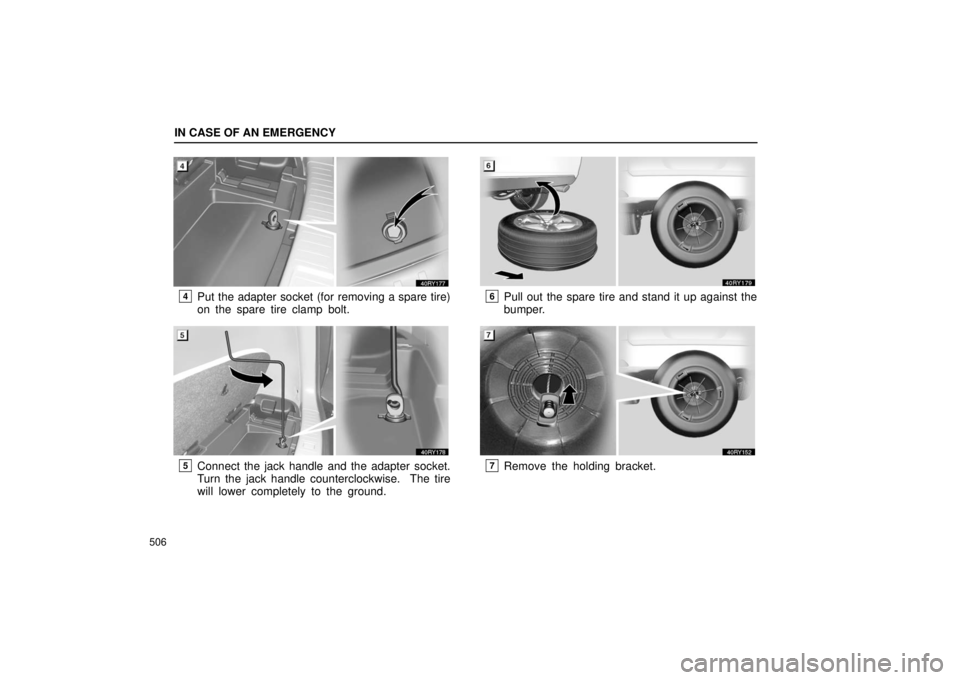
4Put the adapter socket (for removing a spare tire)
on the spare tire clamp bolt.
5Connect the jack handle and the adapter socket.
Turn the jack handle counterclockwise. The tire
will lower completely to the ground.
6Pull out the spare tire and stand it up against the
bumper.
7Remove the holding bracket.
Page 530 of 651
IN CASE OF AN EMERGENCY
509
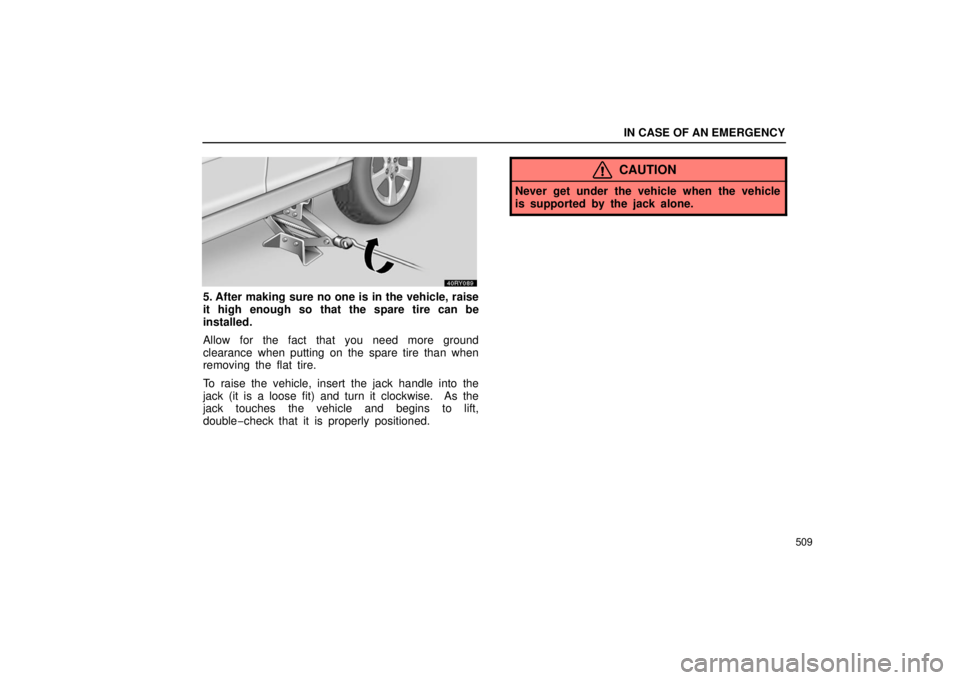
5. After making sure no one is in the vehicle, raise
it high enough so that the spare tire can be
installed.
Allow for the fact that you need more ground
clearance when putting on the spare tire than when
removing the flat tire.
To raise the vehicle, insert the jack handle into the
jack (it is a loose fit) and turn it clockwise. As the
jack touches the vehicle and begins to lift,
double−check that it is properly positioned.
CAUTION
Never get under the vehicle when the vehicle
is supported by the jack alone.
Page 533 of 651

IN CASE OF AN EMERGENCY
512
8. Lower the vehicle completely and tighten the
wheel nuts.
Turn the jack handle counterclockwise to lower the
vehicle.
Use only the wheel nut wrench to tighten the nuts.
Do not use other tools or any additional leverage other
than your hands, such as a hammer, pipe or your foot.
Make sure the wrench is securely engaged over the
nut.
Tighten each nut a little at a time in the order shown.
Repeat the process until all the nuts are tight.
CAUTION
�When lowering the vehicle, make sure all
portions of your body and all other persons
around will not be injured as the vehicle is
lowered to the ground.
� Have the wheel nuts tightened with torque
wrench to 103 N·m (10.5 kgf·m, 76 ft·lbf), as
soon as possible after changing wheels.
Otherwise, the nuts may loosen and the
wheels may fall off, which could cause a
serious accident.
� Do not attach a heavily damaged plastic wheel
ornament. It may fly off the wheel and cause
accidents while the vehicle is moving.