2006 LEXUS LS430 trunk
[x] Cancel search: trunkPage 72 of 419

56
1-6. Theft deterrent system
■Items to check before locking the vehicle
To prevent unintended triggering of the alarm
, check that there is no one in the vehi-
cle and that all windows are clos ed bef
ore locking the vehicle.
■Alarm operation
The alarm will sound if any of the following conditions occur.
• When a locked door or trunk is opened in any way other than using a key or
wir
eless remote control, such as someone exiting the vehicle after the alarm is
activated.
• When the hood is lifted open while the vehicle is locked.
• When the battery is reconnected.
■Sounding an alarm
Manually triggering the alarm will help de ter an
yone from breaking into or damag-
ing your vehicle. (
P. 12 )
■Certifications for the engine immobilizer system (for vehicles sold in U.S.A.)
This device complies with Part 15 of the FCC Rules.
Operation is subject to the following two co
nditions: (1) This device may not cause
harmful interference, and (2) this device must accept any interference received,
including interference that may cause undesired operation.
■Certifications for the engine immobilizer system (for vehicles sold in Canada)
This device complies with RSS-210 of Indu str
y Canada. Operation is subject to the
following two conditions:
(1) This device may not cause interference, and (2) this device must accept any
inter
ference, including interference that may cause undesired operation of the
device.
FCC ID: MOZ RI-20BTY
MADE IN JAPAN
FCC ID: MOZ RI-15HTY
MADE IN JAPAN
Page 90 of 419
74
1-7. Safety information
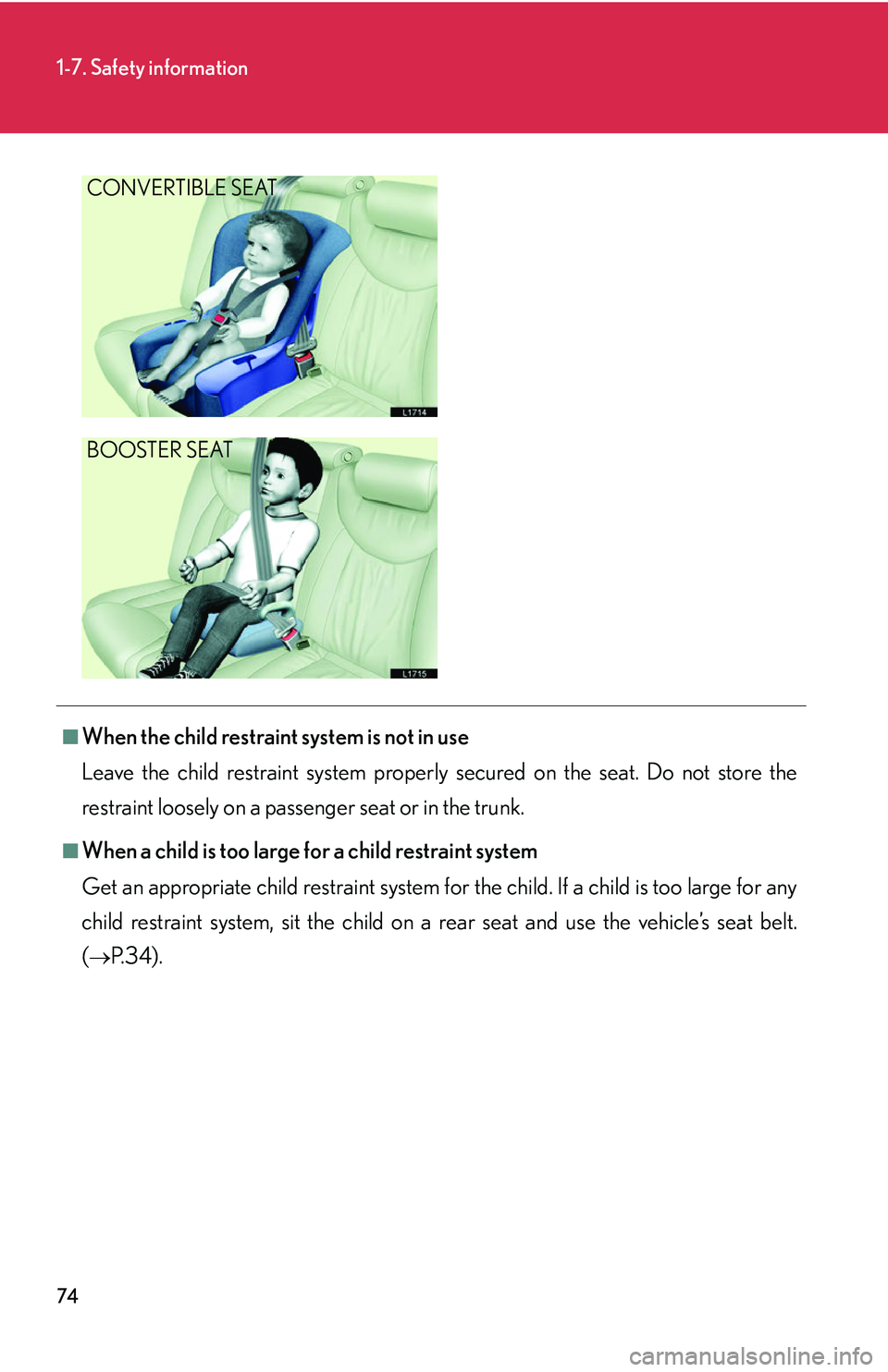
CONVERTIBLE SEAT
BOOSTER SEAT
■When the child restraint system is not in use
Leave the child restraint system properly secur
ed on the seat. Do not store the
restraint loosely on a passenger seat or in the trunk.
■When a child is too large for a child restraint system
Get an appropriate child restraint system for the
child. If a child is too large for any
child restraint system, sit the child on a re ar seat and use the vehicle’s seat belt.
(
P. 34 ).
Page 105 of 419
89
2-1. Driving procedures
2
When driving
CAUTION
■When driving the vehicle
●Do not drive if you are unfaniliar with the location of the brake and accelerator
pedals to avoid depressing the wrong pedal.
Accidentally depressing the accelerator pedal instead of the brake pedal will
r
esult in sudden acceleration that may lead to an accident that could result in
death or serious injury.
●Do not drive the vehicle over or stop the vehicle near flammable materials.
●Do not let the vehicle roll backwards while the selector lever is in a driving posi -
tion, or roll forward while the selector lever is in R.
Doing so may cause the engine to stall or lea
d to poor brake and steering perfor-
mance, resulting in an accident or damage to the vehicle.
●If you smell exhaust fumes in the vehicle, open the windows and close the trunk lid
to ensure plenty of fresh air enters the vehicle.
If you can smell exhaust fumes even through there are no other vehicle in sur -
rounding area, have your vehicle checke d b
y you Lexus dealer. Continued inhala-
tion of exhaust fumes can lead to death by gas poisoning.
●Do not shift the selector lever to P, R or N while the vehicle is moving under any
circumstances.
Doing so can cause significant damage to the tr
ansmission system and may result
in a loss of vehicle control.
●Do not turn the engine off while driving.
The power steering and brake booster systems will not operate properly if the
eng
ine is not running.
●Use the engine braking (downshift) to maintain a safe speed when driving down a
steep hill.
Using the brakes continuously may cause the brakes to overheat and lose effec -
tiveness. ( P.98 )
●Do not shift the selector lever to N.
Doing so may cause the engine brake to not operate properly and lead to an
acc
ident.
●When stopped on an inclined surface, use the brake pedal and parking brake to
prevent the vehicle from rolling backward or forward and causing an accident.
Page 141 of 419

125
2-4. Using other driving systems
2
When driving
CAUTION
■When using the rear view monitor system, observe these precautions to avoid an
accident that could result in death or serious injuries.
●Never depend solely on the monitor system when reversing.
●Always check visually and with the mirrors to confirm your intended path is clear.
●Depicted distances between objects and flat surfaces differ from actual dis-
tances.
●Do not use the system if the trunk is open.
■Conditions which may affect the rear view monitor system
●If the back of the vehicle is hit, the camera’s position and mounting angle may
change. See your Lexus dealer.
●Rapid temperature changes, such as when hot water is poured on the vehicle in
cold weather, may cause the system to function abnormally.
●If the camera lens is dirty, it cannot transmit a clear image. Rinse with water and
wipe with a soft cloth. If extremely dirty, wash with a mild cleanser and rinse.
●The displayed image may be darker and mo ving images may be slightly distorted
when the system is cold.
Page 151 of 419
135
2-4. Using other driving systems
2
When driving
CAUTION
■To avoid accidentally engaging the cruise control
Keep the ON-OFF switch OFF when not in use.
■To avoid death or serious injury
The following conditions are unsuitable for cruise control use:
• In bad weather (rain, fog, sno
w, sandstorms, etc.)
• If the wipers are operated at high speed (radar cruise control), or at high or low spe
eds (laser cruise control.) This includes when the wiper lever is set to the
“AUTO” position.
• In heavy traffic.
• On roads with sharp bends.
• On slippery road surfaces.
• On steep downhill slopes.
• When the warning tone sounds frequently.
• On roads with steep, short inclines and declines.
• When exiting from, or when ente ri
ng or merging onto a freeway.
■When using the dynamic radar/laser cruise control
Always drive carefully and attentively.
Do not rely on the system to avoid accidents or control the vehicle’s speed in emer -
gency situations. The cruise control is not a collision-av
oidance system.
■Conditions which hinder the radar cruise control's vehicle detection capability
●The rear section of the vehicle ahead is extremely small (unloaded trailer etc.)
●The vehicle ahead or other vehicles are flinging up water or snow.
●Heavy luggage in your trunk or on your rear seats causes the nose of your vehicle
to rise.
Page 152 of 419
136
2-4. Using other driving systems
CAUTION
■Conditions which hinder the laser cruise control’s vehicle detection capability
A delay in detection of a vehicle may occur in the following situations. You must
ap
ply the brakes manually to avoid accidents.
• The vehicle ahead has higher ground clearance, meaning the reflectors are in a higher position
.
• The rear section of the vehicle ahead is extremely dirty.
• Surrounding vehicles are fl in
ging up water or snow.
• Your front view is obscured by excessive exhaust smoke.
• Protective film is attached to the reflectors of the vehicle ahead, or they are d
amaged.
• Reflectors are not installed on the vehicle ahead.
• Heavy luggage in your trunk or on your r
ear seats causes the nose of your vehi-
cle to rise.
• A vehicle cuts in at short range.
• A motorcycle is traveling along the side of the same lane
■To ensure the radar/laser cruise control system functions correctly
●Keep the radar sensor and grille cover/la ser sensor glass clean. When cleaning,
use a soft cloth and be careful not to damage the sensor or grille cover.
●Avoid strong impacts around the sensor, as incorrect sensor alignment will result
in system malfunction. A special device is required to adjust the sensor alignment.
See your Lexus dealer for adjustment.
●Do not disassemble the sensor.
●Do not affix stickers (including transparent stickers), or attach accessories
around the sensor or grille cover/sensor glass.
●Do not modify or paint the grille cover. When replacing the cover, be sure to use
a genuine Lexus cover. *
* Vehicles equipped with the radar cruise control only.
Page 161 of 419
145
2
When driving
2-5. Driving information
Cargo & luggage
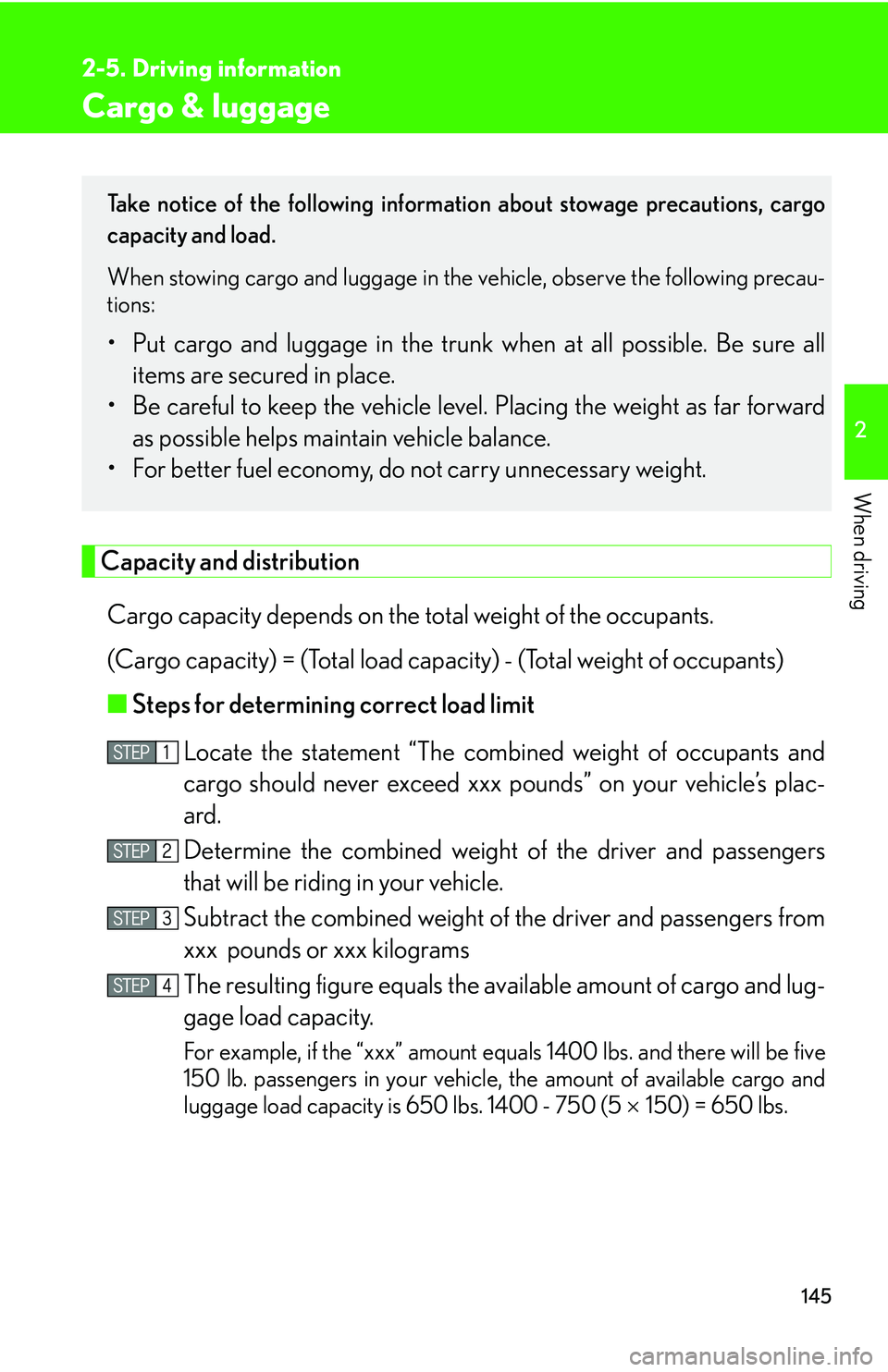
Capacity and distribution
Cargo capacity depends on the total weight of the occupants.
(Cargo capacity) = (Total load capacity) - (T
otal weight of occupants)
■ Steps for determining corr
ect load limit
Locate the statement “The combin ed w
eight of occupants and
cargo should never exceed xxx pounds” on your vehicle’s plac -
ard.
Determine the combined weight of the driv
er and passengers
that will be riding in your vehicle.
Subtract the combined weight of the driver and passengers from
xxx pounds or xxx kilograms
The resulting figure equals the available amount of car
go and lug-
gage load capacity.
For example, if the “xxx” amount equa ls 1400 lbs. and there will be five
150 lb. passengers in your vehicle, the amount of available cargo and
luggage load capacity is 650 lbs. 1400 - 750 (5 150) = 650 lbs.
Take notice of the following information about stowage precautions, cargo
capacity and load.
When stowing cargo and luggage in the vehicle, observe the following precau-
tions:
• Put cargo and luggage in the trunk wh en at all possible. Be sure all
items are secured in place.
• Be careful to keep the vehicle level. Placing the w
eight as far forward
as possible helps maintain vehicle balance.
• For better fuel economy, do not carry unnecessary weight.
Page 177 of 419

3Interior features
161
3-1. Using the air conditioning
system and defogger ........... 162
Automatic air conditioning
control .......................................... 162
Rear window defogger............. 170
Rear air conditioning
controls ........................................ 172
3-2. Using the audio system .......... 174 Audio system ................................. 174
Operating the radio................... 176
Operating the cassette
player ............................................ 182
Using the CD changer ............ 185
Optimal use of the audio
system ............................................ 191
Using the rear controller ......... 193
Using the steering switches.... 195
3-3. Turning on interior lights ...... 198 Interior lights list ......................... 198
3-4. Storage ...................................... 201 Storage features......................... 201 3-5. Other interior features ....... 208
Sun visors ..................................... 208
Vanity mirror and light ............ 209
Clock ............................................... 210
Ashtray............................................. 211
Cigarette lighter ......................... 213
Power outlets................................ 214
Outside temperature display .......................................... 216
Seat heaters .................................. 218
Climate control seat
switches ..................................... 220
Refreshing rear seat
switches ...................................... 222
Coat hooks................................... 223
Floor mats ..................................... 224
Sunshades ................................... 225
Trunk features.............................. 227
Garage door opener ............... 232
Compass (vehicles without
navigation system) ................ 238