Page 126 of 419
110
2-3. Operating the headlight and windshield wipers
Headlight switch
Turning on the high beams
With the headlights on, push the
lever forward to turn on the high
beams.
Pull the lever back to the center
position to turn the hi
gh beams
off.
Pull the lever toward you to turn
on the high beams.
Release to turn them off. You
can flash the high beams with
the headlights on or off.
The headlights can be operated manually or automatically.
The side marker, parking,
license plate and instru
-
ment panel lights turn on.
The headlights and all
lights listed abo
ve turn on.
The headlights and parking
lights ar
e turned on and off
automatically. (When the
ignition switch is turned to
ON.)
1
2
Page 136 of 419
120
2-4. Using other driving systems
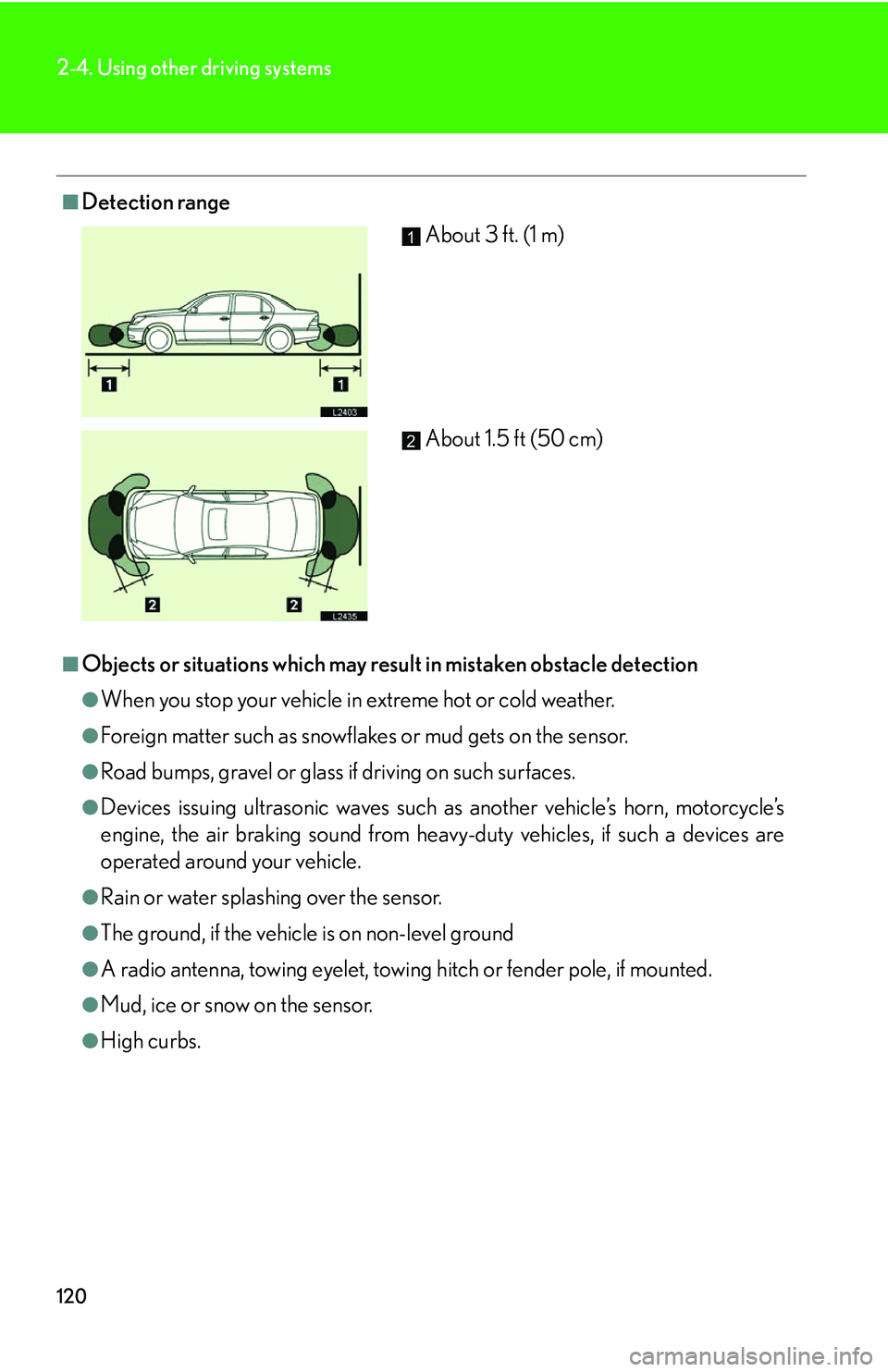
■Detection range
■Objects or situations which may result in mistaken obstacle detection
●When you stop your vehicle in extreme hot or cold weather.
●Foreign matter such as snowflakes or mud gets on the sensor.
●Road bumps, gravel or glass if driving on such surfaces.
●Devices issuing ultrasonic waves such as another vehicle’s horn, motorcycle’s
engine, the air braking sound from heavy-duty vehicles, if such a devices are
operated around your vehicle.
●Rain or water splashing over the sensor.
●The ground, if the vehicle is on non-level ground
●A radio antenna, towing eyelet, towing hitch or fender pole, if mounted.
●Mud, ice or snow on the sensor.
●High curbs.
About 3 ft. (1 m)
About 1.5 ft (50 cm)1
2
Page 143 of 419
127
2-4. Using other driving systems
2
When driving
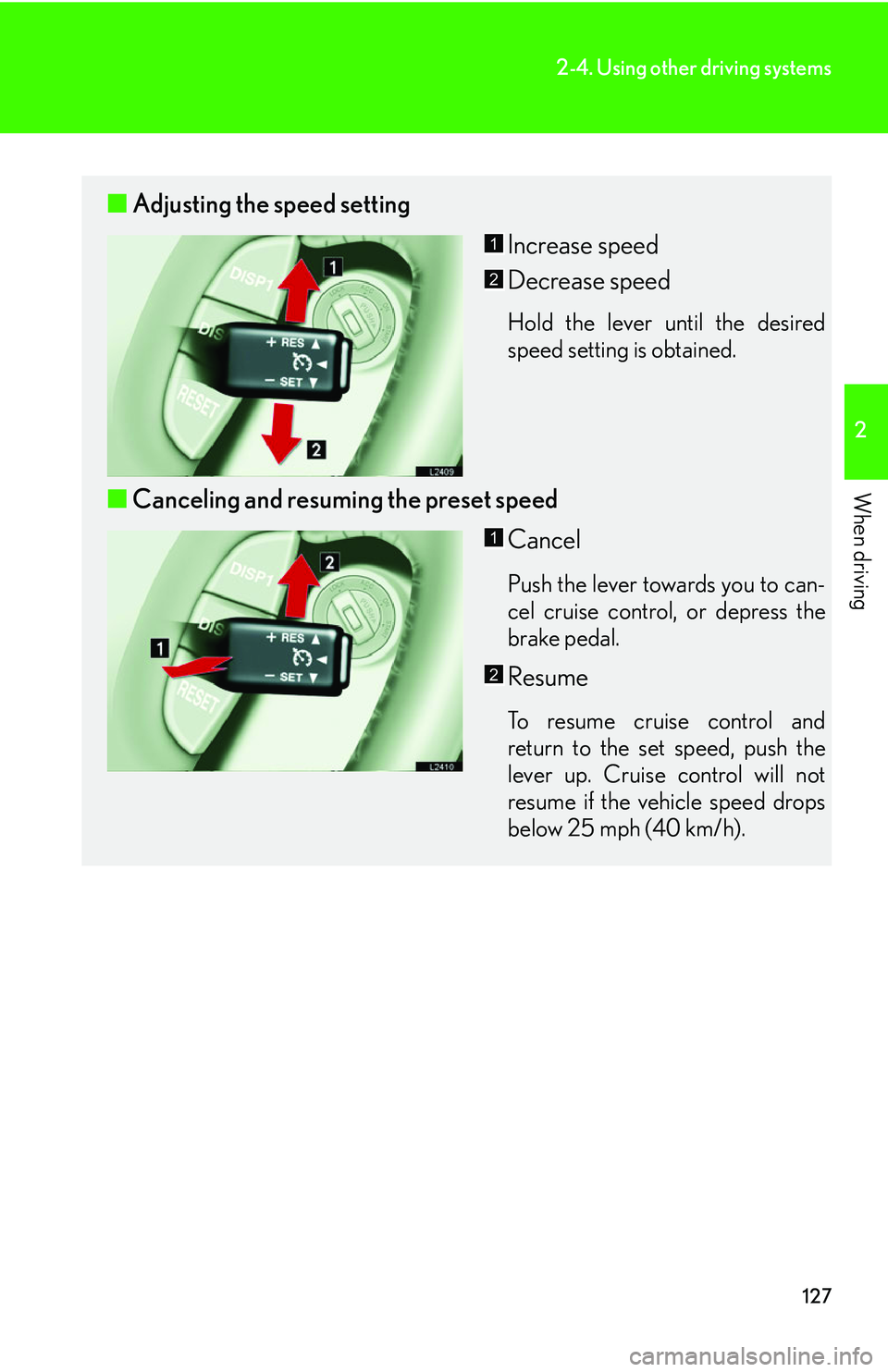
■Adjusting the speed setting
Increase speed
Decrease speed
Hold the lever until the desired
speed setting is obtained.
■Canceling and resuming the preset speed
Cancel
Push the lever towards you to can-
cel cruise control, or depress the
br
ake pedal.
Resume
To resume cruise control and
return to the set speed, push the
lever up. Cruise control will not
resume if the vehicle speed drops
below 25 mph (40 km/h).
1
2
1
2
Page 158 of 419
142
2-4. Using other driving systems
CAUTION
Any of the following conditions may result in-an accident which could cause death
or serious injury:
■The ABS may not operate effectively when:
●The limits of tire gripping performance have been exceeded.
●If the vehicle hydroplanes while driving at high speed while the road is wet or
slick.
■Stopping distance when the ABS is activated will exceed that of normal condi -
tions
The ABS is not designed to shorten the v
ehicle’s stopping distance. Always main -
tain a safe distance between you and the vehicle in front of you, particularly in the
fo
llowing situations.
• When driving on dirt, gravel or snow-covered roads
• When driving with tire chains
• When driving over bumps in the road
• When driving over roads with potholes or uneven roads
• When towing a trailer
■TRAC may not operate effectively when:
Directional control and power may not be ac hi
evable while driving on slippery road
surfaces, even if the TRAC system is operating.
Do not drive the vehicle in conditions where control and power may be lost.
■When the slip indicator flashe s and a warning buzzer sounds
This situation occurs immediately before VSC is activated. Always drive carefully.
R
eckless driving may cause an at the recommended level.
Exercise particular care when an indicator light flashes and a buzzer sounds.
■Replacing tires
Ensure that all tires are the same size an d
brand, have the same tread pattern, and
that the level of tire pressure is at the recommended level.
The ABS and VSC systems may not operate no rmal
ly if different tires are installed
to the vehicle.
Contact your Lexus dealer for further info rmati
on when replacing tires or wheels.
Page 161 of 419
145
2
When driving
2-5. Driving information
Cargo & luggage
Capacity and distribution
Cargo capacity depends on the total weight of the occupants.
(Cargo capacity) = (Total load capacity) - (T
otal weight of occupants)
■ Steps for determining corr
ect load limit
Locate the statement “The combin ed w
eight of occupants and
cargo should never exceed xxx pounds” on your vehicle’s plac -
ard.
Determine the combined weight of the driv
er and passengers
that will be riding in your vehicle.
Subtract the combined weight of the driver and passengers from
xxx pounds or xxx kilograms
The resulting figure equals the available amount of car
go and lug-
gage load capacity.
For example, if the “xxx” amount equa ls 1400 lbs. and there will be five
150 lb. passengers in your vehicle, the amount of available cargo and
luggage load capacity is 650 lbs. 1400 - 750 (5 150) = 650 lbs.
Take notice of the following information about stowage precautions, cargo
capacity and load.
When stowing cargo and luggage in the vehicle, observe the following precau-
tions:
• Put cargo and luggage in the trunk wh en at all possible. Be sure all
items are secured in place.
• Be careful to keep the vehicle level. Placing the w
eight as far forward
as possible helps maintain vehicle balance.
• For better fuel economy, do not carry unnecessary weight.
Page 162 of 419
146
2-5. Driving information
Determine the combined weight of luggage and cargo being
loaded on the vehicle.
The weight may not safely exceed the available cargo and luggage load
capacity calculated in Step .
If your vehicle will be towing a trailer, load from your trailer will be
transferred to your vehicle. Consu lt this manual to determine ho
w
this reduces the available cargo and luggage load capacity of
your vehicle. ( P.148 )
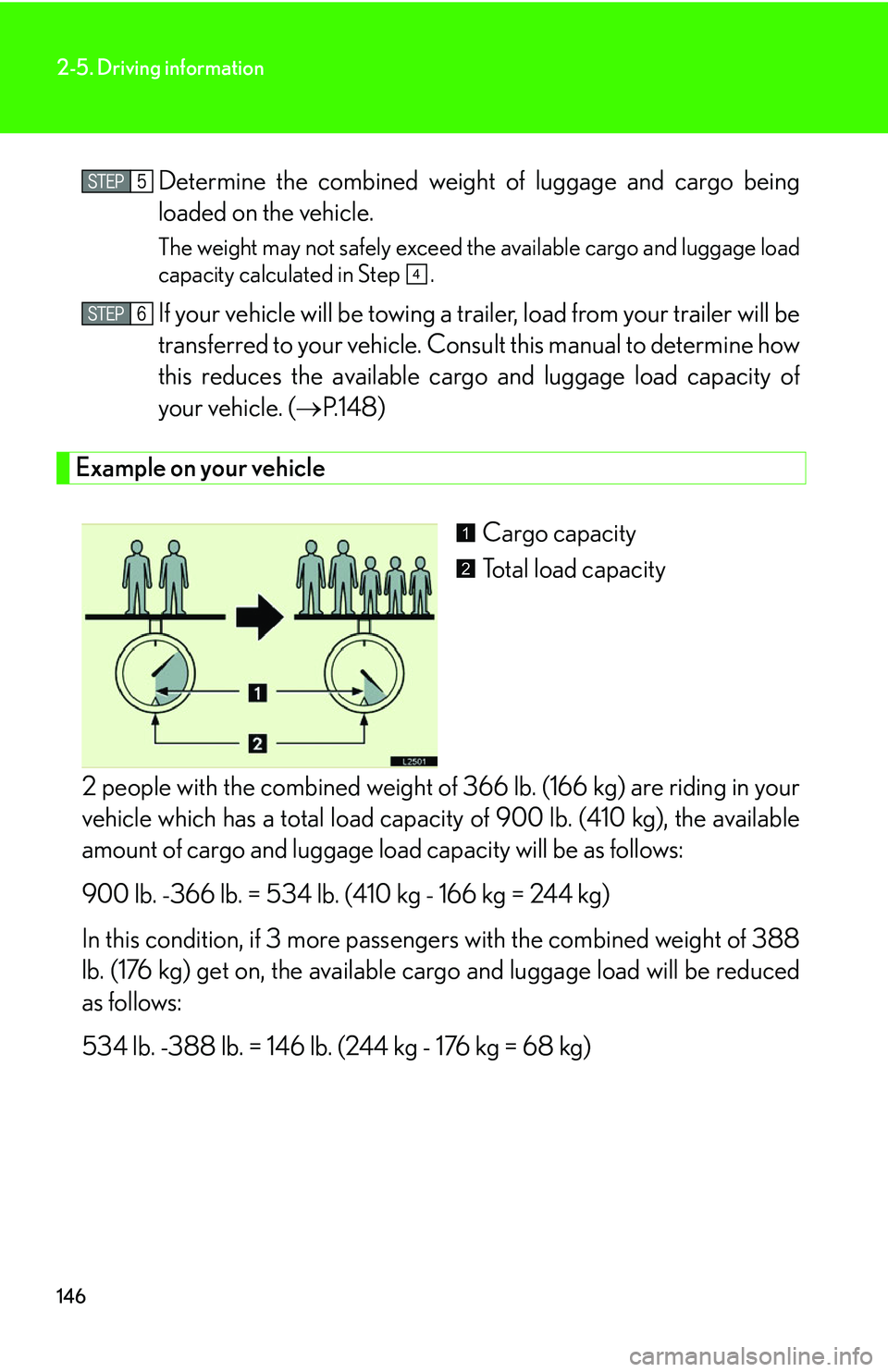
Example on your vehicle
Cargo capacity
Total load capacity
2 people with the combined weight of 366 lb. (166 kg) are riding in your
v
ehicle which has a total load capacity of 900 lb. (410 kg), the available
amount of cargo and luggage load capacity will be as follows:
900 lb. -366 lb. = 534 lb. (410 kg - 166 kg = 244 kg)
In this condition, if 3 mor
e passengers with the combined weight of 388
lb. (176 kg) get on, the available cargo and luggage load will be reduced
as follows:
534 lb. -388 lb. = 146 lb. (244 kg - 176 kg = 68 kg)
4
1
2
Page 164 of 419
148
2-5. Driving information
Vehicle load limits
■Total load capacity and seating capacity
These are also described on the tire and loading information label. ( P. 2 8 3 )
CAUTION
■Overload
Do not apply excess load.
It may cause not only damage to the tires, but also
deterioration of steering ability
and braking ability, resu lting in an accident.
Vehicle load limits include total load ca pacity, seating capacity, towing capac-
ity and cargo capacity.
■ Total load capacity: 900 lb. (410 kg)
Total load capacity means the comb ined w
eight of occupants, cargo
and luggage.
■ Seating capacity: T
otal 5 (Front 2, Rear 3)
Seating capacity means the maxi mum number of occupants whose
estimated a
verage weight is 150 lb. (68 kg) per person.
Even if the number of occupants ar e within the seating capacity, do not
exceed the total load capacity.
■ Towing capacity: 2000 lb. (907 kg)
Towing capacity means the maximum gross trailer weight (trailer
w
eight plus its cargo weight) that your vehicle is able to tow.
■ Car
go capacity
Cargo capacity ma y incr
ease or decrease depending on the weight
and the number of occupants. ( P.145 )
Page 168 of 419
152
2-5. Driving information
Trailer Towing
Your vehicle is designed primarily as a passenger-carrying vehicle, thus tow-
ing a trailer will have an adverse effec t on
handling, performance, braking,
durability, and fuel consumption. For yo ur safety and the safety of others, do
not overload the vehicle or trailer.
Lexus warranties do not apply to damage or malfunction caused b
y towing a
trailer for commercial purposes
■ Weight limits
Confirm the total trailer weight, gross v
ehicle weight, gross axle weight
and trailer tongue load are all within the limits.
■ Gr
oss vehicle weight
The gross vehicle weight must not exceed the Gross Vehicle Weight
R
ating (GVWR) indicated on the Certification Label. The gross vehi -
cle weight is the sum weight of th e unloaded v
ehicle, driver, passen-
gers, luggage, hitch and trailer tongue load. Also included is the w
eight
of any special equipment installed on your vehicle.
■ Gr
oss axle weight
The load on either the front or rear axle r
esulting from distribution of
the gross vehicle weight on both ax les must not exceed the Gross Axle
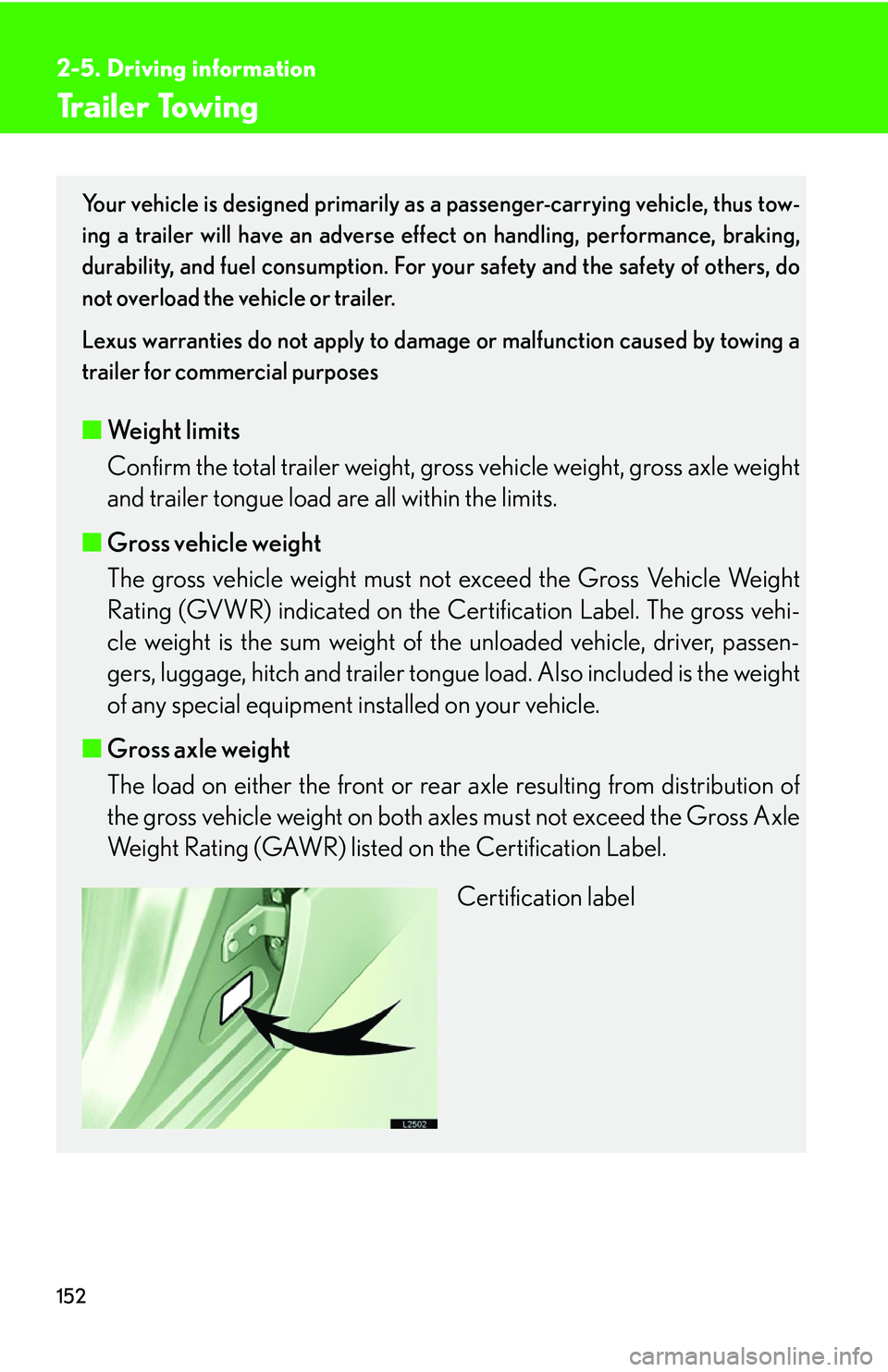
Weight Rating (GAWR) listed on the Certification Label.
Certification label